

The Holocaust in Vienna: From the Jewish Community of 1938 to the Aspangbahnhof
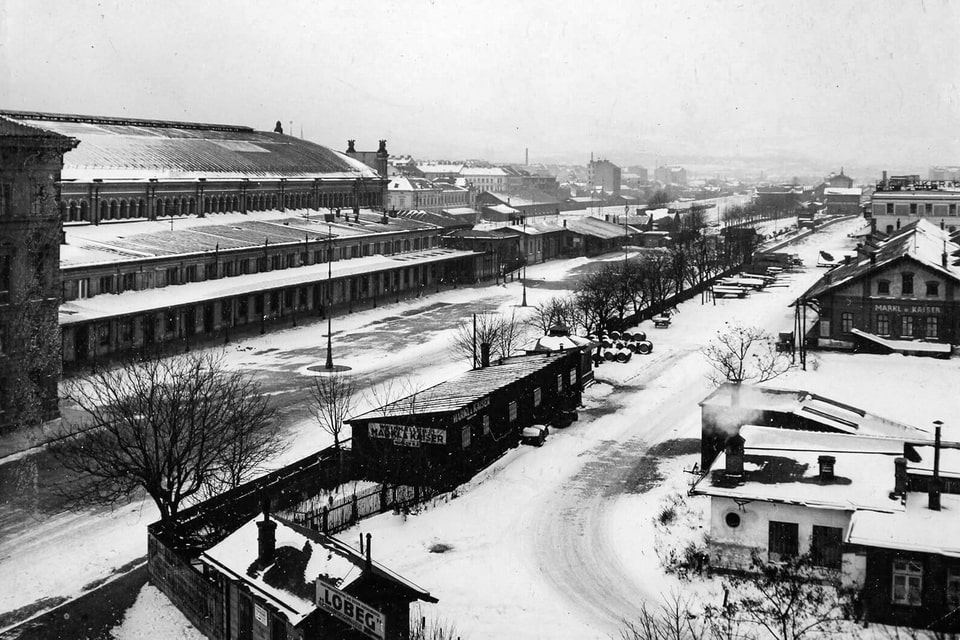
Between 1939 and 1945, more than fifty thousand people were deported from Vienna to concentration and death camps. Almost all of them left from one place: a suburban goods and passenger station in the third district, built in the 1880s to carry freight towards the Balkans, and by then largely disused. It was called the Aspangbahnhof.
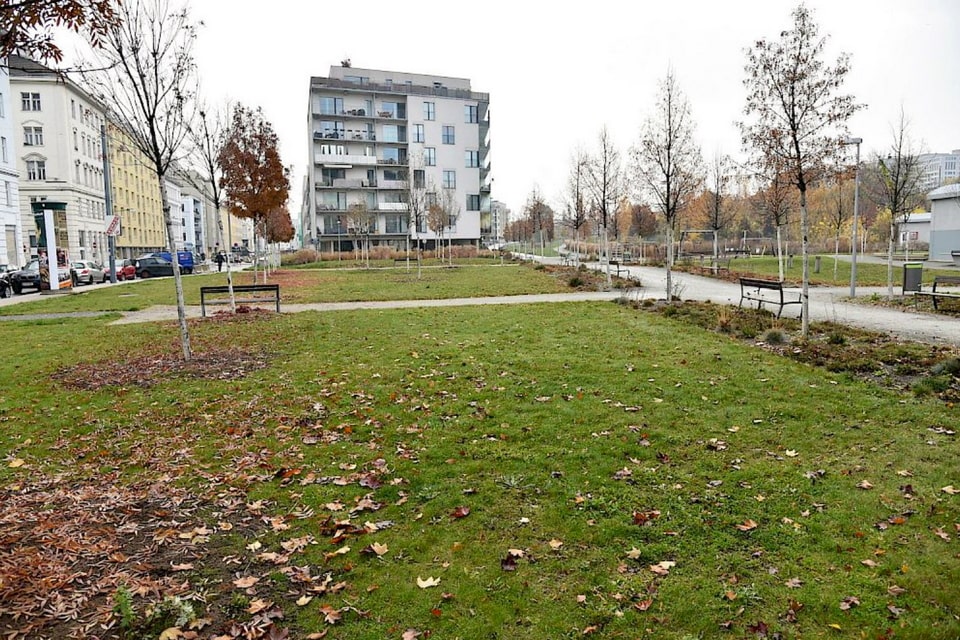
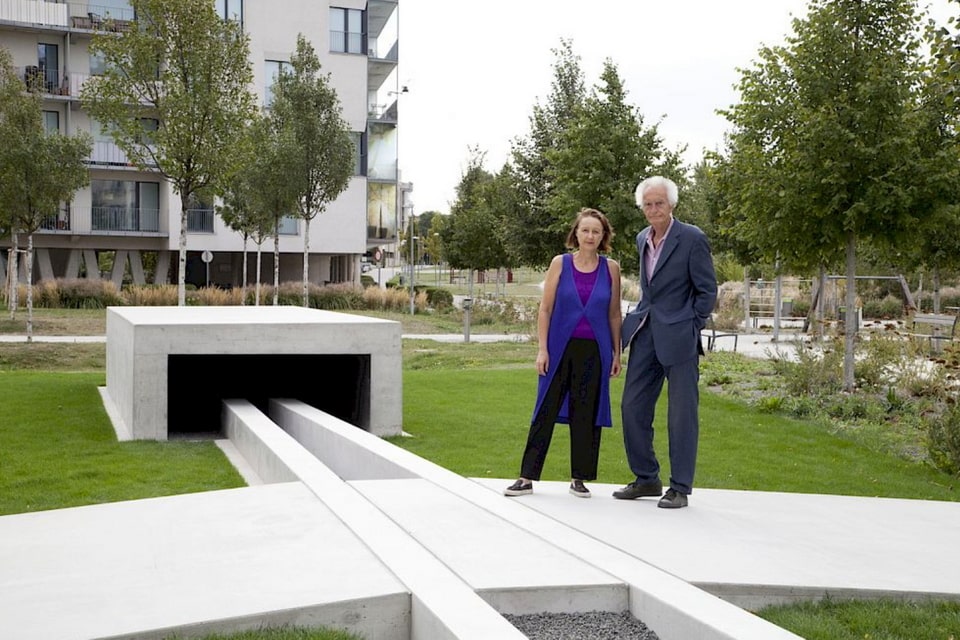
The station is gone. It was demolished in 1977, and the site is now a residential quarter with a park. But the ground is marked: the square beside it has been the Platz der Opfer der Deportation — Square of the Victims of Deportation — since 1995, the park was named Leon-Zelman-Park in 2013, and in 2017 the city installed the Mahnmal Aspangbahnhof: two sets of rails running out of the pavement and stopping.
This article is about how a city of 176,034 Jews — the third-largest Jewish community in Europe, a tenth of Vienna’s population — became a city from which trains left every few days. It covers the community as it was in 1938, the scrubbing parties of March, the Zentralstelle für jüdische Auswanderung that Adolf Eichmann ran out of the confiscated Rothschild Palace, the burning of 42 synagogues in a single November night, the assembly camps in the schools of Leopoldstadt, and every deportation route in turn — Nisko, Kielce, Riga, Łódź, Minsk, Izbica, Maly Trostinets, Theresienstadt.
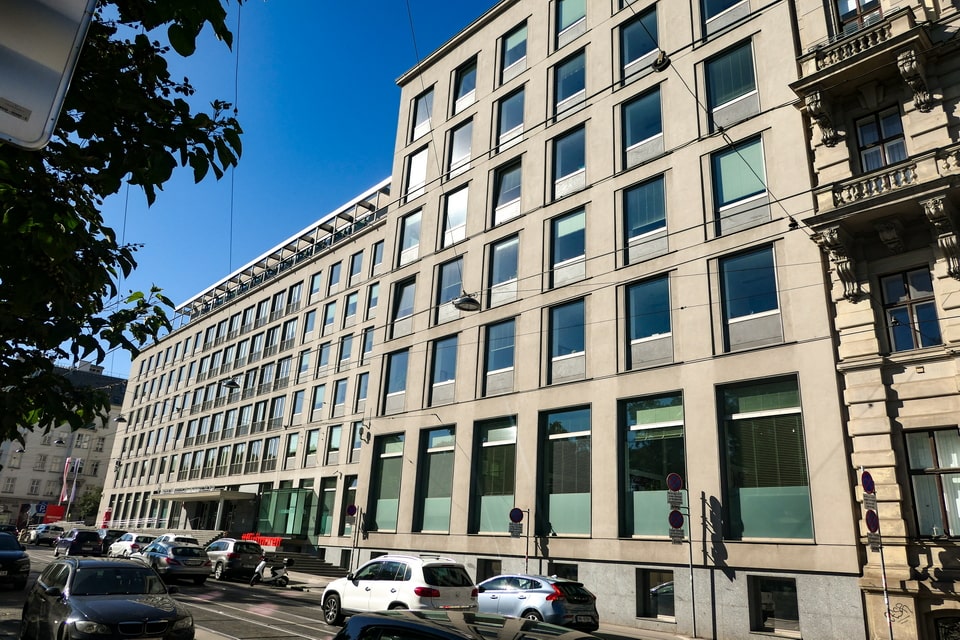
Almost none of it is marked. The Rothschild Palace was pulled down in 1954. The assembly camps are working schools. The addresses are in this article, with photographs of each as it looks now, taken in 2021.
THE ASPANGBAHNHOF BEFORE 1938: A STATION BUILT FOR THE BALKANS
Despite being known for the establishment of centers of death, Nazi Germany extensively used the pre-war infrastructure, often from the 19th century, for implementing their genocidal policy against other nations, particularly in the Holocaust to exterminate the Jewish population. They rarely invented train connections and located the war camps, labor camps, and extermination facilities based on the existing railway system, either in Poland or the soviet Union, or in pre-war Germany or annexed Austria. In the way that logistics is known as the blood of war, the Third Reich took advantage of the available transport systems and turned them into instruments of terror and genocide. In his well-established article ‘German railroads, Jewish souls’ (1976), famous Holocaust historian Raul Hilberg reminded us that ‘the railroads have been overlooked’, and this claim strongly correlates with the history of the Second World War and Nazi Germany. A modern cozy park to the southeast of Vienna’s historical center reminds us how deceptively calm the former sites of mass suffering are, and that is why the history of the old Austrian railway station known as ‘Wien Aspang Bahnhof’, from which around 47,035 men, women, and children were deported in 1939-1942, is worth our precise attention.
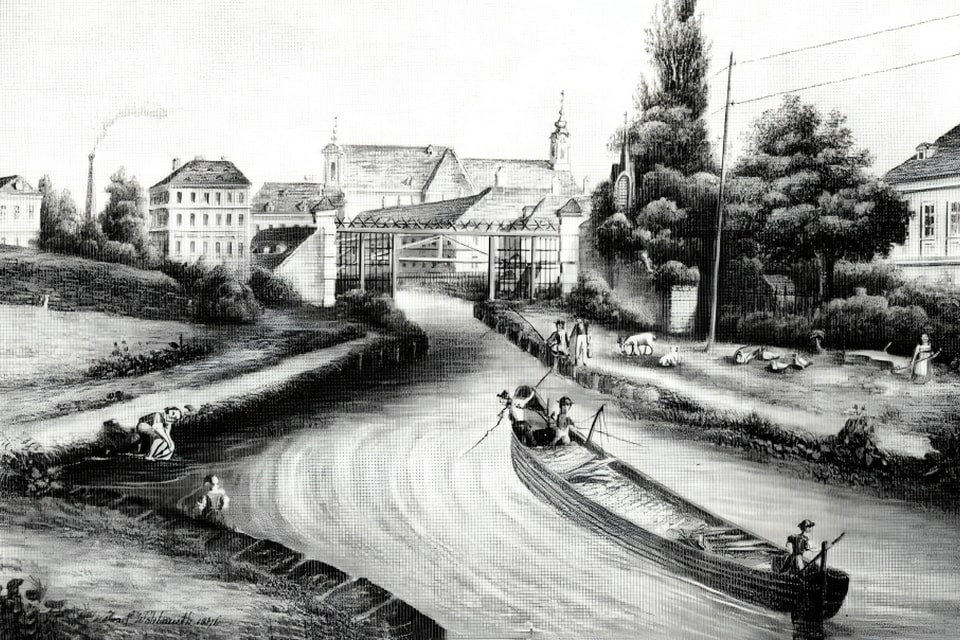
Half a century before the opening of the famous Suez Canal, which connected two parts of the world, more moderate projects of water channels were used in Europe, particularly in England, as both water supply sources and means of transport. On the verge of the 18th century, Austrian Emperor Franz II (1768-1835) was impressed by the economic benefits of water canals in England and sought to establish his own to improve the supply of resources to Vienna from a region of Lower Austria rich in coal and wood. The construction became a hell of a task, regarding the complexity of the terrain, the storms, and the foreign war campaigns, and lasted between 1797 and 1803, when the new canal was finally filled with water and put into operation. The canal improved the flow of supplies to the capital as was anticipated, but over the decades, it became financially nonviable, and after the loss of the Austrian-Prussian War, all its property was listed for sale. The new owners established “Erste Österreichischen Schiffahrts Kanal AG,” and despite earning a profit from operating the canal from 1871 to 1873, they obtained state permission to build a railway line on the site of the former water canal.
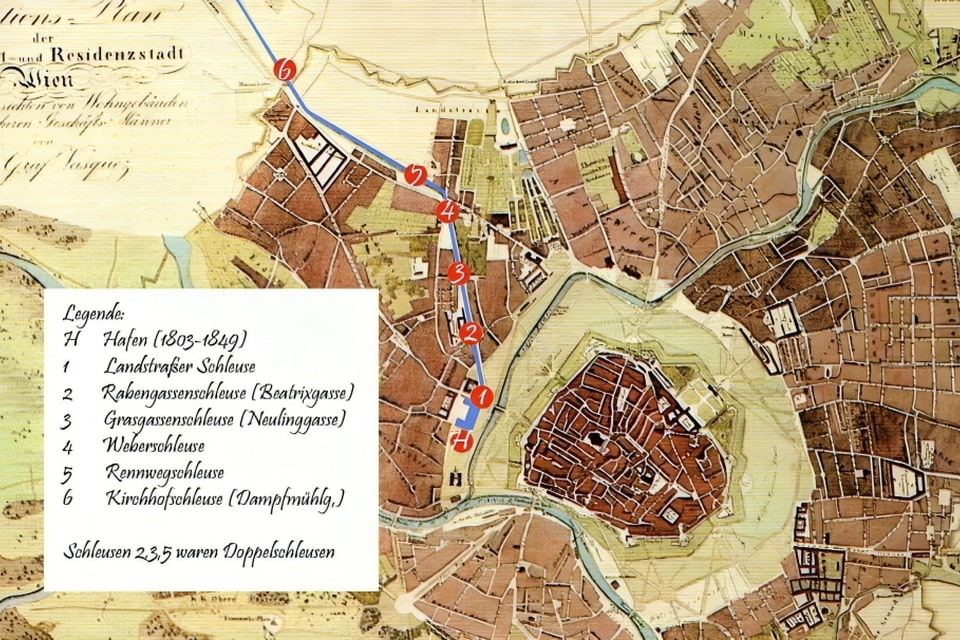
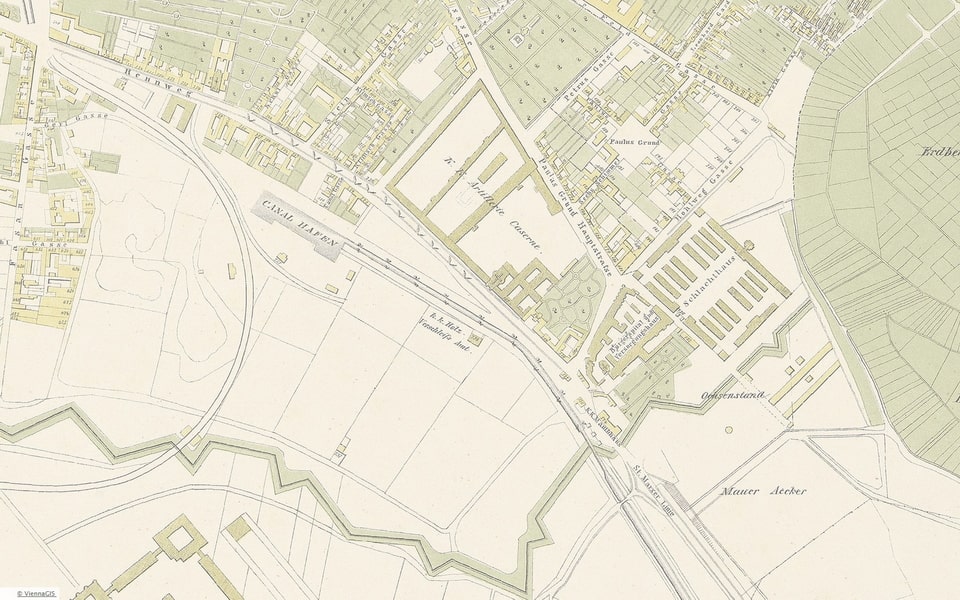
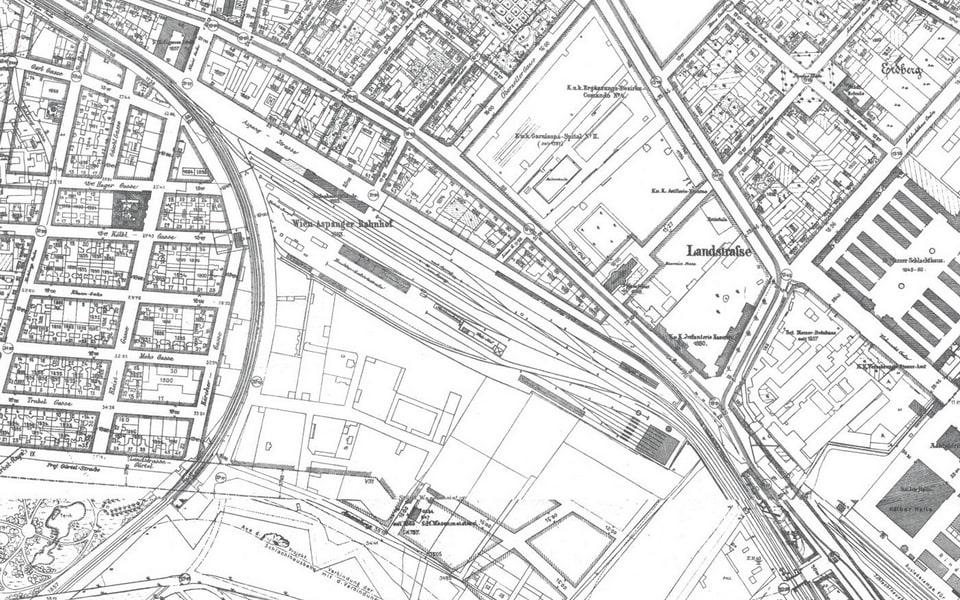
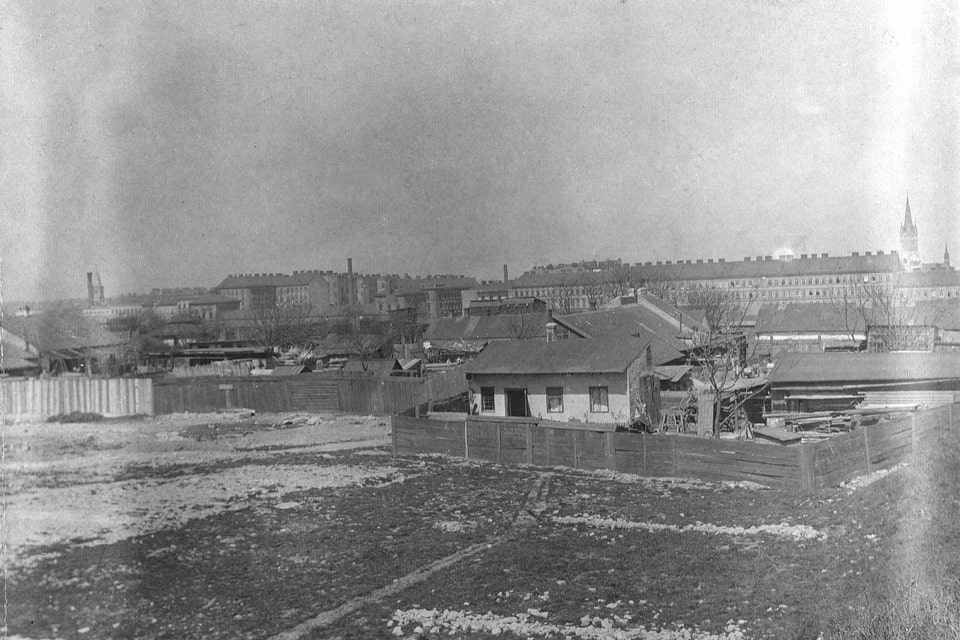
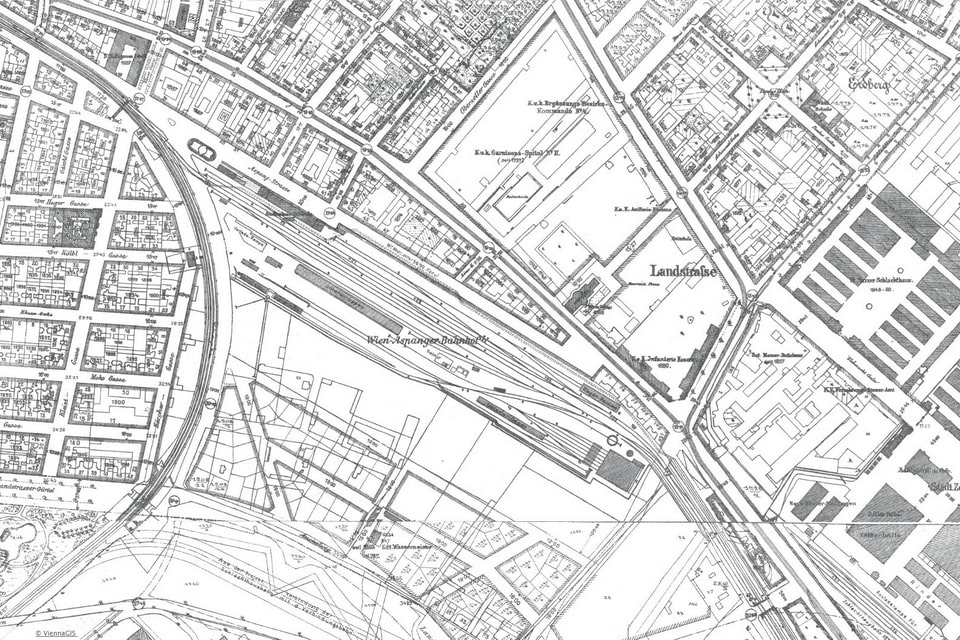
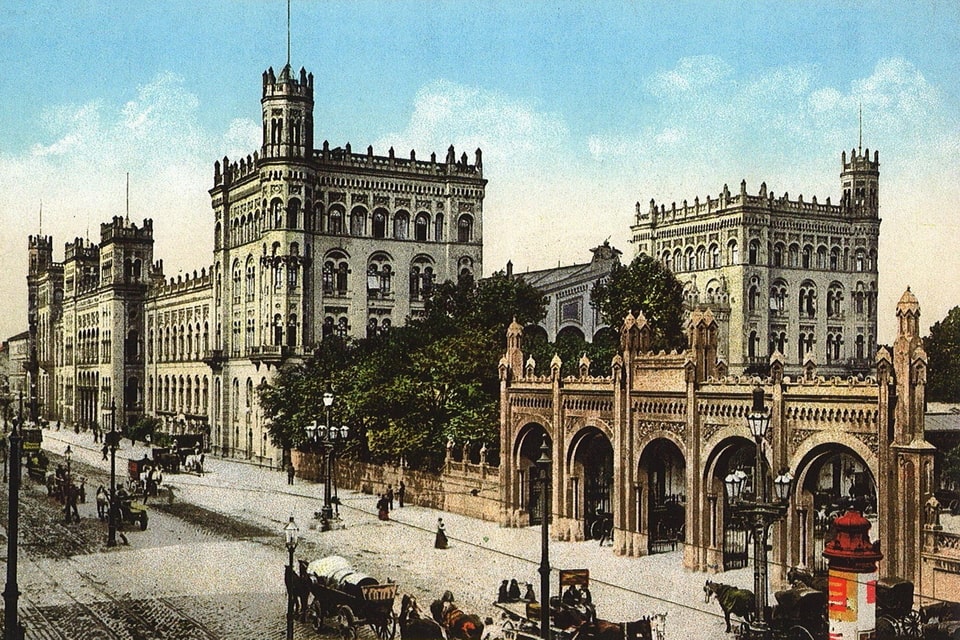
The new railway line was planned to evolve into a connection between Vienna and Salonica, and the first section to be built was aimed at connecting Vienna with the market town of Aspang to the south. After draining the canal around Vienna (parts of which still exist in Lower Austria today), with all necessary permissions and state support, the new line, 85 km long, was completed and opened in October 1881. The construction was conducted by a newly established subsidiary company called “kk privilegierte Eisenbahn Wien-Aspang” (Imperial and Royal Privileged Railway Vienna-Aspang). On Vienna’s end of the line, the starting point was set on the site of the former canal’s harbor (‘Canal Hafen’ in German). Shipping operations were suspended in 1879, and the canal facilities were drained and filled with soil, while the former cargo depot was dismantled. A new railway station with a spacious transport depot was constructed between 1880 and 1881 and put into operation in August 1881. The total area of ‘Aspangbahnhof’ (Aspang Train Station) covered eight hectares with eight kilometers of tracks and occupied a city quarter. The infrastructure included a freight depot and workshops, and through a double-track connection, Aspang was connected with Nordbahnhof station.
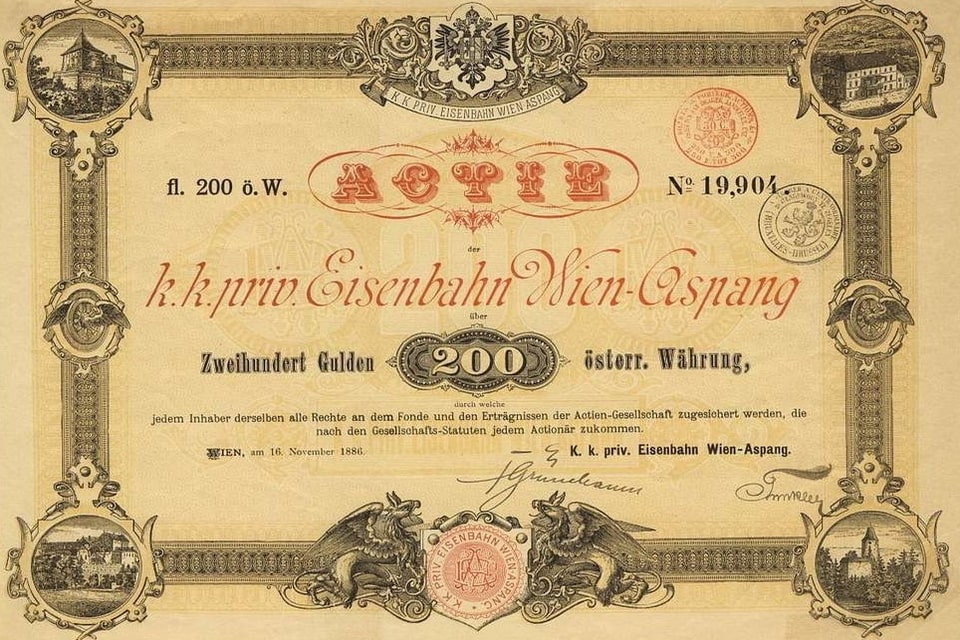
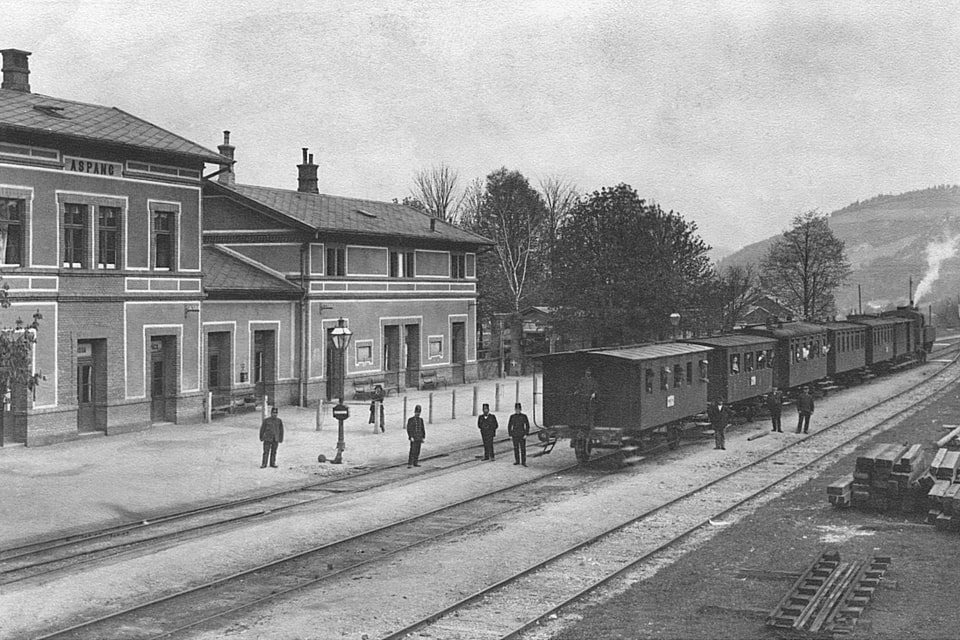
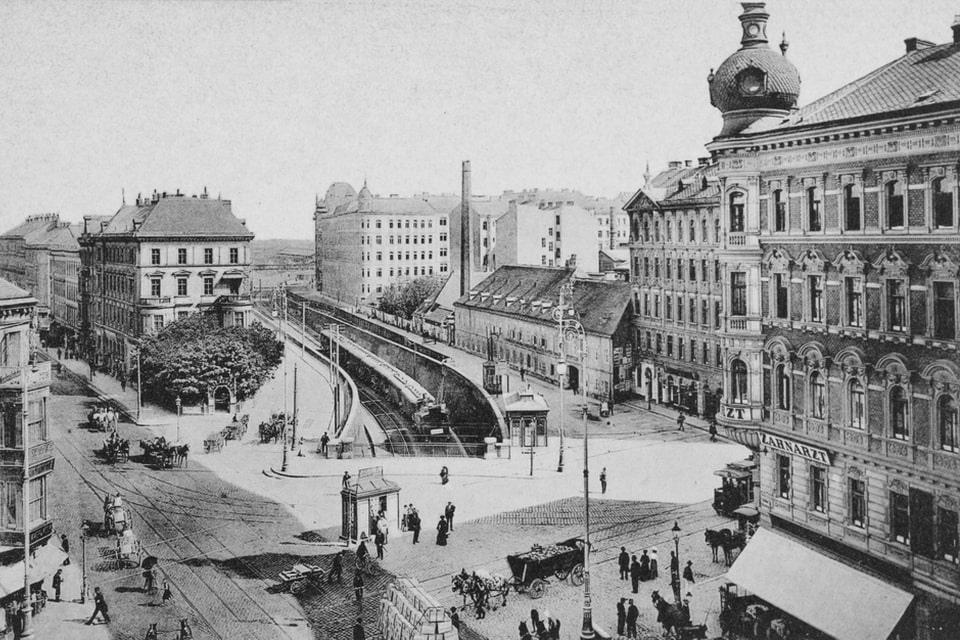
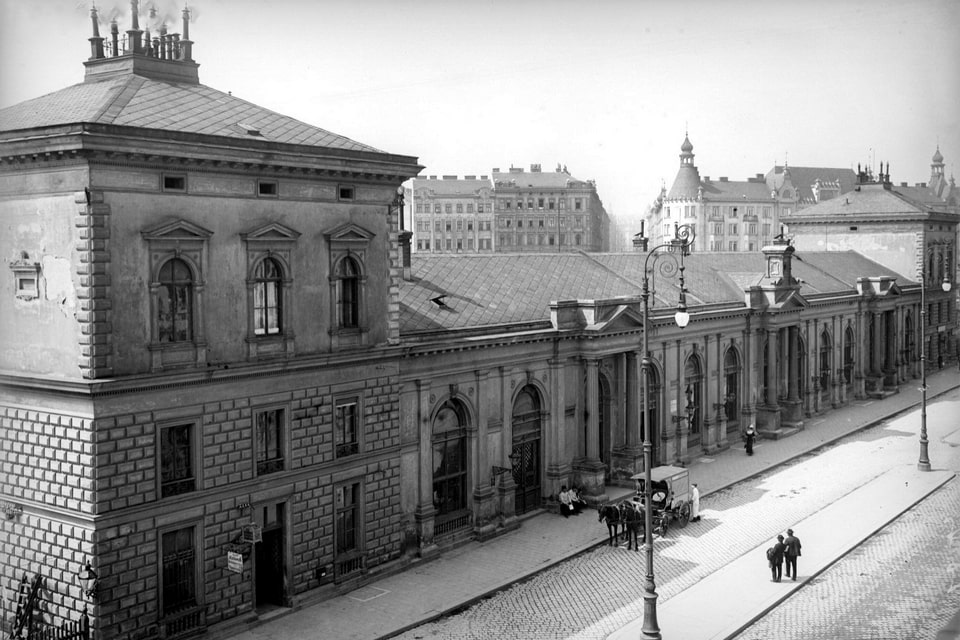
The railway main reception building was built north of the tracks on the street called ‘Am Canal’ (on the canal), which would be renamed ‘Aspangstrasse’ in July 1894. The reception building was designed by Franz von Gruber (1837-1918), an Austrian architect who received his education at the Academy of Fine Arts (Akademie der bildenden Künste Wien), the same institution from which the young Adolf Hitler later failed to enter. As an army officer, Gruber began his career by designing military barracks, which he improved to enhance the living conditions for servicemen. Known mostly as an architect of hospitals in Vienna, Linz, and Carlsbad, Gruber designed the Aspang station reception building in a Renaissance style, which made it distinguishable from the common practice for railway stations of the era. The building was 97 meters long, and the adjustment platform with a roof was 160 meters long. Apart from the reception hall, the station had a large restaurant and a modern postal office equipped with a telegraph. The Aspang Bahnhof welcomed its first guest on August 7, 1881, when the first section of the new line between Vienna and the market town of Pitten was opened, and the complete route to Aspang became available on October 28, the same year.
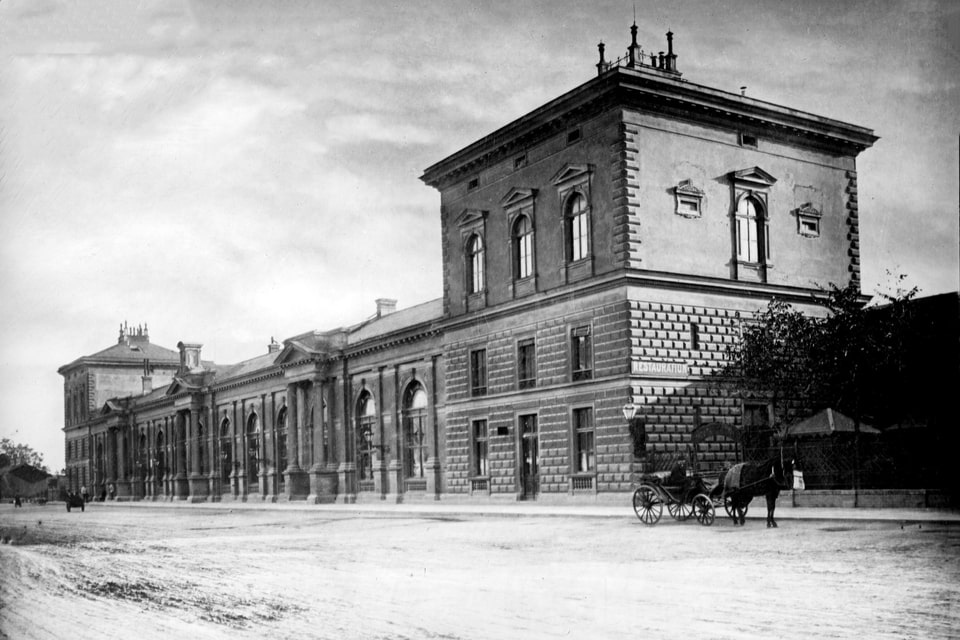
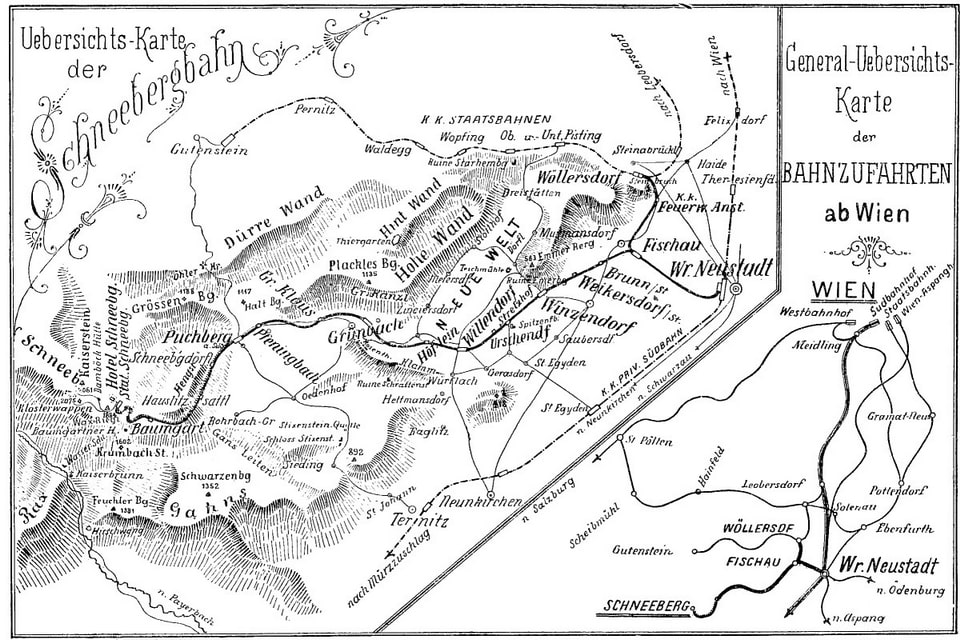
The ambitions of extending this line to Thessaloniki never materialized; still, the milestones with the three-letter code “WSB” (Wien Salonika Bahn or ‘Vienna-Salonica railway’) can be found along the former line. Apart from that, the line between Vienna and Lower Austria was a popular destination in the following decades. In 1899, ‘Eisenbahn Wien-Aspang’ took control over ‘Schneebergbahn’ (The Schneeberg Railway), and through a connecting line, now expanded its routes to Schneeberg and the Wechsel region. Since then, the Aspang station in Vienna became a starting point for weekend trips to the south, and even Emperor Franz Joseph I of Austria (1848-1916) departed from here to Schneeberg on June 18, 1902. Since the key stakeholders of the mother company ‘Eisenbahn Wien-Aspang’ were the Belgian-based company called ‘Société Belge de Chemins de Fer’, after the outbreak of the First World War in 1914, the Belgian owners left the board of directors. The lines saw a fall in passenger traffic during the war, though they gained state financing for servicing the military industry.
While the ‘Schneeberg Railway’ regained its profitability in the 1920s, thanks in part to increased ski tourism, the mother company, EWA (Eisenbahn Wien-Aspang), faced financial problems that deteriorated in the 1930s. Finally, on July 1, 1937, both companies with the remaining hierarchy were overtaken by BBÖ (Bundesbahn Österreich or ‘Austrian Federal Railways’), which gained the debts of the former owner. After the Anschluss of Austria in March 1938, the lines were taken under the control of the German state-owned DRB (Deutsche Reichsbahn) company, and they have since lost their autonomy. The de jure nationalization took place on January 1, 1940, without any compensation to the shareholders, and in 1942, the EWA was dissolved and completely integrated into the DRB.
JEWISH VIENNA BEFORE MARCH 1938: 176,034 PEOPLE, 94 SYNAGOGUES
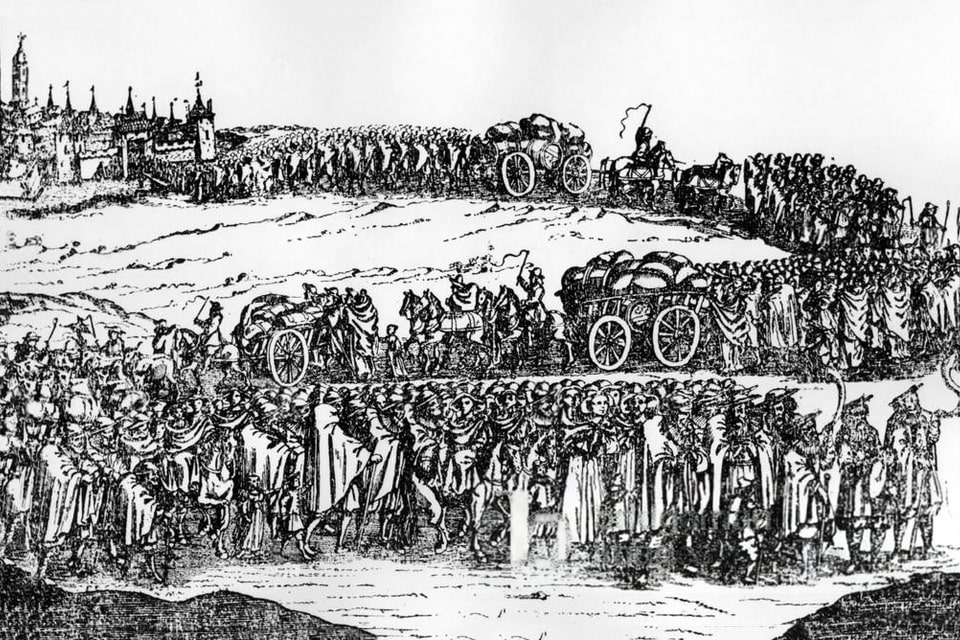
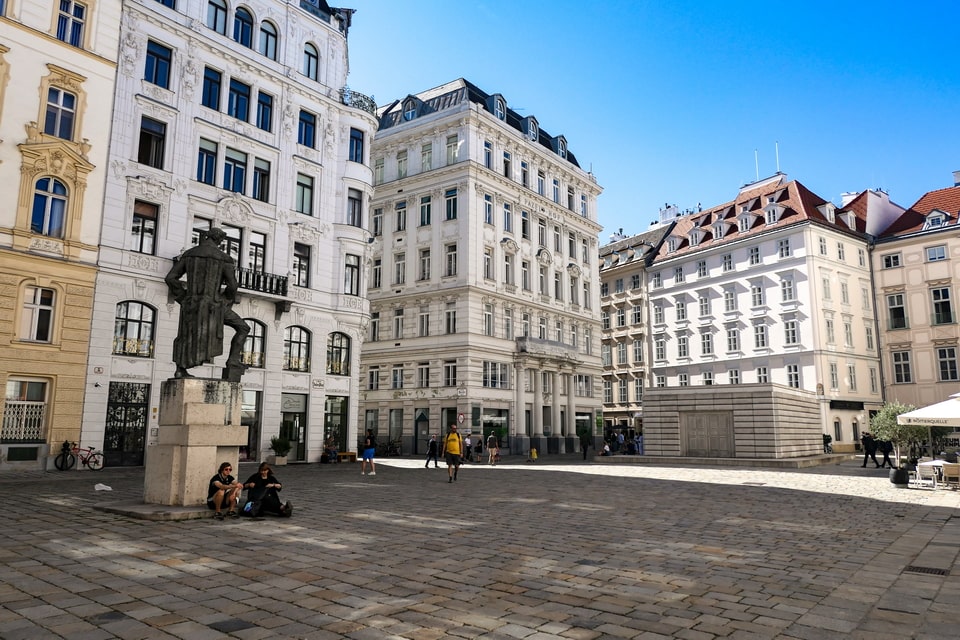
Before the Second World War, Vienna had the largest Jewish community in the German-speaking world and one of the largest in Europe. It had not emerged from nothing in the XX century, but had a long and vibrant history of assimilation and of facing antisemitism as well. The House of Babenberg, and the ancient rulers of what later became Austria and the predecessors of the Habsburgs, allowed Jews to settle in Vienna since 1150. The initial settlement was around the modern Judenplatz, and the first synagogue was built here as early as around 1200. The Jewish population lived in a separate area until the pogroms in 1421, after which they scattered across Vienna, but the heart of the community remained in the inner city. Another wave of hatred and expulsion came in 1623 when 130 Jewish families were evicted from the center and later created a new ghetto area to the west between the arms of the river Danube. In 1670, they were once again expelled from Vienna by Holy Roman Emperor Leopold I (1640-1705), and the area where the Jewish community had prospered was renamed Leopoldstadt. Seven years later, Jews were allowed to come back to the city and occupy the same area. Three centuries later, at the beginning of the 20th century, every third Jewish family still lived in Leopoldstadt.
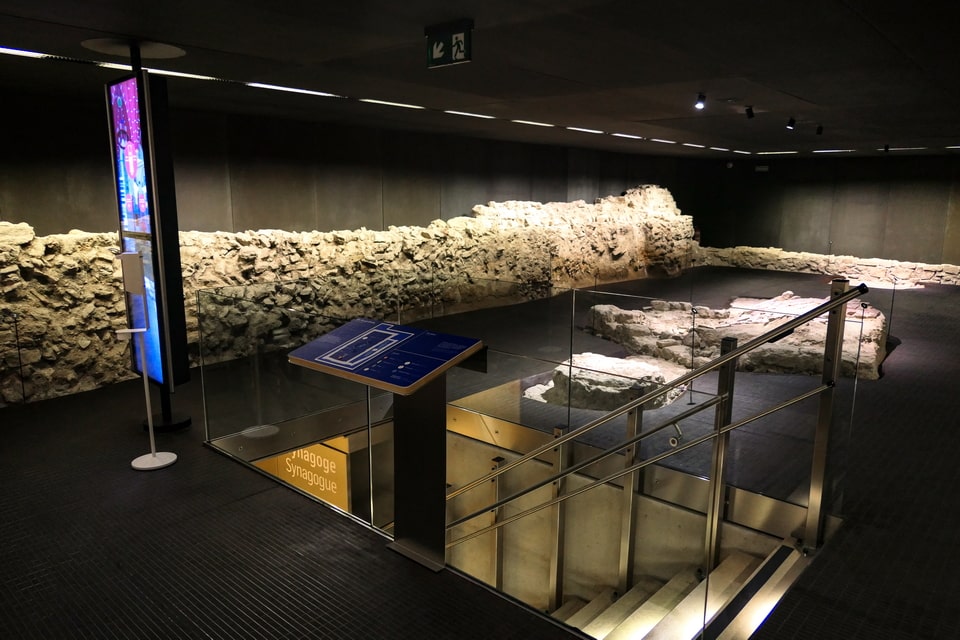
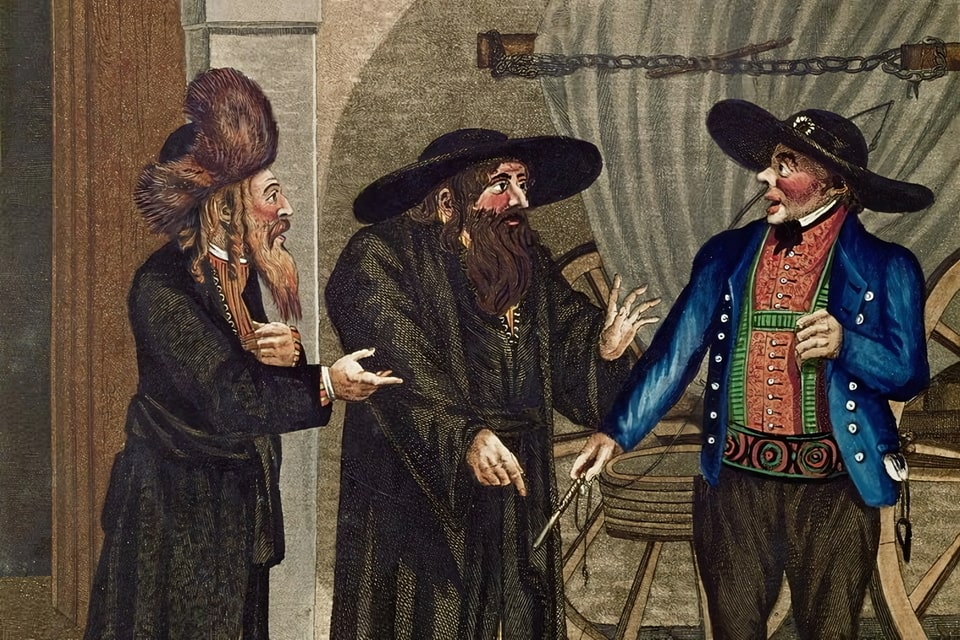
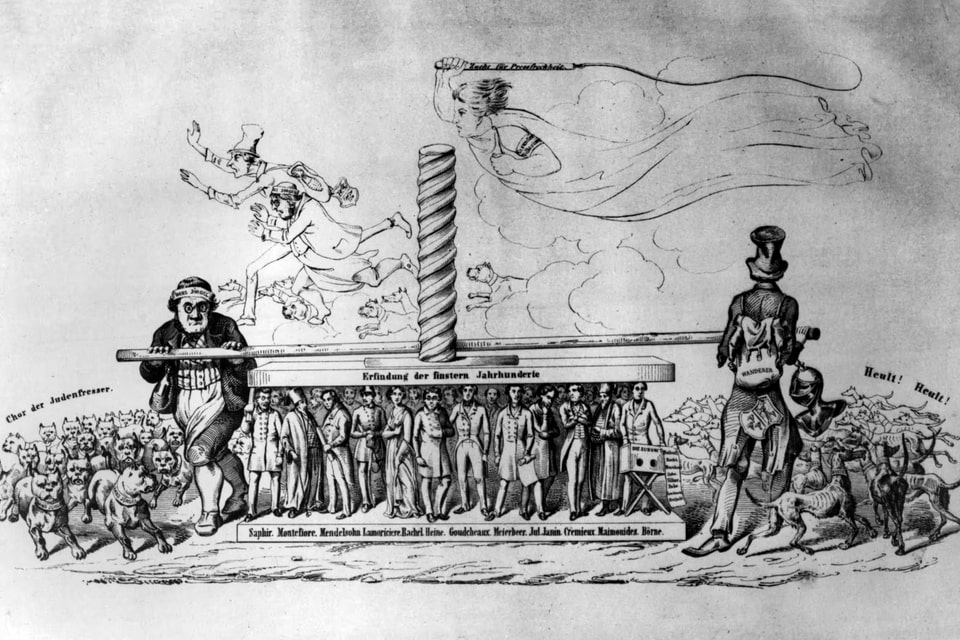
The ‘golden era’ for the Jewish community in Vienna came in 1867 with the adoption of the ‘Dezemberverfassung’ (December Constitution), signed by Emperor Franz Joseph I on December 21, 1867. The new supreme law of the Austro-Hungarian Empire included six acts, one of which, called ‘the Basic Law on the General Rights of Nationals’, gave equal rights to all ethnicities in the country, with freedom of religion among other provisions. After centuries of persecution and ostracism, Jews finally gained full citizenship with equal access to education, civil servant positions, and property. This event initiated the massive influx of the Jewish population into Vienna, the Empire’s capital city, with maximum possibilities for education and work. Among the first newcomers were Jews from the suburbs and the surrounding area, who were later followed by people from distant corners of the Empire: Bohemia and Moravia, Hungary, Galicia, and Bukovina.
The increase in Jewish population in Vienna was palpable, from 6,200 in 1860 to 40,200 in 1870, only three years after the adoption of a new constitution. By 1880, the number almost doubled and reached 72,600, or around 10% of the city’s population at that time. In the following decades, the process of inner emigration resulted in 118,500 Jews in Vienna by 1890, 147,000 in 1900, and 175,300 by 1910. It is worth noting that the estimation gave the number of people who followed Judaism and did not include highly assimilated and Christianized Jews. The third group, or 122,930 among these people, spoke German or Yiddish (the latter was included in the same language group), and the remaining 51 thousand were identified as Hungarians, Ukrainians, Czechs, Romanians, and other ethnicities. While the share of Jewish population (around 8-10%) in Vienna was larger than in large German cities like Frankfurt (5%), Berlin (4%), or Hamburg (2-3%), it was moderate compared with some European cities like Krakow (50%), Lviv (Lemberg) with 25%, and Budapest (25%).
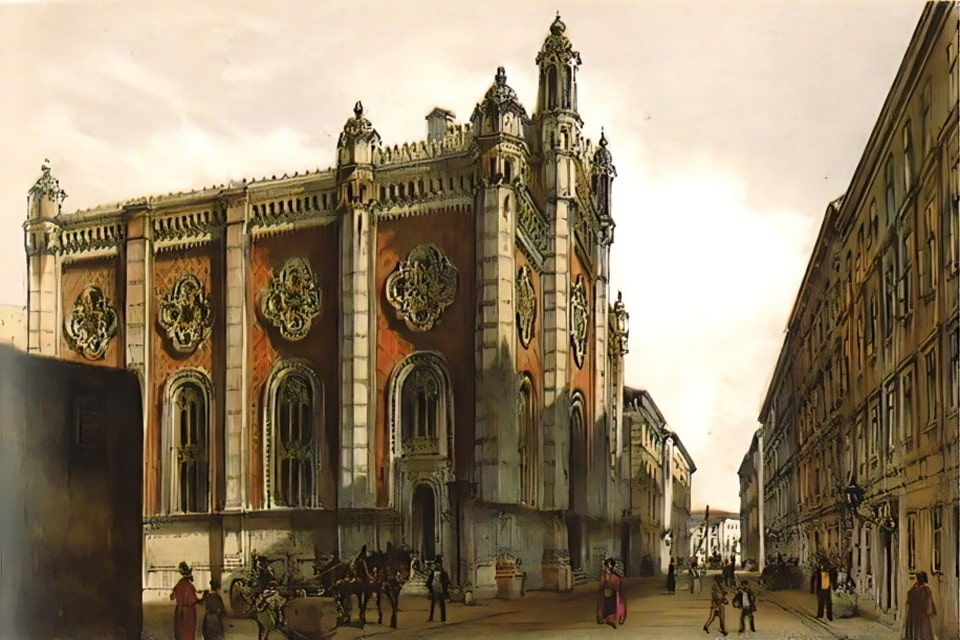
![The Leopoldstädter Tempel, also known as the Israelitische Bethaus in der Wiener Vorstadt Leopoldstadt 1958]](https://war-documentary.info/wp-content/uploads/2025/08/jewish-community-in-vienna11.jpg)
The Jewish population was ecstatic toward gaining education and new job opportunities, and often the high percentage of Jews in some spheres was explained by their diligence, and not by the anti-Semitic argumentation of ‘profiteering nature’. Despite comprising 10% of the population, the Jewish students amounted to 30% of gymnasium pupils, 47% in high schools, and in general, 25% of Jews studied in universities. The traditionally preferred professions were found in medicine and law practice. In the late 1860s, there were thirty-three Jewish lawyers in Vienna, and in 1889, there were 394 out of 681 in the city. In 1913, Jewish students comprised 40% of medical seats in universities and 25% of law students. At the same time, mixed marriages between Christians and Jews were prohibited, and one of the spouses had to either change their religion or reject it. Despite equal rights, the Jewish community in Vienna still faced prejudice and open anti-semitism, and this practice was institutionalized even in political life. Often, the elections were shaped by the openly anti-semitic position of the parties, even in the case of the Social Democrats. From 1897 to 1910, the Viennese mayor Karl Lueger, a zealous anti-semite, ran a campaign of hatred and prejudice in the capital, which shaped the anti-Jewish populism later adopted by Adolf Hitler, who lived in Vienna between 1907 and 1913. For people like Hitler and other pangermans and extremists, Jews personified modernism and social changes as opposed to conservatism. In the eyes of the xenophobes, the Jewish population was the ‘profiteers’ protected by the law.
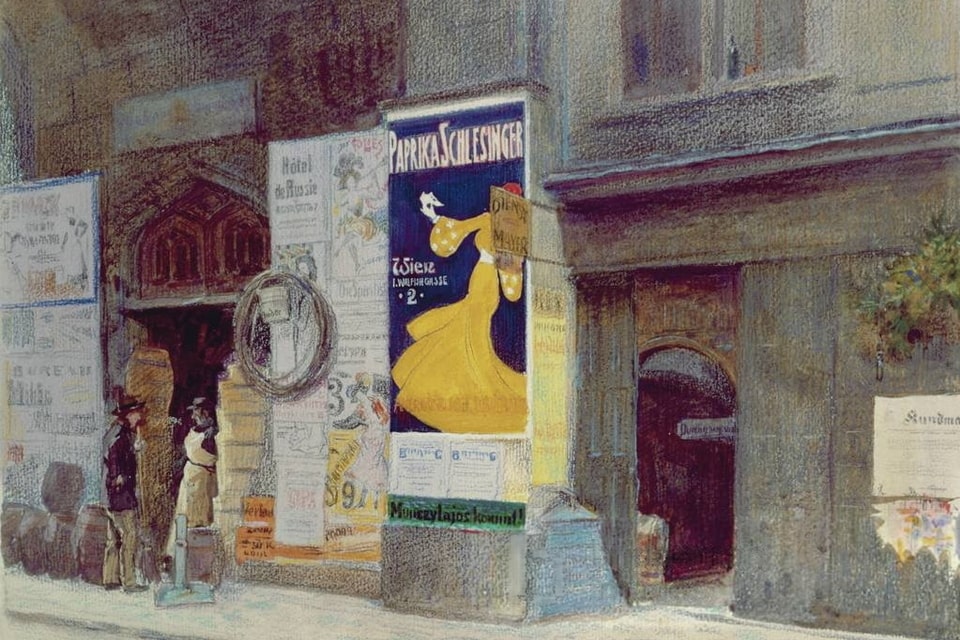
After the fall of the Habsburg Empire in 1918, the anti-semitic sentiments in the newly born Republic of Austria increased, but remained on a controlled level throughout the 1920s and 1930s. The 1934 census counted 191,481 people identifying themselves as Jews in Austria (or only 2,8% of the total population), of which 176,034, or 92%, lived in Vienna, a year after Hitler’s rise to power in neighboring Germany. In the wake of the coming of the Nazi state across the border, the Austrian Jews and even the majority living in one city were not a homogeneous community, a factor which would play its role after the Anschluss. Because of the rapid rise of the number of Jews in the capital due to internal migration, Viennese Jews spoke many languages, since the Habsburg Monarchy previously had eleven official languages and many more for minorities. Vienna, with its diverse Jewish community, had eighty-eight different religious congregations, though all Jews were considered Austrians regardless of their place of birth or the origin of their parents.
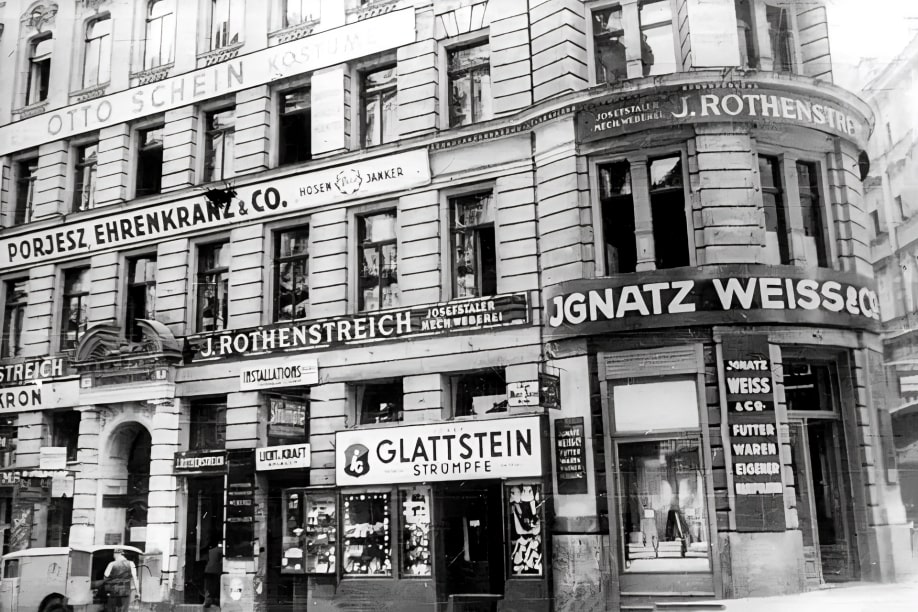
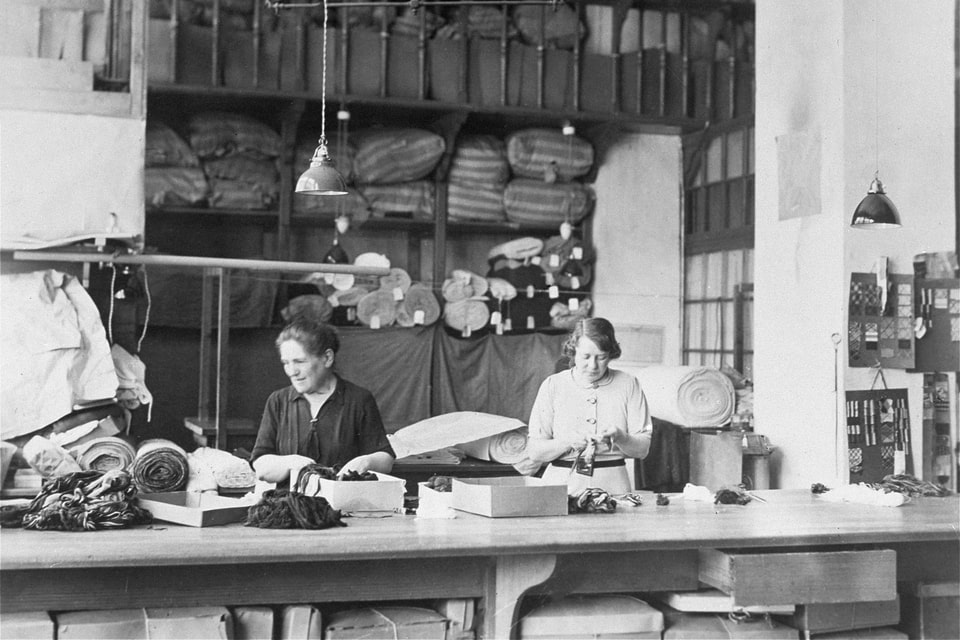
In the years before the coming of the Nazis, Jews who comprised 9.4% of the city’s population (in 1934) lived in all city districts, while a large part of the community was concentrated in four: Leopoldstadt, Landstrasse, Alsergrund, and Brigittenau. Their religious determination differed from people who considered themselves Zionists to those who converted to Christianity, renounced the religion, or simply did not attend synagogues often. The Jewish community in Vienna in the 1930s was separated by their political preferences and socio-economic classes, but the most vivid split appeared between the assimilated Jews and those regarded as ‘Ostjuden’ (Eastern Jews). Most of the latter came to Vienna in the late 19th century and the first three decades of the twentieth century from Eastern regions of the former Empire, the parts of modern Ukraine, Poland, Romania, Moldova, and Serbia. Many of them left their localities to escape the hardships of ethnic persecution, and upon their arrival in Vienna, the majority of these people settled in the 2nd district, Leopoldstadt, the historical area for the Jewish population. By the early XX century, around 60,000 Jews, or a third of the total city’s community, lived here, which gave the district a nickname ‘Mazzesinsel’ or ‘Matzah Island’ in English, a reference to a traditional Jewish bread. This part of the community was less assimilated and preferred to speak Yiddish or the languages of the regions they came from, were mostly strict in preserving religious traditions, and even directed open criticism against a more liberal understanding of Judaism.
![Haredi Jews at the Karmelitermarkt [de] in Leopoldstadt during the Austro-Hungarian Empire, in 1915](https://war-documentary.info/wp-content/uploads/2025/08/jewish-community-in-vienna07.jpg)
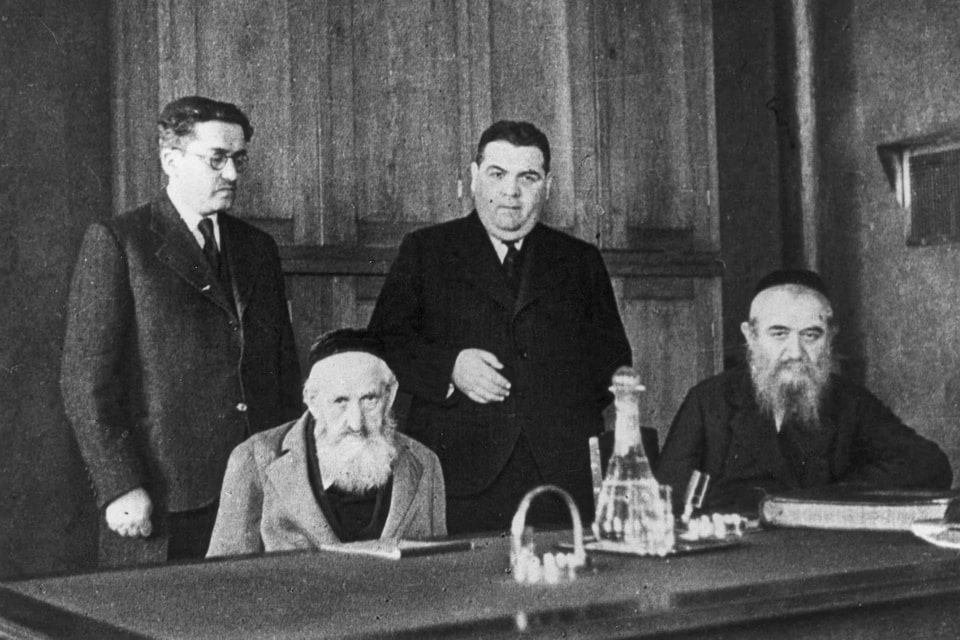
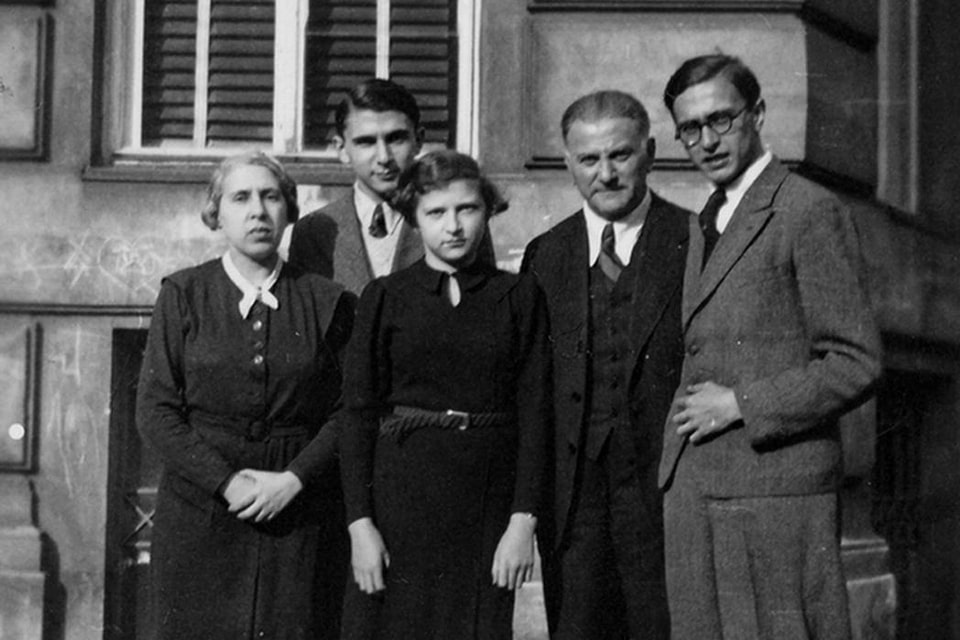
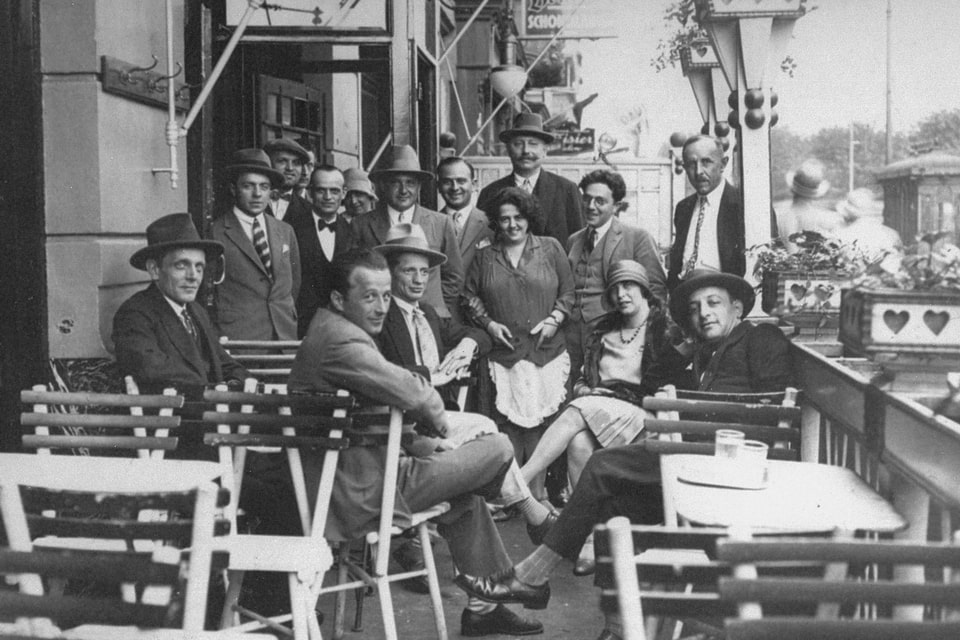
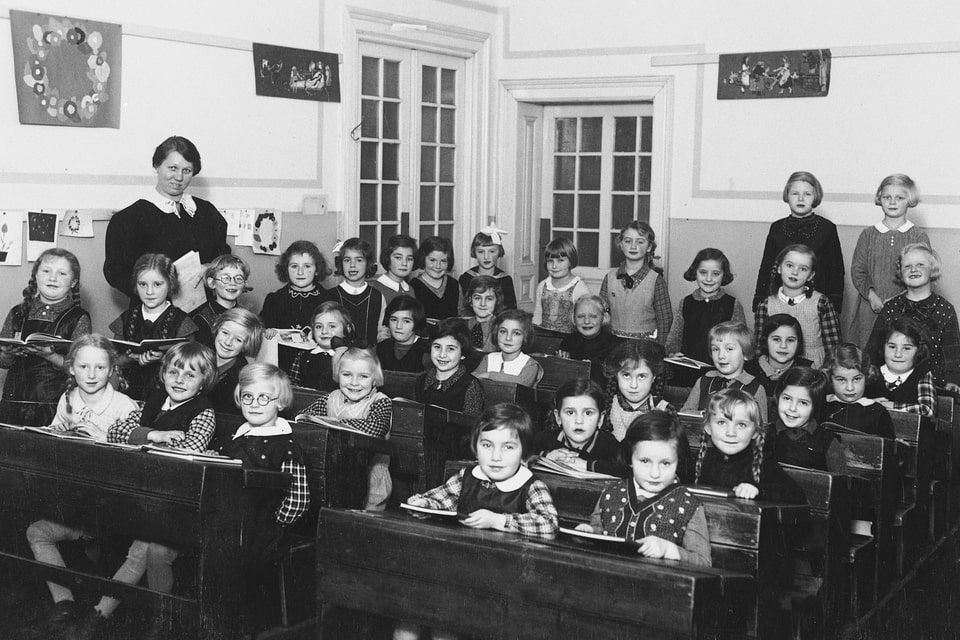
Despite comprising only around 9-10% of the city’s population, the Jewish community prospered due to their diligence and hard-working nature. By the mid-1930s, every fourth of the registered businesses in Vienna, or 33,000 out of 146,000, were owned by Jews. As I stated above regarding education, the high percentage in some fields followed, with 62% of lawyers in the city, 52% of physicians and dentists, and 25% of university professors. By 1938, there were twenty-three synagogues in Vienna, more than four hundred different organizations, and an uncounted number of prayer rooms. The Jewish community operated two schools, five kindergartens and four orphanages, a library and a care center, an elderly house, a hospital and a paediatric clinic, and an institution for blind people. There were 119 Jewish welfare organizations responsible for 60,000 people who received some form of support. The Zionist organizations in Vienna had 12,000 registered members in eighty-two separate groups.

MARCH 1938: THE SCRUBBING PARTIES AND THE FIRST TRANSPORT TO DACHAU
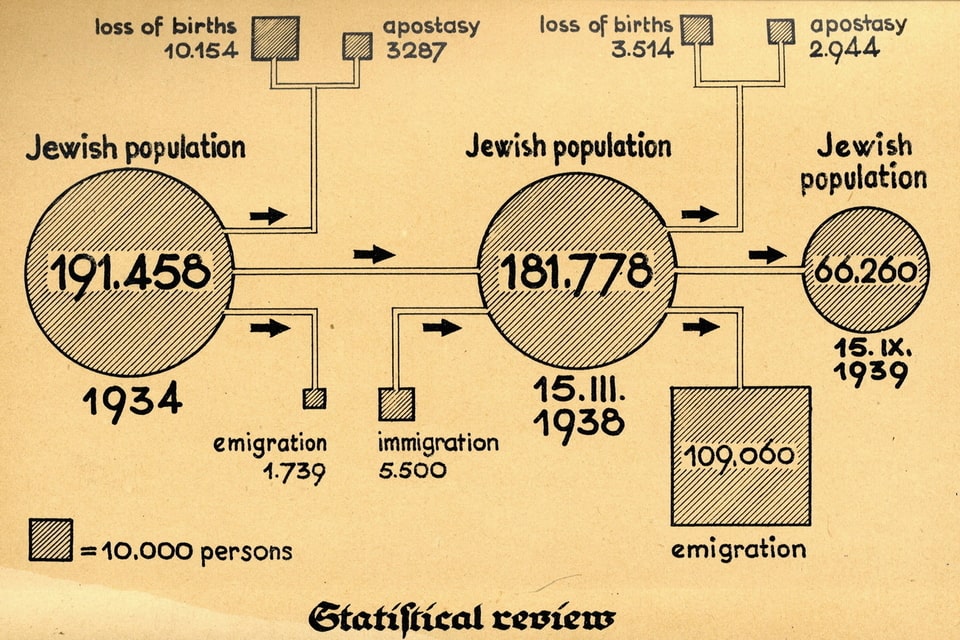
Starting from 1933, the Jewish community in Austria and particularly in Vienna witnessed the rise of Adolf Hitler and his party as a dominant political factor in neighboring Germany. They hesitantly watched the anti-Jewish pogroms, the rise of forced migration, public ostracism, and the introduction of the infamous Nuremberg Laws, but Austrian Jews did not react adequately against a new existential threat. One reason was the false feeling of safety across the border, since they now lived in an independent country outside Germany. This sentiment was ever-present, particularly among men who had fought in the Great War and were combat veterans. The second reason dealt with the perception of life in historical perspective. Jews in Vienna calmed themselves that their ancestors had successfully survived centuries of anti-semitic sentiments, pogroms, and ostracism, and that the Nazi regime in Germany was a temporary unpleasant factor that their people would outlive, like many times before. More than that, even the Jewish newspapers and organizations did not actively encourage people to leave Austria after 1933. Only 1,739 Jews left Austria by March 1938 out of two hundred thousand, and what is also shocking is that approximately 5,500 German Jews came to Austria as a safe haven.
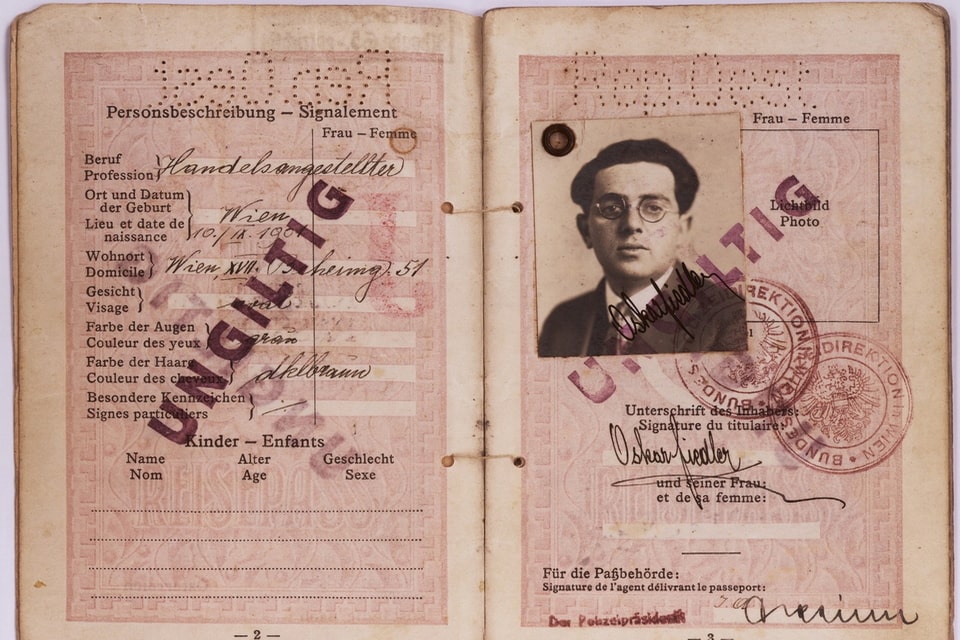
In the wake of the German invasion of Austria in March 1938, around two hundred thousand people identified themselves as Jews in Austria. In his 1978 book ‘Verfolgung und Selbstbehauptung. Die Juden in Österreich 1938–1945′ (Persecution and Self-Assertion: The Jews in Austria 1938–1945), Jewish Historian Herbert Rosenkranz (1924-2003), who rose in Vienna himself and left Austria in 1938, calculated that 185,028 Jews resided in Austria in March 1938. This established figure is supported by the surviving documents of Israelitische Kultusgemeinde Wien (or simply IKG; ‘the Jewish community of Vienna’ organization). At the same time, considering Jews who had previously converted themselves to Christianity, and were later targeted by the Nazis as well, the final number was higher. A Jewish-Austrian historian, Jonny Moser (1925-2011), whose family lived in eastern Austria, calculated in his 1999 book ‘Demographie der jüdischen Bevölkerung Österreichs 1938–1945.’ (Demographics of the Jewish population of Austria 1938–1945.) calculated that at least 201,000 people were later regarded by the Nazi regime as Jews and persecuted in Austria after 1938. At the same time, out of the official figure of 185,028, at least 170,000 lived in Vienna. This decline from the 1934 figure of 176,034 (out of 191,481 in Austria) may be explained by people moving from the capital to the provinces.
Back in July 1934, the Austrian Nazi paramilitary formations attempted a failed coup d’état in Austria against the government of Engelbert Dollfuss (1892-1934), the chancellor of Austria since 1932. The armed Austrian Nazis formations assaulted the building of the Federal Chancellery of Austria in Vienna (Ballhausplatz 2) and violently killed Chancellor Dollfuss. Their attempt to change power in the country failed since most of the nation and the political parties in Austria strongly opposed the coup, and Adolf Hitler did not directly intervene in the events with his armed forces from across the border. The leading party remained in power and chose Kurt Schuschnigg (1897-1977) as the new Chancellor, a post he held until March 1938. Hitler became confident in seizing Austria as early as 1937, and during his meeting with Schuschnigg on February 12, 1938, he presented the Austrian leader with an ultimatum, which was partially fulfilled, but that did not evade the upcoming Anschluss. Facing another ultimatum of armed invasion, Kurt Schuschnigg resigned on March 11, and the next day, Wehrmacht troops entered Austria without any fighting or organized opposition.
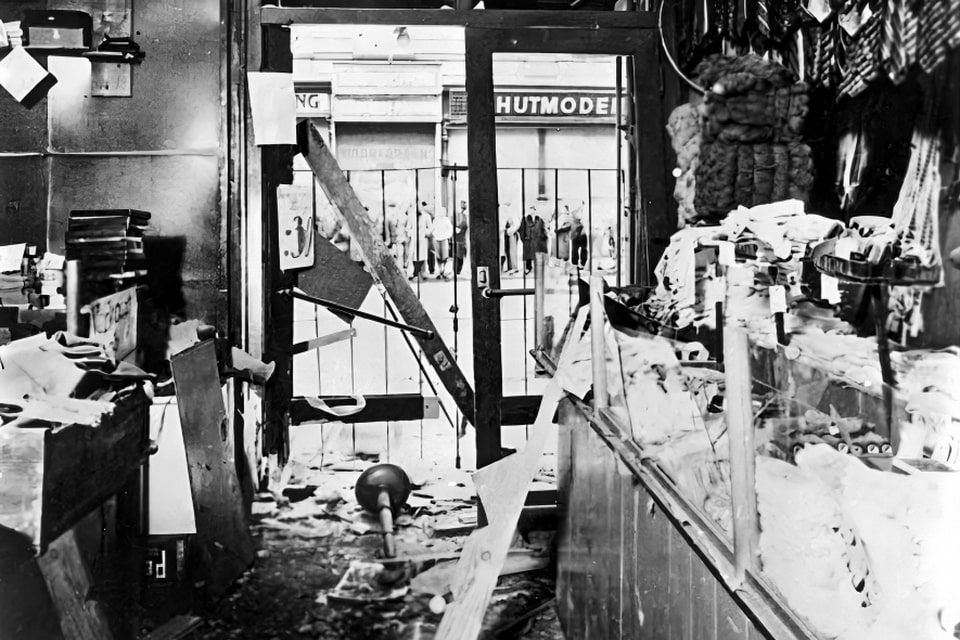
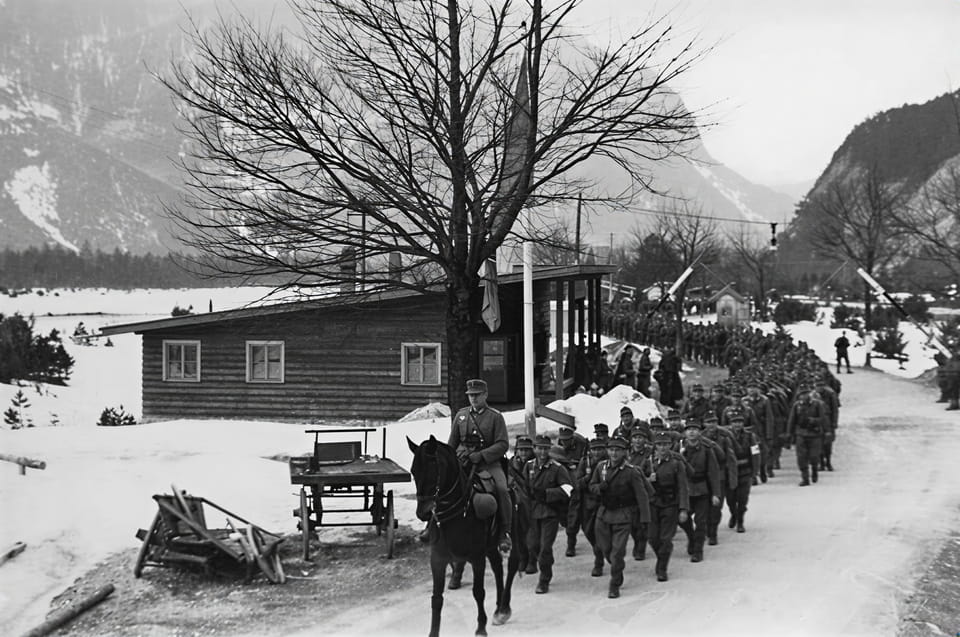
As early as February 1938, more than a month before the invasion, someone threw a smoke bomb into the ‘Leopoldstädter Tempel’, a large Jewish synagogue in the Leopoldstadt district of Vienna. When the German troops entered Austria on March 12, they were generally welcomed by the cheering crowds, especially in Vienna, where Adolf Hitler came two days later on March 14. When Kurt Schuschnigg ended his last radio speech with the words ‘God Protect Austria’, he could neither foresee the upcoming World War nor the level of violence that would affect the Austrian Jews. The latter witnessed how enthusiastically the mob on the streets of Vienna welcomed Hitler and the Nazis, and how they changed the colors of the country to the swastika. Two hundred thousand Jews in Austria suddenly found themselves in another reality, unprotected and surrounded by people who willingly joined the Third Reich with all its anti-Jewish policies and popular sentiments. On those days, the Jewish population could be identified among the crowd, among other things, by not joining the mob enthusiasm toward the Anschluss.
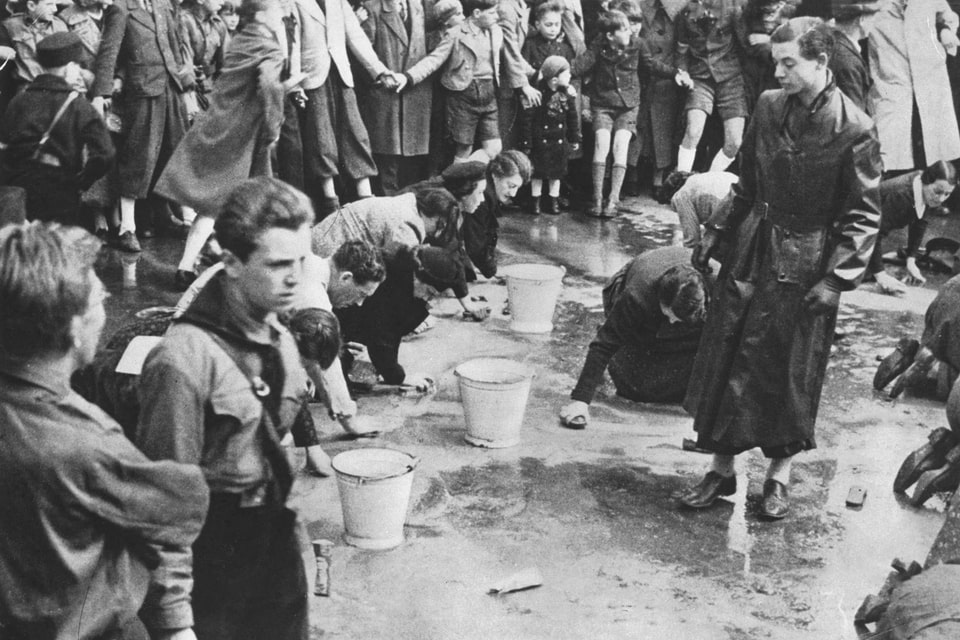
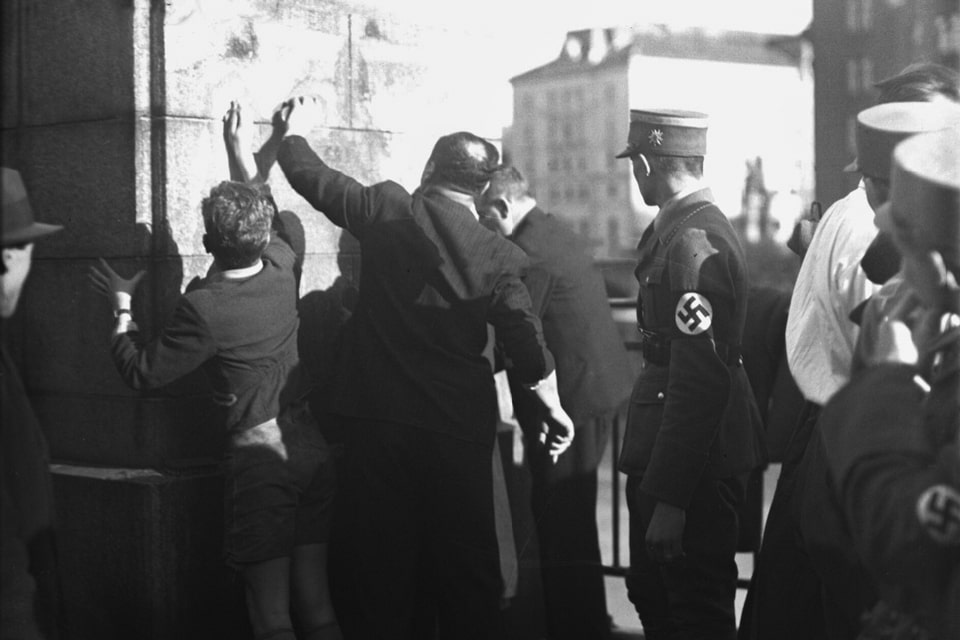

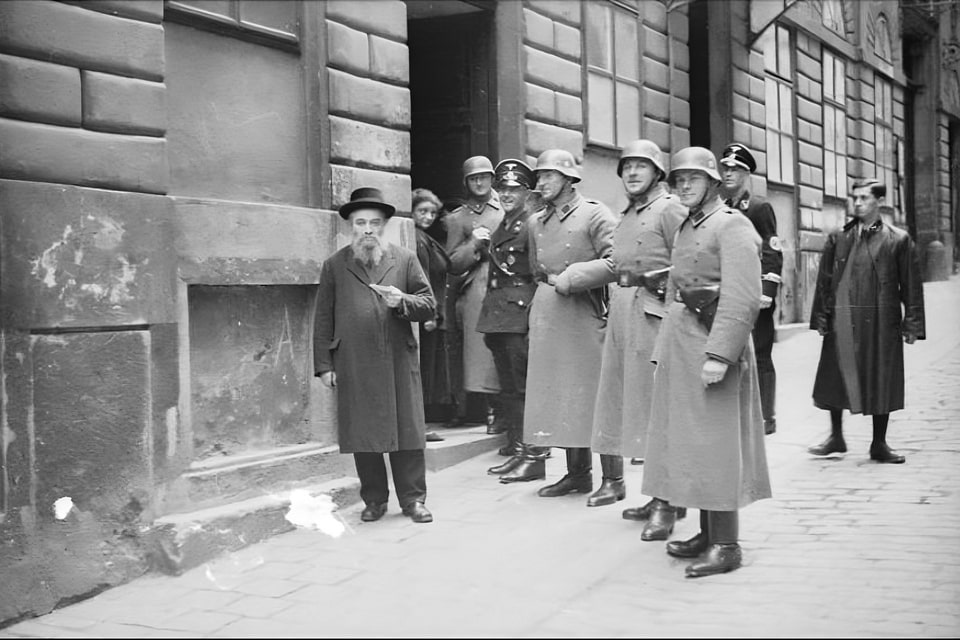
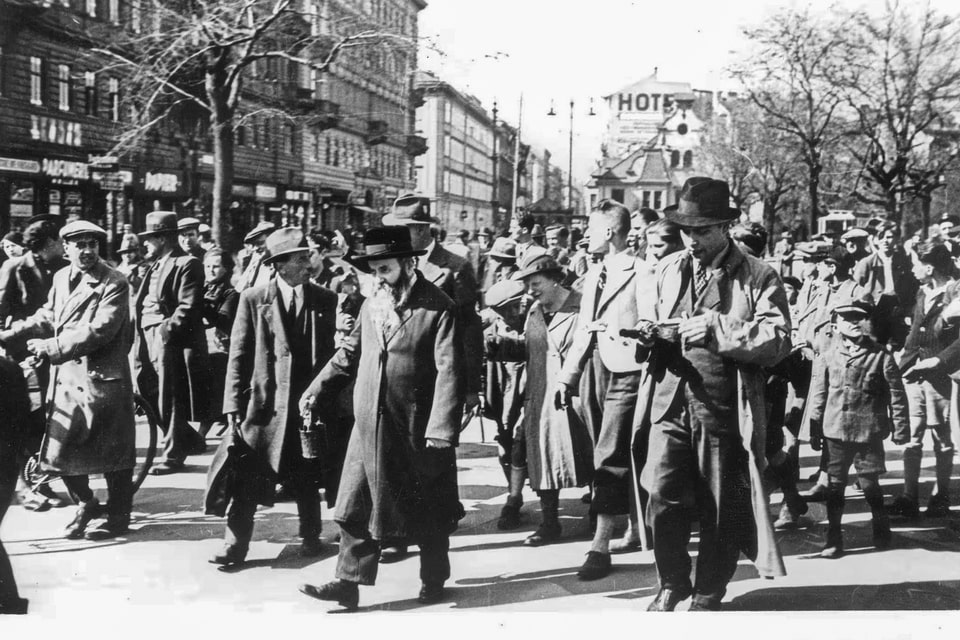
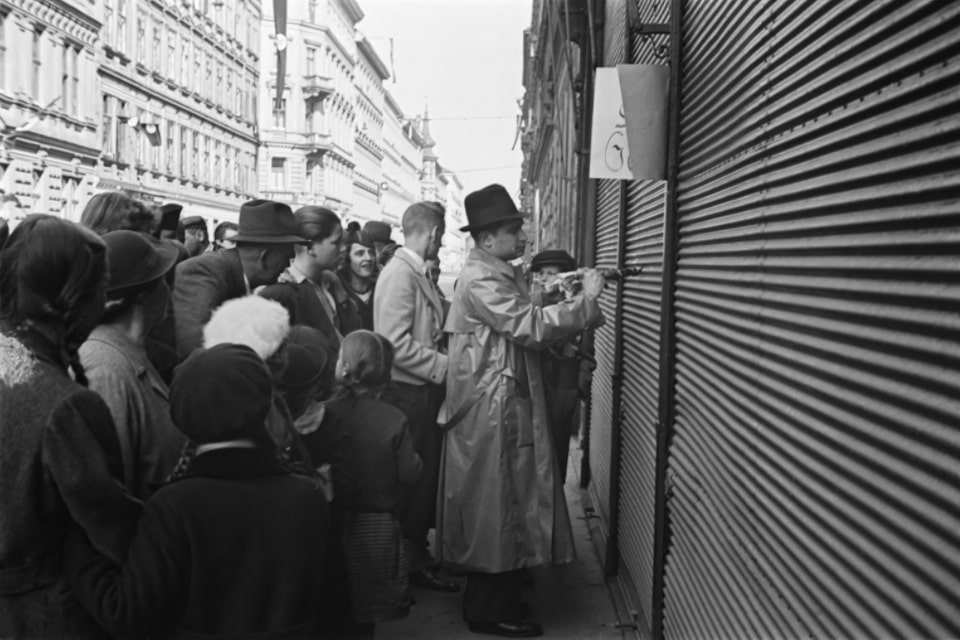
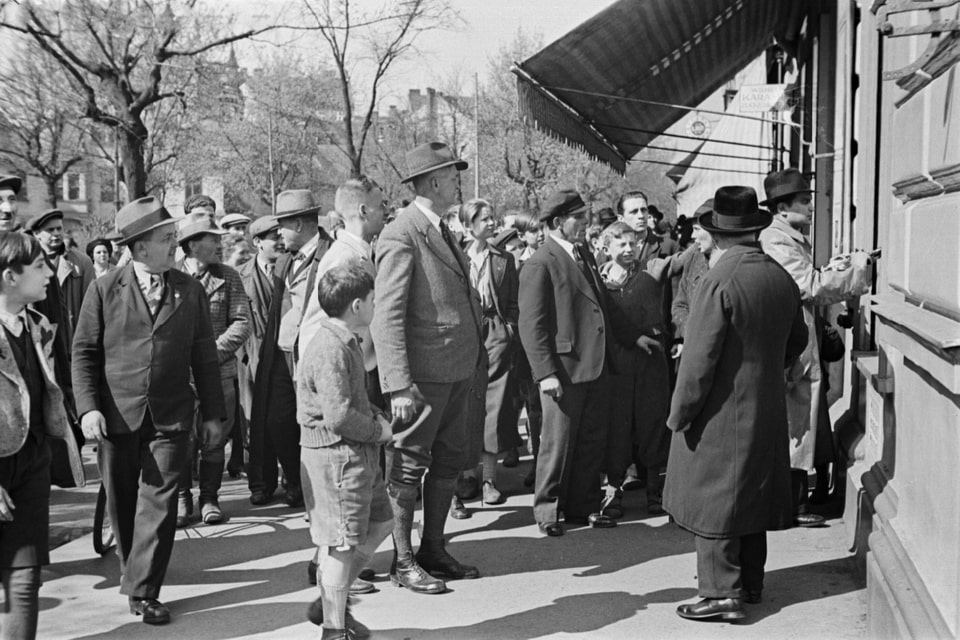
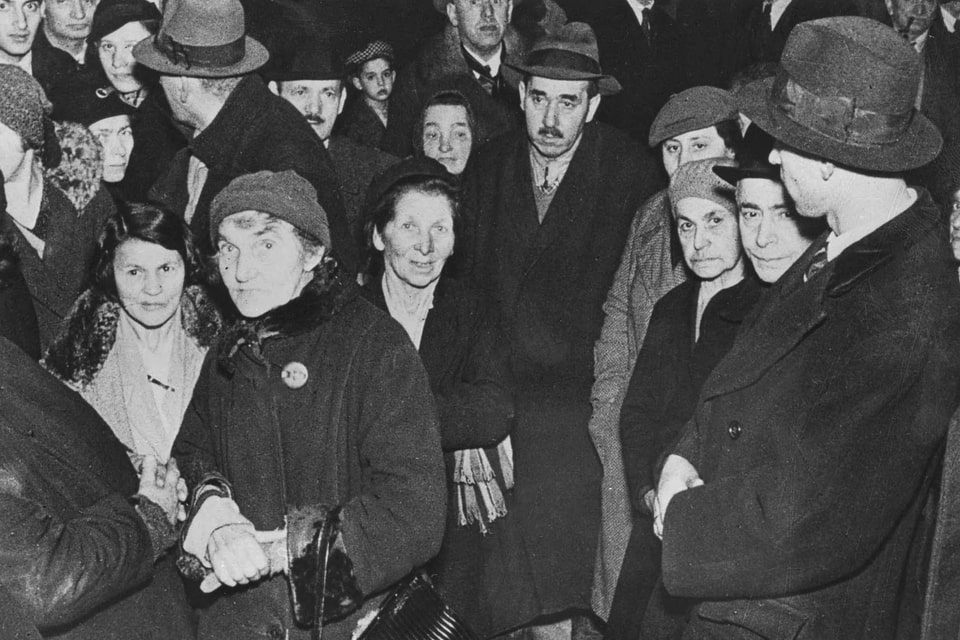
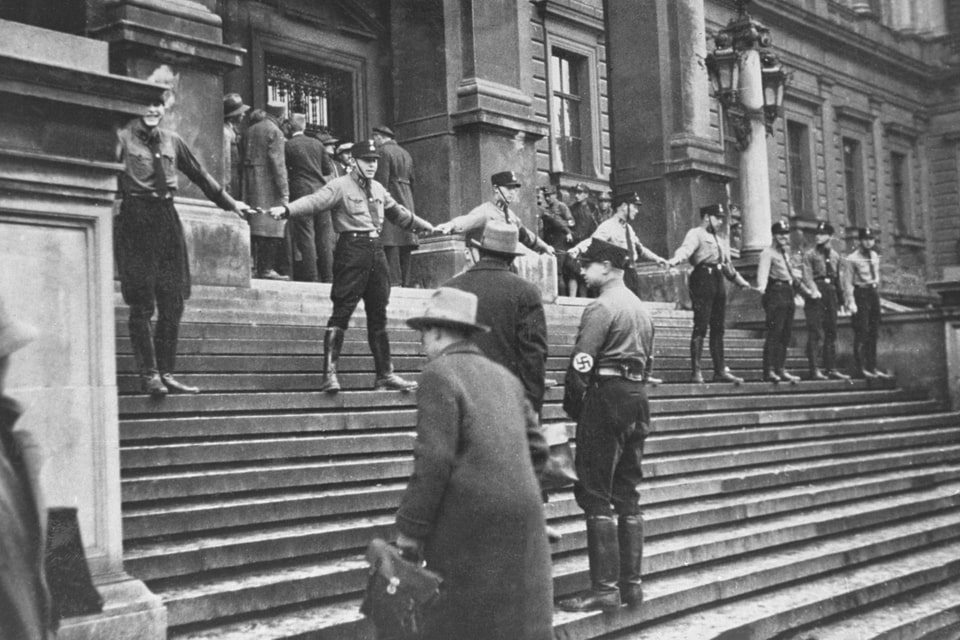
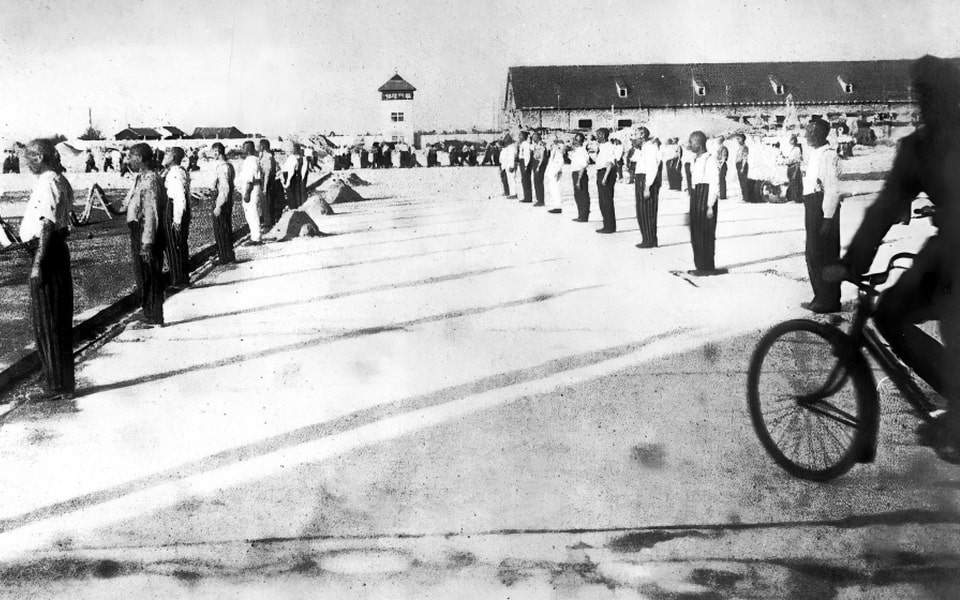
In contrast to German Jews, who had lived through the years of steady anti-semitism and anti-Jewish legislation after 1933, the life of the Austrian Jewish community changed instantly. The infamous Nuremberg Laws, that was adopted in the Reich in 1935, were extended to Austria as early as March 13, 1938, thus revoking the human rights of two hundred thousand Jews and making them a stateless group of people in their own country. From the first days, the Jews in Vienna became victims of open harassment and humiliation. Men and women, young and old, found themselves the targets of the German soldiers and the SA, but more often of the members of the Nazi organizations from Austria. People were caught on the streets or dragged from their homes and forced to perform aimless labor work, like washing streets, scraping pro-Austrian, pro-Schuschnigg, anti-Nazi symbols from pavement and buildings, and cleaning German barracks. The stalkers made their victims perform calisthenics for hours, or even eat grass; they cut the beards of Jewish rabbis and destroyed Torah books. Often, these acts of humiliation were unavoidable and spontaneous. One estimate shows that every tenth representative of the Jewish community in Vienna went through such a form of harassment in the first weeks after the Anschluss. While German Jews were scattered across a giant country, more than 90% of Austrian Jews were concentrated in one city, thus making them an easy target for dehumanization. As a result of the Anschluss, the Nazis gained control over 200,000 Jews, the same number of people whom they pushed to emigrate from Germany since 1933; thus, in their eyes, ‘the progress’ was nullified, and new measures were needed.
ADOLF EICHMANN AND THE ZENTRALSTELLE AT THE ROTHSCHILD PALACE
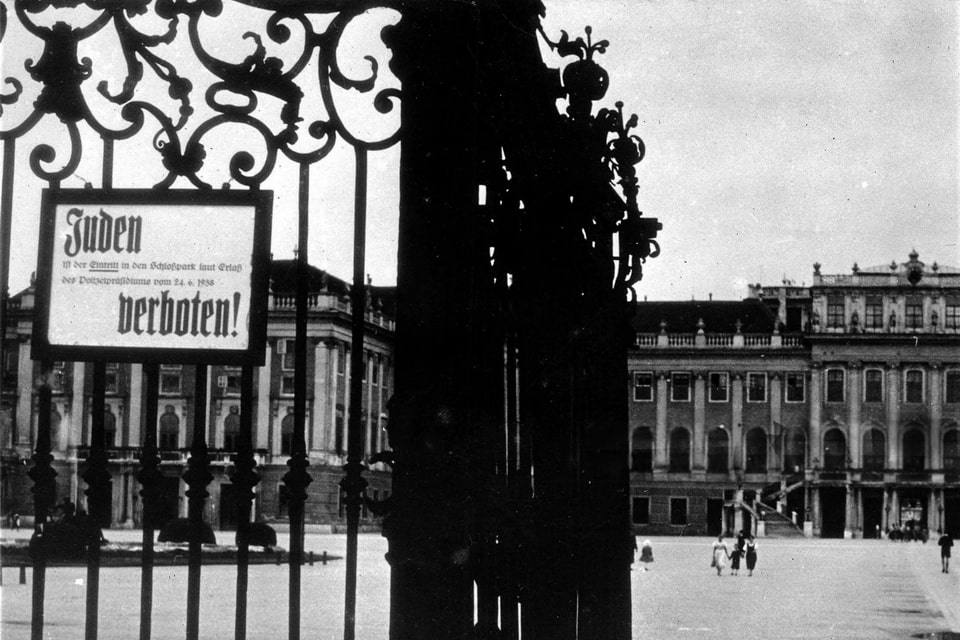
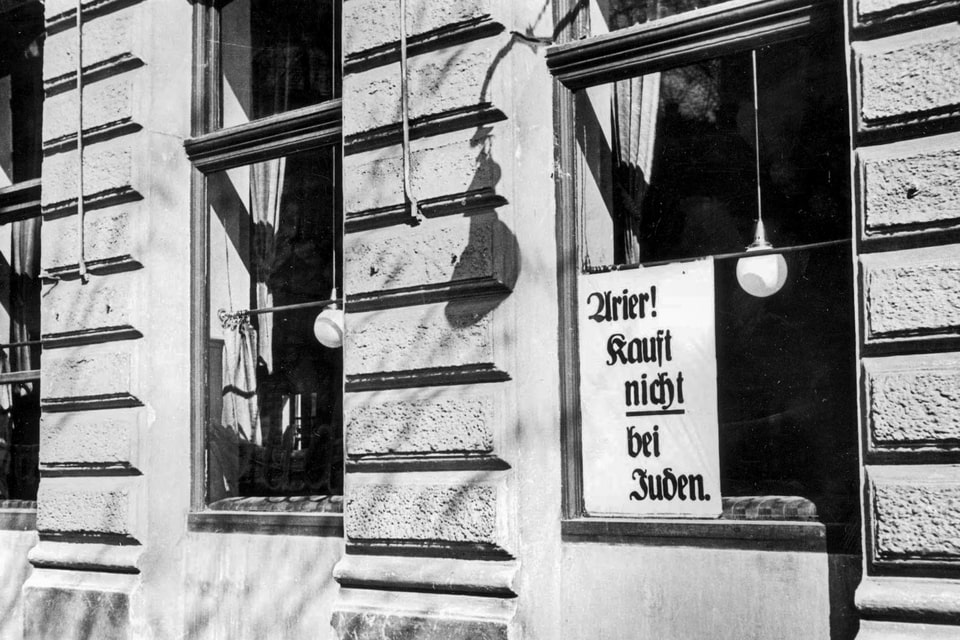
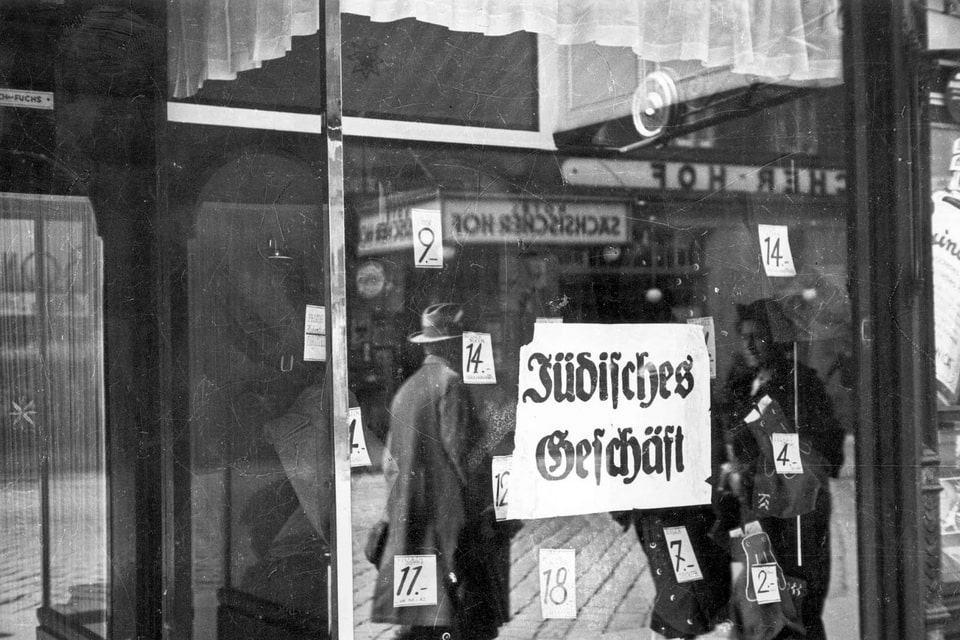
Public acts of harassment against accidental people on the streets were one form of humiliation and a new era of ostracism. Austrian Nazis and anti-Jewish sympathisers made pogroms of Jewish property by breaking glass in the shops and forcing business owners to paint humiliating or sarcastic inscriptions on buildings such as ‘Jews’, ‘Don’t buy from Jews’, or ‘On vacation in Dachau’. Other signs marked the ‘Aryan’ businesses, and the Austrian Nazis also marked some public places with humiliating slogans like ‘Only for Aryans’ or ‘No entrance for dogs, not for Jews’. Another form of separating Jews from other Austrians and depriving them of human rights was legislation and practice of forbidding the Jewish population from many professions, thus stripping people of the means for survival and of some purpose in their lives. In the first days after the Germans came, many Jewish workers were sent back home by their employers without final pay or an adequate explanation of whether they would be able to perform work again.
As early as March 15, 1938, only four days after the fall of Kurt Schuschnigg’s government, the newly appointed Nazi leader in Austria (Reichsstatthalter), Arthur Seyss-Inquart (1892-1946) issued a decree, which obliged all public officials in Ostmark (this is how Austria was now regarded in the Third Reich) to take a personal oath to Hitler to continue work. Since the Jewish officials were forbidden from giving an oath to Hitler, they were immediately moved from their positions. The same month, all Jews, even half-Jewish judges, were forbidden from office, and they were no longer allowed to work as notaries or lawyers. Apart from losing Jewish professionals as their defenders, the cases in the courts where one of the sides was of Jewish origin were often marked in such a way as to decide against them anyway, regardless of the pull of evidence and the pretext. By the end of March 1938, all professors, lecturers, and teachers were dismissed from their posts, and in April, Jewish youth were banned from studying in the universities and expelled en masse.
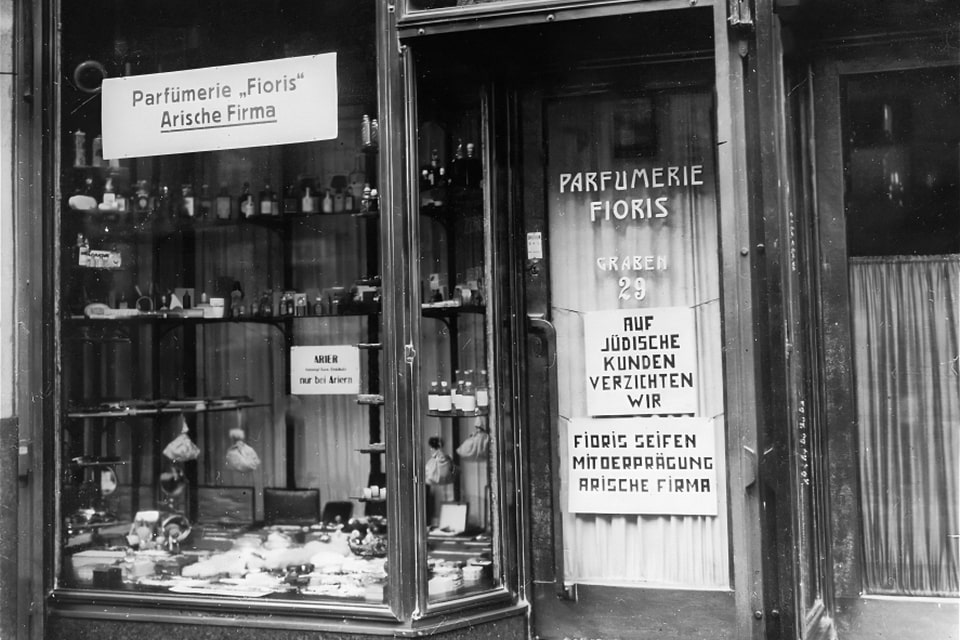
The list of professions now closed for Jews expanded to musicians, journalists, and actors. Throughout 1938, the puppet government of Seyss-Inquart adopted more than one hundred new anti-Jewish provisions, including the massive campaign of the so-called Aryanization of Jewish property from the previous owners, forbidding Jews to wear uniforms, own weapons, and banning Jewish press. People were defined as Jews or half-Jews based on the provisions of the Nuremberg Laws, particularly the so-called ‘Law for the Protection of Blood and Honour’, which clauses ignored the religious affiliation of a person and defined who was a Jew on a racial basis and ancestry. In August 1938, those identified as Jews but, according to the Nazi views, ‘with not recognizably Jewish names’, were obliged to add Israel for men and Sarah for women as their new middle names. In October, the passports of Austrian Jews were marked with the letter ‘J’ to make immigration and even travel inside the country more complex and dangerous. As a continuation of Aryanization, on November 12, a new decree banned the Jewish population from owning businesses and from practicing trade. Three days later, Jewish children were forbidden and expelled from public schools. Jewish doctors lost their licenses but were allowed to treat Jewish patients. Only two months after the Anschluss, around five hundred Jews in Vienna committed suicide.
It was in this atmosphere of the steady destruction of Jewish life in Austria that a thirty-one-year-old Adolf Eichmann (1906-1962) came to Vienna in the spring of 1938 and reshaped the whole practice of ‘solving the Jewish question’. A son in a family with strict protestant beliefs, Eichmann came to Austria with his family in 1914 when he was eight years old. His older friend, Ernst Kaltenbrunner (1903-1946), and the later head of the German SD (Sicherheitsdienst) brought Eichmann to the Austrian branch of the SS in 1932. After the ban of the Nazi party in Austria in 1933, Eichmann came back to Germany and was transferred to the Jewish department in the SD, where he soon gained a reputation as an ‘expert on Jewish matters’. Adolf Eichmann was promoted to the rank of SS-Untersturmführer (second lieutenant) on November 9, 1937, and in Berlin, he worked under Herbert Hagen (1913-1999), who was seven years younger than Eichmann. Hagen was assigned as the head of SD Department II–112, a branch of the SD Main Office of the Reichsführer SS responsible for dealing with the Jewish organizations.
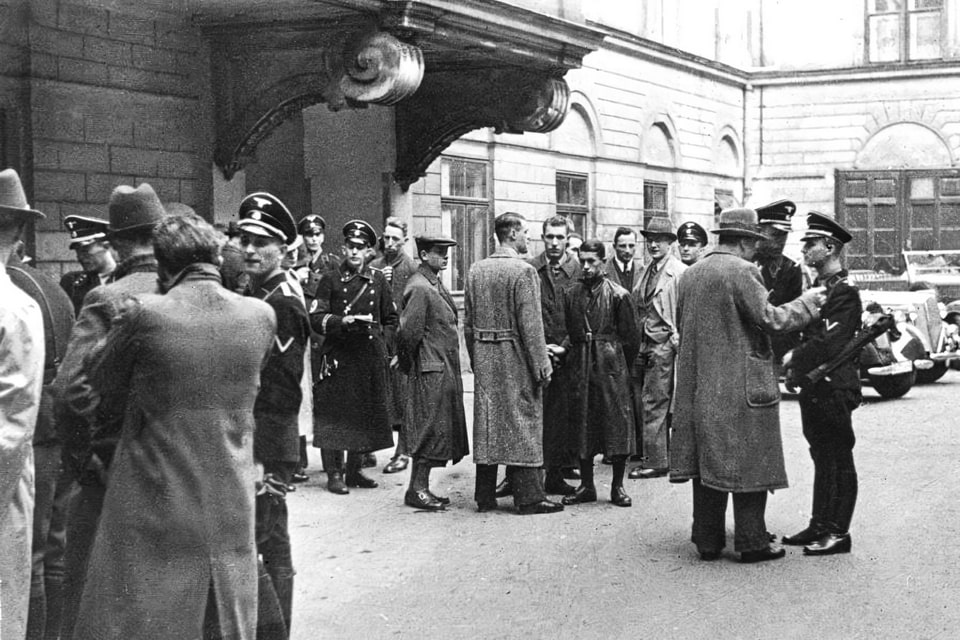
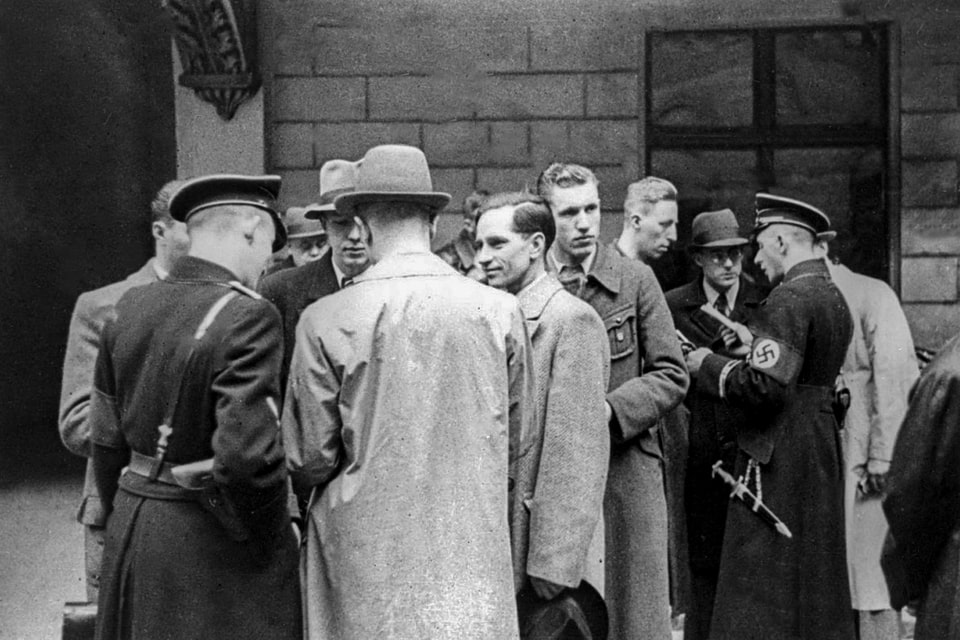
The central office of the Jewish Community in Vienna (Israelitische Kultusgemeinde) was raided as early as March 16, and two days later, a more centralized action took place. Despite Adolf Eichmann’s later testimonies that he came to Vienna after the raid and immediately released the imprisoned Jewish leaders, he actually arrived in the city on March 16, two days before, and on March 18 participated in the operation with his boss, Herbert Hagen. On that day, the special unit of the SD, which was brought from Berlin to Vienna, arrested Desider Friedmann (1880-1944), the President of the Israelitische Kultusgemeinde since January 1933. On April 1, 1938, he was sent to Dachau concentration camp, spent the next six years in other camps, including Theresienstadt, and was killed in Auschwitz in 1944. Also, Friedmann’s deputy and fervent zionist, Robert Stricker (1879-1944), and another vice president, Josef Ticho, were arrested. The third vice president arrested was Josef Löewenherz (1884-1960), a skillful organizer. Another Jewish leader, a target of the March 18 raid, was Jacob Ehrich (1877-1938), a municipal councillor and the representative of the Jewish community in the city’s government. In contrast to the previously mentioned Jewish leaders, he died in Dachau a few weeks after his arrest from beatings, and his body was returned home in a sealed coffin.
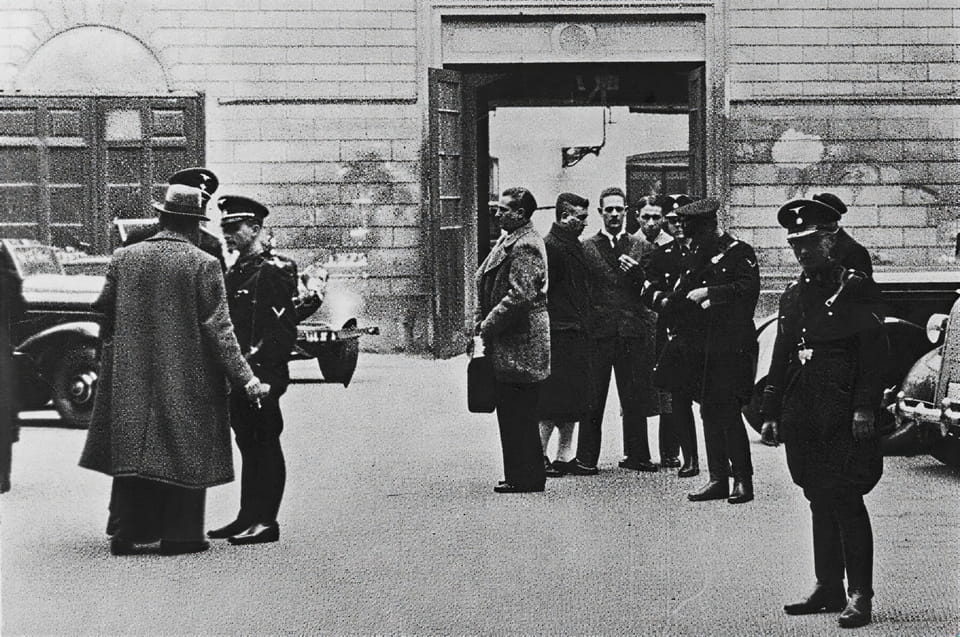
Initially, the Nazis decided to dissolve the Kultusgemeinde institution, but with time, Eichmann changed his plans. After Hagen came back to Berlin, Eichmann took the role of the head of the SD Department II–112 branch in Vienna and of its staff. On March 25, 1938, he summoned eighty representatives of all major Jewish organizations that existed in the city before the Anschluss. The meeting took place in the building of the former preparatory school for Jews aiming for emigration to Palestine on Marc-Aurel-Strasse 5 in the city center, not far from Maria am Gestade church. There were no chairs in the large room, except one for Eichmann, who sat at the desk and received reports from the summoned Jewish leaders, those who had not been previously arrested. In contrast to the harassment acts on the streets originating from the mob, Adolf Eichmann had a more centralized and calculated agenda of expelling Jews from Austria and further from the Third Reich to other countries. These eighty functionaries were given three days to submit written suggestions regarding the possible reinstallation of the Jewish community in the city. On March 29, 1938, Eichmann formulated his approach of removing the Jews from the German Reich by encouraging them to emigrate and the need to reestablish a centralized Jewish organization to operate the process. He sent his considerations to Berlin to the head of the Security Police, SS-Gruppenführer Reinhard Heydrich, who approved Eichmann’s approach.
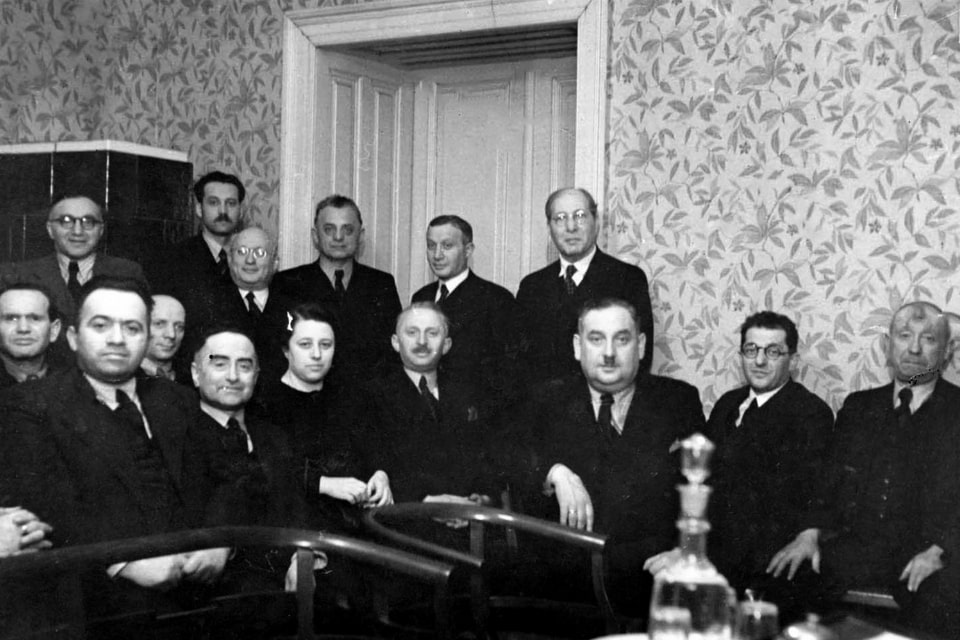
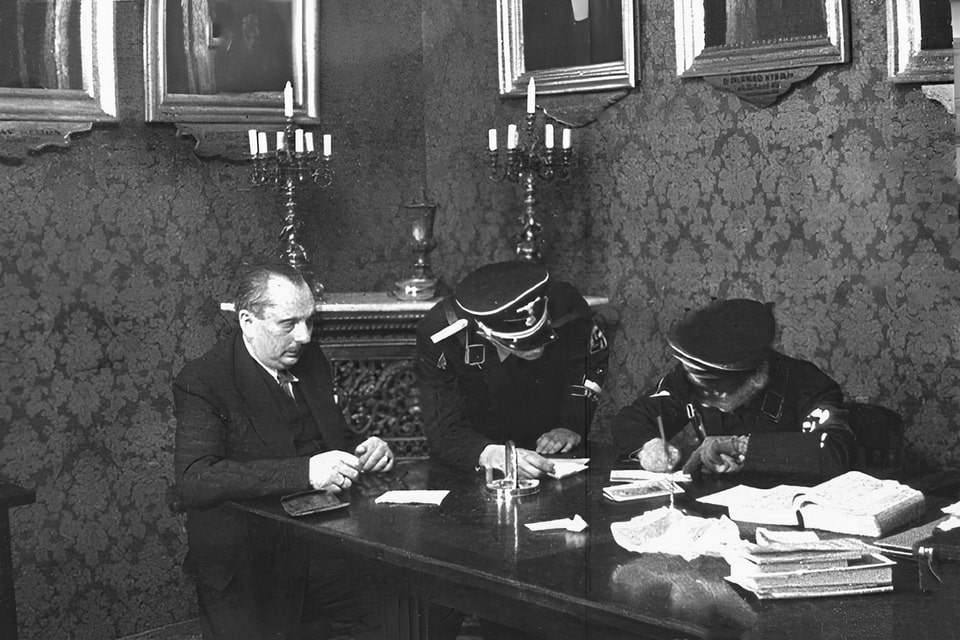
Despite being a proponent of anti-Jewish genocide and an anti-semite, Adolf Eichmann was an extremely pragmatic bureaucrat, and his ‘banality of evil’ lay in meticulously structured work. He summoned Alois Rothenberg, a dedicated zionist and a former head of the Palestine office, and ordered him to prepare the reestablishment of the institution. Along with that, on April 20, ten days after the notorious Anschluss referendum, Eichmann ordered the release of Josef Löewenherz, whom he considered a new temporal leader of the Jewish community. On the same day, ‘Reichsvertretung der Juden in Deutschland’ (Reich Agency of Jews in Germany), the still-existent Jewish umbrella organization in Germany, proposed their plan for reestablishing welfare for the Jewish community in Austria with a further focus on immigration to Palestine and other countries. In early May, Eichmann allowed Josef Löewenherz and other prominent Jewish leaders to reestablish the Jüdische Gemeinde Wien (Jewish Community of Vienna), a new name for the more established Israelitische Kultusgemeinde Wien or simply IKG.
Only 4,710 Jews left Austria in the first one and a half months after the Anschluss, and Adolf Eichmann regarded this figure as too low. His instruction to Löewenherz was to work out a plan for pushing at least 20,000 Jews to emigrate from Austria by the end of 1938. He clearly understood that the systematic, well-organized process of immigration was possible only with the assistance of the Jewish organization and its leaders. Thus, starting from May 1938, the former IKG was no longer an independent body with freely elected leaders, but an instrument for Nazi bureaucrats like Adolf Eichmann in the pursuit of making Austria ‘Judenfrei’ (Free of Jews). As for Josef Löewenherz, he now occupied several positions and was the sole leader responsible for the fulfillment of any task given by the Nazi authorities. Eichmann clearly understood that most of the Jews in Austria and particularly in Vienna were frustrated and frightened, and possible immigration was an obvious choice for many.
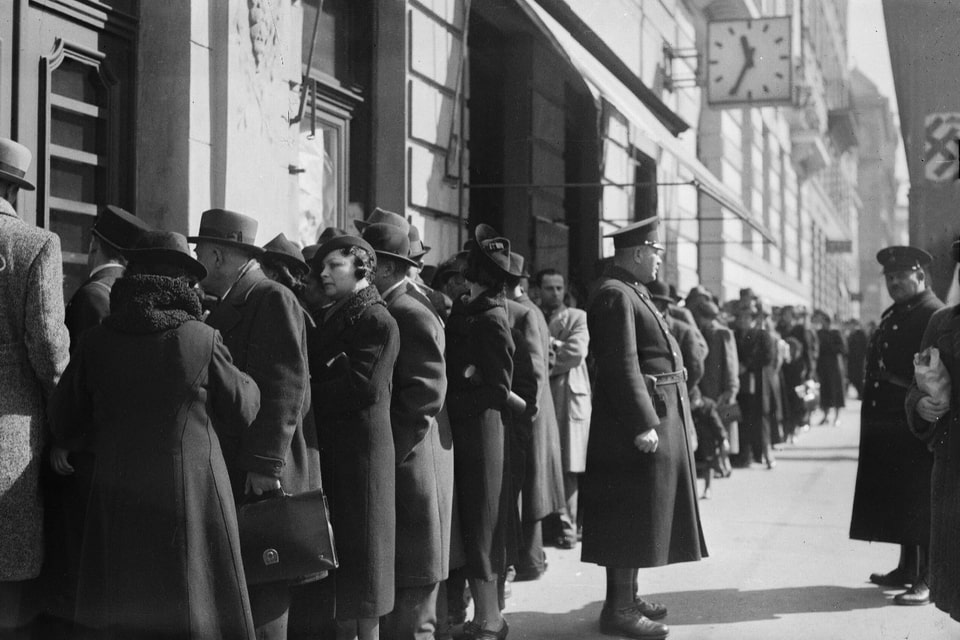
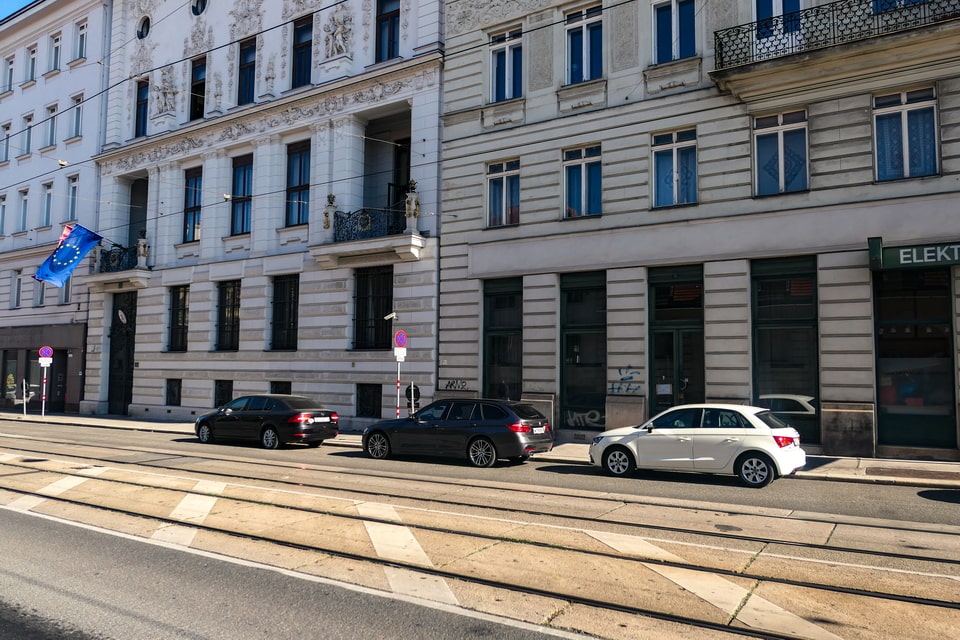

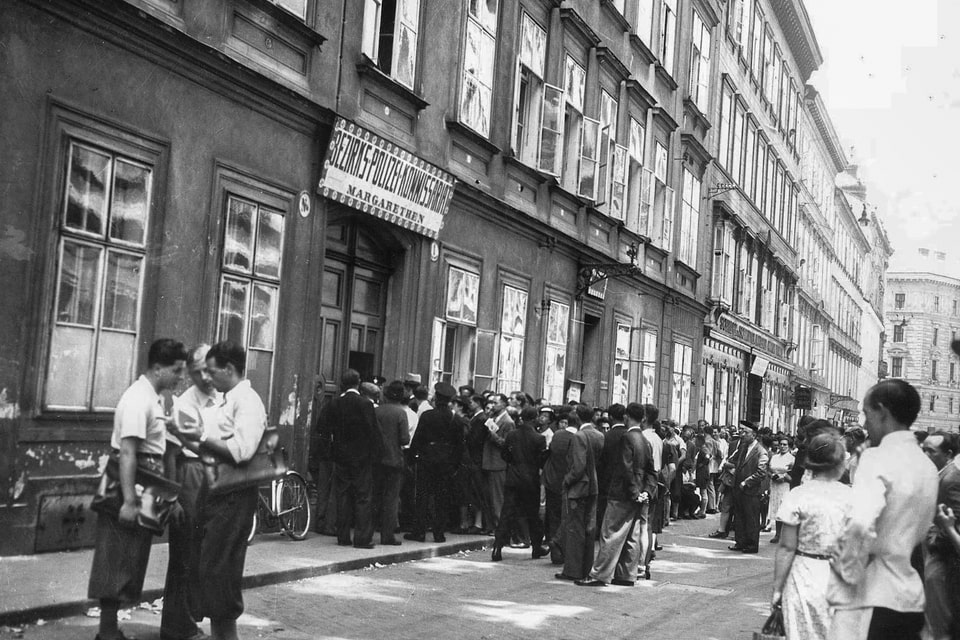
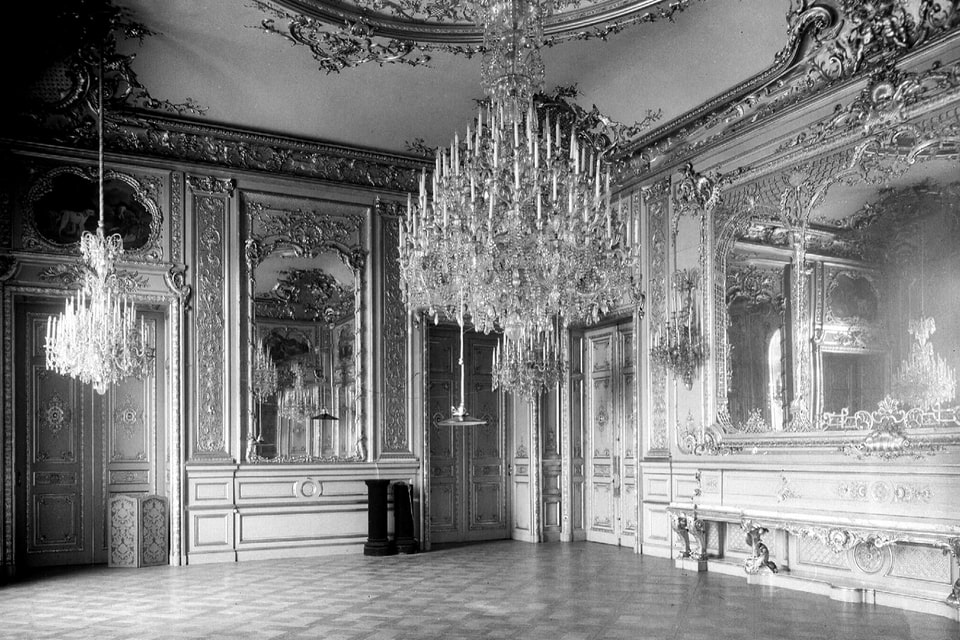
Only three months after the reestablishment of the Kultusgemeinde, in August 1938, the Jewish leaders followed the orders and close supervision of Eichmann and opened a separate organization called ‘Zentralstelle für jüdische Auswanderung’ or simply ‘die Zentralstelle’ (Central Office for Jewish Emigration or simply ‘Central Office’). The office was opened on August 20, accommodating Rothschildpalais (the Rothschild Palace), a magnificent palace of the famous Jewish Rothschild family built in 1876 on Prinz-Eugen-Straße 20-22 in the city’s fourth district. The property was previously expropriated by the Nazis from Louis Nathaniel Rothschild (1882-1955), whom they arrested in 1938 for a year and later released from the country for a large ransom equivalent of 20 million dollars. The ‘Central office’ was organized to carry on all affairs related to the expulsion of the Jewish population from Austria. This invention of Adolf Eichmann would later be adopted by the Nazis through the establishment of similar offices in Prague and Amsterdam. Eichmann was sent to Prague, since after the occupation of the Czech Republic in 1939, around 125,000 Jews found themselves under Nazi control in the so-called Protectorate of Bohemia and Moravia, and the regime wanted to get rid of them. Die Zentralstelle ensured that all organizations worked closely to speed Jewish emigration from the country in an organized and manageable manner. Putting different offices in one building simplified the process of getting different documents for a potential emigree. A hope of rescuing as many Jews as possible from the Nazis encouraged the Jewish leaders to work hard on the emigration policy.
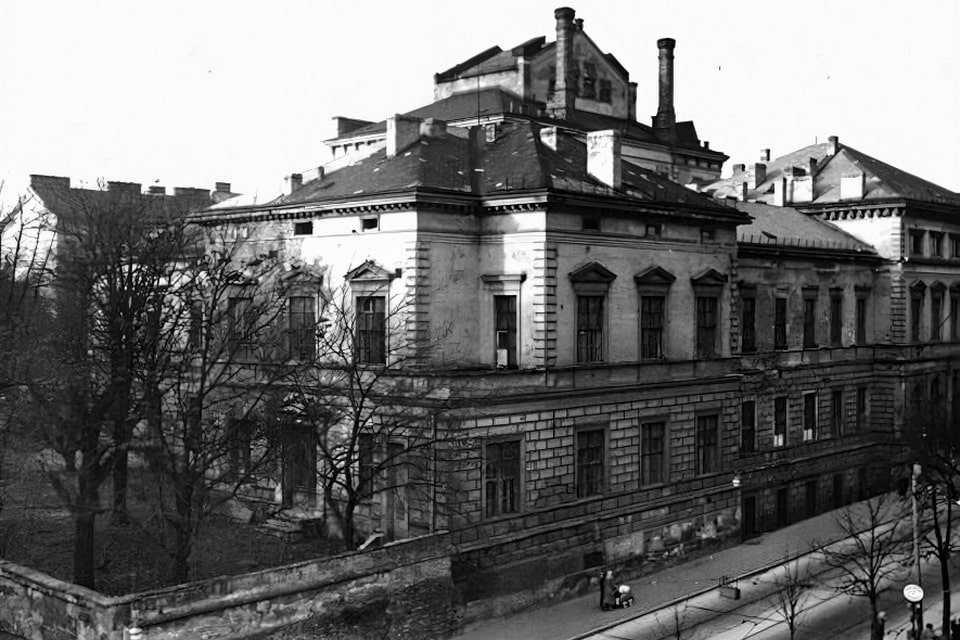
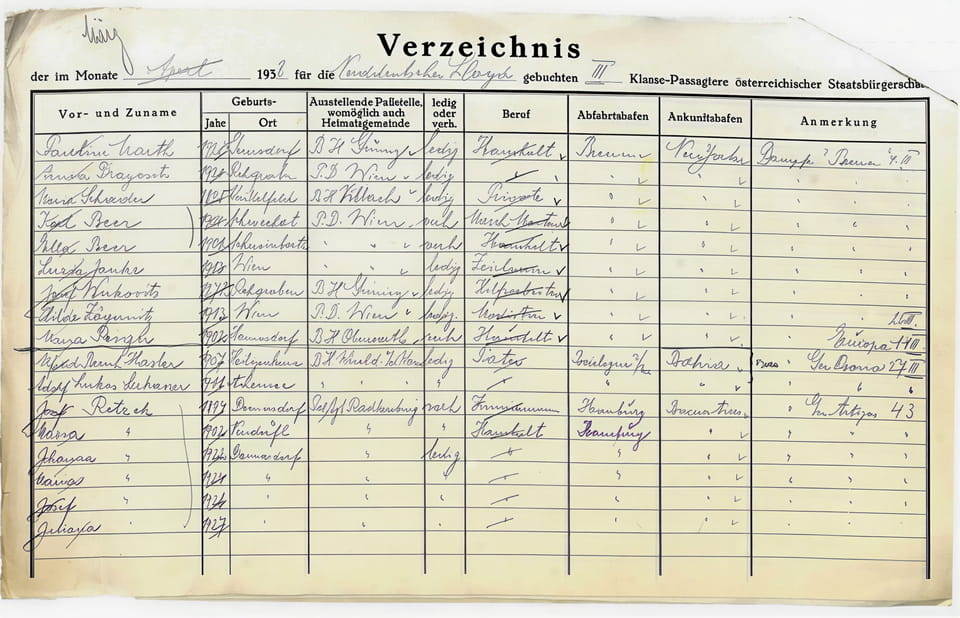
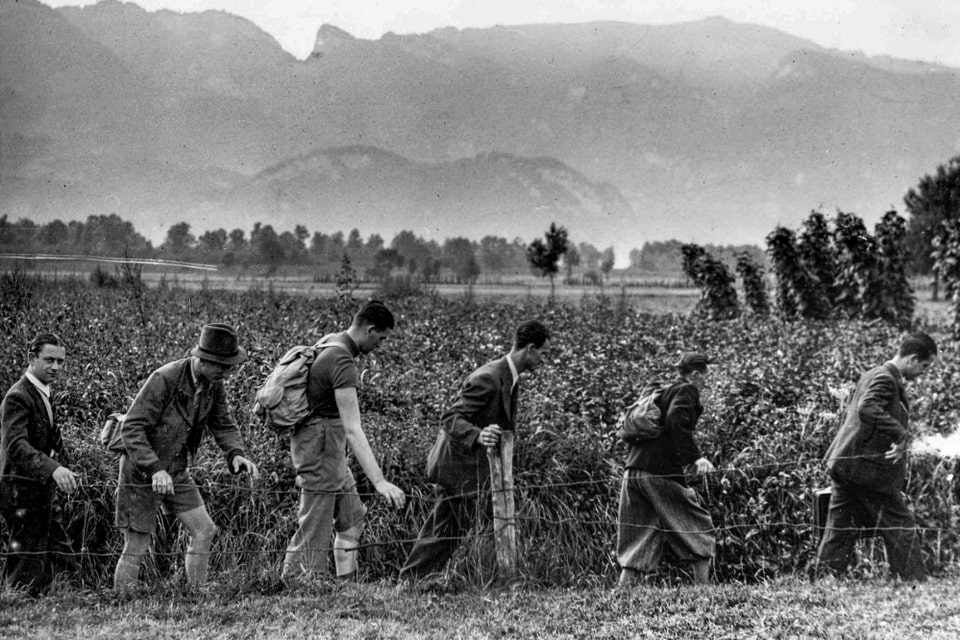
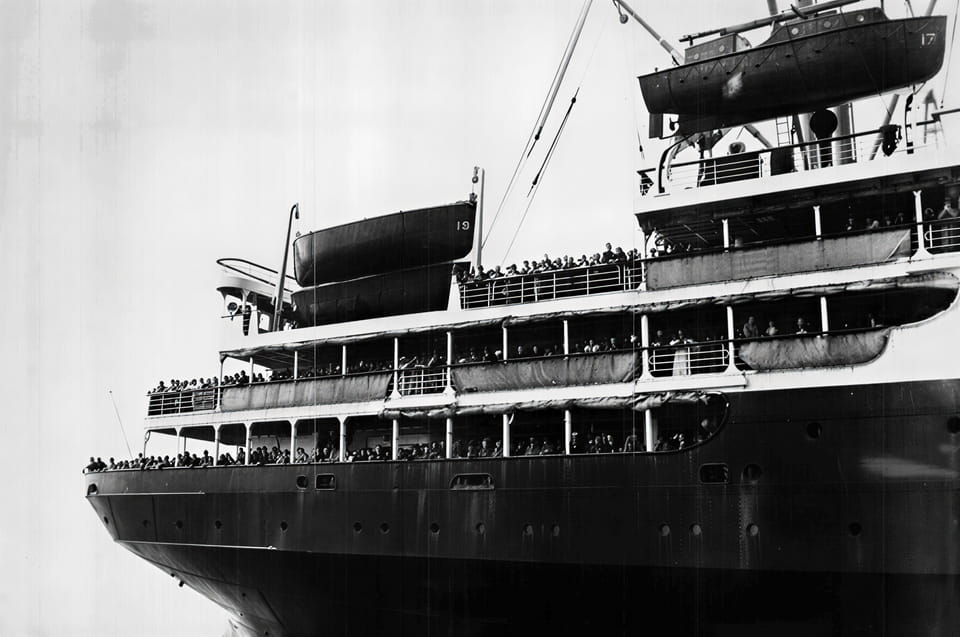
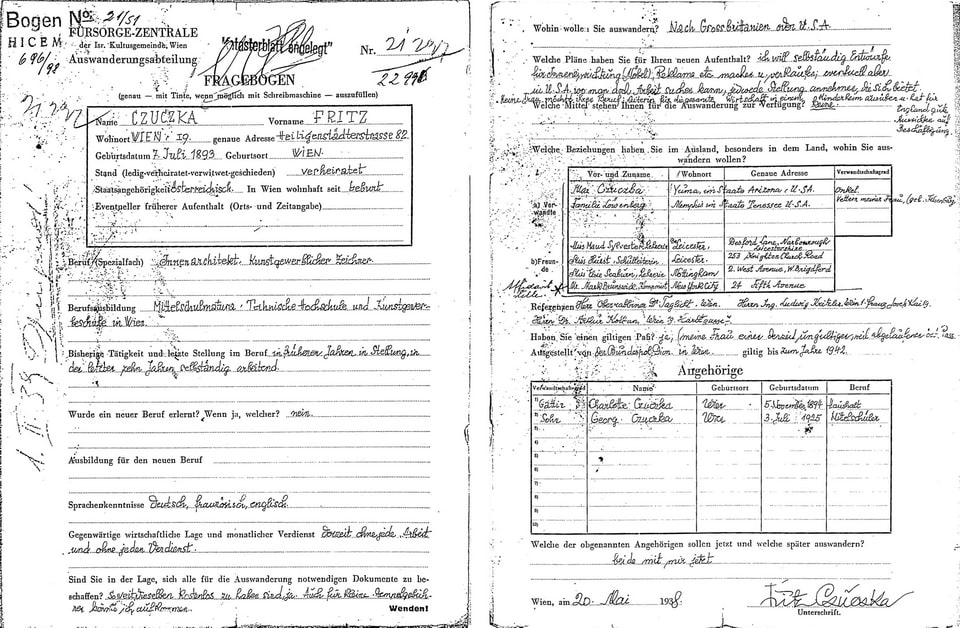
To facilitate the mass emigration, the IKG established free educational courses for the members of the Jewish community, which supplied them with useful information regarding procedures and documents needed for a particular desired destination. By July 1939, around 24,000 attended such courses, generally funded at the expense of donations from abroad. Apart from information, people retrained themselves to be able to work in specific spheres, mostly labor professions like industrial workers, farmers, chauffeurs, and others. By October 1938, as many as 117,979 people registered themselves for emigration, of which 63,134 or 53% were men and 47% or 54,845 were female. The top countries where people wanted to emigrate from Austria were the United States, Palestine, England, Switzerland, Argentina, Czechoslovakia, France, Italy, Luxembourg, and even China.
THE NOVEMBER POGROM IN VIENNA: 42 SYNAGOGUES BURNED IN ONE NIGHT
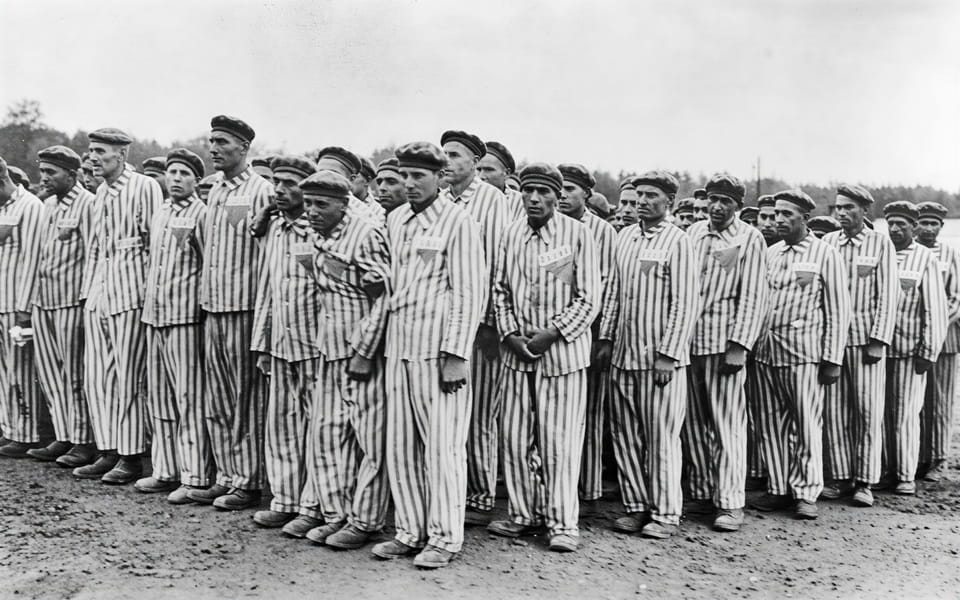
The harassment actions in the streets and the ordered arrest of the Jewish leaders in the first weeks after the Anschluss were only the first wave of violence and terror against the Jewish population of Vienna. The destination for the first transports from Vienna to concentration camps was Dachau. A year before, the first Nazi concentration camp witnessed an expansion ordered by Reichsführer Heinrich Himmler, which turned Dachau into a centralized place for political prisoners and Jews, a ‘model camp’ for other KL of the regime. The first transport from Vienna to Dachau departed on April 1, 1938, with 151 deportees on board, mainly former politicians, opponents to the regime, intellectuals, and community leaders, of whom sixty were Jews, including the former leader of IKG, whom I have mentioned above. Because of the high status of the prisoners, this action and transport became regarded as ‘Prominententransport’ (vip transport). The second wave of raids and arrests came in late May, which resulted in sending another two transports to Dachau on May 31 and June 3, each carrying approximately six hundred men. New trains followed on June 15 with 24 prisoners, 96 people were sent on June 17, another 330 on June 24, and 155 the next day, June 25.
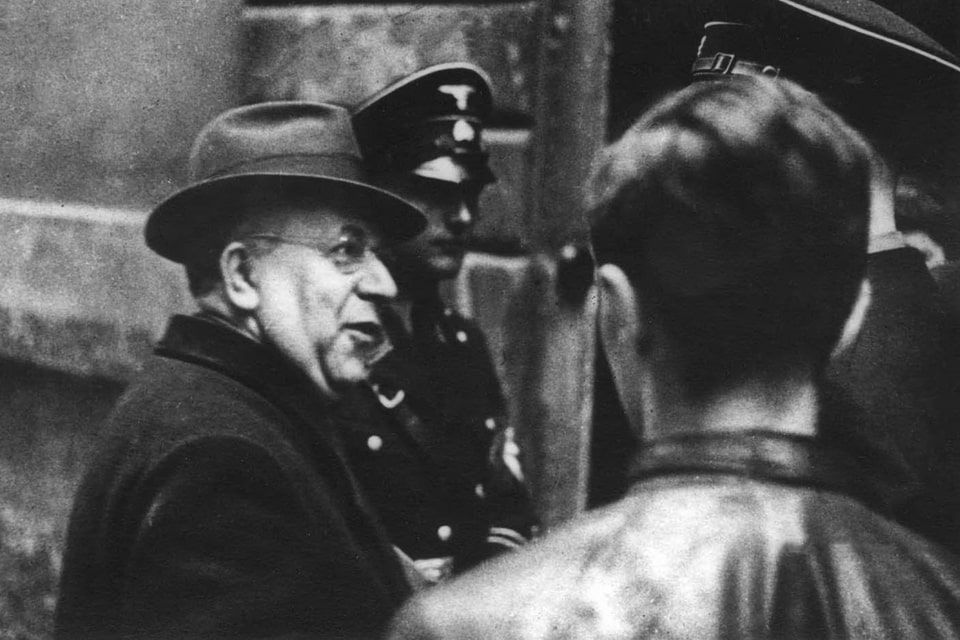
These arrests and deportations in April-June 1938 increased the feeling of insecurity and anxiety among the Jewish community in Vienna. While early arrests were motivated by the government status of the deportees, the following raids often became random and did not give a strict explanation of their nature or the reason why this or that person was caught and deported. As early as May 24, 1938, the Austrian Gestapo headquarters, located in the former Hotel Metropole on Morzinplatz (confiscated from the Jewish owners and operational since April 1 with staff mostly recruited from Austrian policemen and Nazi sympathizers, up to 900 men in total), distributed a circular (Schnellbrief) to all police district headquarters in Vienna. It permitted the arrest and sending to Dachau ‘undesirables’ among the Jews, especially those people who previously had criminal records. The focus was on Jewish men under fifty years old without severe health issues. After the arrest, Jews were questioned according to a special questionnaire and were taken to the improvised prison on Karajangasse. The Gestapo turned a building of a gymnasium on Karajangasse 14 near the Augarten park in the Brigittenau district into a temporary jail for those sent to Dachau. They brought people here in dark, covered police wagons. As I stated above, these measures resulted in the deportation of around 1800 Jewish people from Vienna in May-June 1938.
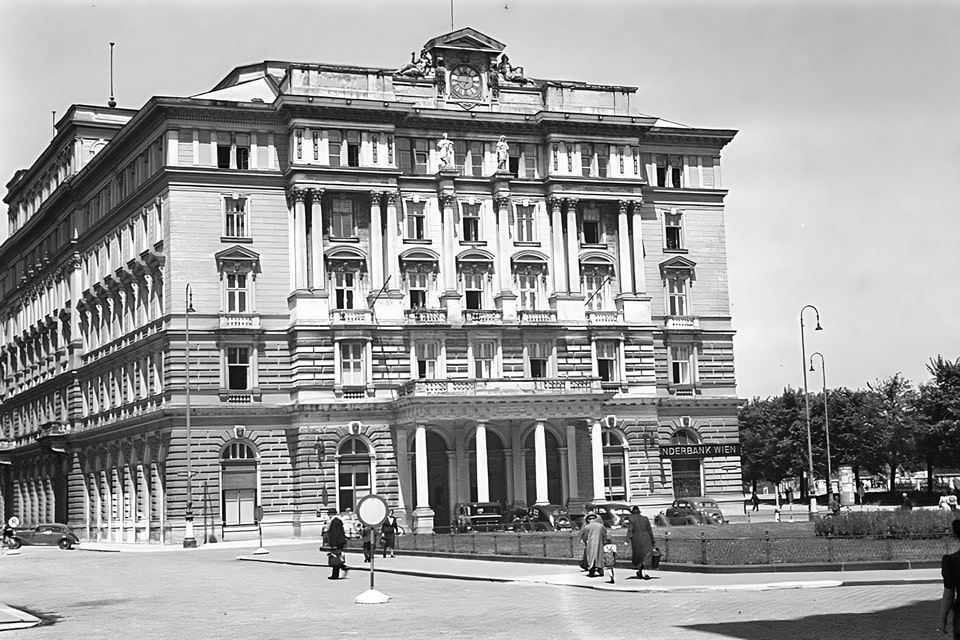
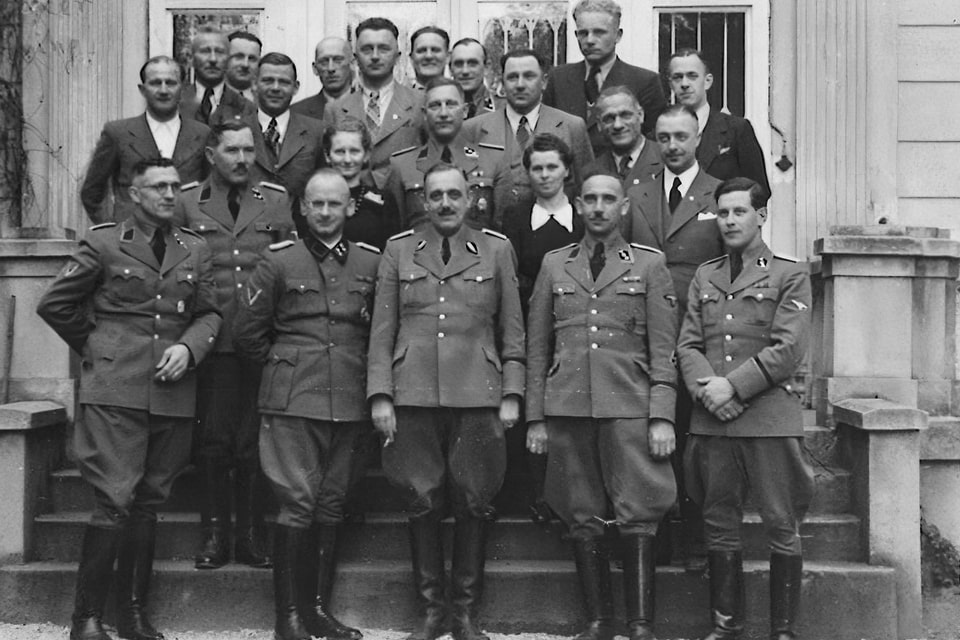
When deportees arrived at Dachau, 420 km to the West of Vienna, thus leaving Austria, most of them were already exhausted by days of detention and interrogation. Men got no answers from the Austrian police or Gestapo officers regarding the reason for their arrest and their future. In wider terms, stripping these people of their civil and human rights began with Anschluss, then extended to their homes and streets of Vienna, continued in the police stations and a temporary detention center, and climaxed in the deportation trains to Dachau. At the time, a train journey from Vienna to Dachau took six hours, but the journey for the deported lasted twice as long. Those trains were not yet cattle wagons but third-class passenger trains, but deportees were cramped into the compartments of up to twelve men in each. On September 4, 1938, the head of the Security Police, SS-Gruppenführer Reinhard Heydrich, admitted that there were 1,142 prisoners still held in ‘Schutzhaft’ (protective custody – another Nazi euphemism), thus referring to people arrested and held without formal charges or trial, of whom most were Jewish.
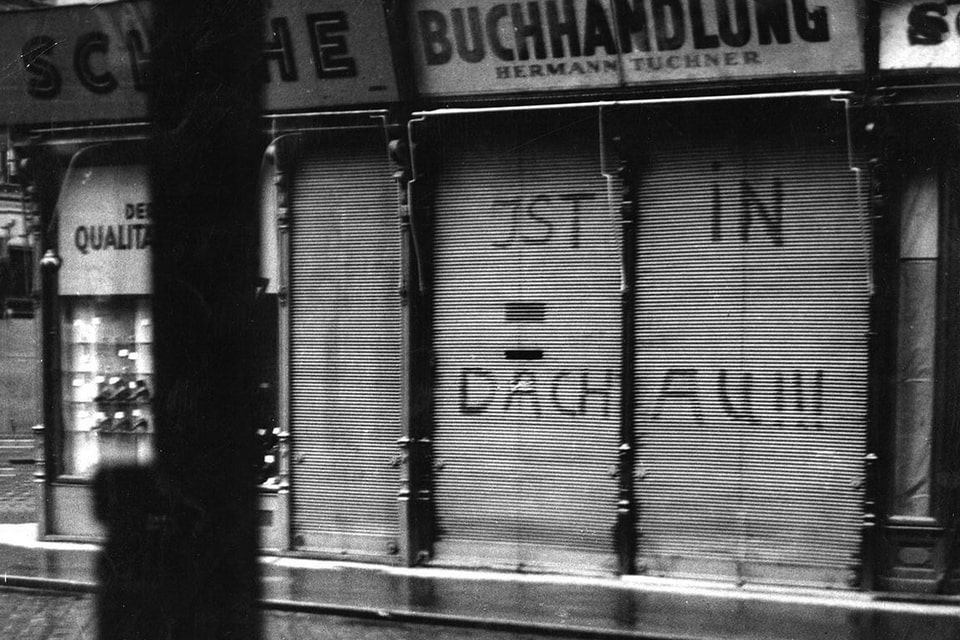
Getting back to the Eichmann plan and the IKG’s obedience to support the mass emigration of Jews from Austria, the Jewish organizations directed their efforts to securing emigration possibilities for people who were now in emotional turmoil as a reaction to the raids and arrests, and the adoption of anti-Jewish legislation. In the initial phase of March-April 1938, before the reestablishment of the Jewish Community of Vienna, 4,700 Jews left Austria. In May, the figure was 3,668, and in June, after the mass arrests and deportations to Dachau, the number jumped to 8,034 emigrants, then rose to 8,804 in July and saw another peak in August (when the ‘Central office’ was opened) with 9,729. Of the 11,707 emigrants in May and June, 2,161 or 18% received financial aid from IKG. This includes covering the landing fees and buying train and ship tickets for immigrants. On August 3,422 persons, or 35%, received aid.
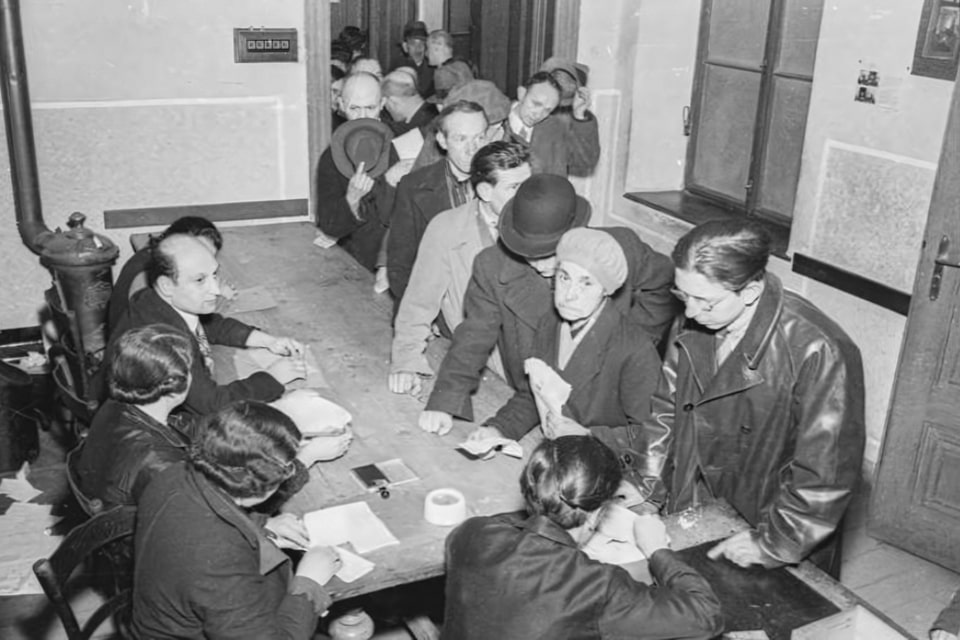
The United States was the most desired destination for the Austrian Jews, but the US quota for 1938 provided only 1,413 slots, while the number of applicants in the first month after the Anschluss amounted to 25,000 people. In April 1938, the quota for Austrians was combined with Germany and totaled 25,957, which gave Jews born in Austria more chances for getting a permit to leave for the United States than Jews born elsewhere. Apart from the top destinations, Austrian Jews also opted for Mexico, Morocco, Egypt, Cuba, Costa Rica, Peru, Haiti, and Panama. Unfortunately for the German and Austrian Jews, the so-called Evian conference, which summoned delegates from thirty-two countries in the French town of Évian-les-Bains between July 6 and 15, 1938, brought poor results in expanding the existing quotas of different countries to receive immigrant Jews. Most of the countries, including the USA, England, Canada, and Australia, left their quotas unaltered, and thus, the emigrants now had to invest even more effort to leave Hitler’s Third Reich. Only the Dominican Republic offered to accept up to 100,000 refugees, but only slightly more than 600 arrived there in the coming years. In total, 117,409 Jews left Austria by December 1939, and 136,000 by the end of 1941.
A new turn of the situation for the Viennese Jews for the worse and for the Jewish population in Germany and Austria actually happened in November 1938. The Nazis used the pretext of the murder of Ernst vom Rath (1909-1938), a minor German diplomat in Paris, to stage nationwide pogroms against Jews. Rath joined the NSDAP in 1932, the SA a year later, and as a career diplomat, worked in the German embassy in Paris since 1935 in a minor position as a third secretary. On November 7, he was shot five times by a seventeen-year-old Polish-German Jew, Herschel Grynszpan (1921-1945), and died two days later in the late hours of November 9. Within a few hours, the regime orchestrated a mass ‘retaliation’ aimed at the Jewish population throughout the Third Reich. Within two days, the Nazis arrested up to 30,000 innocent people, mainly men of Jewish origin, and sent them to ‘protective custody’, a euphemism for concentration camps such as Dachau, Sachsenhausen, and Buchenwald. Synagogues and prayer houses, businesses, private property, and homes of the Jewish population were attacked. In Germany and Austria, more than 7,000 Jewish businesses were burned or damaged, along with 1,400 synagogues. In Vienna alone, the violence of Kristallnacht resulted in the arrest of 7,800 men, the devastation of forty-two synagogues and prayer houses, and damage or closure of 4,000 businesses owned by Jews. In total, between March and November 1938, more than 7,000 Jewish men were sent from Vienna to Dachau, of whom around 5,000 were released until March 1939 due to the combined efforts of IKG and their relatives.
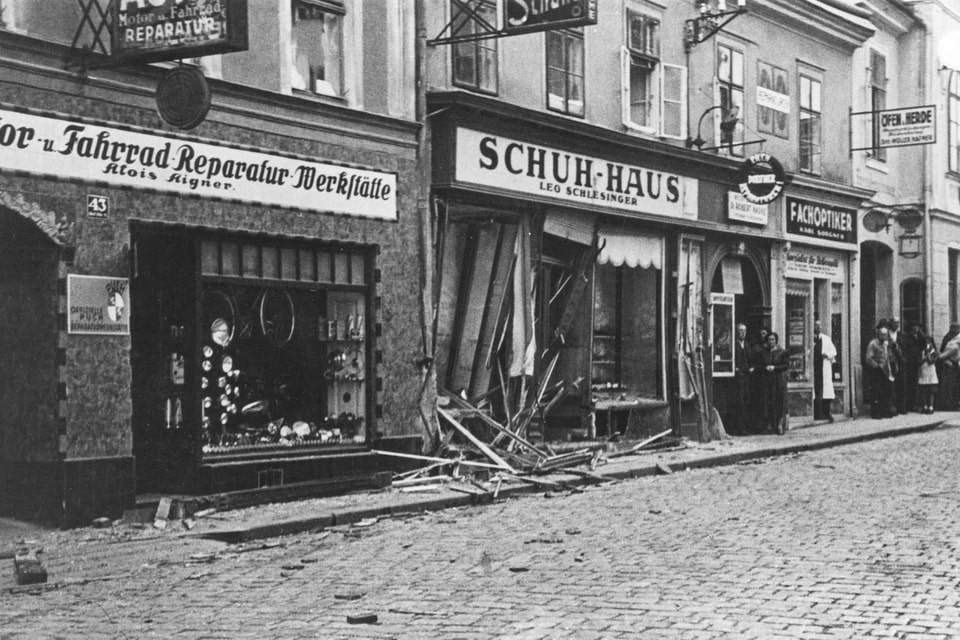
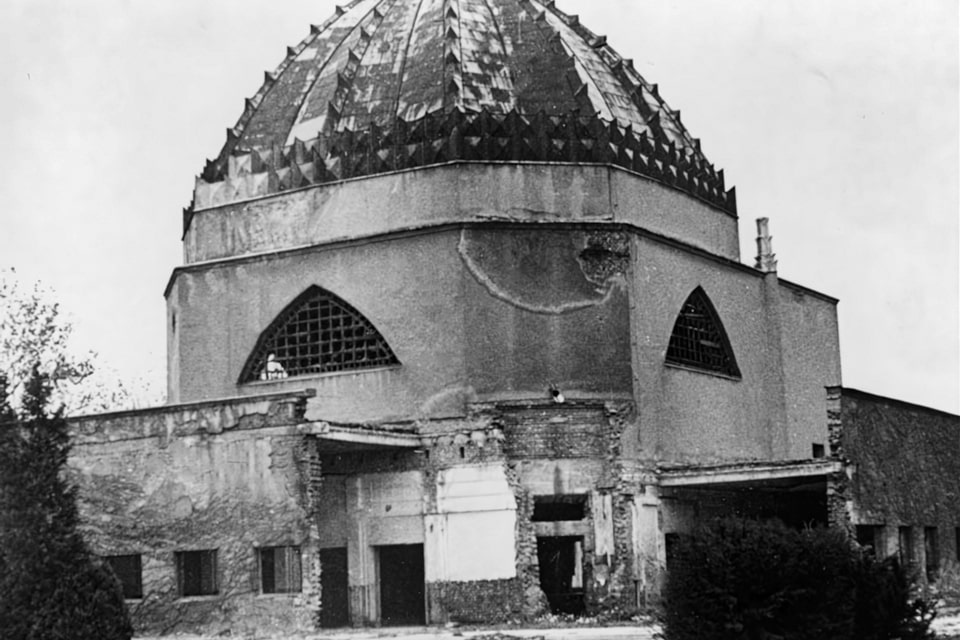
THE FIRST DEPORTATIONS, 1939–1941: NISKO, KIELCE, RIGA
A new bad turn in the fate of Austrian Jews came in September 1939 with the German invasion of Poland and the start of a new European war. By the start of the war, 66,940 registered Jews still lived in Vienna, of whom 39,238 were men, 27,702 were women, and two-thirds of these people were over forty-five years old. Between September 9 and 11, the streets of Vienna witnessed the arrest of 1,408 Jewish men who had Polish citizenship, current or past. The men, many of whom were old or under eighteen years old, were taken to the Praterstadion in the Leopoldstadt district and imprisoned under the grandstand for three weeks under the order of Reinhard Heydrich. On September 30, 1,038 were sent to Buchenwald, of which only 44 were released, and probably only 26 of the remaining were still alive in 1945. Two-thirds of the initial 1,038 died in the first few months in the camp. For the Nazi regime, the occupation of Poland gave them a long-anticipated exercise ground for racial experiments and unseen violence, which had a prolonged effect on the fate of the Jewish population in Germany and Austria. A smaller number went in the other direction, to a camp inside Austria itself. Mauthausen, opened near Linz in August 1938 — five months after the Anschluss — became the central concentration camp of the annexed country.
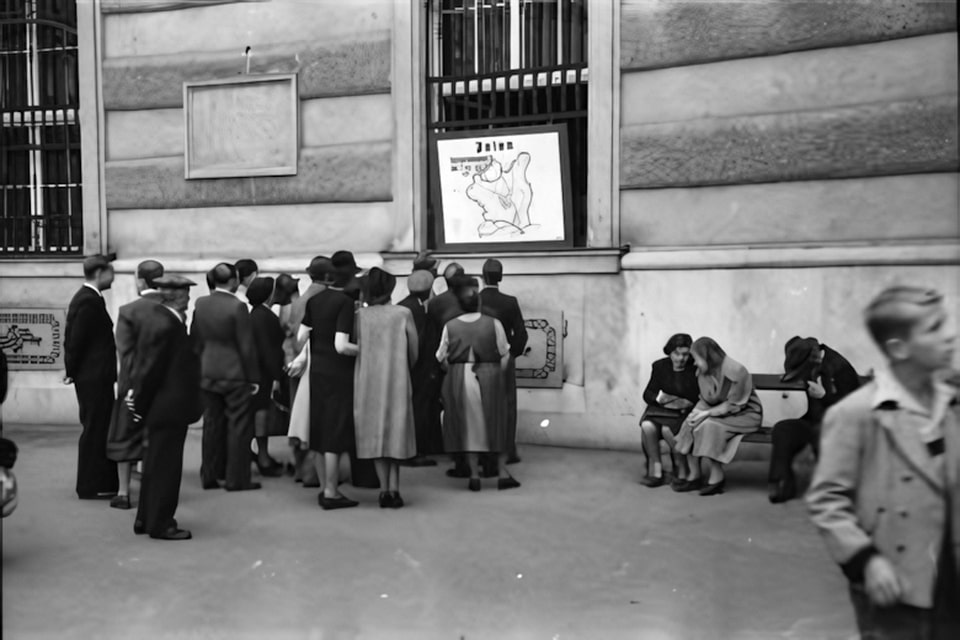
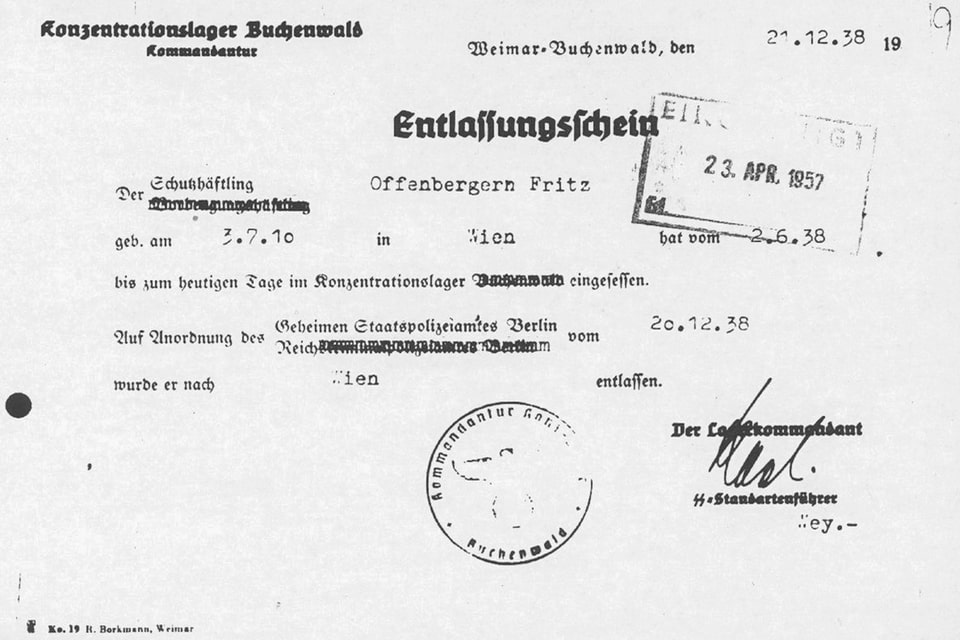
The third wave of deportation from Vienna was initiated on September 9-11 and continued in October 1939 as a result of the so-called ‘Nisko plan’. The Nazi ideologists formulated the grand idea of creating ‘Judenreservat’ (a Jewish reservation) in the East in late summer 1939, and it took a finished form in September after Poland was divided between Hitler’s Germany and Stalin’s Soviet Union. Among the architects of the creation of the reservation, a special area for resettlement to the southeast of the city of Lublin was Adolf Eichmann, who at that time had already left Vienna for Prague, where he headed the ‘Central Office for Jewish Emigration’. It was Eichmann who extended the initial targeted groups of Jews to be deported to include the Jewish population from the Protectorate of Bohemia and Moravia and Vienna, two areas best known to Eichmann. A special transit camp was set in the town of Nisko, south of Lublin, which gave the operation its name. Apart from mass immigration, Eichmann considered creating the so-called ‘Jewish reservations’ in the East a possible ‘solution of the Jewish Question’; at that time, this was not yet an ‘Endlösung’ (Final Solution).
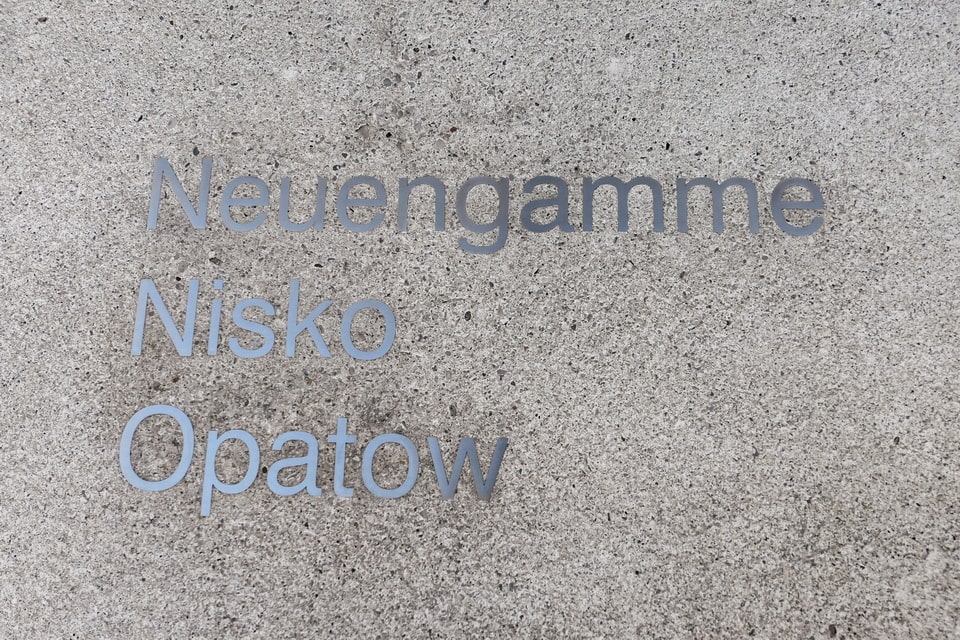
Viennese Jews were not the first to arrive in Nisko, since the first transport came on October 19, 1939, and these were Jewish men from the Czech city of Mährisch-Ostrau, a large industrial center, whose pre-war population included around 5% of Jews. The first 901 men brought here were ordered by Eichmann personally to erect a transit camp with barracks and watchtowers by carrying building materials from Nisko to a selected area five kilometers away. When it came to sending Jews from Vienna to a new Nisko ‘reservation’, this time no arrests were used. The Germans ordered the Jewish Community (IKG) leaders to select the first one thousand men for ‘resettlement’, describing this as an opportunity for men and that their families could join them later. Despite German assurances, the Jewish population met the decree without enthusiasm, but they carried out the order in three days. In total, 1584 Jewish men departed Vienna in two trains: 912 persons left on October 20, and another 672 men on October 26. The trains also carried building materials and food supplies for the deportees, enough for several weeks of work on the site. It was the first mass transport from Vienna’s Aspang train station, which carried Jews to the East.
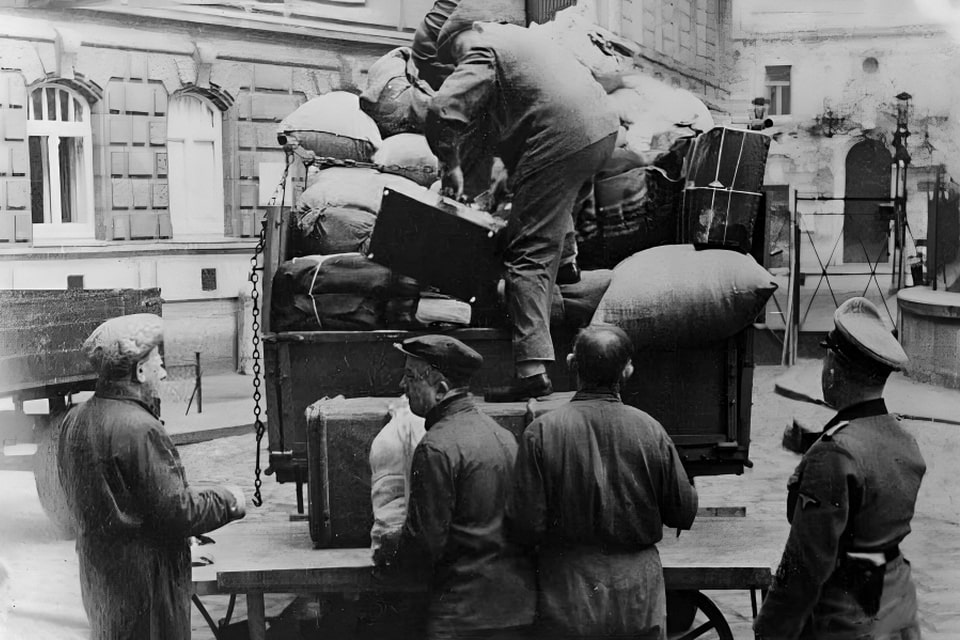
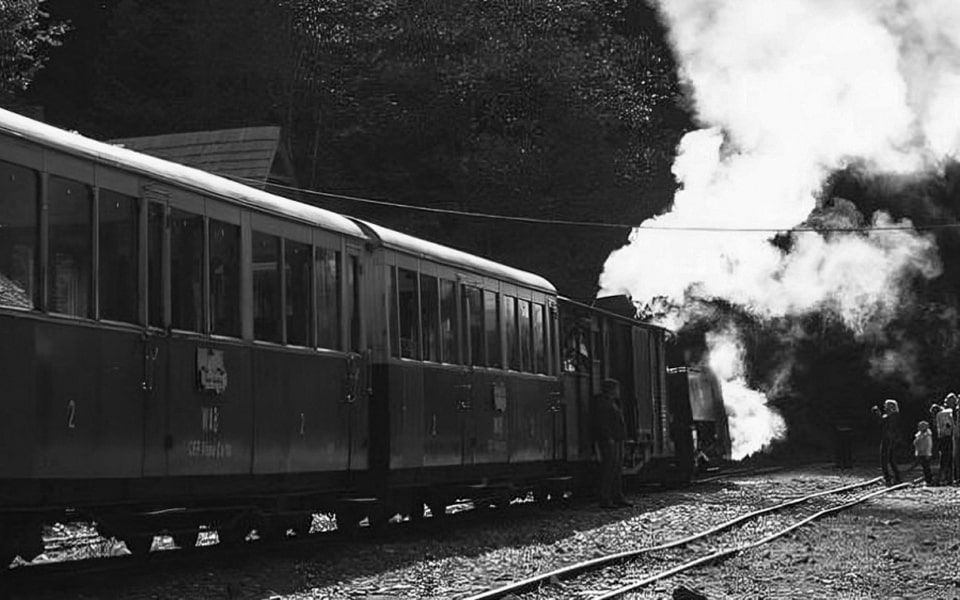
Despite not knowing the exact destination of the ‘resettlement’ to the East, people opted for the third transport to Nisko, which was initially planned for October 30, then postponed for November 4, and finally canceled a day before. Since the Nisko plan soon became a disappointment for the Nazis, Eichmann halted further trains, and 750 people, this time including women and children, were not released home but taken to the pre-war homeless shelter on Gänsbachergasse 3. Located one kilometer South of Aspang station, the shelter was turned by the Germans into a detention and transit camp. Men were separated from women and children, and these passengers of the never-materialized third transport to Nisko had to spend three months here until February 1940. Eichmann envisioned weekly transport from Vienna to the East, but the Nisko plan failed, since people died en masse from poor nutrition and diseases, and the idea of resettling hundreds of thousands of Jews to the Nisko area appeared to be impractical. The whole operation was dissolved in March, and of the 1,584 men from Vienna, only 198 survived until April, when they were brought back to Vienna. Since the Jews had given up their homes before leaving, most of the Jews who either came back from Nisko or were released from the detention camp on Gänsbachergasse became homeless.
While the Aspang train station was used for the first time for mass deportations in October 1939, there were no further trains that year and throughout the whole of 1940, which allowed the Jewish community in Vienna to focus their efforts on centralized immigration abroad. The new wave of deportations materialized the Nazi heads in February 1941, but this time, even the illusion of choice was gone. Alois Brunner, the SS officer historically known as the right-hand of Adolf Eichmann, and the head of the ‘Zentralstelle‘ in Vienna in 1941, agreed to all deportation lists. Previously agreed-upon lists were then given to the Jewish leaders, since they were still obliged to facilitate the deportation process. The first transport in this new wave left Aspang station in Vienna on February 15, 1941, with 996 Jews on board heading toward Opole Lubelskie (not to be confused with a large Polish city of Opole). The pre-war population in the town comprised 70% Jews, and after the occupation, the Germans established a ghetto here, bringing Jews from the surrounding area and Austria and Czechoslovakia. The second transport for Opole departed Aspang on February 26 with 1,049 people. The arriving people were cramped into the lodgings of the resident Jews. Jews from Opole were sent to the Belzec and Sobibor death camps between March and October 1942, and only 28 of the Jews brought here from Vienna are known to have survived the Holocaust.
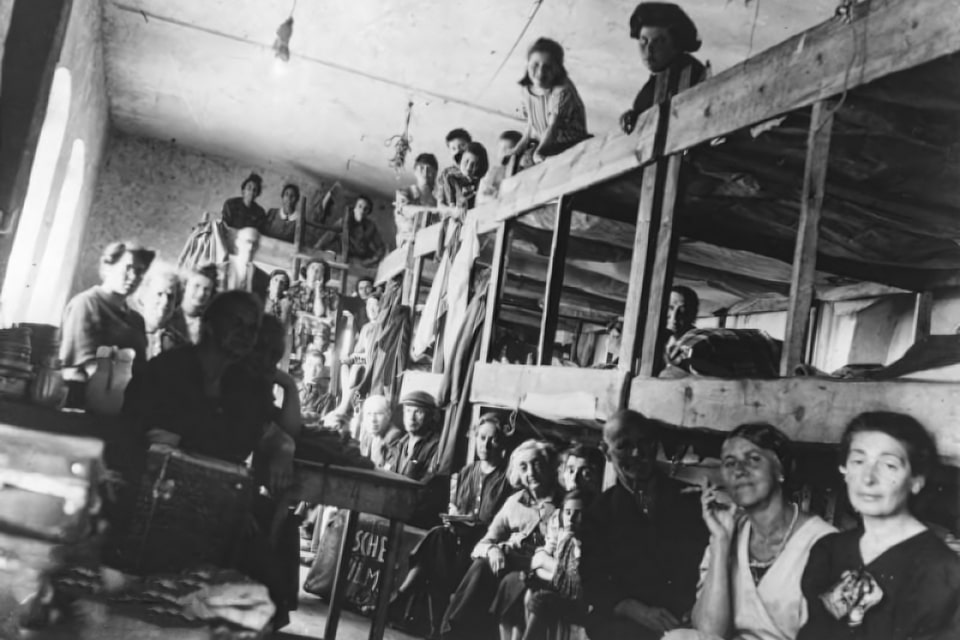
In parallel with sending Viennese Jews to Opole Lubelskie, 40 kilometers to the West of Lublin, on February 19, 1941, another train left for Kielce, a large city in central Poland, whose pre-war Jewish population amounted to 24,000 people. Despite the influx of Jews from Poland and a transport from Austria, the ghetto there was created as late as April 1941. The liquidation of the Kielce ghetto, including the murder of the Austrian Jews, happened in August 1942 when more than twenty thousand Jews were sent to the Treblinka death camp and gassed. On March 5, another transport departed from Vienna to Modliborzyce with 981 people on board. A small town in eastern Poland, 50 kilometers South of Lublin, accepted Jews from Vienna, a great majority of whom later died from poor conditions and starvation. A small ghetto was established in 1942 and liquidated in October, after sending the remaining Jews to Krasnik, from there to the Belzec camp for extermination. The last destination in the spring of 1941 was two small Polish towns, Opatów and Lagów, on March 12, not far from Kielce. The train brought 995 (another source says 992) people from Vienna, mostly senior women and men over sixty years old. The ghetto in Opatów was liquidated in October 1942 by sending its residents to the Treblinka extermination camp. The Jews from Lagow were killed there the same month. Before being deported, people from these five trains were held at the former school compound on Castellezgasse 35 in the second city district or in the former school at Kleine Sperlgasse 2a.
The deportations in February-March 1941 were not only shocking after one and a half years of a relatively calm period, but now the Germans demanded the whole families on the lists agreed by Alois Brunner. Giving keys to their houses and apartments was another vivid indication that the deported families were not meant to come back to Vienna soon. Between 1938 and 1942, up to 70,000 apartments in Vienna were taken from or left by the Jewish families. To calm the doomed people, Dr Loewenherz, the leader of the IKG, summoned a bank representative to the collection point to allow people to change Reichsmark for Polish Zloty. After the March 12 train, the deportations were halted until October. According to the census made by the Jewish community on June 30, 1941, there were still around 44,000 Jews left in Vienna. The Jewish community was reduced by around 75% since the Anschluss in March 1938 due to the emigration of around 130,000 people, arrests, and sending people to concentration camps, due to forced deportations to Poland, internal emigration, and also due to suicides, deaths from health problems and stress, and malnutrition. The community now was disproportionately old, with 19,961 people sixty years old and older, and only 2,412 children under eighteen. 39% of all people were males and 61% women. Out of 26,657 Jewish women in Vienna in June 1941, around 21,000 were older than forty-five, and 9,540 were older than sixty.
The remaining Jewish community in Vienna depended largely on the help of the IKG, which received most of its donations from abroad from two key organizations: the American Jewish Joint Distribution Committee and the British Council for German Jewry. The influx of money allowed the Jewish leader not only to facilitate more immigration efforts but also to improve the living conditions for the Jews remaining in Austria. For example, the international donations allowed the IKG to open eight new elderly houses in Vienna between 1938 and 1940, thus increasing the number of people covered from 439 to 1,584. The help from abroad also allowed for the maintenance of the work of different institutions for the Jews in Vienna, such as schools and kindergartens, and to expand the Jewish hospital by opening a new wing for children. As for the money for immigration, the American Jewish Joint Distribution Committee sent 1 million 451 thousand dollars to the Austrian Jews between 1938 and June 1941.
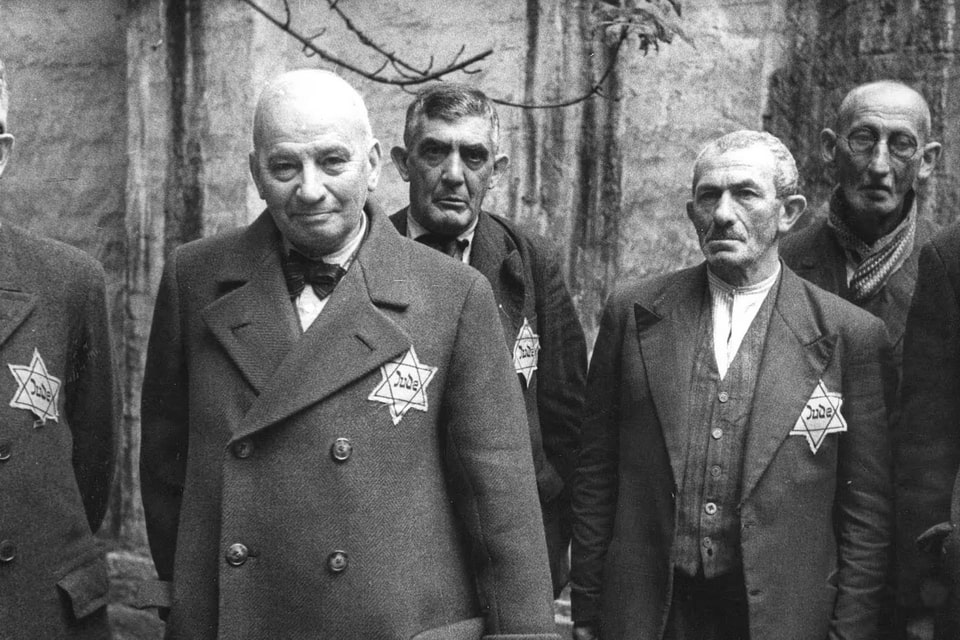
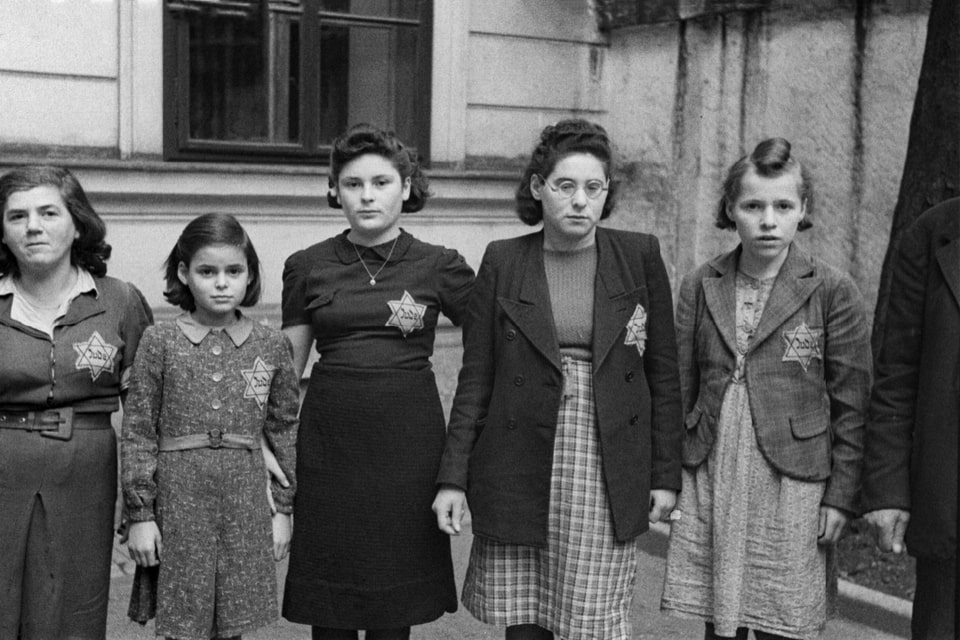
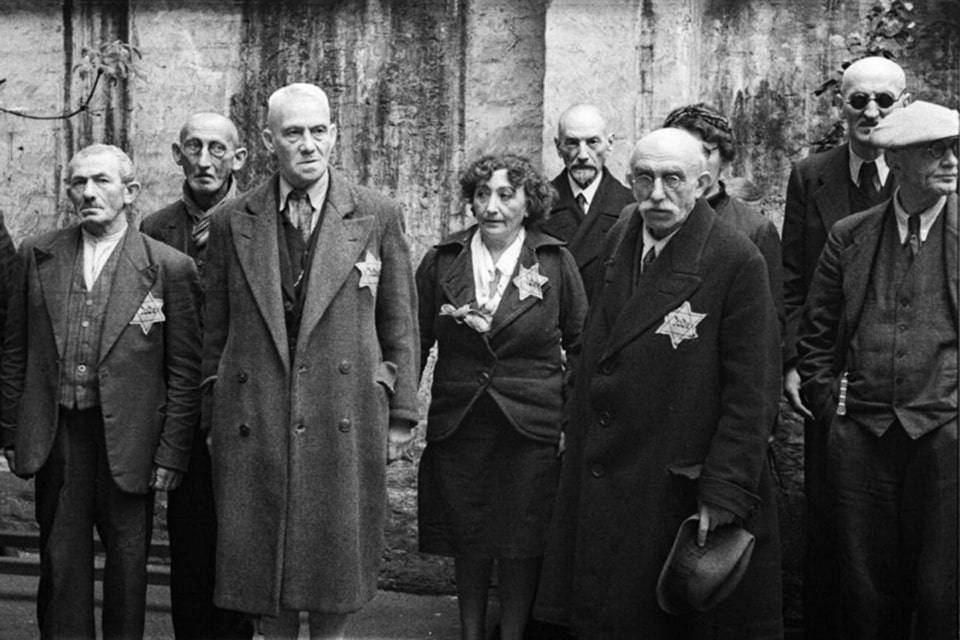
The halt in further deportations to the ghettos in Poland did not mean a halt to the anti-Jewish measures in the Third Reich. September 1941 brought an obligation to every Jew in Hitler’s state above six years old, including the annexed Austria and Bohemia, and Moravia, to wear a distinguishing sign of the Yellow Star, also known as the Star of David, on their clothes. The Nazi authorities introduced these humiliating segregation measures in the General Government in Poland as early as November 1939, in Luxembourg in June 1941, and in Serbia the same summer; now came the turn of the ‘Greater Germany’. In Vienna, the Jewish IKG was responsible for distributing materials and stars among people in the city. The official records show that 44,770 stars were distributed by September 18 to 43,180 individuals, of whom around 4,600 were half Jews or Christened. A third of this number of distributed Yellow Stars, 15,800, were given to people in the second district, Leopoldstadt. Even after three years of occupation, many Jews were dispersed throughout the city, and the distribution of 44 thousand stars was a bit of a challenge for the Jewish community.
OCTOBER 1941 – OCTOBER 1942: THE YEAR OF MASS DEPORTATIONS
While 136,000 Jews left Austria by the Fall of 1941, the flow of immigration was put to an end in October 1941, when the deportations resumed. Unlike the previous prolonged break in sending trains to the East between October 1939 and February 1941 and between March and October, this new phase brought a centralized conveying machine for sending Austrian Jews to their death. Since the Nazi policy toward Jews shifted from ghettoization and forced emigration to extermination in mid-1941, the Jewish transports were now meant to follow the calculated, highly efficient demands of the Nazi authorities. Similar to the previous February-March deportation phase, the Germans prepared the lists of the deportees by themselves, specified dates and a schedule, and a certain pace for the transport, which was now anticipated as approximately once a week. The decision of the names in the deportation lists was made by the staff of Zentralstelle (“Central Agency for Jewish Emigration”) in the former Rotshild Palace. These lists were prepared based on documents on the Jews accumulated since 1938, particularly thanks to the meticulously managed process of immigration. Families were kept together, starting with the men, and then their wives and children were also included.
The process of facilitating the deportation was once again left to the IKG, though the Jewish leaders saw the deportation lists for the first time as a fait accompli after being processed by Zentralstelle and checked by Gestapo, before transferring to the office on Seitenstettengasse 4. Then the IKG staff sorted the lists of names in alphabetical order. They already included the addresses of the Jewish families, since any person who had previously opted for help, such as food rations or permission for immigration, had left information. Despite having all important information, the Germans still needed the Jewish community to cooperate to conduct deportations calmly without accidents until Austria was ‘Judenfrei’ (free of Jews). The Germans at Zentralstelle also created such a notion of ‘Aushebern’ (‘extractors’ or ‘researchers’ in English) by appointing up to 500 Jews in Vienna as special units who assisted in collecting people from their homes, delivering them to the collection points, and sorting belongings. In March, a special unit of ‘Sonderdienst’ (Special services) or JUPO (short for Jüdische Polizei) was formed of Jews in Vienna, whose survival depended on effectiveness in facilitating Jews for deportation by force. The Germans even put several former IKG functionaries in charge of the process. Some groups of Jews were spared from deportation or got a delay, such as First World War veterans, or parents of killed soldiers who were in a mixed marriage, current spouses of a mixed marriage with an Aryan, and civil servants who received pensions.
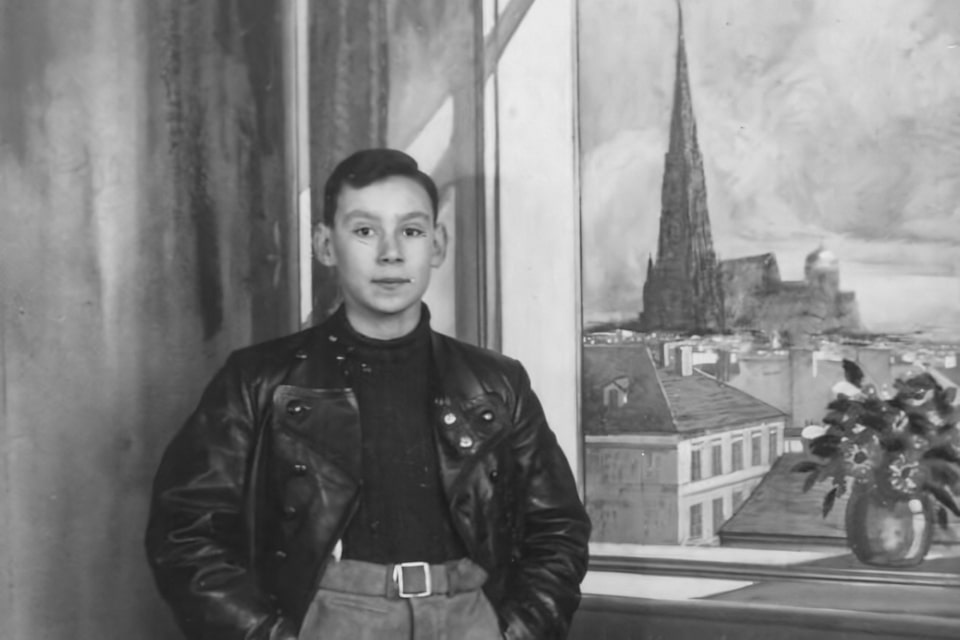
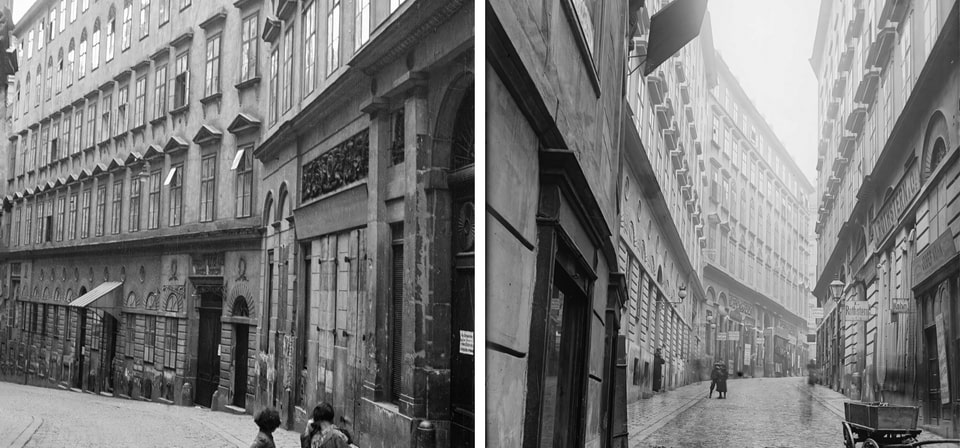
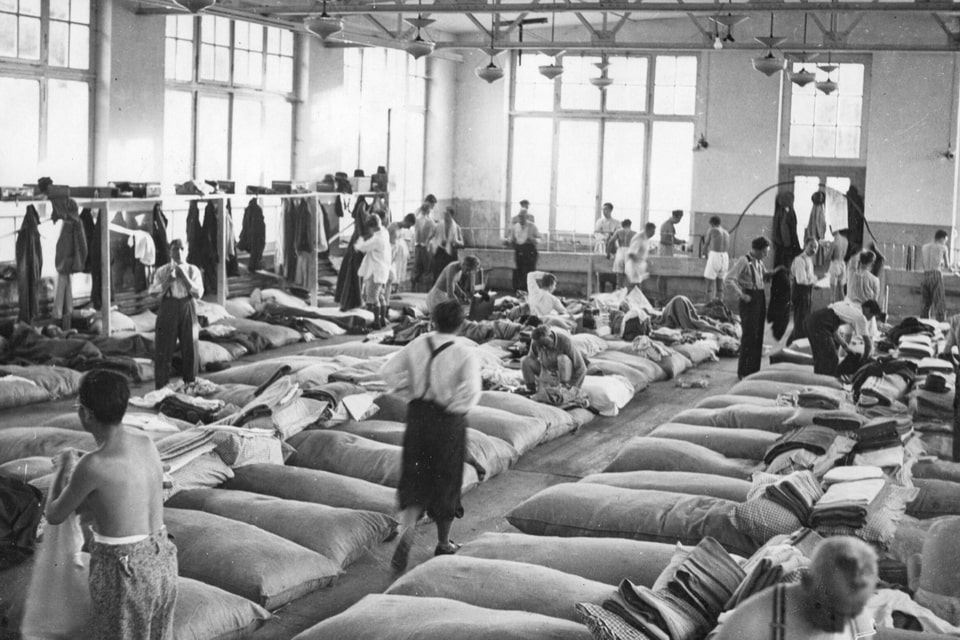
People in the lists for specific transport received a letter with an order to present themselves at one of the collection points in Vienna at a specific time and date. The first two assembly points were set up in February 1941 to facilitate deportations to the ghettos in Poland, inside two former schools at Kleine Sperlgasse 2a and Castellezgasse 35. The ‘Sammellager’ (collection camp) at Kleine Sperlgasse 2a in Leopoldstadt was located in the old 1875 building and was to become the largest of its kind in Vienna, from which most of the Vienna Jews were taken to the Aspang station for deportation. It was used in February-March 1941, and then from October 1941 to October 1942. The second collection camp was operated in the same two months of February-March 1941 and between October 1941 and June 1942. Before the Anschluss, the building accommodated a Jewish elementary school, then a lyceum with courses devoted to immigration for the school-age children. On June 6, 1942, the Germans moved their Zentralstelle to this building at Castellezgasse 35. In June 1942, the Nazis organized another camp for deportation inside the former Talmud Torah School, Malzgasse 16, which also served as a Jewish retirement home for the elderly between November 1939 and June 1942. The fourth collection camp was set nearby at Malzgasse 7, a former Jewish girls’ school, and before 1942, another retirement home, this time for elderly women. This collection point existed the longest among the four until May 1943. With time, Sammellager (collection camp) became regarded as Umsiedlungslager (transfer camp) and as Abwanderungslager (deportation camps), narrowing the horrific Nazis’ euphemisms.
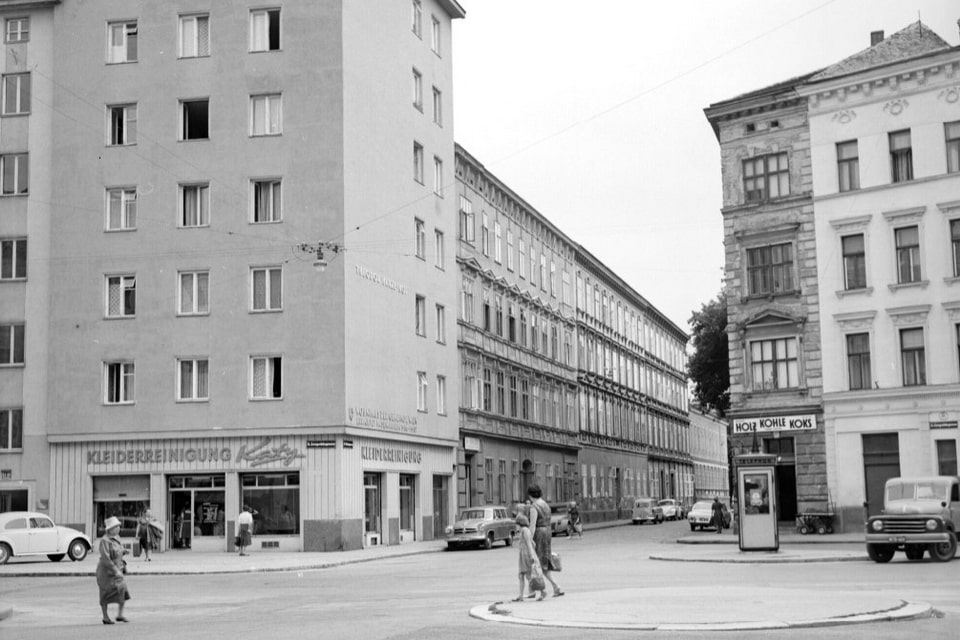
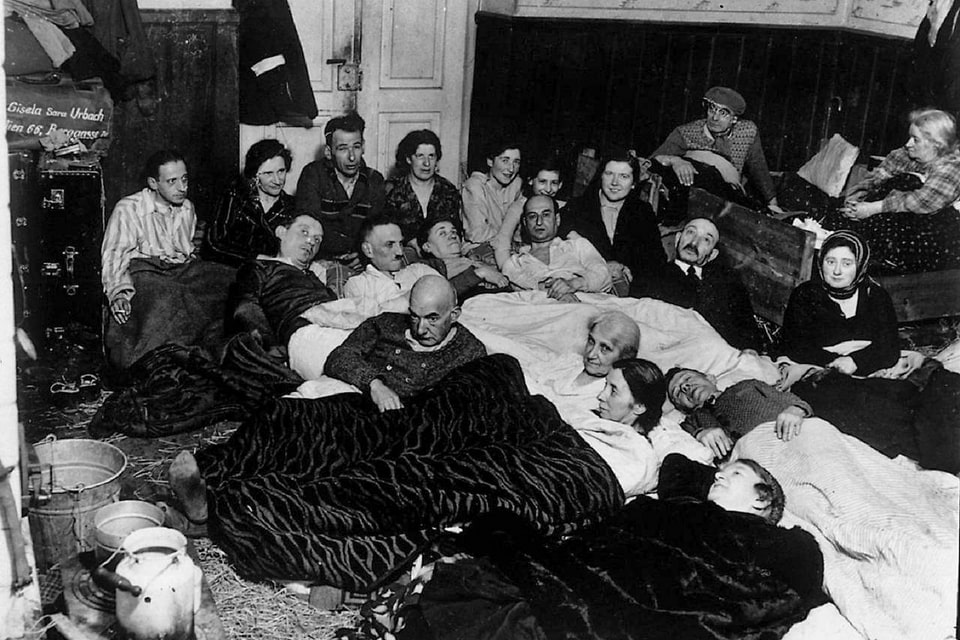
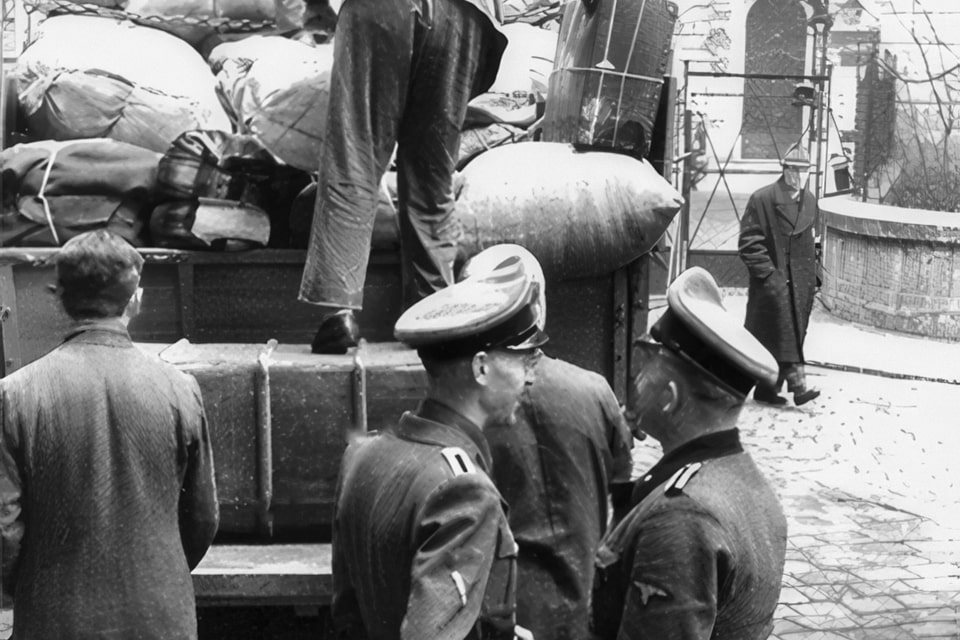
As we see, the Germans used former schools as collection points for further deportations, a pattern similar to placing people in school buildings in Warsaw at the infamous Umschlagplatz. The Viennese Jews, whose names were included in the lists, took their possessions to the assembly points; up to 50 kg was allowed per person. Upon arrival, people were cramped into the relatively small buildings without beds or tables, and the sanitary conditions inside were improper for detaining hundreds and sometimes a few thousand people, who sat on the floor for days waiting for their fate, which was obscure. The IKG staff tried to make conditions bearable. After days of waiting and harsh treatment by ‘Sonderdienst’ Jewish guards, poor women, men, and children were forcibly dragged out of the collection buildings and put in the open trucks, which brought them to the Aspang train station after ten to fifteen minutes of a ride. Since the trucks were open, Viennese people could see the ill-fated Jews on their way, and some urbanites even jeered.
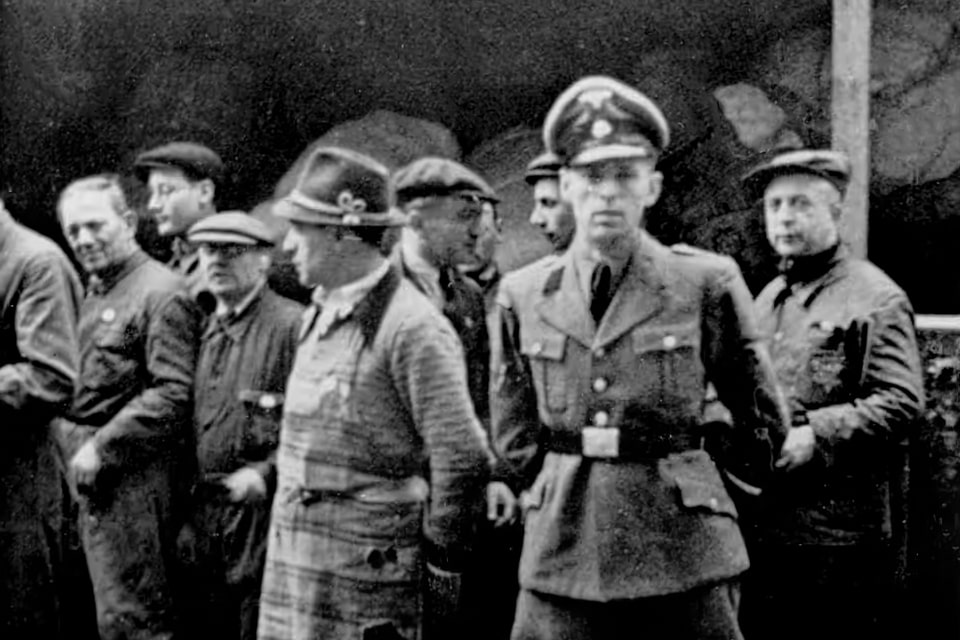
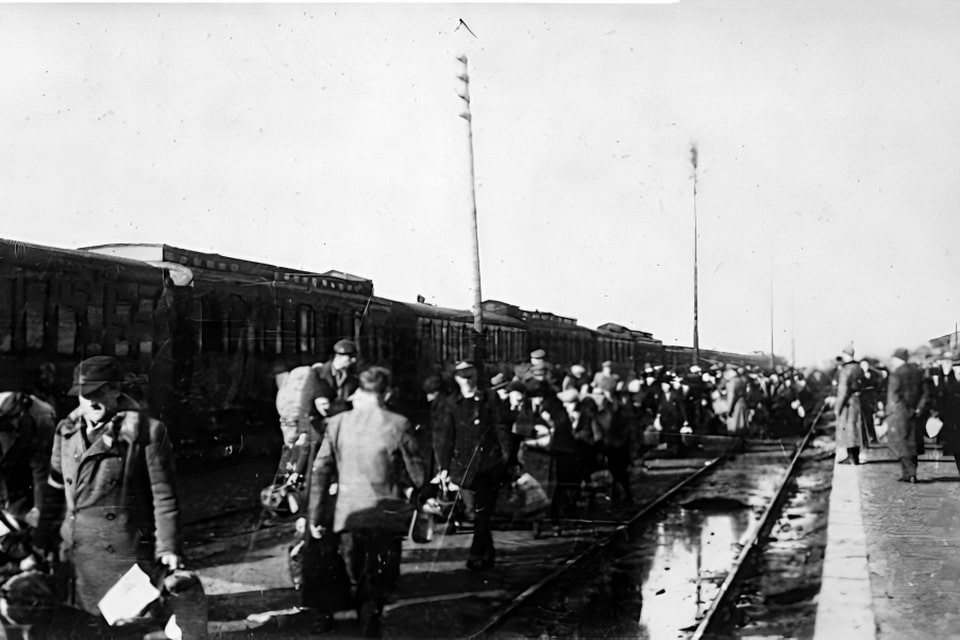
The Aspang station, which now functioned as a fully-fledged deportation depot for Jews, was guarded by a small bunch of men from the Austrian police, sometimes consisting of only seven men armed with two machine-guns and five pistols. They were neither hardened guards from the infamous ‘Totenkopfverbände’ (SS Death’s Head units), nor SS or Gestapo, but the members of the city’s police units, who were, after the Anschluss, incorporated into the German Ordnungspolizei (Orpo). The number of guards and light weaponry meant that they did not expect harsh resistance from the deportees. The process of loading was led by the Jewish units and by Jews from the train selected for this role. People were generally brought to the Aspang station near noon, and the loading process lasted for several hours, with a usual departure time around 7 p.m. People were brought here after days of detention, and the process of loading into the train, though they were second- and third-class wagons, not the cattle cars, was so stressful and exhausting that some old and sick died even before deportation.
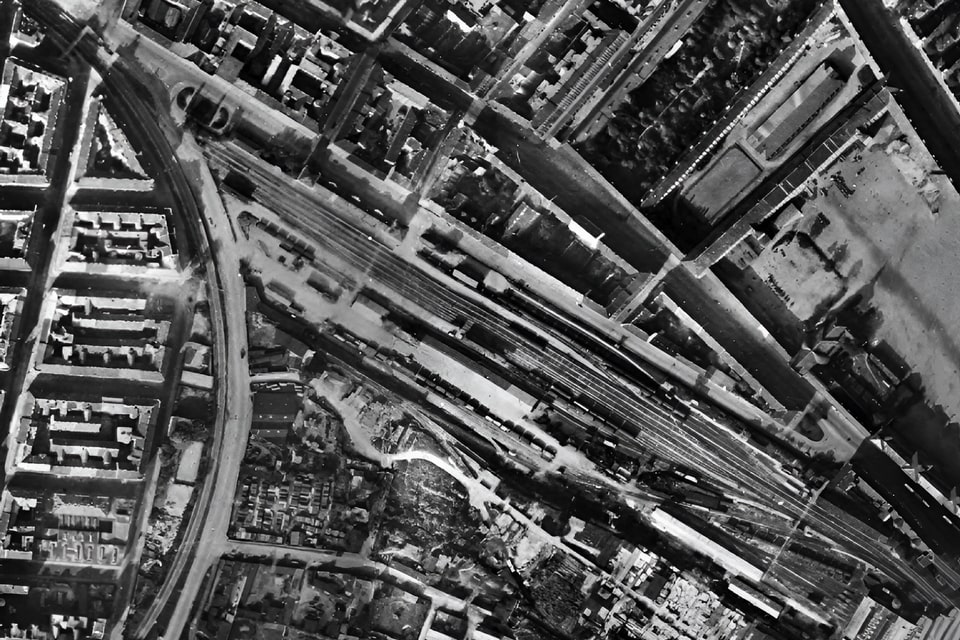
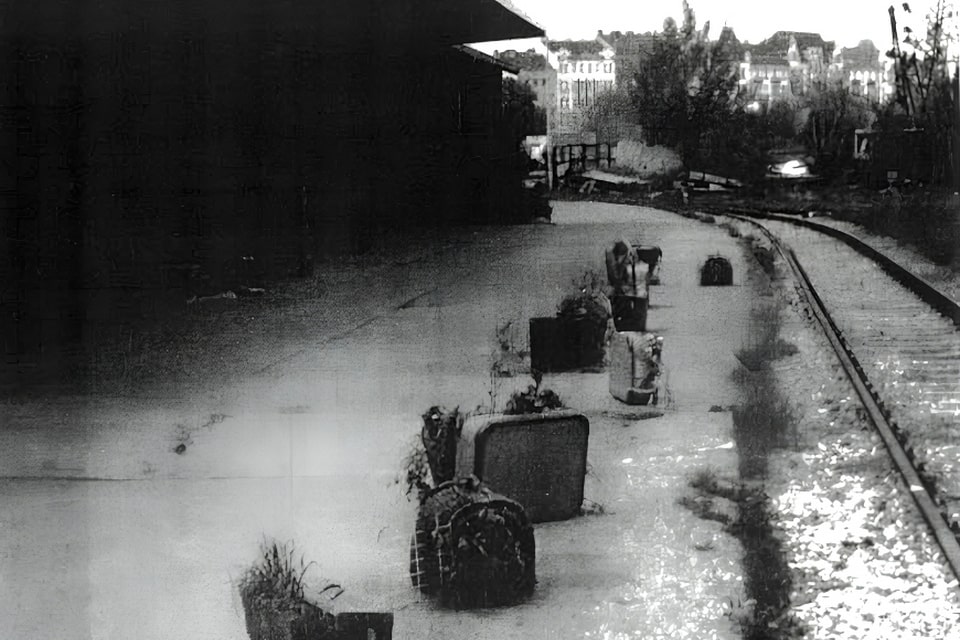
The whole procedure at the station was usually supervised personally by Hauptsturmführer Alois Brunner, the head of the Zentralstelle, and his subordinate SS Hauptscharführer Ernst Adolf Girzik (1911-1977). In 1944, the latter would participate in the deportation of Hungarian Jews to Auschwitz. He was arrested after the war and sentenced to fifteen years of imprisonment for the deportation of Austrian Jews, but was released as early as 1953. The other two notoriously known men behind the deportations from Vienna were two Austrians, Anton Zita (1909-1946) and Josef Weiszl (1912-1984). Before the Anschluss, Zita was illegally a member of both the NSDAP and the SS, and later joined Eichmann’s staff in Vienna. In late 1939, he was one of the officers responsible for the failed ‘Nisko plan’ and later supervised the deportation of Jews from two collection camps at Malzgasse and Sperlgasse. In 1943, he participated in the deportation of the Jews from the Greek city of Salonica. Josef Weiszl grew up in Vienna and joined the Zentralstelle as early as November 1938 as a clerk responsible for issuing passports. He left for Prague with Eichmann in 1939, but he came back to Vienna to handle deportations. After that was he was sentenced to life imprisonment but was released in 1955 and returned to Vienna, where he lived until 1984.
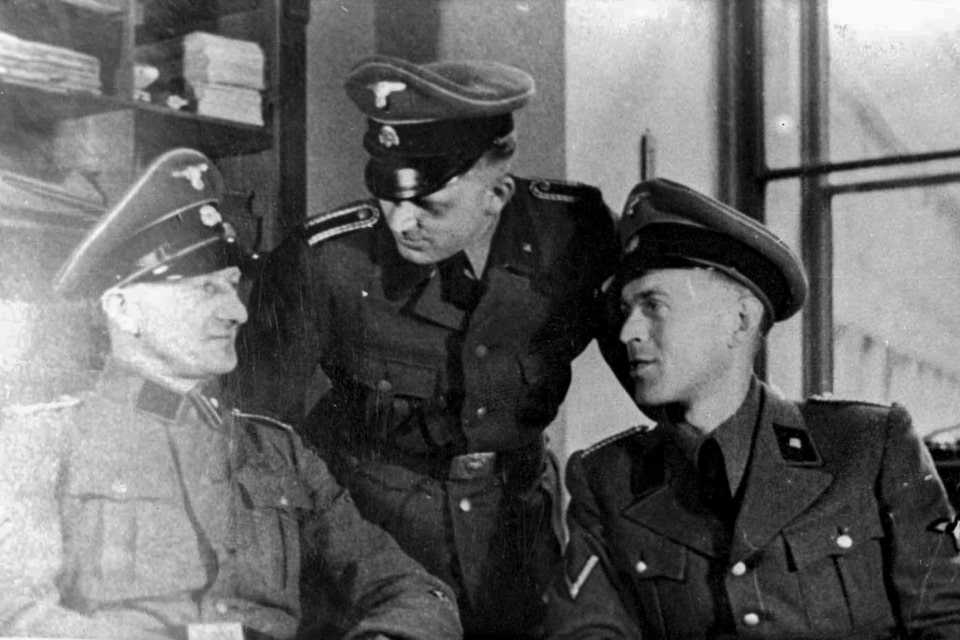
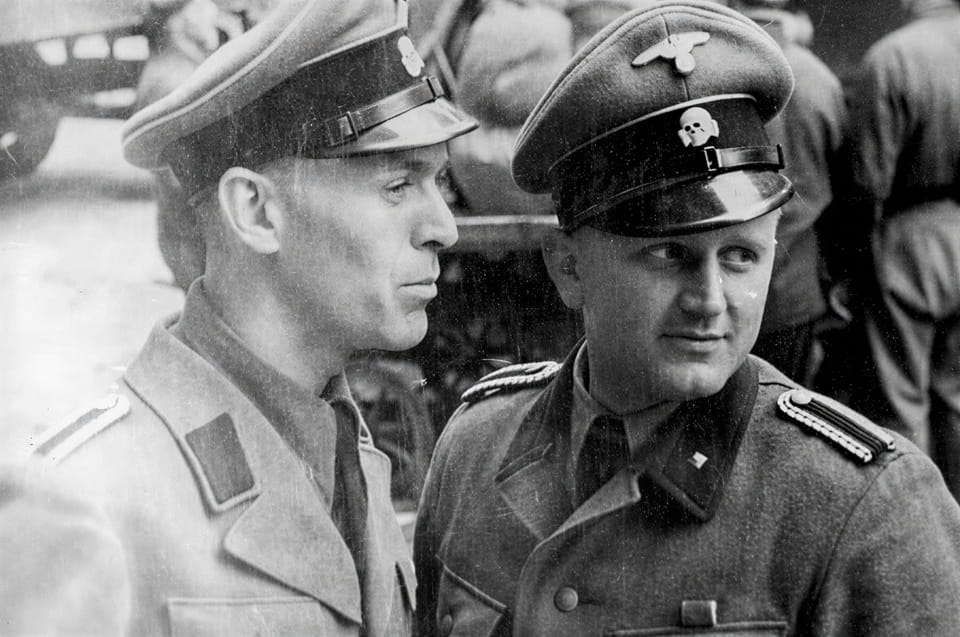
Even though the passenger wagons used for Viennese Jews cannot be compared to cattle cars conventionally used by the Nazi regime, these cars were often overcrowded, since each brought around one thousand people. Depending on the mood of the main assigned guard, the Jews in the train may get enough water or suffer from thirst for days in the overcrowded wagons. Usually, each transport included Jewish doctors, but the death rate among the deportees was still high. Similar to the general practice during the Holocaust, the journeys to the destination sites lasted much longer than they should have. For example, a transport with 994 Jews, which left Vienna’s Aspang station on May 6, 1942, arrived in Minsk, Belarus, as late as May 12, six days later. The sufferings of the deportees were for nothing, since soon after their arrival, people were taken to the Maly Trostinets killing site in the woods and slaughtered. There is a well-known preserved report dated June 20, 1942, written by the commander of one of the Viennese police units. Sixteen men escorted a train that departed on June 14 with 996 people on board. In the late evening of June 16, some able-bodied men were left in Lublin, and the remaining 949 arrived in the Sobibor extermination camp at 8.15 on June 17, 1942, where they were gassed upon arrival. The train led by Austrian policemen left Sobibor back to Lublin immediately after the unloading was completed.
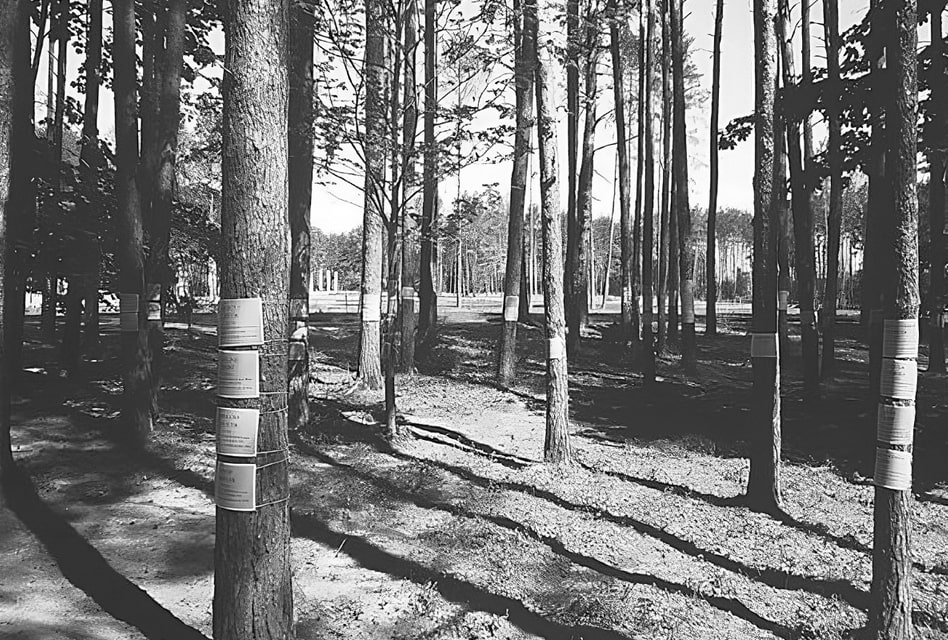
While the deportations in February-March 1941 headed ghettos in the so-called General Government in Poland, mostly around Lublin, the revival of transports in October extended the geography of deportations of Jews from Vienna. The first five transports (October 15, 19, 23, 28, November 2) carried 4,995 people to Litzmannstadt, the German name of the Polish city of Lodz in the Reichsgau Wartheland in central Poland. Starting from November 1941, the Aspang train station became a staging ground for sending Viennese Jews further East to the German-occupied territories of the Soviet Union, designated by the Nazi regime as Reichskommissariat Ostland (RKO). The area was formed on July 25, 1941, and included the Baltic States (Lithuania, Estonia, and Latvia) and the Western part of Belarus. The new destination points for the Austrian Jews now included Riga (Latvia), Kaunas (Lithuania), Minsk, and Maly Trostinec (Belarus). The latter two were annihilation sites, where Jews were killed soon upon arrival without being accommodated in the ghettos. On April 9, 1942, the list of destinations was added by a ghetto in the Polish town of Izbica, the largest transit camp in Eastern Poland, which was liquidated in November 1942. On April 27, another 998 people were sent to Włodawa, 100 km northeast of Lublin, whose ghetto was dismantled by the end of the year by sending Jews to Sobibor.
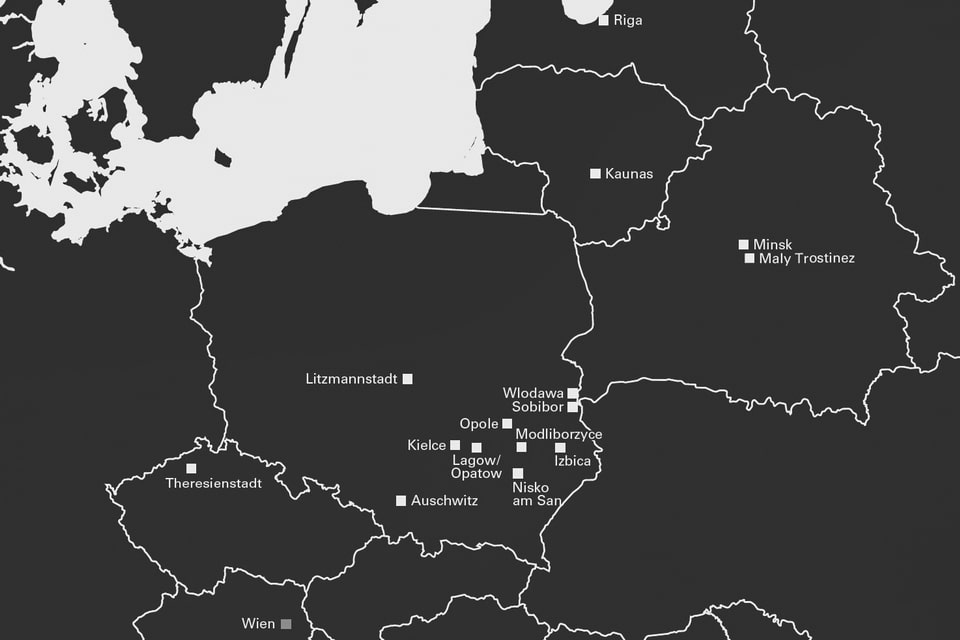
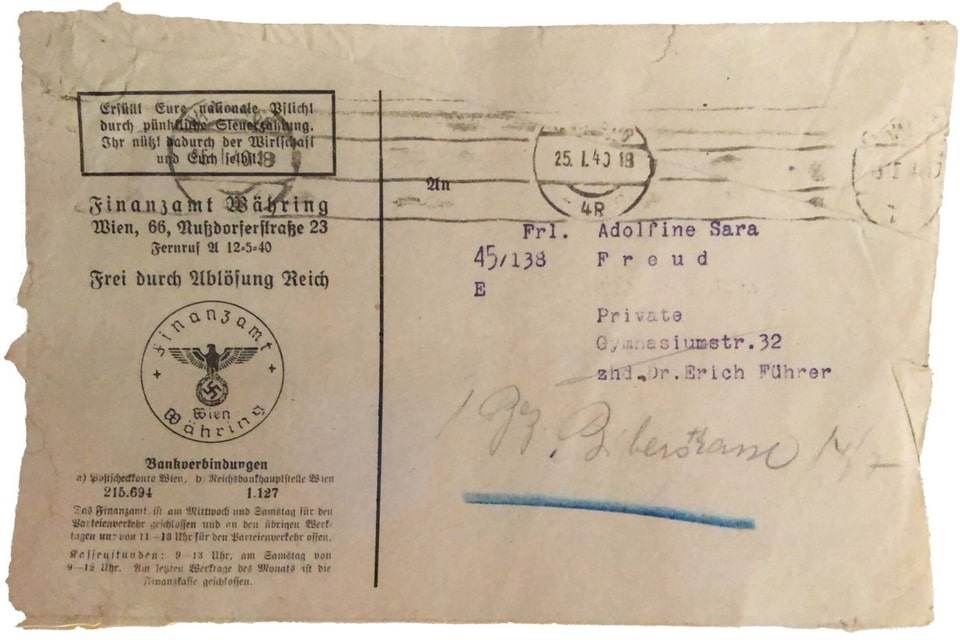
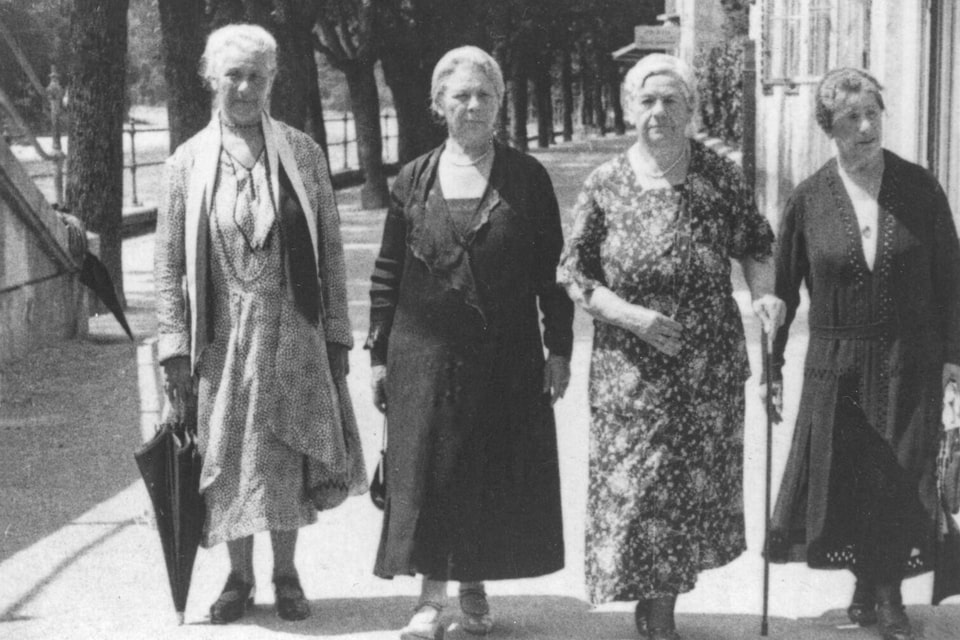
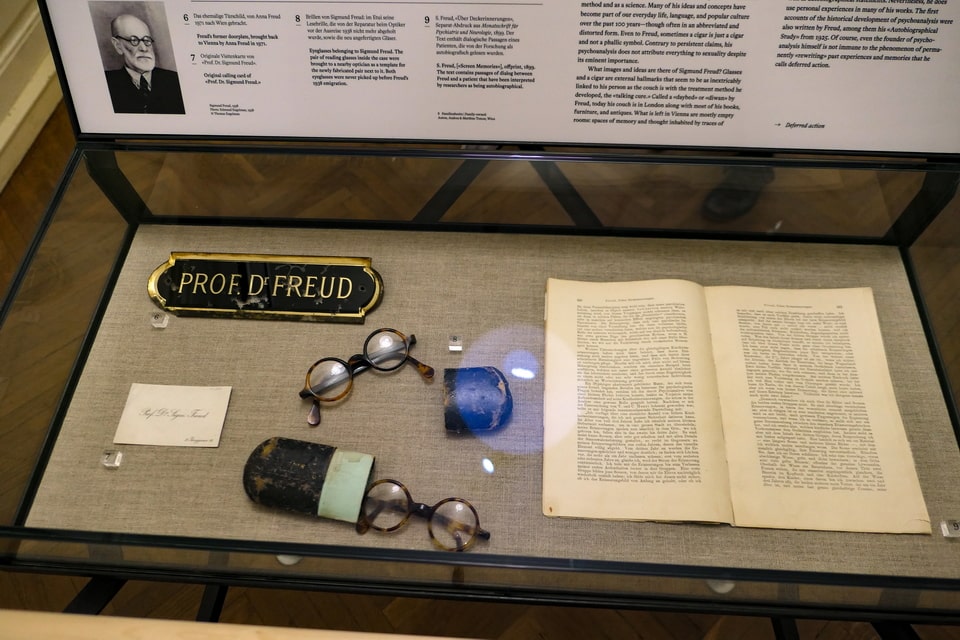
June 1942 brought another destination to the bureaucratically routine deportations from Vienna, this time to the Theresienstadt ghetto in the Protectorate of Bohemia and Moravia (modern Czech Republic). Between June 20 and October 9, 1942, a total of 13,776 people (an alternative estimate gives 13,922), or 29% of all Jews deported between October 1939 and October 1942 from Aspang, were sent to Theresienstadt. The Austrian Jews were the second largest group brought to the so-called ‘model ghetto’ in 1942, the second after Germany, with 32,878. By the end of the war, a total of 15,266 Jews had arrived in Theresienstadt from Austria. Approximately half of the Jews brought here from Vienna were later deported to Auschwitz and Treblinka, where most of them were murdered. Among people who were deported from Vienna to Theresienstadt were four sisters of a world-famous psychiatrist, Doctor Sigmund Freud. Rosa Graf (born 1860), Marie Freud (born 1861), and Pauline Winternitz (born 1864) were sent to the Treblinka extermination camp on September 23 and 29, 1942, and gassed upon arrival. The fourth sister, Adolfine Freud (born 1862), who lived on Seegasse 9 near the Lichtenstein Park before the deportation, died on February 5, 1943, in Theresienstadt. The oldest sister, Anna Bernays, survived the Holocaust and lived until 1955. As I mentioned before, there was another train directly to Sobibor on June 14. A month later, on July 17, another train left Aspang carrying 995 Jews to Auschwitz, mostly women, and arrived a day later, from which 212 women were registered for work.
The last three deportation transports from Aspang Bahnhof were in October 1942. One to the killing site at Maly Trostinez near Minsk, and two, on October 1 and 9, to Theresienstadt. These last October 1942 transports included many of the IKG staff workers, their families, and Jews, whom the Nazi regime had previously considered as ‘privileged’, thus temporarily spared from deportations, particularly spouses in mixed marriages and WWI veterans. For four and a half years, since the reestablishment of the Israelitische Kultusgemeinde Wien in May 1938, its leaders and employees believed that they were spared from the fate of deportations, which proved to be a false belief. After the October transports left, the former IKG was shrunk, and on November 23, 1942, it was reestablished as ‘Ältestenrat der Juden in Wien’(The Council of Jewish Elders in Vienna). Led further by Dr. Josef Löewenherz, an advisory board of three elders and a staff of 254 paid workers and 80 volunteers, it was now responsible for the remaining 7,989 people in the Jewish community of Vienna, 4,150 women and 3,839 men. Most of them (5,564) were people who lived in mixed marriages with Aryan spouses, and the remaining 2,425 were ‘Mischling’ (mixed children) or ‘Geltungsjuden’ (Validated Jews) from these or previous marriages of this kind.

The ‘Central Office’ allowed Dr. Josef Löewenherz to preserve the visibility of a community, leaving them the ability to run a hospital, one children’s hospital, a cemetery, an elderly home, a community kitchen, a bathhouse, and even a newspaper. Of the 8,000 remaining Jews of Vienna, around 3,000 still practiced Judaism, and the other 5,000 were considered ‘Nichtglaubensjuden’ (Non-believing Jews). Despite an illusion of safety by the start of 1943, the Germans did not plan to leave the remaining Viennese Jews in the city, and after a halt of two months, starting from January 1943, new deportations on a smaller scale proceeded. Supervised by the Gestapo, they continued until the last year of the war as small transports of up to 100-150 people deported from Wien Nordbahnhof train station. Throughout 1943, the Nazis deported 1,216 Jews from Vienna, of whom 139 were sent directly to Auschwitz and 1,078 to Theresienstadt. Among them were children from mixed marriages, former IKG workers, and 152 employers of the ‘Council of elders’, including Dr. Benjamin Murmelstein, the last remaining rabbi in Vienna after the Anschluss, who later became the leader of the Judenrat in the Theresienstadt ghetto. 6,259 registered members of the Jewish community were still in Vienna at the beginning of 1943, though small deportations continued. In total, another 1,918 Jews were deported from the city in 1943-1945, with the last transport leaving on March 19, 1945, carrying eleven persons to Theresienstadt.
When the Soviet army entered Vienna in April 1945, 5,512 persons registered as Jews remained in the city, with 619 who survived in hiding.
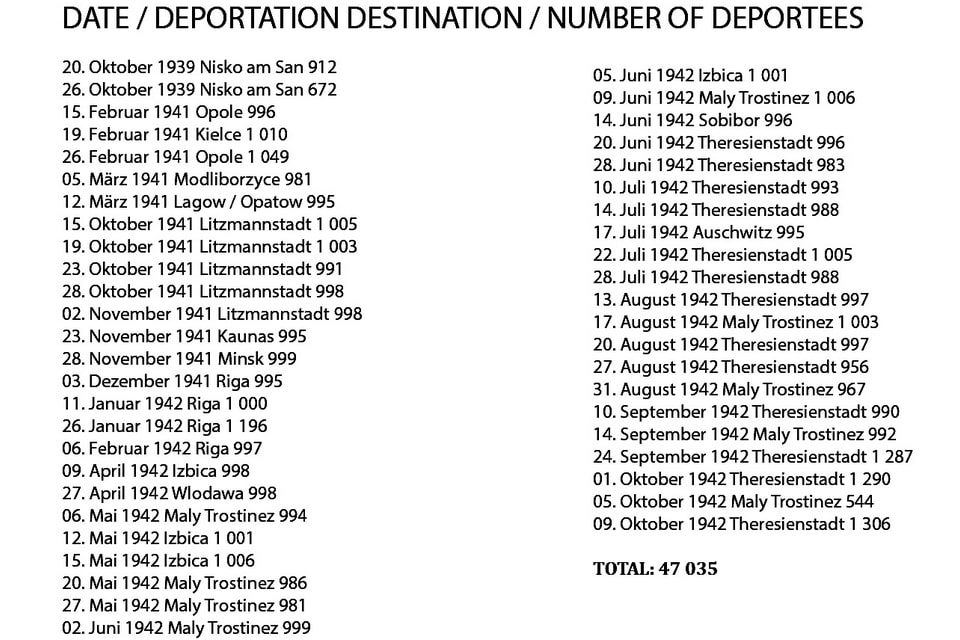
In total, modern historiography gives us the figure of 48,953 people regarded by the Nazis as Jews, who were deported from Vienna between 1939 and 1945, of which 47,035 left the city through the Aspangbahnhof (Aspang train station) between October 1939 and October 1942, or 96%. Two transports left in October 1939, and forty-five between February 1941 and October 1942. Thus, 45,451 persons were deported in just twenty months, of which there was a six-month delay between March and October 1941. The above-mentioned historian Jonny Moser (1925-2011) estimated that only 1,073 of 47,035 deported from Aspang station survived the Holocaust and saw 1945. When including the later deportations to Theresienstadt with a higher chance of survival, a total of 2,142 out of at least 48,953 people survived the war, or only 4%. In total, around 66,000 Jews from Austria were killed or died in the Holocaust, of which at least 63,800 were identified by the Documentation Centre of Austrian Resistance (DÖW). Forcing 136,000 people to emigrate from the country and killing 66,000 Jews in the Holocaust destroyed the pre-war Jewish history and life in Austria and particularly in Vienna. Centuries of Jewish culture and history in the city were now over.
In addition, approximately 3,000 Roma and Sinti were deported from the Nordbahnhof train station to Auschwitz-Birkenau during the occupation.
THE SITE TODAY: LEON-ZELMAN-PARK AND THE MAHNMAL ASPANGBAHNHOF
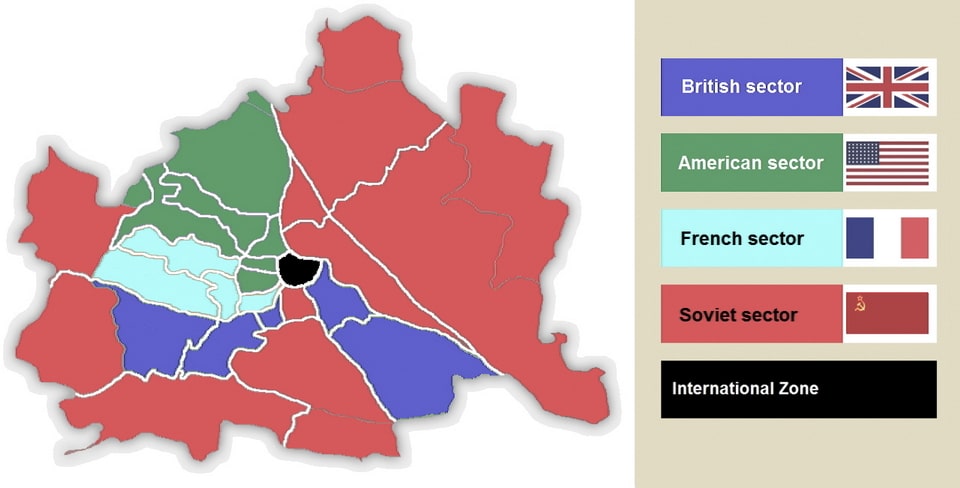
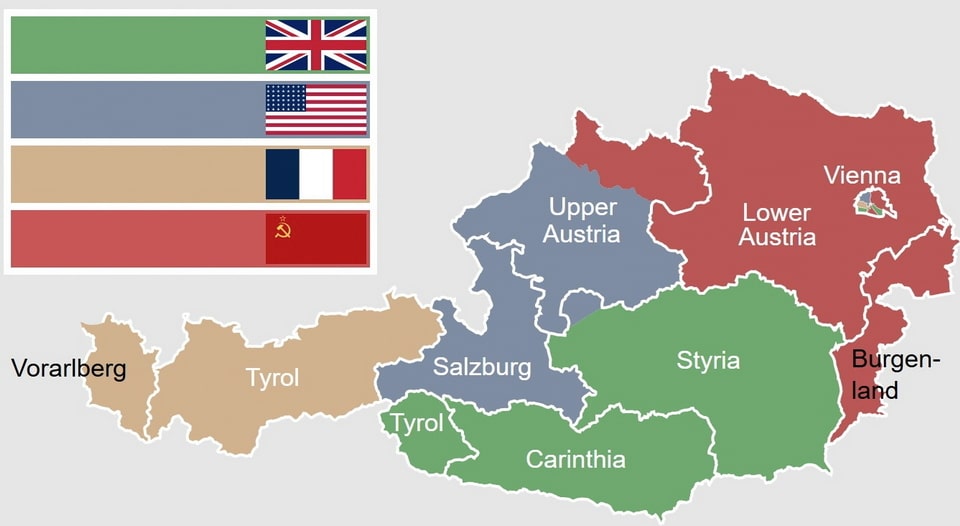
Between 1939 and 1945, the Aspang train station did not suffer direct damage from either Allied bombings of Vienna or the battles over the city in the spring of 1945. After centralized deportations from Vienna witnessed another halt in October 1942, starting from January 1943, smaller transports with deportees departed from the Nordbahnhof station. The Aspangbahnhof was once again used as a transport freight station and probably even for regional passenger trains, until in early 1945 all operations were suspended due to the coming of the front closer to Vienna, and because of the shortages of coal and the lack of trained staff. While the city was first entered by the Red Army in April 1945, similar to Germany, Austria was divided into four zones of Allied control under the Soviet Union, the United States, Britain, and France. Vienna was agreed to be divided into five different control zones. The 1st district, which included the inner city, was announced as an international zone and was controlled by four powers one after another, changing once a month. The Soviets now controlled Leopoldstadt (2nd district), 4 (Wieden), 10 (Favoriten), 20 (Brigittenau), and 21 (Floridsdorf). The US controlled 7, 8, 9, 17, 18, 19. The French took 6, 14, 15, 16. The British were present in the 3, 5, 11, 12, and 13 districts.
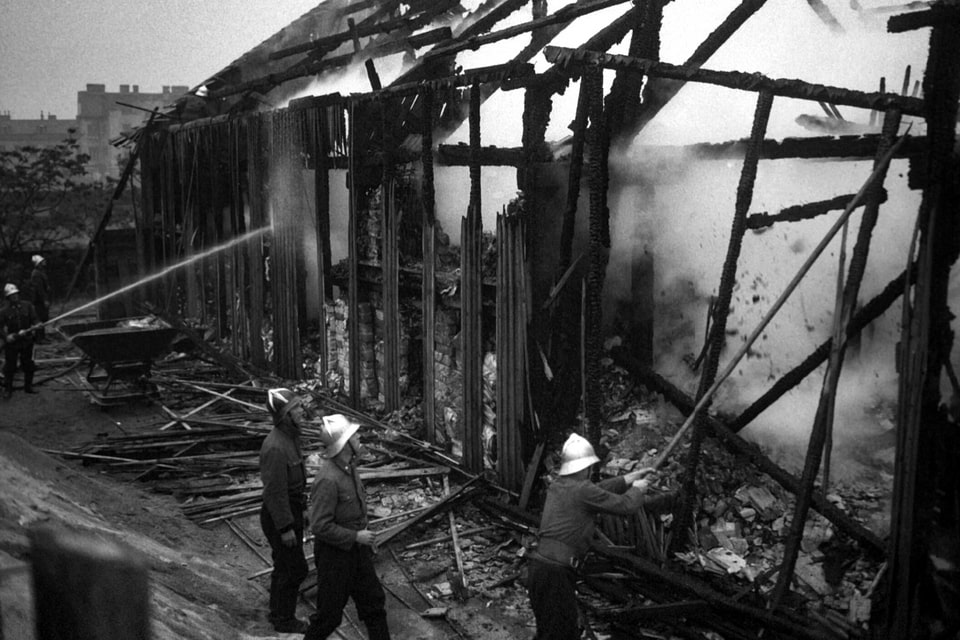
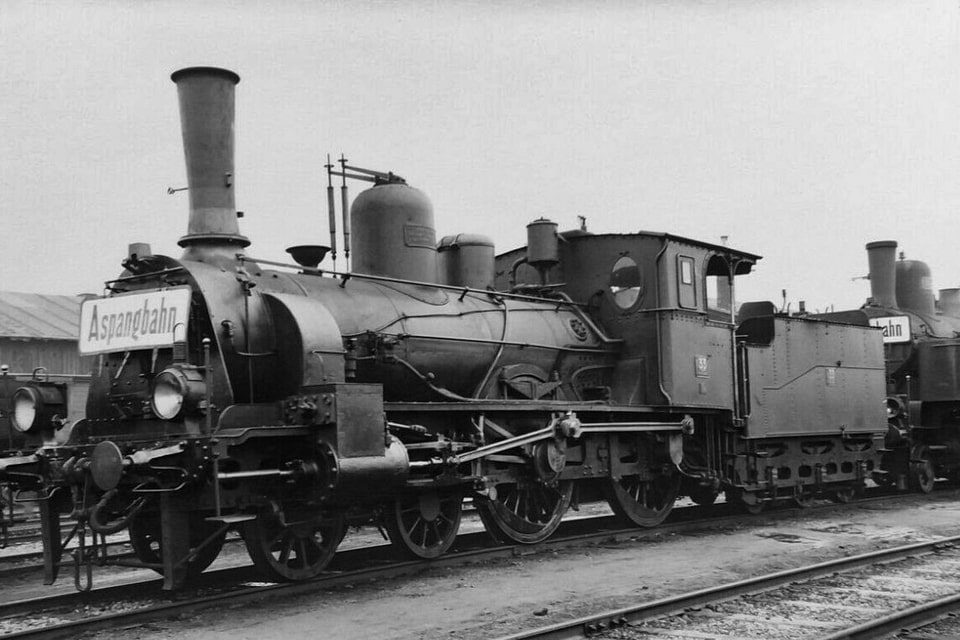
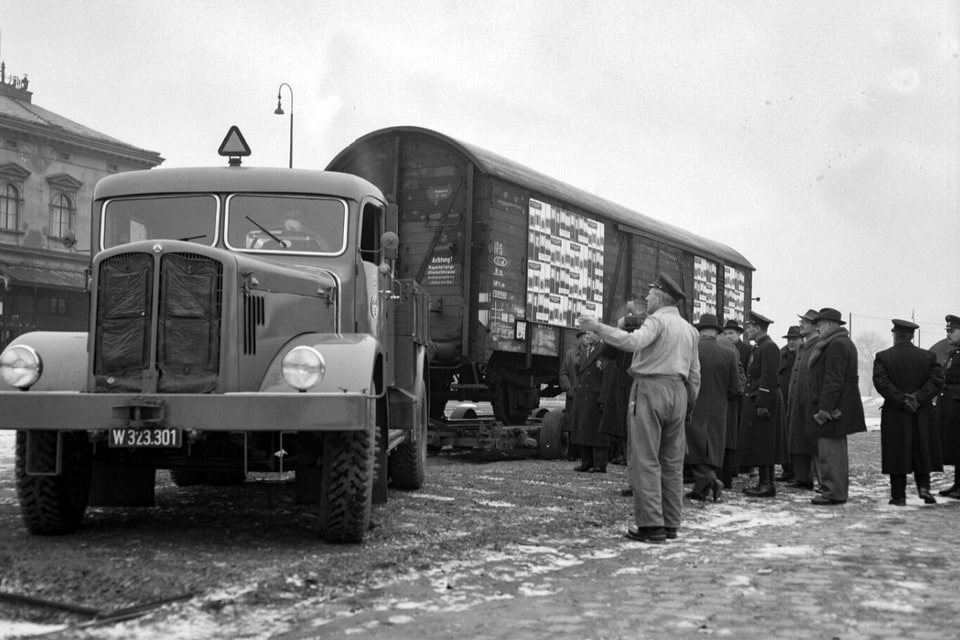
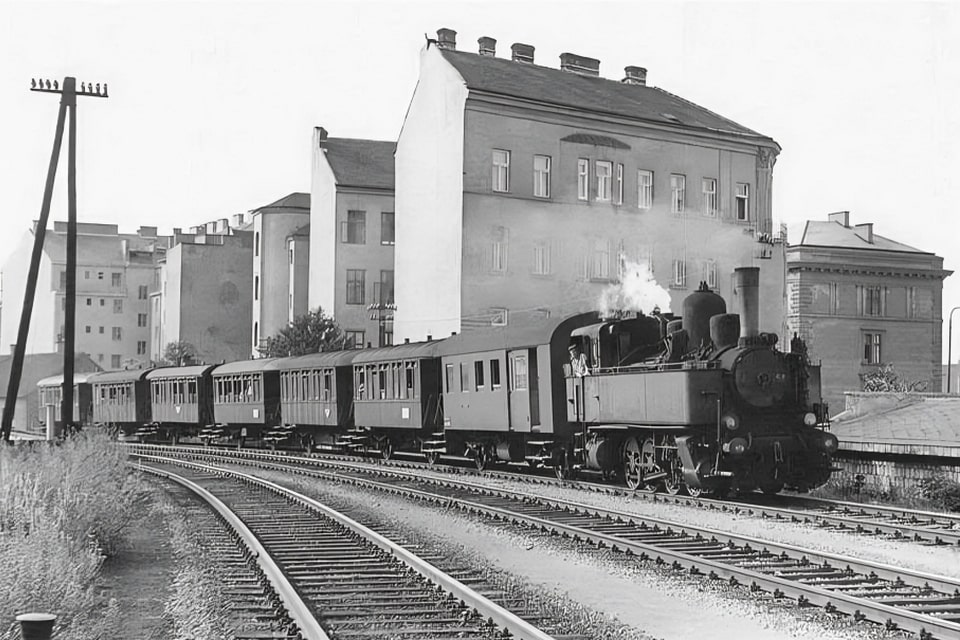
The British sector now included the 3rd district, Landstrasse, with the former Aspangbahnhof. The first post-war train departed from here on July 26, 1945, and until 1955, and the withdrawal of the Allied forces from Vienna, the British used Aspang station for delivering goods and people to their occupational zones in Styria and Carinthia. For years, these trains ran through Lower Austria, occupied by the soviet troops. Until 1947, the passenger flow from the station was limited to only one transport per day due to the shortages of coal. Apart from that, in Vienna, the Aspangbanhof was still connected by a spur to an inner line. After the exodus of the British administration, the station regained its primary use as a civilian suburban service, but the lack of investments into renovation deteriorated the state of the station and the facility over the years. While the last train left Aspang station on September 26, 1970, the complex was terminally closed on May 31, 1971, thus putting the history of the AspangBahnhof to an end. The formerly magnificent main building from 1881 was demolished in the summer of 1977. Despite suspending the passenger traffic, the freight depot facilities were used until 2001, and their demolition a year later opened the perspective for residential buildings for a total of 1,200 apartments and a green zone on the site of the former station.
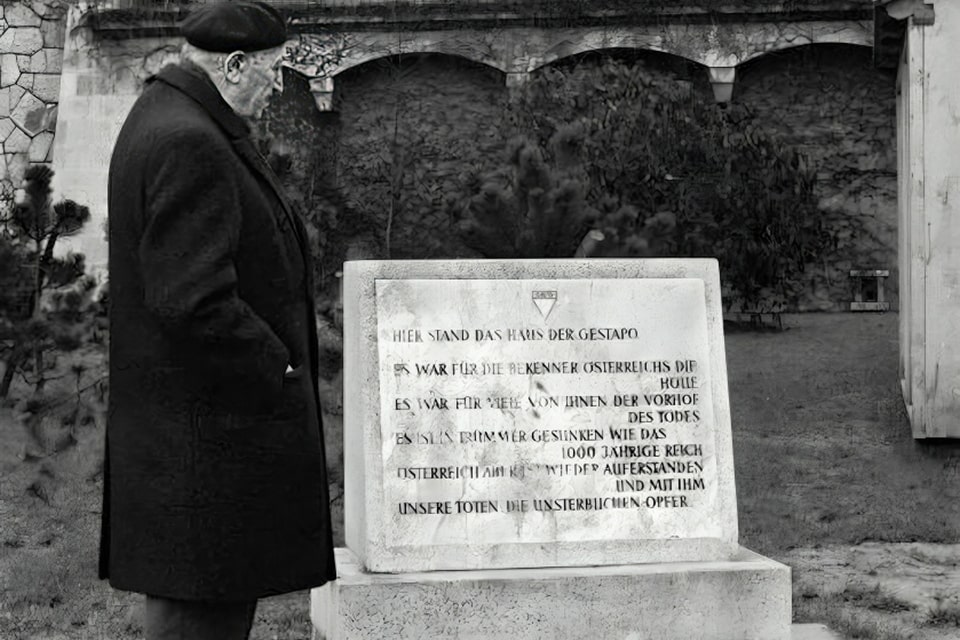
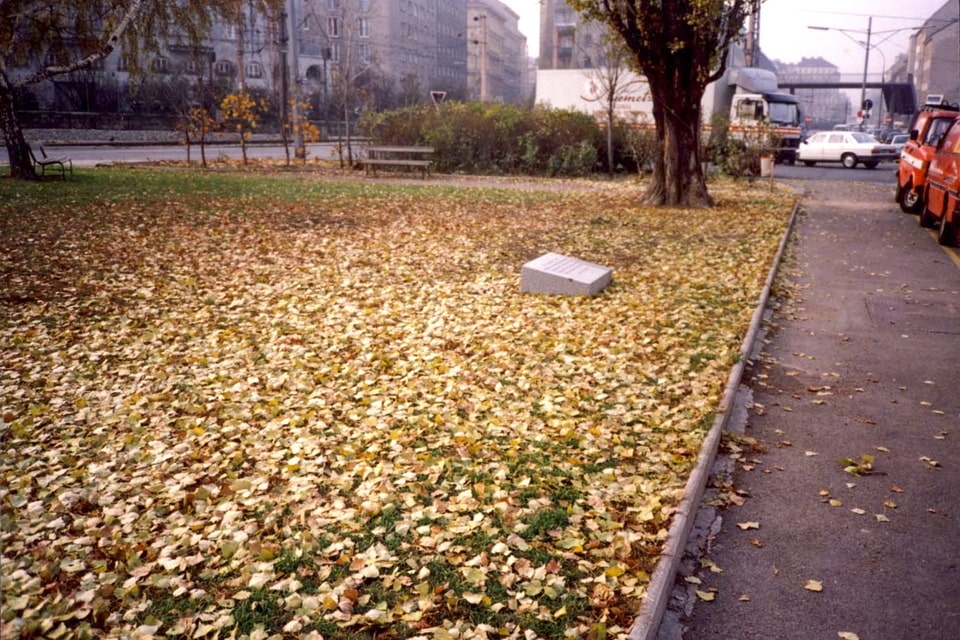
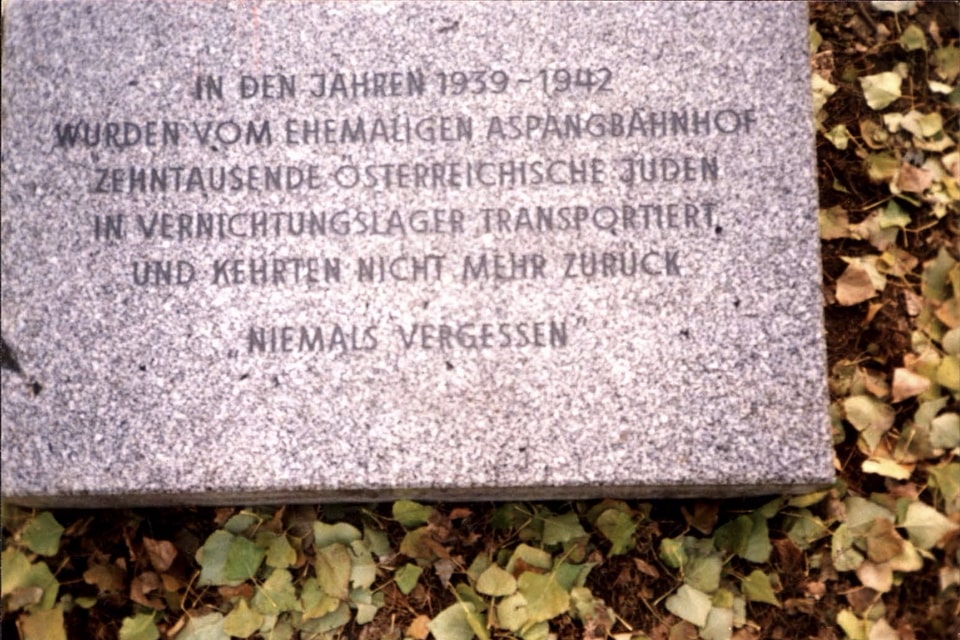
The first commemorative plaque on the site of the former deportation area was erected as late as 1983 with the words ‘Never forget!’, but the first fully-fledged commemorative ceremony took place on November 9, 1994, marking the anniversary of the infamous ‘Kristallnacht’ pogroms in 1938. Since then, the annual ceremony has taken place on this day to commemorate the memory of all victims of National Socialism. A year later, on May 8, 1995, the day of V-E, a small open space was inaugurated as ‘Platz der Opfer der Deportation’ (Square of the Victims of Deportation) next to the site of the former main station building. In October 2013, it became a part of the larger Leon Zelman Park, named after Dr. Leon Zelman (1928-2007), a Holocaust survivor and later the Director of the Israel Department at the Austrian Travel Agency. The year 2014 saw the release of a documentary movie called Aspangbahnhof 1941.
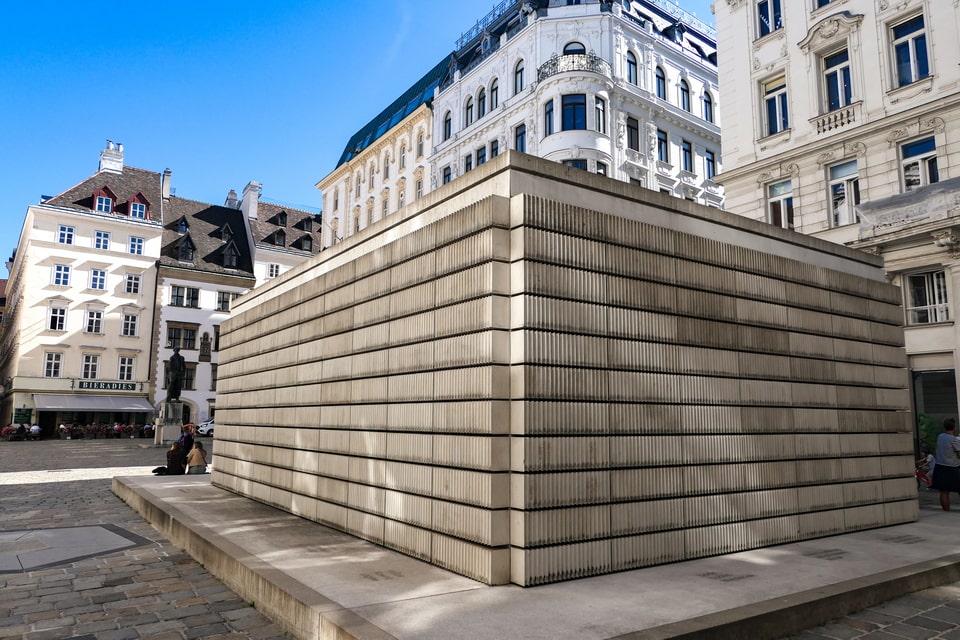
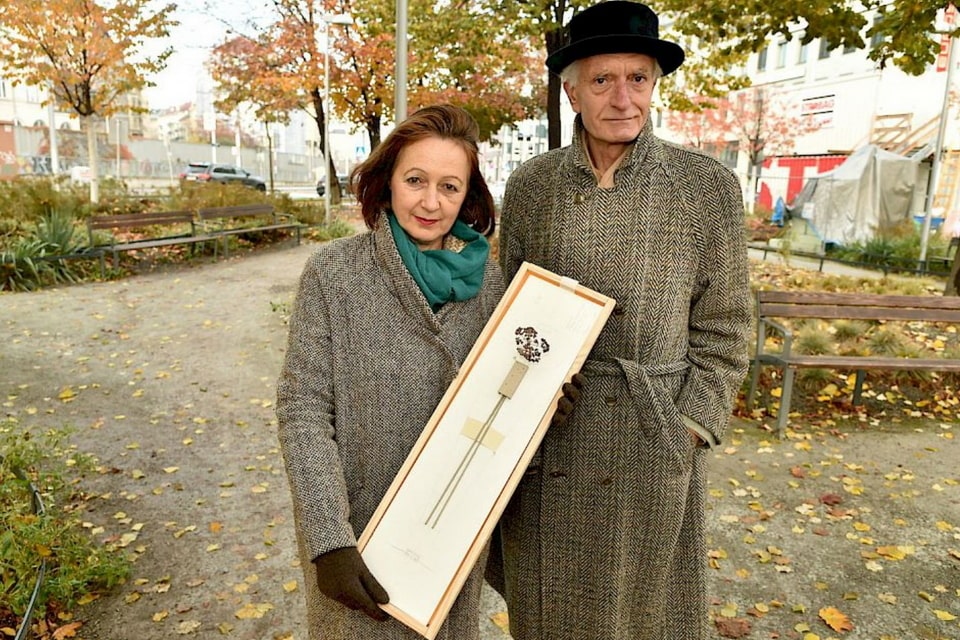
When the city authorities of Vienna approved the creation of a memorial devoted to the former Aspang deportation area in November 2016, the competition was won by a duo of architects from Vienna. Wolfgang Podgorschek (born 1943), who studied architecture in Vienna and Graz, and Brigitte Prinzgau (born 1955) have been working together since 1984. The memorial, which was inaugurated on September 7, 2017, consists of two concrete rails 30 meters long, thus representing the railway tracks, which brought tens of thousands of Austrian Jews to their death in the hands of the Nazi regime. The concrete tracks lead into a dark concrete block, a symbol of nothingness and death. The ceremony was attended, among other guests, by Israel’s ambassador to Austria, Talya Lador-Fresher (born 1962), and by Oskar Deutsch (born 1963, the President of the Jewish Community of Vienna. Among the guests was a 91-year-old Austrian Jew, a Holocaust survivor. Vienna took a very long time to mark any of this. The city’s first prominent public monument to the victims of the Nazi period — Alfred Hrdlicka’s Monument Against War and Fascism on Albertinaplatz — was unveiled only in 1988, half a century after the Anschluss.
Finding the memorial
The site is a fifteen-minute walk from the Belvedere and five minutes from the Landstraße–Wien Mitte interchange. Nothing about the modern quarter suggests what was here; the memorial is easy to walk past, and most people do.
The names. The square is the Platz der Opfer der Deportation, the park behind it is the Leon-Zelman-Park, named after the founder of the Jewish Welcome Service who survived Auschwitz and Ebensee, and the memorial itself is the Mahnmal Aspangbahnhof für die Opfer der Deportation. All four names — including the station’s own — will get you there on a map; «Aspang» alone will send you to a market town eighty kilometres away in Lower Austria.
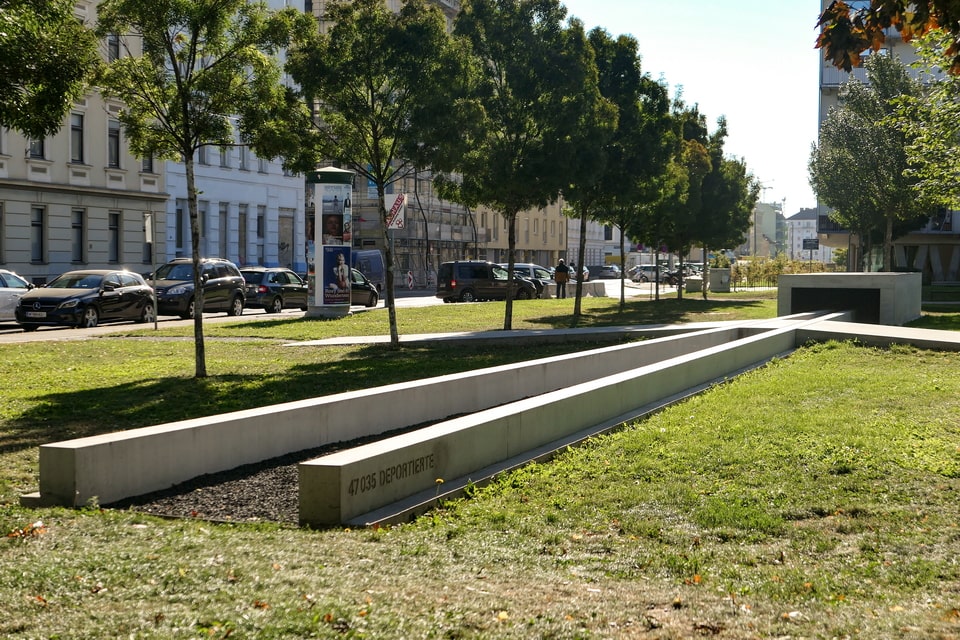
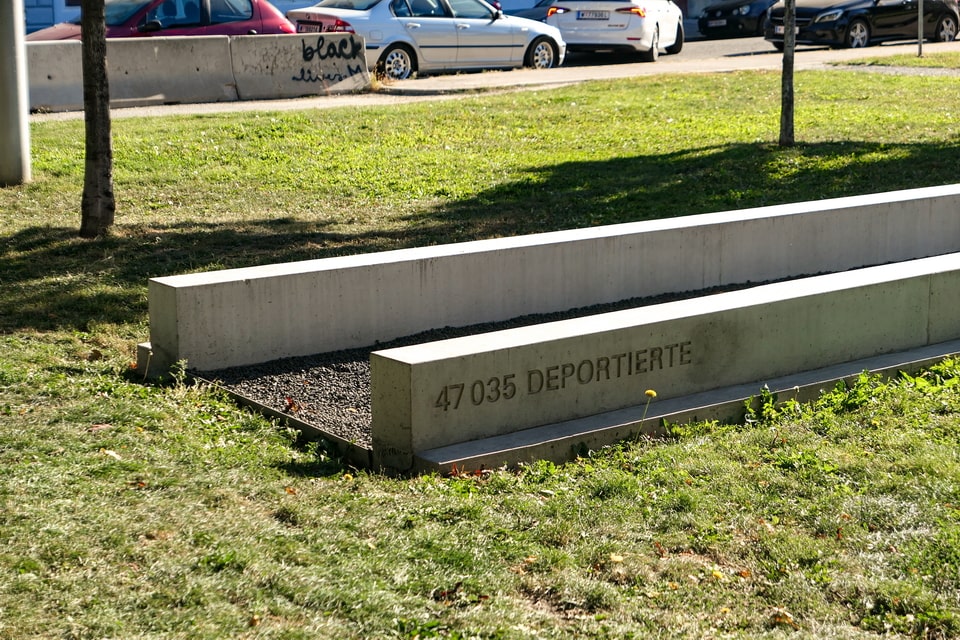
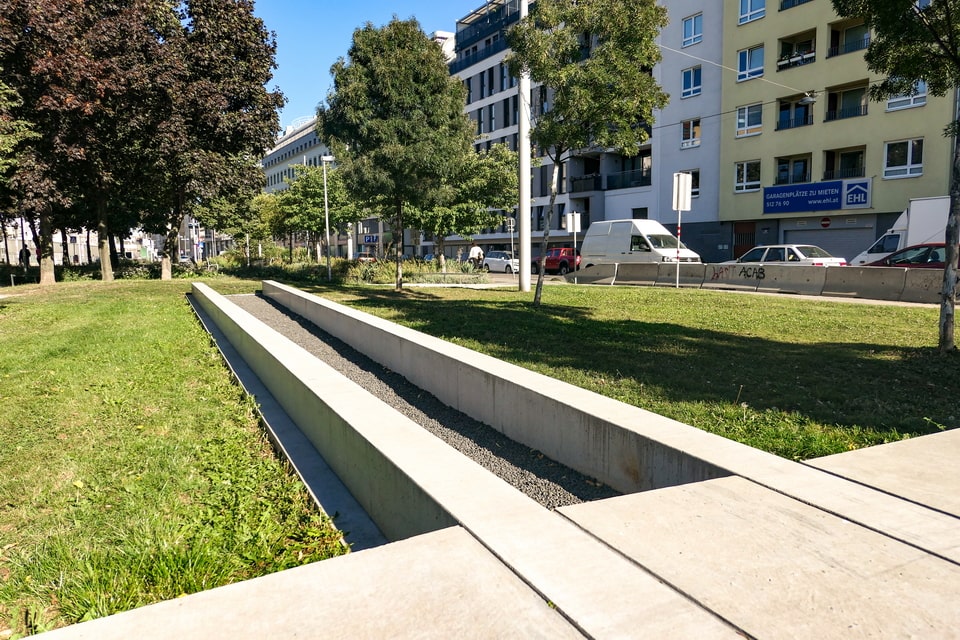
FREQUENTLY ASKED QUESTIONS
What was the Aspangbahnhof? A railway station in Vienna’s third district, opened in the 1880s as the terminus of a private line towards the south-east. By the late 1930s it was a quiet goods station — which is why it was chosen. Between 1939 and 1945, 47,035 Jews were deported from it. It was demolished in 1977.
Where is the memorial and what is it called? On the Platz der Opfer der Deportation in Vienna’s third district, beside the Leon-Zelman-Park. The memorial itself, installed in 2017, is the Mahnmal Aspangbahnhof für die Opfer der Deportation. Searching for «Aspang» alone will take you to a market town in Lower Austria instead.
How many Jews lived in Vienna before the Anschluss? The 1934 census counted 176,034 in Vienna — about a tenth of the city’s population and the third-largest Jewish community in Europe after Warsaw and Budapest.
Where were the Vienna Jews deported to? [Перечислить направления с датами — из таблицы Вставки B.]
What was the Zentralstelle für jüdische Auswanderung? The Central Office for Jewish Emigration, set up by Adolf Eichmann in August 1938 in the confiscated Rothschild Palace at Prinz-Eugen-Straße 20–22. It processed emigration as an assembly line: a Jew entered with property and papers and left with an exit visa and nothing else. The model was later copied in Prague and Berlin. The building was demolished in 1954.
Where were the assembly camps in Vienna? In requisitioned Jewish school buildings in Leopoldstadt — Kleine Sperlgasse 2a, Castellezgasse 35, Malzgasse 16 and 7, and Karajangasse 14. People summoned for deportation were held there for days before being marched or driven to the Aspangbahnhof. All the buildings still stand and most are working schools today.
I am very grateful to war archives, museums, libraries, private collections, and writers for the historical photos in this article. To the extent that some author or a copyright owner may not want some of the above black-and-white photos to be used for educational purposes here, please contact me for adding credits or deleting the pictures from the article.