

Sites Beyond the Birkenau Fence: the Judenrampe, the Little White House
WHAT LIES BEYOND THE BIRKENAU FENCE
The “standard” tourist route to the infamous Auschwitz death camp is generally divided into two semi-equal parts. Visiting the Auschwitz-1 (Main Camp) and Auschwitz-2 (Birkenau). We should remember that the historical significance of the site does not stop at the camp fence (Plaszów camp in Kraków is another preserved example), and a number of equally significant sites lie within walking distance around the barbed-wire perimeter. While walking and researching along the Birkenau, I noticed the narrow focus of the guided tours, limited in both time and the sites they cover. Only a small fraction of visitors ever see the Auschwitz-Birkenau camp succeeded in seeing the sites beyond the fence and pre-planned multi-person routes. This practice allows millions of people to visit the Memorial complex and honor the memory of the victims. Therewith, if you have an additional 1-2 hours, you can expand your understanding of Birkenau, and I hope my improvised route with photos and a map will help you to manage this idea.
Almost everyone who comes to Oświęcim sees two things: the brick blocks of Auschwitz I and the ruined chimneys of Birkenau. The standard tour lasts three and a half hours, follows a fixed path, and ends at the international monument between the ruins of Crematoria II and III. Nearly all of it takes place inside the wire. But some of the most consequential ground at Auschwitz lies outside it. The Judenrampe — the railway siding where transports were unloaded for more than two years before a single train ever passed under the Gate of Death. The Little White House, a converted farm cottage where Heinrich Himmler stood and watched a gassing in July 1942. The ash fields in the treeline, marked today only by low stones in several languages. None of these are on the museum route. All of them are within walking distance of the fence. In May 2018 I walked that ground over two days, with a camera and a map, and this article is what I found: sites beyond the perimeter, in the order you would reach them on foot, with directions, distances, my own photographs, and archive images of the same places seventy-five years earlier.
A note on why this matters beyond curiosity. The image most people carry of arrival at Auschwitz — the ramp, the selection, the gate behind — belongs to May 1944 and later. For the two years before that, the trains stopped a mile and a half short of Birkenau, at a siding in a freight yard, and over half a million people were unloaded there. The place where that happened is now a strip of gravel beside a road, with two goods wagons standing on it. Almost nobody goes. This is a walk through the parts of Auschwitz the tour does not reach.


BRZEZINKA: THE VILLAGE THAT GAVE BIRKENAU ITS NAME
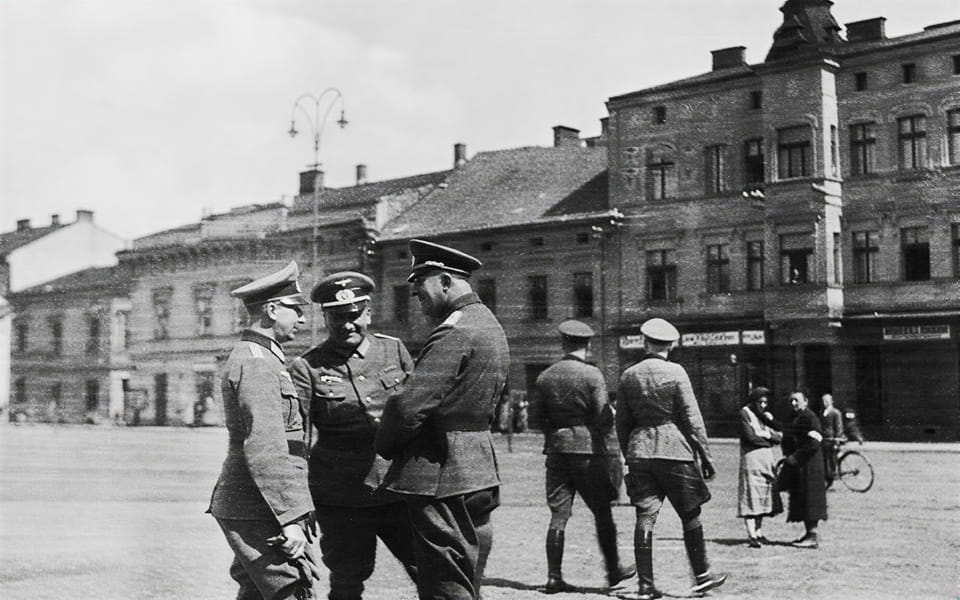
On the same historical principle as the Polish city of Oświęcim has become infamously worldwide known for giving a name to the Auschwitz death camp, a small village of Brzezinka, poorly acknowledged by tourists, gave a name to Birkenau. ‘Auschwitz’ reflects the German linguistic equivalent of the Polish ‘Oświęcim ’, and ‘Birkenau’ is little more than a German interpretation of ‘Brzezinka’. The “Brzezinka” originates from the Polish ‘brzoza’, which means ‘birch’. Brzezinka village dates back to the 14th century and, between now and then, was also a part of the Austro-Hungarian Empire and made its way back to the Polish state after the First World War. The first railway station was modernized the place back in 1856, and at that time, it faced the Brzezinka village. Before World War Two and the coming of the Germans, around 3,000 people lived in Brzezinka village in 536 houses. The civil infrastructure included an elementary school, two nursery schools, twelve shops, and seven workshops. The rapid growth of the village and the town of Oswiecim in the late 19th and early 20th century was influenced by their role as an important railway junction. Three different lines met here: ‘Kaiser Ferdinands-Nordbahn’ (Emperor Ferdinand Northern Railway) from the time of the Austro-Hungarian Empire; ‘Preußische Staatseisenbahnen’ (Prussian State Railways); and the Galician Railway of Archduke Charles Louis. The latter line connected Kraków and Oświęcim.
In the spring of 1941, several months before the German invasion of the Soviet Union, Heinrich Himmler prepared for the influx of prisoners of war, supervising the expansion of the Auschwitz complex to accommodate up to 100,000 POWs. At the same time, the date of the official order for creating a new labor camp was September 26, 1941, and the expansion was planned for the Zazole city district near the main camp. Still, Commandant Hoss preferred the cleared Brzezinka location, and the new location was agreed on October 4.
The present-day Brzezinka village, which is spread out between the Oswiecim railway station and the Auschwitz-Birkenau memorial, was largely reconstructed after World War Two. As a means to expand the Auschwitz-2 camp back in the spring of 1941, the Germans decided to displace the villagers of Brzezinka. A special commission of occupational bureaucratic origin had decided on February 10, 1941. The mass expulsion of the civilians from 7 to 12 April was followed by the dismantling of more than 500 households. Only six houses at that time were historically determined to avoid the earthmover bulldozers. Construction materials from the demolished houses of Brzezinka were later used to raise the brick barracks of Birkenau. A walking experience along the streets of the village reveals historical banners, and the adjacent highway opens a panoramic view over Brzezinka.


This ‘problem’ was about to be solved by the SS at Auschwitz, because a new camp was under construction a mile and a half away from Auschwitz main camp, at a village the Poles called Brzezinka and the Germans Birkenau.
Laurence Rees (The Holocaust: A new history, 2017)

The road that leads us to the Birkenau main gate (infamous “Gates of Death”) constitutes only a small part of the village, spread out along the east side of the camp. The post-war years witnessed the reverse demolition-construction process. The former villagers were now flipping back and using the ruins of the Birkenau camp, including the bricks from the gas chambers, to rebuild their pre-war households. Whereas Brzezinka was almost destroyed, it was not the only village around the Auschwitz-Birkenau camp, exposed to the mass expulsion of the population. The villagers of Plawy, Babice, Harmeze, Rajsko, and Broszkowice shared the same tragedy.


THE JUDENRAMPE: THE OLD UNLOADING RAMP OUTSIDE THE CAMP
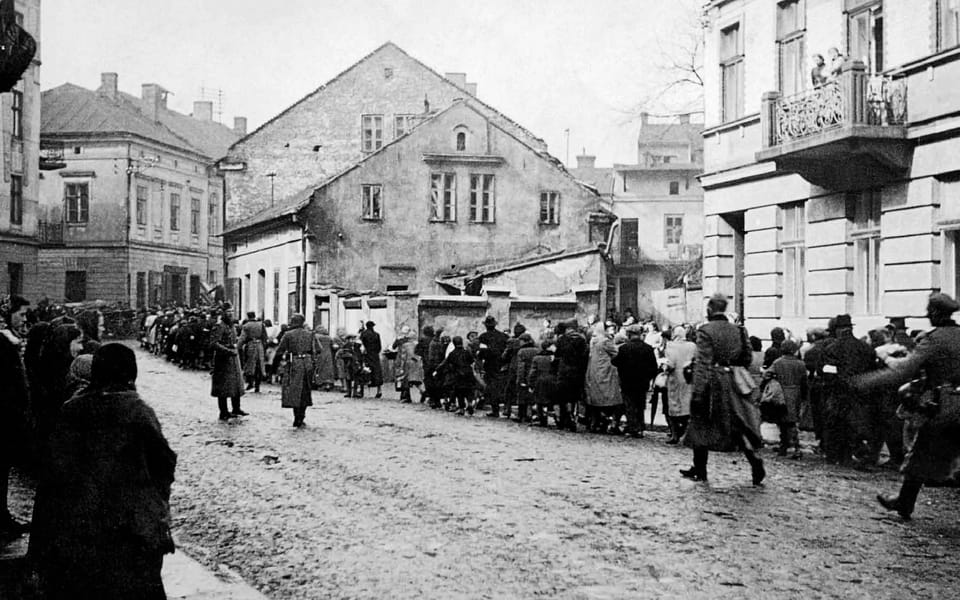
Most visitors to Auschwitz-Birkenau associate the tragic scenes of the victims ‘unloading’ from the cattle wagons with the ramp beyond the “Gate of Death”. Along with that, approximately every second victim (about 500,000) of the Auschwitz death camp got out of the train at this distant spot, a half kilometer away from the ‘Main Gate’. The platform historically known as the ALTE JUDENRAMPE (‘The old Jewish ramp’ or “The old ramp for ‘unloading’ Jews) was in use by the Germans from the Spring of 1942 till mid-May 1944. For example, only between January and late March 1943, sixty-six trains with at least 96,450 people were brought to Auschwitz from Bulgaria, Greece, the Netherlands, Belgium, France, Germany, Theresienstadt, Bialystok, and locations in the General Government. The initial wide wooden platform was later replaced with a concrete ramp 500 meters in length, lit with powerful projectors to be used during the hours of darkness.

During these two years, this very ramp ‘received’ hundreds of thousands of European Jews: people from France, Belgium, Holland, and 48,000 victims from Thessaloniki, Greece. The selection of those capable of work was carried out within the ramp, under the supervision of the SS doctors and the armed guards. This practice originated as far back as the earliest camps in the Reich, such as the Dachau concentration camp. These able-bodied people were forced to make their way to the camp on foot. The remaining 75% of the people who arrived were ‘loaded’ onto trucks with the false Red Cross sign. Their last way was destined to be finished through ‘Sonderbehandlung’ (special treatment), a German euphemism for the mass murder process. Josef Mengele, the infamous SS doctor known as “The Angel of Death”, started his ‘selection’ service here back in May 1943. The prisoners who worked on the ramp, mainly sorting the belongings of the newly arrived and delivering them to the storage facilities in the camp, were called ‘Aufraumungskommando an der Rampe’ (the ramp cleaning squad). Another unit, which collected food from those who arrived, was the ‘Essenwarensammlerkommando’ (a unit of food pickers).

Most of the Jews who died at Auschwitz were gassed upon arrival, never having spent time inside a camp. The journey of Jews from the camp to the gas chambers was a minor part of the history of the Auschwitz complex, and is misleading as a guide to the Holocaust or to mass killing generally.
Timothy Snyder (Bloodlands, 2010)


The Brzezinka village was demolished and turned into an empty field, and the Alte Judenrampe had a panoramic view over the ‘Main gate’ back in 1942-1944. The memorial site includes several plates with the revealed camp drawings, once depicting this tragic panorama with the “Gate of Death” in its pre-1943 state, still without constructive expansion. Two marble plates honor the memory of 70,000 French Jews, victims of the Holocaust, including 11,000 children. During the war, the Reichsbahn granted the SS a special transport tariff amounting to one-half of the standard fee for a third-class passenger. The bureaucrats calculated that the transportation of eighteen trains from France to Auschwitz cost 515,000 Reichsmarks, while delivering all Jews from Salonika (48,533 people) cost 1.9 million. Between 1942 and 1944, Auschwitz in total received at least 613 special trains with Jews, leaving Treblinka with 390 transports ‘in the second place’ in this deadly transportation.
In the days of the Birkenau camp, this ramp was a stone’s throw from the main railway line, connecting the city of Oswiecim with the Polish railroad to the South. The transport junction with several lines was titled the ‘Bahnhof West’ (Western railway station) and was within touching distance of the Kraków-Vienna line to the West-South. Jews from both Kraków and Vienna were among the victims of the Birkenau complex. After the war, it became clear that many railway workers knew that the Reichsbahn delivered hundreds of thousands of people to the killing facilities and concentration camps. For example, Walter Mannl, the chief of the Reichsbahn in Katowice, visited the camp in early 1942 and was told by one of his employees about gassing installations, but Mannl did not want to lose his job and remained in the position. Another railway worker, Willy Hilse, was told by an SS member about the killing process in September 1942, but he also did not ask for a transfer from Auschwitz.

Although Auschwitz was isolated in an area of swamp, rivers and birchwoods, the site had good access to rail communications. This was one of the reasons why the chemical conglomerate IG Farben became interested in establishing a factory there for the production of buna, or synthetic rubber.
Antony Beevor (The Second World War, 2012)
Although the Alte Judenrampe was not preserved after the war, the modern memorial site, made of granite stones, is in proximity to the actual location, now drowned in the green to the right. The actual railroad tracks were dismantled, and the modern one is not the same that was used back in the days of the Birkenau camp. The memorial site was erected only in 2005 with sponsorship assistance, a few dozen meters away from the historical tracks, for the reason of accessibility. At the same time, two cattle wagons are the actual ones, once used in Auschwitz.


The way from the Alte Judenrampe to the camp reveals a shadow profile of the tracks on the ground. This line is known as the ‘Track of Death ‘. We should consider the fact that it was built in 1944 to ‘receive’ trains inside the camp (many know it due to the scene from the ‘Schindler’s List’ movie) and did not exist at the time of the Alte Judenrampe. This shadow trail on the grass now makes its way through the private house holdings ahead to the ‘Main Gate’.


THE KARTOFFELLAGERHALLE: THE SS VEGETABLE WAREHOUSES
The winter months of 1942-1943 witnessed the forced construction of storage facilities a short distance from the main camp territory. This complex of warehouses included ten huge premises to preserve vegetables, potatoes in particular. In 1943, these premises were infilled with harvest fruitage from the surrounding farm holdings under the supervision of the SS. This ‘camp gather’ was generally not intended to be spread among the prisoners, who had made it possible. Vegetables were stored to be transported to the Reich.


The ‘Kartoffel Lagerhalle’ (potato warehouse) complex was constructed a stone’s throw from the Alte Judenrampe. In this respect, the prisoners involved in construction and later those who did work there were witnesses to the new ‘arrival’ and mass selection process in Birkenau. The modern state ruins of the former storage facilities span a quarter of a kilometer. Most of the premises are open-air now, yet some of the warehouses still have preserved wooden doors and even the remains of the electric power system within the walls.


THE KOMMANDANTUR: SS HEADQUARTERS OUTSIDE THE WIRE
The gradual expansion of the Auschwitz camp constantly demanded the ever-increasing importance of the SS staff. While the Brzezinka village was in the process of being leveled to the ground back in the Spring of 1941, only 700 members of the Schutzstaffel were engaged to work in both camps (Auschwitz-1 and Birkenau). In April 1944, only a month before the first trains from Hungary, Auschwitz had nearly 3000 members of the camp guard. Later on, in the same year, while the number of prisoners reached the value of the tragic 90,000 figure, the camp administration decided to raise the Kommandantur building and a complex of buildings for the SS. These new facilities were constructed beyond the camp fence, just in front of the ‘Quarantine’ section and the never-finished ‘Mexico’ sector.


Similar to the Mauthausen concentration camp near Linz in Austria, the Kommandantur is now the only building of this SS section of the camp, preserved today. Nearly twenty erections behind it, including barracks, a relaxation area, and the SS infirmary, were demolished after the war before the Museum was founded back in 1947. The former guard section today is a little more than concrete foundations within a grass field, neighboured by the Brzezinka house holdings. Back in the 1980s, the former SS Headquarters building was involved in a scandal, infamously known as the “War of the Crosses.” The conflict between the Jewish community, which tended to honor the memory of hundreds of thousands of people who perished, and the Polish Catholics. At a time when dozens of Christian crosses were erected within Auschwitz-1, a church occupied the former SS Kommandantur. “Holy Mary, Mother of Poland,” the Roman Catholic Church still uses the building with a cross on the roof.


THE LITTLE RED HOUSE: BUNKER 1, THE FIRST GAS CHAMBER OF BIRKENAU
The first gas chamber, erected in the Auschwitz-1 main camp, caused ‘difficulties’ for the camp administration. In the Winter of 1942, Rudolf Höß (also spelled Hoess), the commandant of the camp, ordered the creation of a new facility for the ”Sonderbehandlung ” (special treatment). Höß chose one of the six remaining buildings of the former Brzezinka village. A farm on the skirts of the woods beyond the Birkenau had been in the ownership of the Harmata family before the occupation and the forced expulsion of the Brzezinka villagers a year earlier. Höß had taken notice of this farm back in 1941, during the visit of Adolf Eichmann to the camp. Later on, the bloody-brown color of the bricks would create the tragic “Little Red House” euphemism. The Germans called the unplastered brick gas chamber Bunker-1.
The windows of the Harmata’s pre-war house were bricked up, and the inner walls were demolished. Therewith, a building 15*6.4 meters in size now had two pre-planned rooms (reduced from the pre-war four) with 80 square meters of total area, capable of killing 800 people at once, ten victims per square meter. Workers among the prisoners were commanded to make holes in the walls. Each of the two inner rooms had only one door with the “Zur Desinfektion” (to disinfection) sign. The doors were constructed from wooden beams and securely sealed at the edges. There were no peepholes, and the doors could be closed by tightening two bolts that also served as door handles. In contrast to the red brick building, the walls in the gas chambers were painted white, and the floor was covered in sawdust.
The Auschwitz administration had already stored some amount of Zyklon-B pesticide crystals, supplied by “Tesch & Stabenow,” who had a monopoly for the distribution of this disinfection chemical to the East of the river Elbe. The first ”Sonderbehandlung ” (special treatment) action in Bunker-1 became possible not until late March 1942. The fact of the matter was not in the ‘construction’ dates, but rather in the natural spring melting of frozen ground, as the corpses were planned to be buried.
In a remote corner of Birkenau, far away from any other habitation, the SS bricked up the windows of a small cottage – known as the ‘Little Red House’ or ‘Bunker I’ – and converted two rooms inside so that they could be used as gas chambers. High up in the walls of the cottage they fashioned hatches, through which they could throw Zyklon B crystals.
Laurence Rees (The Holocaust: A new history, 2017)

The first victims of the “Little Red House” mass actions were among the new Jewish arrivals on the day before. A small percentage of them were designated to manage the corps. The first ‘fully functional’ sonderkommando unit would be created only three months later. Bunker-1 was now just steps from the two wooden barracks, previously constructed by the prisoners for undressing the victims of the gas chamber. The “treatment” capacity of Bunker-1 reached the 800-victim figure. The corpses were loaded on improvised trolleys and transported to the mass burial sites on the skirts of the woods using the primitive narrow-gauge railroad.
From March to June 1942, “Little Red House” (Bunker-1) was the only gas chamber in Birkenau in operation. For example, between May 5 and 11, 1942, up to 5,200 people were gassed here, mainly Jews from the towns of Sosnowiec, Bedzin, Zawiercie, and Dabrowa Gornicza. Being elaborated with the “Little White House” in June, the Bunker-1 facility was in use till the end of April or the beginning of May 1943. Over thirteen months, it caused the death of dozens of thousands of victims. The tragic geography of these actions includes people from all over Europe: France, Belgium, the Netherlands, Germany, Austria, Poland, and even Norway. In May 1943, the Germans completely demolished the building as well as two wooden barracks, used for undressing. Even bricks from the destroyed building were taken away, and the site was leveled to a grass field. The modern site includes a historical banner and a complex of three memorials beyond the fence. Black marble honors the inscription “In memory of the men, women, and children, victims of Nazi genocide, who were murdered here” in Polish, English, and Hebrew.

THE MONUMENT TO THE SOVIET PRISONERS OF WAR
Marble’s three-part memorial to the former Bunker-1 is within touching distance of the Monument to the Soviet POWs, which can be seen on the skirts of the woods to the northwest of Birkenau. The scope of historical sources agrees with the 15,000 estimated figure of the Soviet prisoners of war, transported to Auschwitz at varying periods (12,000 were registered, and around 3,000 were not). Most of them, around 10,000, were brought to Auschwitz as early as October 1941 and placed in a temporary camp in the Stammlager. In March 1942, only 945 of them were still alive and transferred to Birkenau. They were forced to work on the most exhaustive assignments within the camp, including the expansion of Birkenau. Soviet POWs had tragically become among the first victims of the mass murder actions of gassing in Auschwitz, with only a few hundred who managed to survive the war, generally being transferred to other concentration camps.
Four slabs of black marble now honor the inscription in Polish, English, Hebrew, and Russian: “To the memory of the Soviet prisoners of war, who fell victim to Nazi brutality. Here lie their ashes. May their souls rest in peace”. The line about the ashes has more than just a symbolic meaning, as this very memorial was erected side by side with a big ash burial site. According to the memoirs of SS Sergeant Pery Broad of the Political Department of Auschwitz, the mass graves of the Red Army soldiers were about 50 to 60 meters long and 4 meters deep and wide.
The fate of some of the Soviet prisoners who were released from camps in the east suggested what was to come for the Jews. At Auschwitz in early September 1941, hundreds of Soviet prisoners were gassed with hydrogen cyanide, a pesticide (trade name Zyklon B) that had been used previously to fumigate the barracks of the Polish prisoners in the camp.
Timothy Snyder (Bloodlands, 2010)


THE LITTLE WHITE HOUSE: BUNKER 2, WHERE HIMMLER WATCHED
June 1942 witnessed the gradual increase in the number of trains arriving at Auschwitz from almost all parts of Europe. Rudolf Höß, the commandant of the Auschwitz death camp, ordered the assembly of a new facility for the “mass treatment” actions beyond the territory of Birkenau. While the so-called “Little Red House” (Bunker-1) owed its euphemistic name to the bloody-brown color of the bricks, the pre-war house of the Polish family Wichaj was covered in stucco. A short time afterward, this building had gained the “Little White House” epithet among the prisoners and the Bunker-2 among the German SS guards. The second killing site was larger than Bunker-1, measuring 17.07 by 8.34 meters, with four rooms inside and doors similar to the ones in the Little Red House. The pre-war ceiling, made of wood, was replaced with concrete. Because of the larger size, Bunker-2 could kill up to 1,200 people at a time, compared to 800 for Bunker-1. On one occasion, on October 12, 1942, 1250 persons from the transport from the Netherlands (out of 1,703 people who arrived at Auschwitz) were killed in Bunker 1. The corpses of the gassed victims were then transported to the mass burial sites a few dozen meters to the north using the narrow-gauge railroad line. After each killing procession, the prisoners from the Sonderkommando unit cleared out the gas chambers and washed the floor and the walls.
The first ‘period in operation’ of Bunker-2 was carried out between June 1942 and May 1943. It was here, near Bunker-2, that Heinrich Himmler witnessed the whole process of ‘Sonderbehandlung’ (special treatment) during his visit in July 1942: from the unloading of the Dutch Jews from the trains to moving people inside the Little White House. It was not demolished in May, as Bunker-1 (Little Red House) was. The “Little White House” was once again put into operation in May 1944 during the initial phase of the Hungarian Jews’ mass deportations. Regarding Höß’s after-war memoirs, the ‘mass treatment’ actions were always carried out at night, and the former Polish farmer’s house was accompanied by the twigs of fruit trees that brooded above.

Unlike the Bunker-1 facility, the Germans demolished the “Little White House” in the late Autumn of 1944 with the shutdown of the mass murders in Auschwitz. The modern-state condition of the memorial site was recreated by the Auschwitz museum staff in the same way it was carried out within the former crematoria IV and V. Notwithstanding that the site correlated with the actual locations of Bunker-2, the Germans had left no ruins after the demolition. By this means, the form lines of the walls now only replicate the former building of 120 square meters (17*8 meters in size).
The recreated ruins of the former Bunker-2 historically indicate four small gas chambers with the once-used holes for the Zyklon-B, as well as a separate premise for the sonderkommando squad. Some construction parts of the former “Little White House” were used by the local villagers to rebuild their pre-war homes in Brzezinka, leveled to the ground back in the Spring of 1941.


THE ASH FIELDS AND THE REMEMBRANCE STONES IN THE WOODS
While the Auschwitz camp administration was gradually working on modifying and perfecting the gassing facilities, this simultaneously created a new problem: the increase in execution efficiency meant the ‘accrual’ of disproportionately more corpses. Added to this were the bodies of those who had died from deprivation, which were left behind in the barracks at every morning roll call. The space in the morgue barracks built in March 1942 was probably barely sufficient for these. In the short term, only burying the bodies nearby helped the killing machine.
By the time Heinrich Himmler made his second visit to Auschwitz on July 17-18, 1942, the Bunker-1 facility had already been in operation for four months, and the second mass action site had been brought to work a month before (Bunker-2). At that time, in the Summer of 1942, the corpses of the gassed victims were buried in the pits on the skirts of the woods to the northwest of Birkenau, being ‘transported’ through two narrow-gauge rail lines, one to a gassing facility. The meadows were not chosen for the excavation of the mass graves solely because of their proximity to the gas chambers: a large proportion of the murdered Soviet prisoners of war had already been buried on the site. The exact date of the construction of this railway is unclear, but the analogy to Chelmno, Sobibor, and Treblinka, where similar procedures were carried out in the summer of 1942, is obvious.
Two separate ‘sonderkommando’ (special squads) units were used to manage the process at the time. It consisted of twenty, according to other sources, fifty people. After the ‘mass treatment’ action of the Jews from Holland, the Reichsführer of the SS was concerned that the Auschwitz camp could not manage the growing number of trains. Himmler ordered Rudolf Höß to ‘improve’ the process of the mass actions. The very same evening, the Reichsführer had some wine and a cigarette with his subordinates and left the camp using his Mercedes the day after.
On 17 July, Himmler arrived to inspect the growing Auschwitz complex. Afterwards, Himmler, with his entourage, went to the railway siding to watch the unloading of a transport of Dutch Jews, as the camp orchestra played again. Himmler followed the group selected for the gas chambers in Bunker No. 1, and watched through a small window as they died. He then observed the Jews in the work commando dispose of the bodies and told Höss that in future he should burn the corpses instead.
Antony Beevor (The Second World War, 2012)


It took Höß a while to do his best to carry out the order of the Reichsführer by increasing the number of ‘sonderkommando’ members and planning the new methodology. Shortly after Himmler’s visit, Paul Blobel (1894-1951), SS-Standartenführer, came to Auschwitz to speed up the process. Being officially an SD chief in Nuremberg, Blobel was actually the chief of a newly formed secret ‘Sonderaktion 1005′ operation, aimed at destroying the evidence of the Nazi mass crimes. He shared his experience with Höß in digging out, burning bodies, and scattering their ashes to prevent the possible calculation of the number of victims.
Already in September 1942, the selected units of Jews were ordered to excavate the former mass burial sites on the fringe of the forest, 250 meters aside from the Birkenau camp fence to the northwest. From then on, all new corpses of the gassed victims had to be burned open-air soon after the ‘treatment’. Up to 2000 bodies were piled in huge pits, mixed up with logs of wood, and covered with fuel (generally, with oil refuse and methanol) to be burned to complete cremation. People who were killed recently were mixed with the exhumed bodies. After some experiments, the piles were replaced with huge, long pits, 30 meters long, 7 meters wide, and 3 meters deep, with a total capacity of burning up to 5,000 bodies every day. The ashes of these actions were meant to be spread or buried nearby. The core personnel of the incineration squad likely came from the prisoners previously deployed in Bunkers 1 and 2, or in digging the pits there.
Regarding Rudolf Höß’s testimonies, 107,000 corpses were cremated in the same manner till the end of 1942, and this practice was carried out until May 1943, when new crematoriums were put into operation within Birkenau. Mass burning actions taken open-air were once again used in May 1944 with the renewal of the Bunker-2 (‘Little White House’) usage. The firewood for these mass burning actions was brought to Birkenau from the Kobior sub-camp, 15 kilometers to the West. According to accounts from former prisoners, human ashes were also utilized in the construction and maintenance of camp roads, for sprinkling pathways along living accommodations for the camp staff, and thermal insulation in various construction project locations inside Auschwitz.

Historical research has revealed several burial sites, known as the “ash pits” or “ash burial sites,” to the northwest of the former Birkenau death camp territory. These tragic locations include the former pits, where the corpses were cremated by open fire, as well as the burial sites for the ashes, brought here from the four big crematoriums within the Birkenau complex, starting from April 1943. As early as the summer of the same year, the Nazis would initiate an unprecedented action on the cover-up of the physical evidence of the mass killings throughout Europe, particularly in the East (the notorious Babi Yar in Ukraine was to become a scene for such ‘Aktion’). The fate of the members of the Sonderkommando units was closely connected to hiding traces. 80 men, who were directly engaged in Bunkers 1 and 2, were killed as early as August 1942. The second larger group, up to 300 men, who were assigned to the September-November works under Aktion 1005, were gassed on December 3, 1943.
Considered the biggest ash dumpsite, the burial location can be found just beside the Monument to the Soviet POWs. This clearing in the woods is now fenced off from tourists. The second big ash burial site is located within a green glade next to the former “Little White House” location. The site is honored with three marble slabs with the inscription: “To the memory of the men, women, and children who fell victim to the Nazi genocide. Here lie their ashes. May their souls rest in peace”. The ashes from Birkenau were also dumped beyond the territory, thrown off to the rivers of the Vistula and Sola, and used as fertilizer materials. SS personnel were forbidden from using the local water supply; instead, they received free mineral water from the SS-owned (»Aryanized«) Mattoni company. Any use of the Sola stream— from bathing to drawing water, washing clothes, or watering livestock—was considered unhealthy.
In 1965, Hydrokop, a technical enterprise specializing in chemical mining and located in Kraków, was engaged by the Auschwitz-Birkenau State Museum to conduct geological work experiments at Birkenau focused on identifying the sites of incineration pits and pyres. Hydrokop specialists drilled 303 holes, each up to 3 meters deep, and discovered traces of human ashes. Bones and hair were discovered at 42 locations.


THE UNDRESSING BARRACKS AND THE CLOTHING WAREHOUSES
Visitors to the Auschwitz-Birkenau Museum can also distinguish unobvious historical sites, such as the concrete foundations of two buildings 100 meters away from the “Little White House”. The long-drawn premises were once used as the barracks where the doomed victims had to undress before gassing, as well as the warehouses for cloth, which was then sorted and distributed by the inmates from the “Canada” section of the camp.
In February 1943 alone, 824 rail freight cars departed from Auschwitz for the Old Reich with textiles and leather goods. Most of the loot went to the Economics Ministry for recycling purposes, but over 200 loads of clothing, bedding, household linen and towels were sent to the Nazi Party office for the welfare of ethnic German settlers.
David Cesarani (Final Solution, 2015)


HOW TO WALK THE ROUTE: DISTANCES, ACCESS AND WHAT YOU NEED TO KNOW
Everything in this article can be reached on foot, in a single long day, without a car and without a guide. Nothing described here requires permission, and nothing is behind a ticket barrier — but two of the sites are on private or working land, and one is easy to walk past without noticing. What follows is the practical part.
The route, in order. Start at the Auschwitz I visitor centre. The Judenrampe lies roughly halfway between the two camps, on the north side of the road, about 1.5 km from Auschwitz I and about 1 km short of the Birkenau gate. The shuttle bus between the camps passes within sight of it and does not stop; on foot it is a twenty-minute walk along the road. From the Judenrampe it is another fifteen minutes to the Gate of Death. The remaining sites are clustered beyond the western end of Birkenau. Entering the camp by the main gate and walking the length of the rail spur takes about twenty-five minutes. Past the ruins of Crematoria II and III, past the international monument, past the Zentralsauna, the fence turns. The Little White House, the ash fields and the undressing barracks all lie in the few hundred metres beyond that turn — the western fringe, where the camp meets the treeline.
Access. The Judenrampe is open ground, permanently accessible, free, and unstaffed — there is no gate and no opening time. The sites at the western fringe are within or immediately adjacent to the museum grounds and are reached during normal opening hours; some are fenced off from visitors and must be seen from the path. Nothing here is a place to climb over anything for a photograph.
What to expect to see. Very little, and that is the point. The Judenrampe is a strip of platform, a length of track, and two goods wagons. The Little White House is a rectangle of foundations in the grass, with a plaque. The ash fields are a clearing and a pond with low memorial stones around them. None of these sites announce themselves. Without knowing what you are looking at, you would walk past all three.
Practicalities. Allow a full day if you want to do both camps and this route; allow half a day for the outer sites alone. The western fringe is unpaved and floods after rain — boots, not trainers. There is no shade on the walk between the camps and no water anywhere past the visitor centre. In winter the ash fields are under snow, and the stones are invisible; late spring and early autumn are the best times, which is why these photographs are from May.
One thing worth saying plainly. This is a burial ground. The ash fields are not a ruin or a monument; they are where the remains of tens of thousands of people were put. Walk round them, not across them.
FREQUENTLY ASKED QUESTIONS
What is the Judenrampe?
The Judenrampe — the “Jewish ramp”, also called the Alte Judenrampe or old ramp — was a railway siding in the Oświęcim freight yard, between Auschwitz I and Birkenau. It was used from the spring of 1942 until May 1944 to unload transports of deportees. Over half a million Jews were unloaded there, along with tens of thousands of Poles, Roma, and others.
Can you visit the Judenrampe today?
Yes. It is open ground beside a public road, freely accessible at any hour, with no ticket and no staff. It is roughly halfway between the two camps, about a twenty-minute walk from Auschwitz I. The memorial there — part of the original platform, four boards and two original goods wagons — was opened on 27 January 2005.
What was the Little White House at Auschwitz?
It was a farm cottage of the cleared village of Brzezinka, converted by the SS into a gas chamber and in operation from June 1942. Prisoners called it the little white house; in SS documents it was Bunker 2. It was taken out of use in the spring of 1943 when the crematoria opened, brought back into use in May 1944 for the Hungarian transports, and demolished in November. Its foundations are still visible in the grass at the western fringe of Birkenau.
What is the difference between the Little Red House and the Little White House?
They were two separate cottages, a few hundred metres apart, both left standing when the village was demolished. The red house — Bunker 1 — was converted first and was operating by March 1942; its four rooms were rebuilt into two gas-tight chambers, and it was pulled down in 1943. The white house — Bunker 2 — followed in June 1942 and was larger. Only the white house left visible remains.
Did Himmler really watch a gassing there?
Yes. On 17 July 1942, Heinrich Himmler visited Auschwitz and was shown, among other things, the arrival and selection of a transport of Dutch Jews and their killing in Bunker 2. The commandant who conducted the visit was Rudolf Höss — not Rudolf Hess, the deputy party leader, who had been in British captivity since May 1941 and is frequently confused with him.
Where are the ash fields and the remembrance stones?
At the western edge of Birkenau, beyond the last barracks, where the cleared ground meets the treeline. Ashes from the crematoria and the burning pits were dumped in ponds and clearings here. The sites are marked today with low memorial stones carrying inscriptions in several languages. They are not signposted on the visitor route and are easy to walk past.
Why are these sites not on the museum tour?
Time and ground. The standard guided visit runs about three and a half hours for both camps and follows a route that can be walked by large groups; the outer sites are up to a kilometre beyond the end of that route, on unpaved ground that floods. They are not closed to the public — they are simply not included.
What does Birkenau mean?
It is the German form of Brzezinka, the name of the Polish village that stood on the site. Both mean “birch wood” — from brzezina in Polish, Birke in German. The birches are still there, on the western edge, and it is in those woods that the ash fields lie.
I am very grateful to war archives, museums, libraries, private collections, and writers for the historical photos in this article. To the extent that some author or a copyright owner may not want some of the above black-and-white photos to be used for educational purposes here, please contact me for adding credits or deleting the pictures from the article.