

Hitler’s Apartments in Munich and the NSDAP Headquarters, 1913–1945
Ask where Hitler lived in Munich and you will usually be given one address: Prinzregentenplatz 16. That is the famous one — nine rooms, 317 square metres, the flat where his niece Geli Raubal shot herself and where Neville Chamberlain was received in September 1938. But it is the last of several, and by no means the most revealing.
Hitler arrived at Munich’s Hauptbahnhof on 25 May 1913, twenty-four years old and dodging Austrian conscription, and rented a furnished room from a tailor’s family at Schleissheimer Strasse 34. He came back from the war and, from 1 May 1920, spent nine years in a single rented room at Thierschstrasse 41 — a room with a table, a chair and worn linoleum, three hundred metres from the offices of the party newspaper. Only in October 1929, with 150,000 party cards issued and the world economy collapsing, did he move to Bogenhausen and the flat everybody now names. The party moved in parallel, and it moved four times: a back room behind the Sterneckerbräu in 1919, a shopfront on Corneliusstrasse 12 from 1921, thirteen rooms in Heinrich Hoffmann’s photographic building on Schellingstrasse 50 from 1925, and finally the Brown House on Brienner Strasse — a bought palace, opened in March 1931.
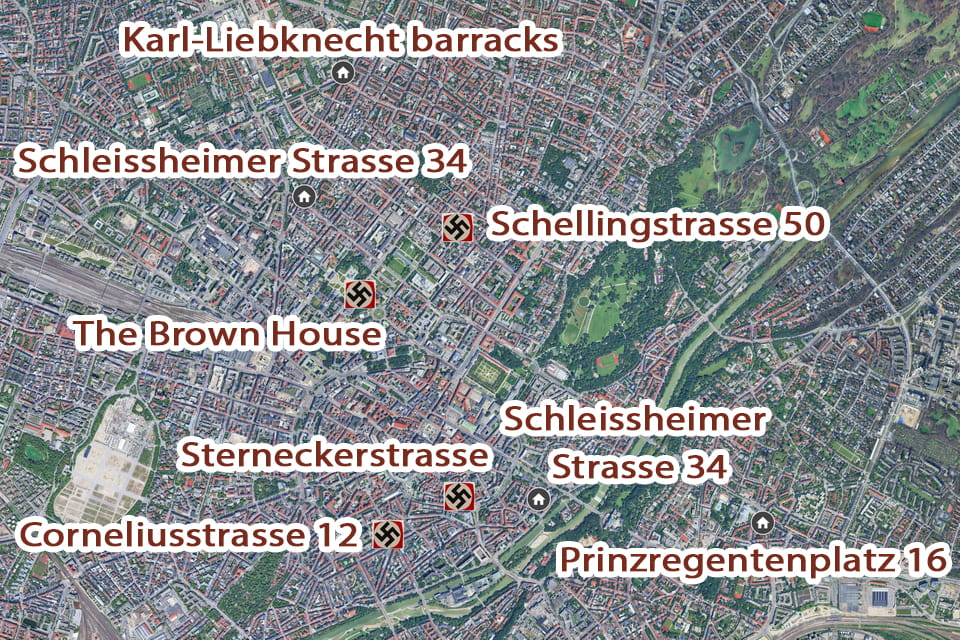
This article follows all seven buildings in order, with the archive photographs, my own pictures taken on the spot in August 2018, and what stands at each address today. Three of the eight are gone or unrecognisable; five are still there, and you can walk between all of them in an afternoon. The map and the full address list are directly below; visiting information and the questions people ask most often are at the end.
WHY HITLER MOVED TO MUNICH IN 1913 — AND WHY HE STAYED
Every authoritative biography of Adolf Hitler, written with the author’s pen by Volker Ullrich, John Toland, Ian Kershaw, Joachim Fest, and Alan Bullock, devotes no less than a definite chapter to Hitler’s life interlude between the so-called ‘Viennese period’ and the battlefields of World War One. Once we forward ourselves deep enough into the past and the story of the Nazi movement, in a voyage to reveal the causes of why Munich had been praised as the “Hauptstadt der Bewegung” (The Capital of the Movement), we find ourselves within a platform of the Munich HAUPTBAHNHOF on May 25, 1913. In these places, Hitler would get acquainted with his future patrons and the members of what would be once called the ‘inner circle’. Those historical relations would lead some of them up to the scaffold of the Nuremberg Trials.
It was nowhere more than Munich to witness the rise of Hitler’s confidence as a political spokesman within the beer halls to the very extent that would push him to challenge the Bavarian government on November 8-9, 1923, in pursuit of what would make history as the ‘Beer Hall Putsch’. Years after that May afternoon of 1913, the DAP party, encouraged by Hitler’s charisma, would open its first headquarters and establish the semi-military formations, known as the ‘stormtroopers’. Thousands of its members would take the personal oath to Hitler, would form an approving devotion to his speeches and vision of the future, as well as millions of Germans would journey to Munich to attend the regime’s sacred places and museums, spirited and benedicted by Hitler first-hand.


SCHLEISSHEIMER STRASSE 34: HITLER’S FIRST MUNICH ADDRESS, 1913–1914
Joachim Fest writes on Hitler, who left Vienna on May 24, 1913, using a Vienna-Munich train. A station, which could be met with the statements of Toland and Ullrich, that the future German Führer stepped onto the platform of the HAUPTBAHNHOF on a sunny Sunday of May 25. Meanwhile, Ian Kershaw cites the fact that Hitler was registered in the local police department on May 26, 1913. One of the only first-hand sources on the ‘Munich’ period of Adolf Hitler’s life before his army service is associated with Rudolf Häusler, a young student at that time. A twenty-year-old, born into a deep-pocketed Viennese family, Rudolf Häusler became friends with Hitler at the Männerheim hostel for men in February 1913 (Rudolf Häusler moved to the hostel on February 4), only three months before they departed for Munich. Upon arrival, the two young men rented a modestly furnished room №3 on Schleißheimer straße 34, a 20-minute walk from the railway station, only five minutes’ distance from the LOWENBRAUKELLER beerhouse and a few city blocks from the apartment that was placed by Lenin some eleven years before (the fact, beyond Hitler’s knowledge).
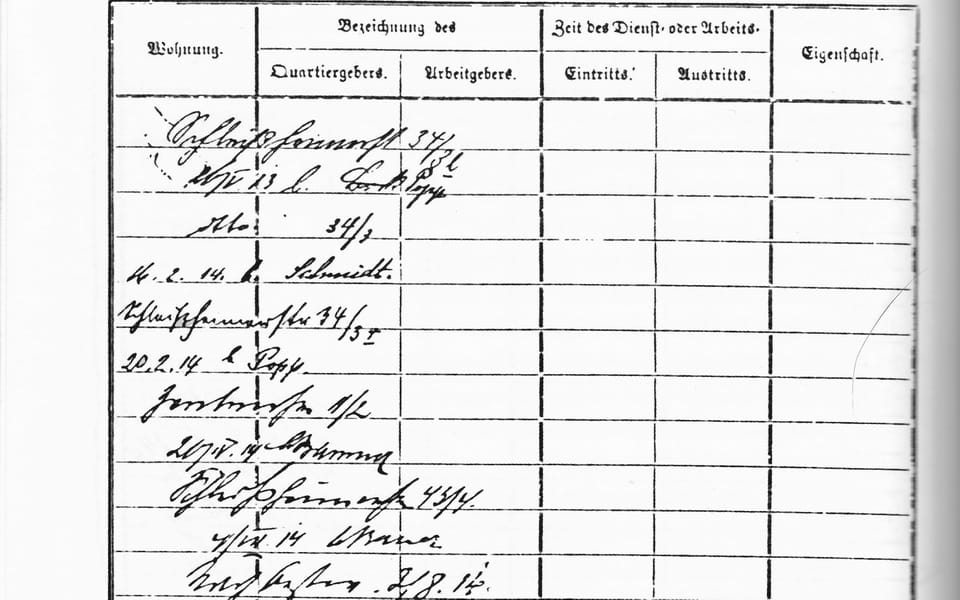
The second, still an important first-hand source on a young Hitler in his Munich year, is historically associated with Herr and Frau Popp, the owners and leaseholders of the very room on Schleißheimer straße 34. The first floor of the building was used as the tailor shop of the Popp family, and the second floor was accommodated by the owners themselves, as the upper two floors were designated for renting as “Furnished rooms to let to respectable men.” (the sign mentioned in every second biography of Hitler). Year after year, the Popp family expressed nothing but warm sentiments on their young Austrian roomer, who (from Popp’s say) used to read a lot within his room, painted drawings for sale, and politely said no to the perspective to share the dinner with the owners.

Another sequence from Hitler’s life to be mentioned in every recognized biography generally reveals the fact of Hitler’s dodging conscription to army service first within the Viennese and then in his Munich period. It was the very room at Schleißheimer straße 34, furnished including a bed, a sofa, a table, and a chair, that witnessed the unexpected visit of an officer of the Bavarian police (to serve a writ on Hitler) on January 18, 1914. After the rejection as unsuitable for army service in February, Hitler went back to his room on Schleißheimer straße 34, which he used to rent on his own at that time (Rudolf Häusler had moved out as early as February 15). By that time, Hitler had succeeded in providing himself with several regular buyers of his drawings and used to live in a small way in a room inside Popp’s household. A month after the devastating news of the assassination of Franz Ferdinand, the heir of the Austro-Hungarian Empire, Hitler finally, for his part, heard the announcement of the war at Odeonsplatz on August 2, 1914. Two weeks after, he was taken into service and left Popp’s house, moving to the army barracks, yet within Munich.


THIERSCHSTRASSE 41: NINE YEARS IN A RENTED ROOM, 1920–1929
On November 19, 1918, a little more than five years since Hitler’s set off from Munich as a soldier of the Emperor’s army and only ten days since the news of the end of the Great War (the moment to be self-distressed by Hitler in the following years and within the ‘Mein Kampf’), he was discharged from the PASEWALK hospital. The future German Führer would later describe this military complex near Strasbourg as the cradle of his political awakening. Two days later, the thirty-year-old corporal Adolf Hitler retraced his way back to Bavaria to be sent, another month later, to Traunstein city, neighboured by the Austrian Salzburg, as a soldier of the 3rd Infantry Regiment. For the following month up to the disbanding of the military camp in mid-January, Hitler did his duties as a guard for the prisoners of war and some civilian prisoners.
Retrieving his way to Munich, Hitler would spend the next one and a half years as a resident of the ‘Karl-Liebknecht-Kaserne’ barracks. As late as May 1, 1920, a month after his demob from the army and after having been a member of the DAP party for nearly eight months, Hitler rented a small 2.5 × 4.5-meter room in apartment number 1 on Thierschstrasse 41 opposite a fruit shop run by Frau Magdalena Schreyer. The apartment on the second (from the ground) floor had been owned by the Reichert family: Ernst and Maria since June 30, 1914. Once again, the modest living space furnished with a table, a chair, and an old, tired linoleum was far from better than his room in the Männerheim hostel in Vienna, as well as his first accommodation in Munich on Schleißheimer straße 34, owned by the Popp family. Hitler would be in some way devoted to the Reichert family: in 1924 Frau Maria Reichert visited Hitler at least twice in his cell in Landsberg prison, and the Reichert couple would serve as house staff in the apartment at Prinzregentenplatz 16, and years later the German dictator would send the family Christmas gifts every year. The elderly couple would outlive Hitler for six years until 1951, and their daughter Antonia would later leave some recollections about him.

Once again, Hitler could be associated as no less than a diligent renter, who used to pay accommodation revenue like clockwork, a habit he had sustained from the year 1910 and his move to the Männerheim hostel in Vienna. The accounts of Hitler’s second Hitler’s apartment in Munich on Thierschstraße 41 had become a thing of history due to ‘Hitler. The missing years’ memoirs of Ernst Hanfstaengl were first published in the US in 1957. In the role of one of the members of the inner circle of the Nazi movement and Hitler back in the 1920s and 1930s, Hanfstaengl managed to describe Hitler in his house-shoe with a rare habit of using other premises of the apartment (he rented a room inside the shared apartment), such as a hallway and a kitchen.

This very apartment on Thierschstraße 41 (not the beer hall as it was depicted in the ‘Hitler: The Rise of Evil’ movie) witnessed a scene when Hanfstaengl did succeed in impressing Hitler with his piano playing. With a closer look, the very chapter of the book bears a symbolic name: ‘Tristan in the Thierschstrasse’, marking the name of the street where Hitler used to live between May 1920 and October 1929 and drawing a parallel between Adolf and the legendary mythological character of the medieval stories.


Once we take a closer look at the very location of Hitler’s second apartment in Munich on Thierschstrasse, it’s easy to make one-plus-one to reveal that building number 41 was at that time located only 300 meters distant from the office of ‘Völkischer Beobachter’. Hitler’s biographers do not have solid facts as to whether it was an informed choice, yet seven months later, on the eve of Christmas 1920, the publishing was bought by the party. Hitler spent his night and the hours of November 8, 1923, before what would be known as the ‘Beer Hall Putsch’, and it was his first destination on the day of release from the Landsberg prison on December 29, 1924. On that day, Hitler would be greeted by the Reichert, Gahr, and Füß families, as well as his dog Wolf.
By the time Hitler moved into a new luxurious nine-room apartment in October 1929, he had already become the sole ruler of the NSDAP party and among the most powerful political figures in the state. In the nine decades since the 1920s, Hitler’s apartment on Thierschstrasse 41 has been changed slightly, and the first floor of the building, the same as it was in the days of Hitler, accommodates a store. Once raising our eyes, we can still observe a modest stone figure of Madonna, between the windows of the second floor. It is worth mentioning that it was Ernst Hanfstaengl who mentioned his visit to Thierschstrasse 41 once again in the 1950s, and the fact Madonna figure was in place, and the building had been preserved in the same look as thirty years before.


PRINZREGENTENPLATZ 16: INSIDE HITLER’S MUNICH APARTMENT, 1929–1945
A circumstance worthy of being noted once again includes the fact that Hitler used to rent a room and later the whole apartment on Thierschstrasse 41 up to October 1929. Though the intimate circle of Hitler’s social environment was reservedly admired with this frugality and spartan living conditions, the ever-increasing status of the leader of the ambitious political movement in Germany fell into contradiction with Hitler’s apartment. The popularity of the party dominated both the cities and the heartlands of the state, and the number of party cards succeeded in reaching an incredible 150,000 figure up to October 1929; at that moment, Hitler was now ready to switch his residence to Munich. Every second authoritative biographer of Hitler, including the deservedly praised Volker Ullrich, finds a little coincidence in Hitler’s moving into a spacious apartment at the height of the world economic crisis.


The former modest apartment on Thierschstrasse 41 with a kitchen, a few rooms, a hallway, and an old piano within a drawing room was located in a less affluent city district of Munich, even if close to the city center. The ground floors of those three-to-five-story buildings were generally occupied by merchants and tailor stores. In contrast, a new residence of Adolf Hitler after October 1, 1929, was now on Prinzregentenplatz 16 within Bogenhausen, the 13th administrative division of Munich.


As far as the first years of the XIX century, the Bogenhausen district to the East of Munich, at that time outside the city limits, had obtained the status of the elite residential township of the Bavarian nobility. As early as 1892, thirty-seven years before Adolf Hitler moved in, the district had officially been assigned to the city limits of Munich. At that time, Luitpold, Prince Regent of Bavaria, was praised as the key persona in the city. A ruler of Bavaria on the threshold of two centuries, he was a grandfather of Prince Ruprecht, the last and never-to-be-inherited heir of the Bavarian crown, and the patron of the KRIEGERDENKMAL Memorial in Munich. Under the rule of Luitpold, the new Prinzregentenstraße took ten years to be included in the city district in 1901. The section of the newborn Magistrale was broadened to become a Prinzregentenplatz square with a Prinzregententheater nearby. It was this place that Hitler chose as his new residence, a building at Prinzregentenplatz 16, close to the theater as his new residence since October 1929.


The apartment on the second floor (third from the ground) with a total space of 397 square meters included eight rooms, two bathrooms, a kitchen, a spacious hallway, and a cloakroom. Early on, Hitler rented the apartment for 4176 Reichsmarks annually, and only sometime later (one year after Hitler’s move-in) the accommodation was bought by the party thanks to the ever-growing funds on the national scale. The residence was decorated with grandiosity and a few servants, particularly the Reichert family from the previous residence at Thierschstraße 41 (they moved here on October 5), used to maintain the household at Prinzregentenplatz 16. It was nowhere else than here that Geli Raubal, Hitler’s niece, committed suicide on September 19, 1931, all while Hitler was in Nuremberg. Hitler used to use the apartment on Prinzregentenplatz 16 as his primary residence up to January 1933 and his appointment as the German Chancellor. He used to host guests from his inner circle at the apartment: for example, in 1932 Hitler hosted a celebration dinner on the occasion of the wedding between Baldur von Schirach and Henriette Hoffmann, the daughter of Hitler’s personal photographer. In the following years, he used to spend progressively more time either in Berlin or in his mountain residence in Berchtesgaden, with rare visits to his Munich apartment. In April 1935, he invited Oswald Mosley, the leader of the British fascist movement, to his apartment. In September 1938, the apartment witnessed a meeting between Hitler and Neville Chamberlain, a British prime minister, shortly before what would be known as the ‘Munich Agreement’. At present, the building is owned by the police department of Munich with pretty much the same look, which has slightly changed since the 1930s.


Lee Miller in Hitler’s bathtub, 30 April 1945
The best-known photograph ever taken inside this flat was made by accident. Lee Miller, a former fashion model working as a war correspondent for Vogue, and her colleague David E. Scherman of Life reached Munich with the American forces and found Hitler’s apartment unguarded. They had spent that morning at Dachau, liberated the day before.
Scherman photographed Miller sitting in Hitler’s bathtub. A framed portrait of Hitler is propped on the rim; a small classical statuette stands on the other side; and on the bathmat, deliberately placed in the frame, are her army boots, still caked with the dirt of the camp she had walked through that morning. She then photographed Scherman in the same tub. That night they slept in the flat. The date is what makes the picture what it is. While Miller was in his bathroom in Munich, Hitler was killing himself in the bunker in Berlin — the two events fell on the same day, and neither she nor Scherman knew it.

WHY MUNICH: THE FOUR NSDAP HEADQUARTERS AND THE ‘CAPITAL OF THE MOVEMENT’

For a variety of interrelated reasons and far from historical coincidences, the followers of the Nazi movement indeed had praised Munich as the “Hauptstadt der Bewegung” (The Capital of the Movement). Alongside the obvious factors and historical events, such as Hitler’s public appearances within the beer houses, the DAP origin, the failed ‘Beer Hall Putsch’, and the following annual manifestations, we should mention some additional milestones. Hitler was in desperate love with Munich from the very moment he arrived at the railway platform of the Hauptbahnhof on May 25, 1913. This kind of obsession, as well as with his native Linz, had been brought through all his years of life as an undisputed value. Once he made his way back to Munich in January 1919, Hitler spent his next fourteen years in the heart of the Bavarian lands.
As far back as 1921, at the height of the negotiations with the Deutschsozialistische Partei (The German Socialist Party in the small city of Zeitz, near Leipzig, Anton Drexler, the DAP secretary and its founder, made a suggestion not only to merge two parties but also to move the mutual headquarters to Berlin. Hitler, who had not taken part in this meeting, got into a rage over Drexler’s initiative. A historical fact, once stranded on the side of a historic road. In the same summer of 1921, Hitler threatened to leave the party, which was faced with the doomed perspective of fission and regress. One of his obligatory demands for retaking the command of propaganda, among the other empowerments, included bidding to assign Munich as the heart of the movement and the residence of its headquarters once and for all. Before his regaining his political career in February 1925, Hitler reacted in the same vein to the suggestion of Kurt Lüdecke to move the HQ to Thuringia, strategically located in the center of the Weimar Republic, on the crossroads between Leipzig, Frankfurt, and Dresden. Hitler denied the suggestion with a little frustration that Munich had become his home, and he could not leave it.

THE FIRST NSDAP HEADQUARTERS: STERNECKERSTRASSE, BEHIND THE STERNECKERBRÄU, 1919
In the far-off days of September 1919, when Adolf Hitler joined the lower-middle-class DAP party, the movement was no more than a numerically insignificant dispute club without a headquarters, yet had been using the Sterneckerbrau beer house for some time as a weekly meeting place. After a relative success (an increased number of attendees) at the Hofbraukeller on October 16, 1919, and due to Hitler’s persistent efforts as the chief of propaganda and the draughtsman of the party leaflets, the movement gained the support of its first patrons.
Later in the same month, the members of the party committee successfully bargained for the rent of a small back premises within Sterneckerbrau, with a separate entrance from the sidelines of a cozy alley (Sterneckerstrasse). This primary DAP headquarters would be furnished with a big table, a dozen chairs, and a few cabinet chests. The spartan interior would be accompanied by a typewriter, which Hitler would take advantage of by typing meeting invitations for the party gatherings and leaflets, distributed among the tables of the Munich beer halls (including Sterneckerbrau next door) and beer gardens. The figure for the attendees of such a meeting would be steadily increased.


Though a new (first) headquarters had become the main meeting point of the party members, now unaffected by the weekly evening biorhythms of the beer hall, the party superiors, including Hitler, used to bring forward their sit-rounds to Anton Drexler’s apartment at Burghausener Strasse 6. On February 24, 1920, the DAP movement with a one-year history (formally established by Drexler in January 1919) was renamed Nationalsozialistische Deutsche Arbeiterpartei or NSDAP, and the first headquarters within an alley of Sterneckerstraße would be once and all associated with the birth of the Nazis. And while as early as next year the movement would settle on a new spacious premise at Corneliusstraße 12, the very first command center on the corner of Tal and Sterneckerstraße would make its everlasting way to the party legends and manifestations.


At dinnertime of November 9, 1923, the column of the putschists, who had started their marching from the steps of the Burgerbraukeller on the opposite bank of the Isar River, would boot in front of the building of its first headquarters. Years from that day, the annual ceremonial column, spearheaded by Hitler himself, would be used to make a one-minute silence stop at this very place. As early as November 8, 1933, Hitler would be the headliner of the first march in Munich and the star guest to ceremonially open a party museum inside the former command point. The building was not damaged during the Allied raids on Munich, yet the famous beer hall saw its last customer as late as 1957. These days, the emplacement is accommodated with a store, and the back door to the former NSDAP HQ now leads to a residential estate.


CORNELIUSSTRASSE 12: THE SECOND NSDAP HEADQUARTERS, 1921–1923
As fast as Hitler had raised his self-confidence and the figure of the party members had risen exponentially, the primary headquarters in a Sterneckerstrasse alley soon put in a position to do the honors of the house for all guests, beneficiaries, and newly minded free-willers of the movement. A marginal room next door to Sterneckerbrau was good enough only for gatherings of a tiny number of the party committee. The ambitions of the Nazi movement had already gone beyond a poorly illuminated room in the backyards of the B-class beer hall. As late as October 1921, Hitler and Drexler gave an eye to a perspective of a new command center, which could get in line with the endeavors of the party, and such a place would soon be found at Corneliusstraße 12, only a few city blocks from the initial HQ. The DAP party bureau moved into the new office as early as November 1, 1921.
All along, before DAP finally took the ground floor of the building on rent, the facility had been used for commercial purposes, and the remaining shop windows were like a dream come true for a new course of the Nazi movement in its pursuit of gaining newcomers. In so much as a new party command center accommodated the whole main floor, new owners obtained ownership of some additional premises inside the estate. The main hall soon became a hangout harbor both for the acting party members and for fresh blood. Another backroom was chosen to be used for the primary function of the political movement as a meeting point for the party superiors, led by Hitler and Drexler, next to a room for taking in guests.

In the ensuing year of active propaganda activity, Hitler’s public appearances, efforts to lure new members, and the number of party cards figured to a game-changing 20,000 figure up to the end of the year 1922. Then, these papers were taken and stored in a vault (safe box) within a committee meeting room. Corneliusstraße 12 had become a place for men, generally of the middle or lower class, to come and join the ranks of the growing nationalist movement. In so doing, Hermann Goering, a blue-eyed hero pilot of the Great War (WWI), visited the building on Corneliusstraße 12 at the end of October 1922. The headquarters was a meeting point for the leaders of the movement on November 8, 1923. They would leave the building in two cars in the direction of Burgerbraukeller after 8 p.m.
As early as November 10, a day after the failed ‘Beer Hall Putsch’ (completely suppressed until the evening of November 9), the Bavarian police made a raid on the NSDAP headquarters at Corneliusstraße 12 and confiscated a few trucks of belongings of the movement. Political banners, as well as leaflets and agitation materials, were subjected to irretrievable taking out, yet the majority of the personal possessions would be given back. It is worth mentioning that some difficult-to-obtain items, such as typewriters and metallic helmets, were never returned to the NSDAP and found for use within the police and governmental units. Nominally, the command center on Corneliusstraße 12 had been associated with the office of the NSDAP until 1925, yet only technically, as the movement had been banned in Bavaria since 1923. Over the years, the ground floor has been used as a commercial estate again, and the modern look includes the showcases of a jewelry store and a postcard shop.


SCHELLINGSTRASSE 50: THE THIRD NSDAP HEADQUARTERS AND HOFFMANN’S STUDIO, 1925–1931
In June 1925 (June 24), soon after Hitler reverted to a full-fledged political career in Germany, the now-banned NSDAP party had a new office as a follow-on to a temporary one within the ‘Eher Verlag’ publishing house at Thierschstrasse. A new party command center was located at Schellingstrasse 50, to the North of the Munich city center, just a step away from the Alte Pinakothek. Heinrich Hoffmann, Hitler’s personal photographer, who had obtained a party card №427 back in April 1920, now (in 1925) made a few premises of his photo studio available for the NSDAP party. Hoffmann had several ateliers in Munich. He particularly rented a part of the building at Schellingstrasse 50 (his ‘Weiss-Blau Atelier’: White-blue atelier) on 1 August 1919 and bought it in 1921. In 1925, after the resurrection of the NSDAP, he suggested Hitler rent thirteen empty rooms in the building and, as Hoffmann later wrote in his memoirs, the Führer was glad to get twelve of them into possession of the party as a new headquarters.


For the span of the next six years, the party headquarters at Schellingstrasse 50 was assigned as the office and the command center of the Nazi movement. In 1926, Gregor Strasser appointed a young Heinrich Himmler as his right hand with a table right inside the rooms at Schellingstrasse. Two years later (1928), Adolf Hitler designated Strasser as Reich’s organizational director, and the Führer’s deputy would carry one’s duties nowhere but here. About midnight of May 20, 1928, overnight after the national elections, Hitler came to the party office at Schellingstrasse 50 to make his enthusiastic and semi-philosophical speech about a better tomorrow despite the loss of 100,000 votes in contrast with the previous year’s triumph. Two years after that relative political failure, the enormous 18.3% of the national support in September 1930 would turn Schellingstrasse 50 to be if not enough capacity to welcome all the newcomers of the NSDAP.


THE BROWN HOUSE (BRAUNES HAUS), BRIENNER STRASSE 45: NSDAP HEADQUARTERS FROM 1931
September 1930 witnessed never-before-seen national support of the NSDAP party with 6 million and 400 thousand votes, which made a party office on Schellingstrasse out of doing honors to all newcomers, who had been astonished by the success of the recently poorly known movement. Along with that, the party had already obtained a luxurious PALAIS BARLOW (at that time Brienner Strasse 45) in the very heart of Munich, next to the Königsplatz Square (King’s or Royal Square). Indeed, the building, built in 1828 and once a seat of the Royal Bavarian Court, was set for an auction as far back as 1928, and Hitler personally had been obsessed with the idea of repatriating the superb estate to turn it into a new command center of the ever-growing movement, which had been taking the minds of the ever-increasing figure of the German population. All the papers were harmonized and considered for approval back in May 1930, and the palm-sweating amount of money had amounted to 800 000 RM (Reichsmark) by massive donations, party funds, and Hitler’s royalties from the recently redoubled sales of ‘Mein Kampf’. There was a bit of criticism both from party members and political opponents, whether a ‘working party’ should accommodate a palace.


When the papers were signed on July 5, 1930, Hitler made a magnetic appeal to Paul Ludwig Troost, a famous architect, who would make the reconstruction possible no later than in September of the same year. The future Führer was deeply involved in reforming the party headquarters, at times at the expense of the ongoing political issues. The renewed NSDAP residence was ceremonially opened in March 1931, once incarnating functionality and beauty, as Hitler would comment firsthand. Leaving no doubts, a new office was pre-determined to house a grand political presence of Hitler, a cabinet with a portrait of Friedrich the Great on the wall next to a bust of Benito Mussolini. The new party center was planned to accommodate newly created departments of Propaganda, Agricultural Policy, Justice, and Press. In contrast to previous party headquarters, the security measures around the Brown House were strict, in the measure never given before. Hitler himself proclaimed detailed security regulations as early as January 1932, and Heinrich Himmler was put in charge of supervising those measures. Three groups of guards, listed from both the SS and the SA, each up to twenty men, were to conduct protective regulations at any time, with another three groups in reserve for rotation. The groups served a two-hour shift and were positioned inside the building and in the security area, including the park behind the Brown House. The guards at the main entrance, armed with gas pistols, had to check papers (only a special pass gave permission to enter the HQ), secure the building from strangers, check for suspicious bypasses, and report on potential mass gatherings in front of the headquarters, including those conducted by party members. Despite such precautionary measures, the guarding personnel were helpless against the Bavarian state police until Hitler’s rise to power in 1933, and in 1932 the staff was arrested or locked in the premises at least twice, in April and July after temporary prohibitions.
The former PALAIS BARLOW was heavily damaged by the Allied air raids on Munich back in the Spring of 1945 and had been left in ruins for decades. As early as 2015, the location of the former Nazi residence was taken by ‘NS-Dokumentationszentrum München – Lern- und Erinnerungsort Zur Geschichte des Nationalsozialismus’ (Munich Documentation Centre for the History of National Socialism).


VISITING HITLER’S MUNICH ADDRESSES TODAY
Hitler’s own addresses
— Schleissheimer Strasse 34, Maxvorstadt · May 1913 – February 1914 · a furnished room in the flat of the tailor Joseph Popp. A plain apartment block, replastered; otherwise the building Hitler knew. During the Nazi period, a sign on the facade announced his residency; nothing marks it now. Nearest station: Josephsplatz (U2). Five minutes from the Löwenbräukeller. Still standing.
— Karl-Liebknecht barracks (later renamed), Munich · 1919 – April 1920 · army quarters after his return from the war.
— Thierschstrasse 41, Lehel · 1 May 1920 – 5 October 1929 · one rented room, later two, in the Reichert family’s flat. Still a residential building with a shop on the ground floor, as in Hitler’s time. The commemorative plaque the city council put up in 1936 was removed in 1945. The stone Madonna between the second-floor windows, which Hanfstaengl noted was still in place when he came back in the 1950s, is still there today. Nearest station: Isartor (S-Bahn) or Lehel (U4/U5).
— Prinzregentenplatz 16, Bogenhausen · October 1929 – 1945 · nine rooms on the second floor. The flat is occupied by Polizeiinspektion 22, the district police station — a deliberate choice, partly to discourage the wrong kind of visitor. The building is under camera surveillance, and the rooms are not open to the public. From the street, the facade is unchanged from the 1930s photographs, including the left-hand entrance Hitler used. Nearest station: Prinzregentenplatz (U4), directly outside. There is no sign of any kind; there have been repeated proposals for a multilingual information panel, and none has been installed.
The party’s addresses
— Sterneckerstrasse, behind the Sterneckerbräu at Tal 38 · from October 1919 · one back room with a table and a typewriter. The building stands; the beer hall closed in 1957. The first party office was in the back room; the entrance was from the alley. The ground floor is now a shop and the back door leads into a residential building. Nearest station: Isartor or Marienplatz.
— Corneliusstrasse 12 · November 1921 – 1923 · a former shop with display windows. Shops on the ground floor, as when the party rented it for the display windows. Unremarkable and unmarked. Nearest station: Fraunhoferstrasse (U1/U2).
— Schellingstrasse 50 · June 1925 – 1931 · twelve rooms rented from Heinrich Hoffmann. The one address on the list where something is still visible: the outline of the party eagle can still be made out on the facade. Nearest station: Universität (U3/U6), a few minutes from the Alte Pinakothek.
— Brienner Strasse 45, the Brown House · March 1931 – 1945 · the former Palais Barlow, bought and rebuilt by Paul Ludwig Troost. The Brown House was destroyed in 1945 and the ruins cleared. Since 2015 the site has been occupied by the NS-Dokumentationszentrum München — the one place on this route built specifically to explain what happened here, and the only one worth going inside. Nearest station: Königsplatz (U2).
Six of the eight buildings still stand. The distance from the first address to the last is about six kilometres across the city, and the whole set can be walked in half a day — though nothing at any of them is marked, and at most of them there is nothing to see but a facade.
FREQUENTLY ASKED QUESTIONS
Where did Hitler live in Munich? At four addresses over thirty-two years: a rented room at Schleissheimer Strasse 34 in 1913–1914, army barracks in 1919–1920, a single room at Thierschstrasse 41 from May 1920 to October 1929, and a nine-room flat at Prinzregentenplatz 16 from 1929 until 1945. The last is the one usually meant by «Hitler’s Munich apartment».
What is Hitler’s apartment used for today? Prinzregentenplatz 16 houses a Munich police station, Polizeiinspektion 22. The rooms are not open to the public, and the building is under camera surveillance. There is no plaque and no information panel — repeated proposals for one have not been carried out.
Can you go inside Hitler’s Munich apartment? No. It is a working police station. The facade can be seen from the square, and the entrance on the left is the one Hitler used; that is all there is.
What did the apartment look like inside? Nine rooms on the second floor, two bathrooms, two kitchens, refurnished in 1935 in a heavy neoclassical style. The two rooms that are remembered are the one where Geli Raubal shot herself in September 1931 — kept locked afterwards — and the reception room where Chamberlain and Daladier were received in September 1938. The section above describes it in full, with the photographs that exist.
Why did Hitler move to Munich in 1913? Two reasons, and the biographers weigh them differently. He wanted to live in a German rather than an Austrian city — the reason he gives in Mein Kampf. And he was evading Austrian military service: the Bavarian police served a writ on him at Schleissheimer Strasse 34 in January 1914, and he was examined in Salzburg in February and found unfit.
Is Thierschstrasse 41 still standing? Yes, and it is barely changed. It was Hitler’s home for nine years — longer than any other address in his life apart from Berchtesgaden. From 1936 to 1945 the building carried a plaque reading «Adolf Hitler lived in this house from 1 May 1920 to 5 October 1929». The exact room can no longer be identified with certainty, because two flats on that floor were registered to the Reichert family.
Where were the NSDAP headquarters in Munich? Four buildings in succession: a back room behind the Sterneckerbräu beer hall from 1919, Corneliusstrasse 12 from 1921, Schellingstrasse 50 from 1925, and the Brown House at Brienner Strasse 45 from 1931. Only the last was destroyed; the other three still stand.
What was the Brown House and what is there now? The Braunes Haus was the NSDAP’s national headquarters from March 1931: the former Palais Barlow of 1828, bought by the party and rebuilt by Paul Ludwig Troost. It was destroyed by Allied bombing in 1945. Since 2015, the site at Königsplatz has been occupied by the Munich Documentation Centre for the History of National Socialism.