

Kriegerdenkmal im Hofgarten: Munich War memorial – History & guide
The Kriegerdenkmal im Hofgarten (Munich War Memorial) is a sunken rectangular war memorial in the Hofgarten park, central Munich, inaugurated on 4 November 1923 and completed in 1928. It commemorates 13,000 Munich citizens who fell in the First World War, and was later expanded with inscriptions honouring 22,000 fallen, 11,000 missing, and 6,600 air war victims of the city of Munich in the Second World War (1939–1945). The memorial is located at the eastern end of the Hofgarten, directly in front of the Bavarian State Chancellery. At its centre lies an open stone crypt containing a bronze statue of a fallen soldier on a red marble slab. The exterior walls are carved with two reliefs: a column of marching soldiers (north wall) and a row of burial crosses (south wall). On the crypt roof: «SIE WERDEN AUFERSTEHEN» — «They Shall Rise Again»; on the reverse: «UNSEREN GEFALLENEN» — «To Our Fallen». Entry to the memorial is free of charge, and it is open at all hours.
This article is devoted to the extended history of both the Hofharten Park and the War Memorial, from its inauguration to the present day. I combined periodic postcards and archival photos with modern photos of Hofgarten, the Bavarian State Chancellery, and the Kriegerdenkmal. A separate ‘how to visit’ section is included at the end of the article.
HOFGARTEN PARK IN MUNICH: HISTORY, DIANATEMPEL AND THREE CENTURIES OF LAYOUT

The historically amazing map of Munich, delivered to the world by Matthäus Merian in his ‘Topographia Germaniae’ back in 1642, reveals way more than a city of a sophisticated shape, fortified with walls and ditches. The far-from-coming ODEONSPLATZ at that time was no more than an urban open space, yet next to the rectangular park with eight midlines, diagonally and squarely converging to the center. The territory for raising a park was already designated in the 1560s, yet half a century before any practical means of bringing a green zone within the ‘Alte Stadt’ (Old Town)into being. The Hofgarten Park had a powerful patron, Maximilian I, who had been a ruler of Bavaria for 54 years.
The territory of the HOFGARTEN Park was outlined in the years between 1613 and 1617. The ‘Temple of Diana’ covered pavilion, devoted to the Roman goddess of hunting, femininity, and childbearing, the incarnation of a Moon, a protector of women and girls, had soon become a signature highlight of the whole park complex. The temple of the goddess has the form of a twelve-sided pavilion as the convergence point of the all-landscape axis of the Hofgarten. With the passing of the years, new green zones and architectural designs began to shape the northern part of the Old Town of Munich. The last years of the XVIII century witnessed the erection of a new ‘ENGLISCHER GARTEN’ (English Park) to the North-East, an urban miracle of the times, which nowadays leaves behind Central Park in New York in terms of area within the city. The 19th century brought up the ODEONSPLATZ square along with Theatinerkirche, just as the ‘Münchner Residenz’ to the South had been constantly expanding.


THREE GENERATIONS: FROM HOFGARTENKASERNE (1807) TO BAVARIAN ARMY MUSEUM (1905) TO STATE CHANCELLERY
HOFGARTENKASERNE. The Bavarian army originated in the year 1682, and the next two centuries provided a means to make the region the second-strongest in the German Reich (The German Empire) up to 1871. In this fact, it was a small wonder that Maximilian I Joseph, prince-elector of Bavaria, wasted no time giving the order to build up a new complex of the army barracks, a few minutes after the complaints of the soldiers against the improper conditions had been brought to his notice. The building-up process of the HOFGARTENLASERNE lasted six years and was finalized only in 1807, in the third year of the semi-use of the partially erected premises.
Maximilian I Joseph fulfilled his destiny to become the King of Bavaria, yet the fortune of the army barracks, once patronized by his order, would be dealt with by his successors years later. The initially substandard works on pond drainage with the foundation on the very site had later been fraught with high dampness. In such a curious way, the building that had been predesignated to ‘revise’ the inappropriate conditions became a seat for diseases, all the way to typhus outbreaks. The end of the year 1893 witnessed the complete evacuation of the HOFGARTENLASERNE army barracks, yet it took another six years to take down the buildings to clear a historical and architectural way for the Bavarian Army Museum.

THE BAVARIAN ARMY MUSEUM (1905–1944): HALL OF FAME, WWII DESTRUCTION, AND THE STATE CHANCELLERY TODAY
In contrast to the architectural predecessor, which caused fatigue and diseases for thousands of Bavarian Army soldiers for 90 years, the museum was destined to stand for less than 40 years. The new foundation was laid a few meters to the West of the previously dismantled army barracks. In this landscape respect, the upcoming Bavarian Army Museum was to become the Eastern ‘wall’ of the Hofgarten city park. It took another four years to maintain all the needed construction works up to the inauguration ceremony of the ‘Bayerisches Armeemuseum’ (Bavarian Army Museum) in 1905. Historically, de facto, the museum had been established twenty-five years before the grand opening and had been accumulating artifacts from all over Bavaria, under the lead and roof of the Munich Arsenal.


The new building with a colonnaded facade, a stairway, and a dome had much in common with the Capitols in the USA. In addition to the gargantuan collection of exhibit units devoted to the Bavarian Army with its three centuries of history, the ‘HALL OF FAME’ occupied the 32-meter dome of the building as the museum highlights. At the time of the opening, the backside of the building was not facing the road (paved later) and was designed to be architecturally modest and laconic. Unfortunately, the Bavarian Army Museum was tragically damaged during the air raids on Munich during the Second World War. The semi-preserved sections, including the dome, were later reconstructed to become the Bavarian State Chancellery. The surviving exhibit items were moved to the Bavarian National Museum in 1946 to be exhibited there for a quarter-century.


BAVARIAN STATE CHANCELLERY: FROM NAZI ORIGINS (APRIL 12, 1933) TO THE RESTORED BUILDING TODAY
Almost forty years of abandonment and neglect have passed since the surviving collection of the devastated Bavarian Army Museum was moved in 1946. During that time, the wings of the building were dismantled due to the announced emergency state of the building, leaving the central part of the former architectural colossus a grim reminder of the Second World War. Finally, the year 1982 witnessed the initiation of the repair and renovation works, which lasted for another decade. In a strictly historical sense, the Bavarian State Chancellery, as the governmental authorities were established on April 12, 1933, under the rule of the Nazis and Hitler, who had taken power only three months before. Over half a century, the Chancellery repeatedly changed locations all along before the opening of a new building in 1993. Today, the restored central part of the building is being architecturally infused with two wings, roofed with glass.

KRIEGERDENKMAL IM HOFGARTEN: THE MUNICH WAR MEMORIAL (1924–1928), BERNHARD BLEEKER AND CROWN PRINCE RUPPRECHT
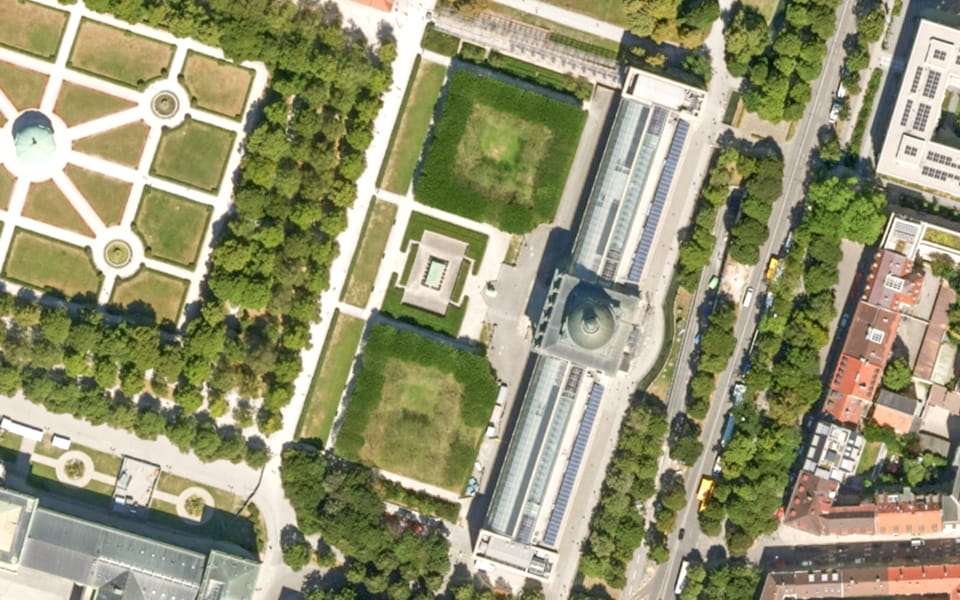
Summarizing the above brief history of the HOFGARTEN, we now have a slightly deeper understanding of a site once chosen as the architectural home of the KRIEGERDENKMAL (Krieger – War, Denkmal – Monument/memorial). In 1923, the still unfinished memorial was opened to the public within the Eastern part of the Munich garden with a three-century history. Arounded by the ‘RESIDENZ’ complex of buildings to the South, ODEONSPLATZ square (a site to finish the so-called ‘Beer-Hall Putsch’ only a few months before) to the West, the gargantuan ‘ENGLISCHE GARTEN’ to the North-West, and a new residential district (erected upon the location of the old textile factory) to the East.
Having in mind the fact that Munich had many buildings of a military nature and intended purpose (for example, the War Ministry – captured by Ernst Roehm during the ‘Beer Hall Putsch’), it was the Hofgarten that was chosen to become home for a new memorial. As was already mentioned above, the park area itself had less in common with the military history and praised the goddess of femininity and childbearing. On the bright side, the Eastern part of the HOFGARTEN had been a home for the Bavarian military barracks for nine decades and for the Bavarian Army museum for another twenty years. That is to say, thousands of soldiers of the Bavarian Army, once called up for military service under Wilhelm II, gave their lives on the battlefields of the Great War (the First World War).

Rupprecht Maria Luitpold Ferdinand, the crown prince of Bavaria, was the prime guest at the opening ceremony of the memorial, which was destined to be fully finished only four years after the opening. Being fascinated with the idea of a military career since his childhood, Prince Rupprecht had become the commander of the corps before forty and the military rank of Feldmarschall and Commander of the Army group, named after him. That very day of the year 1918, with the declaration of the Bavarian Republic, the Crown Prince and Feldmarschall were deprived of the right to become a King, a tradition of seven-century history.
The frustrated, unfulfilled King of Bavaria was a passionate supporter of the prohibition of Chemical Weapons, sea blockades, and air raids on cities. In the face of the promises of the Nazis to restore the Bavarian monarchy, Prince Rupprecht had always regarded Hitler as a madman. The senior Feldmarschall spent the Second World War years in Italy, as a personal guest of King Victor Emmanuel II (Hitler visited Italy several times, particularly to become a guest of the King in May 1938). In dramatic contrast, his wife and children had to experience the horrors of the Nazi concentration camps, and they welcomed the end of the war in Dachau.


Three decades after the opening ceremony of the memorial, the Crown Prince of Bavaria was buried in a crypt of the Theatinerkirche, a church to the South-East of the HOFGARTEN and KRIEGERDENKMAL. Harkening back to the year 1924, he was supposed to be the most ‘appropriate’ candidate to give a blessing to a memorial, which was meant to honor the soldiers of the Great War. The Feldmarschall had lost thousands of his subordinate soldiers, the Bavarian citizens, in particular, the Munich citizens, not least of all. Properly speaking, the better part of 13,000 soldiers of the Great War, who were honored by the memorial, had served and lost their lives under the command of Prince Rupprecht.
The Kriegerdenkmal memorial held great historical significance during both the Weimar Republic and the Third Reich. It was an annual practice to lay floral tributes to the statue of the soldier inside the crypt and along the memorial to honor the fallen warriors of the most slaughtered war in human history. In the same typical way for the graves of the unknown soldiers, an honor guard used to stand in front of the Kriegerdenkmal War memorial in Hofgarten. As a result of the damaging air raids on HOFGARTEN, the war memorial suffered tragic destruction at the end of the Second World War. As opposed to the almost vanished Bavarian Army Museum at a stone’s throw, concrete blocks of 2-meter thickness survived the bombardments. At the same time, the inscriptions and the names of the fallen soldiers were irrevocably lost.


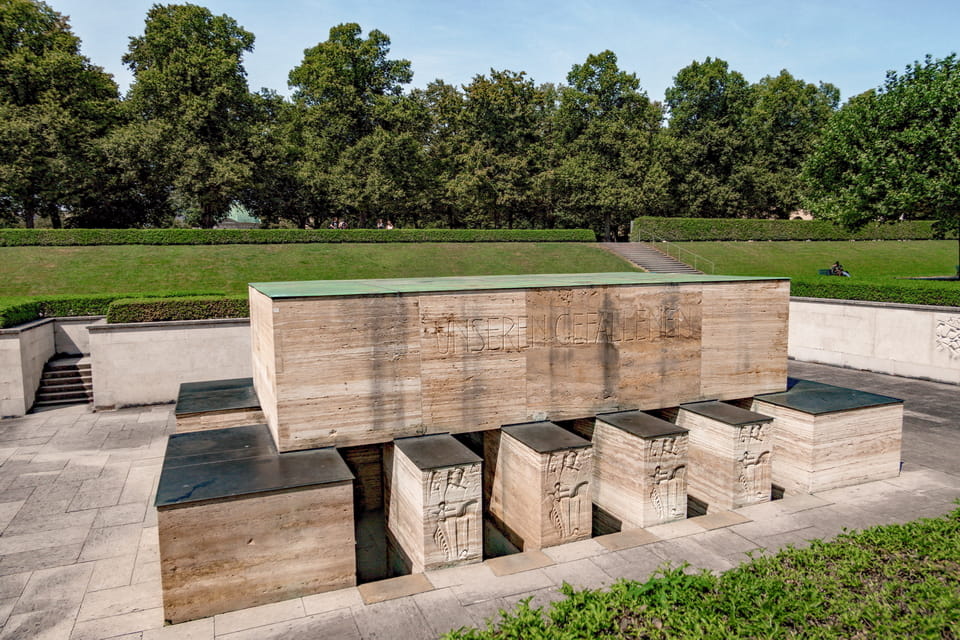
The KRIEGERDENKMAL memorial can be divided into three parts, each being of equal architectural and historical value. To begin with, the memorial is presented with a right-angled pit of two meters deep, paved with marble. Four stone staircases at the corners offer convenient access to the deepening, being a part of the complex itself. In a position facing the monument of Otto, I and the building of the Bavarian State Chancellery, the left side wall of the pit describes the close formation of the Bavarian Army marching in a shoulder-arms manner. The opposite right side wall characterizes twelve crosses, symbolizing the graves of the fallen warriors with death at the end of the march.
The Kriegerdenkmal was designed by architects Thomas Wechs and Eberhard Finsterwalder, with sculptural reliefs on the pit walls by Karl Knappe (Professor at the Munich Academy of Fine Arts). The pit measures 28 × 17 metres and is lined with Muschelkalk (shell limestone). The central roof panel weighs approximately 250 tonnes. The original statue of the fallen soldier inside the crypt was carved from red marble and is attributed to the design of Bernhard Bleeker, a professor at the same Munich Academy who later received state commissions under the Third Reich, including portrait busts of Adolf Hitler. In 1972, the original marble statue was replaced with a bronze cast made by sculptor Thomas Wimmer. The bronze replacement is the version visible to visitors today. On 4 November 1923 — five days before the Beer Hall Putsch — Alfred Rosenberg and Adolf Hitler attended the ceremonial laying of the first stone, captured in a photograph reproduced in this article. The memorial was not fully completed until 1928.


The following section of the memorial composition is made like a stone crypt. The giant right-angle plate, 2 m thick, is centered on four corner-based stones. The West and East sides are architecturally accompanied by another four stones, each with an anaglyph of an armed warrior. The two inscriptions on the exterior of the crypt are central to the memorial’s meaning:
SIE WERDEN AUFERSTEHEN — facing the Bavarian State Chancellery — translates from German as «They Shall Rise Again» (literally: «They will be resurrected»). The phrase is taken from the Christian tradition of resurrection and was common in German war memorials of the Weimar Republic era as a consolation to the bereaved and a promise of spiritual continuity.
UNSEREN GEFALLENEN — on the reverse side of the crypt roof — translates as «To Our Fallen». This is the dedication formula of the memorial: an address from the living to the dead.

I took this photo in the reverse direction with the Bavarian Museum behind

Either of the two stone staircases leads by the hand inside a marble crypt, where a shadow and marble sustain moderately chilly temperatures even in hot summer weather, a stereotypical reminder of the grave. The third part of the historical and architectural composition is to be inscribed in memory with a LYING STATUE OF A FALLEN SOLDIER, recumbent on a plate, made of red marble. The statue and the plate were made according to the design of Bernhard Bleeker, a professor of the Munich Academy, who later enjoyed privileges during the years of the Third Reich, staying in the Nazi’s good graces. Years later, the works on the statue of the fallen soldier in HOFGARTEN, Bleeker made portrait sculptures of Adolf Hitler and some architectural creations for the regime. Back in 1972, the authentic marble statue, which had survived the war and air raids, was replaced with a bronze copy, still available on the site. ‘BAYERNS HEER SEINEN TOTEN’ (To Bavarian Army and its fallen) inscription made on marble can also be seen a few inches from the legs of the warrior.


The stone crypt is also an architectural home for two more letterings, which were made during renovation works after the war.
‘ERBAUT VOM OBMANNS-BEZIRK MÜNCHEN-STADT DES BAYR. KRIEGERBUNDES DEN 13 000 GEFALLENEN HELDENSÖHNEN DER STADT MÜNCHEN’ – Erected by the Obmanns district of the city of Munich, Bavaria. The 13,000 fallen hero sons of the city of Munich.
‘ZUM GEDENKEN AN DIE 22 000 GEFALLENEN, 11 000 VERMISSTEN, 6 600 OPFER DES LUFTKRIEGES DER STADT MÜNCHEN 1939-1945’ – To honor 22 000 fallen, 11 000 missed and 6 600 victims of the air war of the city of Munich 1939-1945.


13,000 GEFALLENEN: MUNICH IN THE FIRST WORLD WAR — BAVARIAN ARMY, SPANISH FLU AND FOOD RIOTS
As we have discovered before, the KRIEGERDENKMAL war memorial in Munich was inaugurated by Rupprecht, a Crown Prince of Bavaria (never-fulfilled King), a Feldmarschall, who had been a supreme commander of the ‘Heeresgruppe Kronprinz Rupprecht von Bayern’ (Army Group Rupprecht of Bavaria) during the First World War. By the time of August 1914 and the outbreak of the Great War in Europe, the Bavarian Army had been satisfied with a respective autonomy, de facto being a part of the army of the German Empire. The soldiers used to swear their military oaths to the King of Bavaria and not to Kaiser Wilhelm II. The second day of the announced war and nationwide mobilization witnessed the formation of a new 6th Army, created based on the major amount of the Bavarian pre-war Army and now led by Prince Rupprecht.

The first fallen warriors among the soldiers of the Bavarian Army historically accounted for the battles along the Eastern border of France and in South Belgium. One year later, in September 1915, the soldiers of the 6th Army made their tragic way to history as the first victims of the first English gas attacks. It should be said that ‘the first enemy victims’ were the English soldiers, who suffered the failed attacks to a greater extent due to insufficient use and unfavorable wind.
In the following years of the Great War, the newly formed ‘Army Group Rupprecht of Bavaria’ included three armies with only a skeleton staff still formed from the Bavarians, as the newly mobilized reinforcements were taken from almost every region of the German Empire. Even though the Bavarian Army lost 200 000 men in combat, 13 000 among whom were the male citizens of Munich. The amount engraved within the KRIEGERDENKMAL memorial. Some contingent of these fallen warriors, honored in HOFGARTEN, had been buried in ‘LANGEMARK’, a large military cemetery in Belgium, close to the infamous town of Ypres.

The KRIEGERDENKMAL memorial was made to honor the memory of 13,000 fallen soldiers, male citizens of Munich, who lost their lives in the battles of the Great War. With that said, this 13,000 figure does not indicate the CIVIL VICTIMS, inevitable at the core of the conflict. The naval blockade of the German Empire caused starvation and famine all along the former prosperous European ruler. The food rations came true for the people of the once-blooming and well-to-do Kingdom of Bavaria and its capital in particular. An unexpected conflict between the urban citizens and the villagers for food and the so-called ‘FOOD RIOTS’ within the streets became a tragic reality.
Already in 1916, Munich had become a reception center for the wounded soldiers from the frontlines, and some schools and even famous Munich beer halls were turned into medical aid stations. Two years later, in 1918, Munich witnessed an outbreak of the Spanish flu with a death toll of close to 600 people. Along with that, thousands of families, who had lost their breadwinners: husbands, sons, fathers, and brothers, now become the unwilled victims of the War, never engraved on the stone of the KRIEGERDENKMAL memorial. A few thousand of the people who lost their lives for the sake of the failed ‘Münchner Räterepublik’ (also known as the ‘Bavarian Soviet Republic’) were also not honored among the victims of the First World War.

The human cost of the First World War for the city of Munich — summarised in the inscriptions of the Kriegerdenkmal and in the records of the period:
— 13,000 Munich citizens killed in action during the First World War (1914–1918) — commemorated in the original Kriegerdenkmal dedication
— Approximately 200,000 total casualties of the Bavarian Army across all fronts
— ~600 people killed in Munich by the Spanish Flu epidemic of 1918
— Several thousand further civilian casualties of war-related starvation, riots, and the suppression of the Bavarian Soviet Republic (Münchner Räterepublik) in 1919 — none of these appear on the memorial.
MUNICH IN THE SECOND WORLD WAR: 74 BOMBARDMENTS, 22,000 FALLEN, AND 6,600 AIR WAR VICTIMS
‘To honor 22 000 fallen, 11 000 missed, and 6 600 victims of the air war of the city of Munich 1939-1945’. This lettering within the KRIEGERDENKMAL memorial provides a historical glimpse of the citizens of Munich, the casualties of the most bloody conflict in world history. The Nazis used to appraise the heart of Bavaria as the ‘Hauptstadt der Bewegung’ (The capital of the movement), and the annual November celebrations of the failed ‘Beer Hall Putsch’ had become history. In September 1938, Munich happened to appear as the front-page story of almost every recognized news periodical all around the world. As history has shown, the newsworthy event was no more than an attempt to accredit the so-called ‘Munich Agreement’ with the never-fulfilled role of the peacemaker against the ambitions of Hitler and a means of preventing a new World War.

The first days of the Second World War expressed no signs of exciting enthusiasm, which was common for the people of Munich back in August 1914, a few minutes after LUDWIG III, the King of Bavaria, with his passionate speech. Looking back to the summer of 1939, a few weeks before the invasion of Poland, the unprecedented mobilization ‘devastated’ the homes of Munich and Bavaria and left them without men, who had been called to the army. The first per-person food rations were implemented weeks before Europe experienced the first gunshot on the Polish border. Already in 1933, six years before the War, the Dachau concentration camp, the first of its kind, had been put into operation. Nonetheless, it was the war years that witnessed the creation of several concentration and labor camps around Munich, as well as the major part of the Jewish pre-war population, who had already left the country or were despotically imprisoned.

As one of the largest cities in Germany, the transport and manufacturing center of the region, Munich was tragically destined to suffer massive air raids during the War. Contrary to popular belief, the first bombs dealt damage to Munich already on June 4, 1940, during the Battle of France, and on the day when the last soldiers were to be evacuated from the coast of Dunkirk. In the years that followed that first raid, Munich witnessed 74 bombardments, which caused the death of 6600 citizens and another 15,000 were wounded. 3.5 million air bombs made unprecedented damage to the city, leaving the major part of the ‘ALTE STADT’ (Old Town) in ruins and 300,000 people without homes. The mass evacuation, the drift from the urban, and the deaths resulted in a population than Munich had before the War.

The Second World War inscriptions added to the Kriegerdenkmal after 1945 record the following figures for the city of Munich:
— 22,000 fallen (military deaths of Munich citizens, 1939–1945)
— 11,000 missing (soldiers listed as missing in action)
— 6,600 air war victims (civilians killed in the 74 Allied bombing raids on Munich)
— 15,000 wounded by air raids
— 300,000 made homeless by bombing
— 3.5 million bombs dropped on Munich, leaving the majority of the Altstadt (Old Town) in ruins
US forces entered Munich on 30 April 1945 — the same day Adolf Hitler took his own life in Berlin.
VISITING THE KRIEGERDENKMAL IM HOFGARTEN: LOCATION, HOW TO GET THERE, AND NEARBY MUNICH WW2 SITES
Location & practical information
The Kriegerdenkmal is located at the eastern end of the Hofgarten park, in front of the Bavarian State Chancellery (Bayerische Staatskanzlei). Adress: Hofgarten, 80539 München. GPS: 48°08’33.1″N 11°34’55.3″E. The memorial is open 24 hours, 365 days a year. Entry is free of charge.
Getting there:
- U-Bahn: Line U3/U6 to Odeonsplatz (2-minute walk east through the Hofgarten). Line U4/U5 to Odeonsplatz also stops here.
- Bus: Lines 100, 153 stop at «Odeonsplatz».
- On foot: from Marienplatz, approximately 12 minutes north-east. From the Residenz (south entrance): 5 minutes north through the Residenzgarten.
Visiting tips: The memorial is sunk 2.25 metres below ground level — it is easy to miss if you walk through the Hofgarten without stopping at the eastern end. Approach from Odeonsplatz along the central axis of the park, past the Dianatempel. The crypt is most atmospheric in early morning or late afternoon when light enters through the opening above the fallen soldier statue. The bronze statue (a 1972 replacement of the original marble original by Karl Knappe) lies on a slab of red marble; the roof panel weighs approximately 250 tonnes.
Nearby Munich WW2 and historical sites:
- Odeonsplatz (2 min walk): The square where the Beer Hall Putsch of 8–9 November 1923 ended in the death of 16 Nazis and 4 police officers. A plaque on the Feldherrnhalle marks the site.
- Munich Documentation Centre for the History of National Socialism (NS-Dokumentationszentrum, Max-Mannheimer-Platz 1): 10-minute walk west. Documents Munich as the «Capital of the Movement». Open Tue–Sun 10:00–19:00, admission approx. €7.
- Theatinerkirche (2 min, south-west): Where Crown Prince Rupprecht of Bavaria — prime guest at the 1923 opening of the Kriegerdenkmal — is buried in the crypt.
- Hofbräuhaus beer hall. The most well-known among similar locations in Munich, and an important site in the context of the rise of the NSDAP and Adolf Hitler in the 1920s. An article devoted to the Nazi beer halls in Munich.
I am very grateful to war archives, museums, libraries, private collections, and writers for the historical photos in this article. To the extent that some author or a copyright owner may not want some of the above black-and-white photos to be used for educational purposes here, please contact me for adding credits or deleting the pictures from the article.