

Munich Beer Hall Putsch Locations: the 1923 Route, Then and Now
WHERE DID THE BEER HALL PUTSCH TAKE PLACE: THE ROUTE OF 9 NOVEMBER 1923
To this day, a march of the right-wing plotters, who opposed the Bavarian government and the Weimar Republic, is still a matter of sustained historical interest. The failed revolution of 1923 has become known in history as the ‘BEER HALL PUTSCH’ or ‘Hitler’s Putsch,’ and every guest of the city of Munich can retrace and explore the infamous route, which was destined to be carried through by an enlarging column of 2000 men of the still politically immature Nazi party and its supporters on a cold afternoon of November 9, 1923. Except for the forever gone BURGERBRAUKELLER beer hall, the bridges, squares, streets, and even the medieval gates are still accessible to be explored to find Where did Beer Hall Putsch take place. The route does not need to be overly guided and will take you a maximum of two hours of historical walking, including pauses to catch your breath and take photos. Within this exhaustively detailed material, I will take you across all the main Beer Hall Putsch locations, with historical insight into every site or building before, within, and after the Third Reich era. A map with the markings is provided to make it easy for you to retrace the direction and the line of march, including the planned but failed-to-be-achieved part of the route.


THE BÜRGERBRÄUKELLER: WHERE THE PUTSCH BEGAN, AND WHAT STANDS THERE TODAY
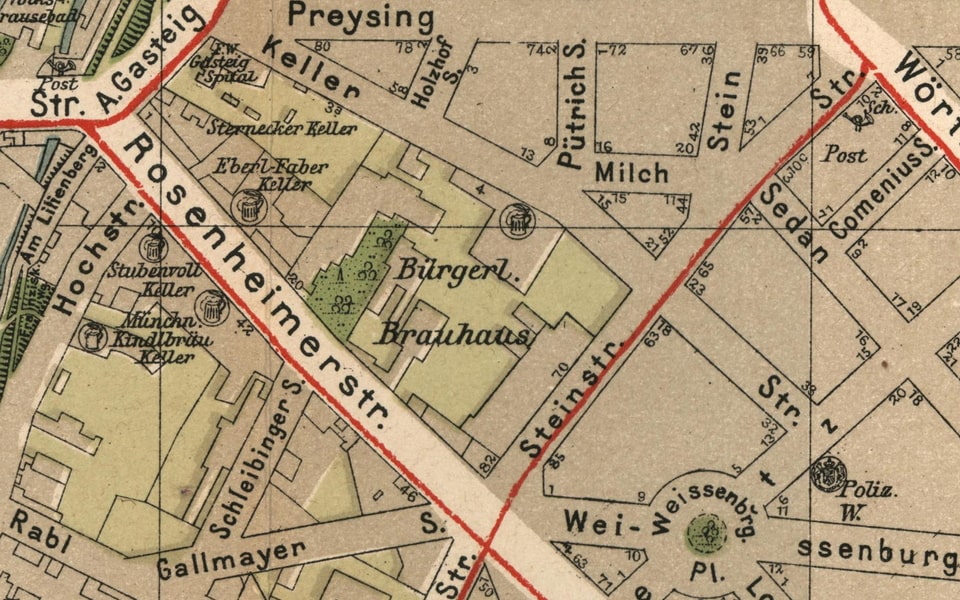
Where did the Beer Hall Putsch begin? In the Bürgerbräukeller, a beer hall on Rosenheimer Strasse in the Haidhausen district of Munich, on the east bank of the Isar. Hitler fired his shot into the ceiling there at about 8:45 p.m. on 8 November 1923; the march set off from the same building the following afternoon.
The building no longer exists. It survived Georg Elser’s bomb in 1939 and the Allied raids, served as an American Red Cross club after the war, reopened as a beer hall in 1958 — and was demolished in 1979. The site is now occupied by three buildings: the Gasteig cultural centre, the GEMA headquarters and the Hilton Munich City hotel. A small plaque to Elser is set into the pavement in the square between the Gasteig and GEMA. The nearest station is Rosenheimer Platz (S-Bahn), two minutes’ walk.
Everything that follows is the rest of the route — nine more locations, all of them still standing, over three kilometres and about two hours on foot.
The very location of the modern HILTON hotel, the GEMA state regulatory body, and the GASTEIG cultural center used to have neither more nor less than a sacred meaning in the days of the Third Reich. Over three years before the ‘Beer Hall Putsch’ in November 1923, the Burgerbraukeller drinking house had been a home for the young Nazi movement and a tribune for Adolf Hitler with his heartfelt speeches. One of the largest beer halls in Germany, open for the citizens of Munich since 1885, had dramatically become a platform for gaining newcomers to the radical movement. At that very moment, 34-year-old Adolf Hitler fired a shot with his famed legendary pistol at the ceiling (breaking in the speech of State Commissioner Gustav von Kahr), and the number of party members amounted to 50,000. That evening, Hitler came to the Bürgerbräukeller in his red Mercedes-Benz, which was later confiscated by the Bavarian police and used until 1933 and the Nazis’ rise to power in Germany.
“Pale, a dark lock of hair hanging down his forehead, and with a pistol-wielding storm trooper on either side,” Hitler began to negotiate the clogged way to the stage. When he was ten steps away from Kahr, he got up on a chair and fired a shot into the ceiling to quiet the tumult. Then he took the stage and proclaimed excitably: “National revolution is under way. The hall is under the control of 600 heavily armed men. No one is allowed to leave.
VOLKER ULLRICH (HITLER, 2013)

A few hours of challenging doubts, dissonant news from other parts of Munich and the armed squads, and the now obvious betrayal of the Kahr-Lossow-Seisser (State Commissioner Gustav von Kahr /Commander of the Reichswehr military region Otto von Lossow / Head of the Bavarian State Police Hans Ritter von Seisser) left Hitler no choice (from his viewpoint) other than to make a desperate attempt to take power by marching the streets of Munich. In charge of his personal ‘’Stoßtrupp Adolf Hitler’’ guard squad and a few hundred stormtroopers near the beer hall, the party leader left the BURGERBRAUKELLER. The planned march between the initial location and the War Ministry on Königsplatz, three kilometers length became a visionary but rather unattainable hope to win the support of the citizens of Munich. Across the entire walking, the core of the march, mastered by frustrated Hitler, was reinforced and recruited with hundreds of party members, veterans of the Great War (The First World War), cadets of the Munich Infantry School, and some accident supporters to number 2000-3000 (every second authoritative book on the Third Reich or Hitler gives one of these two figures) people in total. The column was headed by Adolf Hitler, Hermann Göring, Erich Ludendorff, Max Erwin von Scheubner-Richter, Friedrich Weber, Ulrich Graf, and Theodor von der Pfordten.


On November 9, 1933, a decade after the failed Nazi revolution and ten months after Hitler’s appointment as the Chancellor, the city of Munich witnessed the first-of-its-kind ceremonial march across Beer Hall Putsch locations, with BURGERBRAUKELLER as the starting point. Once succeeding in shifting the role of the leader of the growing right-wing Bavarian party of the low-middle class to the German Führer, Hitler now established the annual tradition to give a speech within the main hall of the beer house, in many ways sacred for the Nazi regime. Throughout the seven years between 1933 and 1939, Adolf Hitler used to master the tribune of the Bürgerbräukeller to address his ‘Alten Kampfer’ (Old Comrades). In the aftermath of the failed assassination attempt by Georg Elser on November 8, 1939, the annual sacramental occasion was held at another famous beer house, known as LOWENBRAUKELLER.

The explosive charge by Georg Elser has historically become one of the most well-known acts of resistance against the Nazi regime inside Germany, probably the second after the ‘July 20 Plot’ (1944). The explosive charge, killing eight attendees and wounding sixty-four others, collapsed the ceiling of the grand hall, devastated Hitler’s tribune, and made any mass events not possible until the full renovation works. The reconstruction was initiated soon after the accident but was never completed in the course of the war years due to a lack of deficiency in construction materials and Allied air raids. One of the Allied bombs dropped broke through the ceiling of the Burgerbraukeller’s main hall and failed to detonate by chance, leaving the building semi-abandoned until the end of the war. The American troops allocated the facility to the American Red Cross and for many years came to the former Nazi sacred beer hall, which served as a leisure site for the military contingent until 1957. After the restoration of the beer hall traditions in the late 1950s, the Burgerbraukeller entertained the citizens and guests of Munich for two more decades. The building, which had survived Georg Elser’s charge and the Allied bombardments, was leveled to the ground in 1979.


In the same manner as the other famous Munich beer halls, the Bürgerbräukeller was once more than a solo beer-house building, rather a complex of buildings with spacious halls, a large cellar, and a summer garden with now-gone seating places for 3000 guests. In summary, the former initial point of the Munich Beer Hall Putsch location route once dominated the whole city block of the same rectangular shape. The central entrance faced the ROSENHEIMER Strasse (as well as another beer hall called Kindl-Keller opposite the road), a few steps aside from the modern metro exit of the same name and the automobile charging station. A cozy square between the GASTEIG Cultural Center and GEMA (state agency, which regulates copyright rights in Germany) reveals a metal sign plate fitted into the block stone on the very place of Georg Elser’s charge in Burgerbraukeller. The words on this tablet honor the memory of his revolt.
How to orient yourself on the site. The Bürgerbräukeller was not a single building but a whole city block: halls, a large cellar, and a beer garden seating three thousand. The main entrance and the arch faced Rosenheimer Strasse, roughly where the Gasteig forecourt meets the street today, a few steps from the Rosenheimer Platz S-Bahn exit. The great hall in which Hitler fired his shot stood behind it, on the ground now covered by the GEMA building. The beer garden extended towards what is now the Hilton. If you are standing at the Elser plaque, the historical photographs above were taken looking roughly north-west, with the entrance arch behind you.
On this place, on November 8, 1939 in the former Burgerbraukeller, carpenter Georg Elser attempted the life of Adolf Hitler. He intended to make an end of the National-socialist terroristic regime, but he failed. Johann Georg Elser was executed on April 9, 1945 in Dachau concentration camp after five and a half years of imprisonment.

LUDWIGSBRÜCKE: THE FIRST POLICE CORDON, AND THE PYLONS WITH THE SIXTEEN NAMES
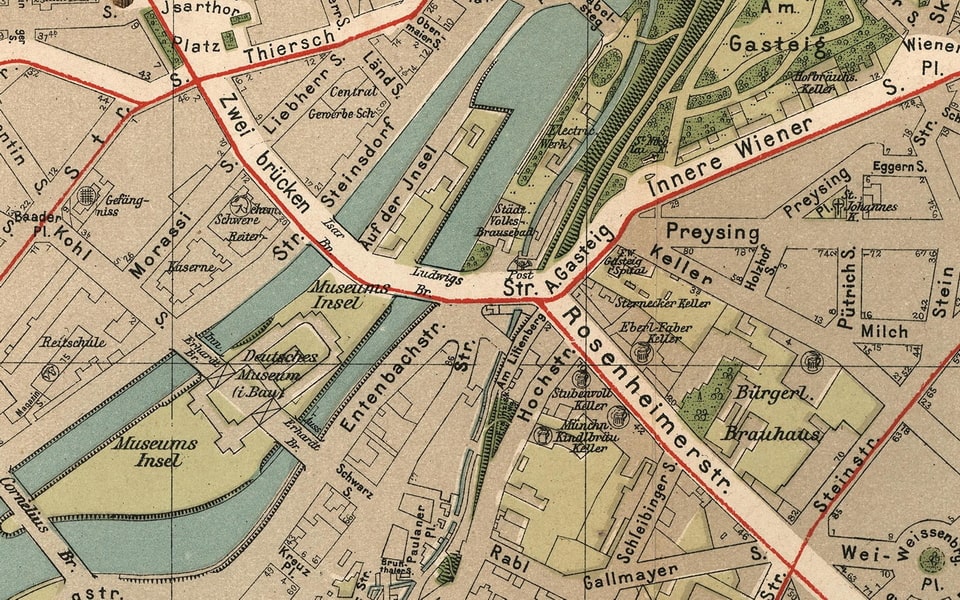
The brief involvement of the LUDWIGSBRÜCKE bridge in the history of the Beer Hall Putsch is historically limited to the extent of its location crossing the Isar River on the way between the Burgerbraukeller beer house and the city center of Munich. On the cold afternoon of November 9, 1923, the column of the Nazis and its supporters had to face the first Bavarian police cordon of thirty men from the ‘Landespolizei’ armed with rifles and one heavy machine gun who had been stationed here (near the start of the bridge next to the famous Mullersche Volksbad, the famous Munich public bathes) an hour before with an order not to let the column cross the bridge. Ignoring the definite note of warning from the police unit commanding officer, Lt. Georg Höfler, Hermann Goering appealed to the policemen not to kill their comrades (in the sense of former WWI soldiers and German citizens). A few moments later, the ‘’Stoßtrupp Adolf Hitler’’ members under Joseph Berchtold (1897-1962) and a few dozen of the putschists caught the two squads of the Bavarian police at a weak moment and disarmed them without a shot. Some of the putschists in the column spat on the policemen. At least twenty-eight policemen, now unarmed and some of them beaten and with arms behind their backs, were driven back to Burgerbraukeller under escort. In later years the Nazis tried to mask their attitude towards the Bavarian State police unit on that day and tried to present the case as ‘fraternization’.

It was almost noon when the straggling column moved off. In fifteen minutes the 2000 men reached the Ludwig bridge and a small force of state police. The police commander stepped forward as the Putschist skirmishers slowly advanced, called out to halt or be fired upon, then turned to his men and told them to load with live ammunition. As he spoke a bugle blasted, and selected Putschists suddenly converged on the police with bayonets leveled, shouting, “Don’t shoot at your comrades!” The police hesitated and before a shout could be fired were overrun. The column continued across the bridge and marched straight ahead.
JOHN TOLAND (ADOLF HITLER, 1976)


The Isar River witnessed the first bridge in this very location back in the XII century. The white waters used to wipe out flimsy wooden and even stone ancestors of the ‘Isar bridge’ until the years 1891-1892, when these weak constructions were replaced with two compound stone bridges. The so-called ‘museum’ island, extended along the Isar river, was aggraded by the waters at the very beginning of the XVIII century, and all the following ones were to become made up of two formations. On the very day of November 9, 1923, when Hitler and his column of revolutionaries crossed the LUDWIGSBRUCKE, its inner-shorter-western part (Inner Ludwigsbrücke) was made of three stone arches. The ‘Äußere Ludwigsbrücke’ (external-longer-eastern) part from the Rosenheimer Strasse (witnessed the first steps of the column) had four arches.


In 1934, in any case within a year after gaining power in Germany, the Nazis initiated an extended reconstruction of both bridges over the Isar River (Inner and External ones). The new design included only one arch on the Western side and two on the Eastern, additionally reinforced with concrete. It was this particular renovated LUDWIGSBRUCKE, which was once made an integral feature of the annual Nazi celebrations to celebrate the failed revolution of 1923, a sacred event for the regime and the Third Reich.


The renovation or actual replacement works within the years 1934-1935 were supervised by German Bestelmeyer (German is his name, not Hermann), a famous architect of the Third Reich era. Three years after that, he was awarded the Golden Medal of Honor of the Munich Academy of Fine Arts (Akademie der Bildenden Künste München), granted by Hitler personally. In the course of the renovation works, two of four pylons, 1892, located in pairs on both sides, now stood on the Western side. The newly designed architecture of the LUDWIGSBRUCKE was also correlated with the ‘renovations’ of the DEUTSCHES MUSEUM on an island beneath. Either pedestrian side of the new compound bridge was now completed with a line of new pylons, ornamented with an Eagle, the name of one of the 16 fallen Nazis (who died in the course of the ‘Beer Hall Putsch’), and the fire cup above.


The LUDWIGSBRÜCKE bridge came to relatively minor harm during the Allied air raids in the Second World War, in stark contrast to the Deutsches Museum, which was almost destroyed from 1944 to 1945. For all that, one air bomb hit the Western side of the bridge and completely devastated one of four original pylons of the 19th century. The first repair works were finished already in 1948, and the Nazis’ pylons, which had once honored the failed Putsch, were now dismantled. The final reconstruction was managed in 1988, and the bridge has come to a modern appearance. On your walk across the Isar River, you can notice the preserved stone figure of a German Eagle on the roof of the Deutsches Museum as well as three of the pylons (original ones, which survived the war) on the Western side.


THE ISARTOR GATES: INTO THE OLD TOWN, 400 METRES FROM THE BRIDGE
After the first confrontation with the Bavarian police squad of thirty people on the LUDWIGSBRUCKE, the column of the putschists crossed the Isar River and took the path to the Zweibrückenstraße street, which can be translated literally as the ‘street of two bridges’, defined by two former Isar bridges. Hans Frank, at that time a young lawyer who would later make his infamous place in history as the Governor-General in occupied Poland, held a position on a bridge with a heavy machine gun, previously ‘expropriated’ from the police. That cold November day, the citizens of Munich expressed an opposed attitude to the march of the right-wing putschists. The reaction differed on a scale from excited ‘Heil’ callings and joining the column to unconcealed contempt and disrespect for the participants of the march. Once covering another 400 meters from the Ludwigsbrucke, the November 9 column of the putschists entered the Old Town of Munich through the medieval ISARTOR gates. In 1924 during the post-putsch trial, Hitler stated that on November 9, 1923, he was sure that the people of Munich backed the march, which was, of course, an exaggeration and a part of Hitler’s rhetorical excuses.
After overrunning a police cordon at Ludwigs Bridge, the march continued on to the Isar Gate and Marienplatz, Munich’s central square. Thousands of onlookers had gathered and cheered the demonstrators on. “The enthusiasm was unprecedented,” Hitler later said, “and I couldn’t help but remark to myself during the march that the people were behind us.”
VOLLKER ULRICH (HITLER, 2013)


The ISARTOR gates were once in use as one of four main entrances to medieval Munich, surrounded by a defending wall of 14th-century origin. The 40-meter tower, which survived the centuries and the War until today, was the first building of the complex, further completed with the gates themselves and two defense towers on both sides. The ISARTOR (ISAR – TOR) is to be translated as the ‘Gates (Tor) by the ISAR river ‘. In 1860, the main tower witnessed the installation of the mechanical clock, which would be back only in 2005, sixty years after the end of the War. The ISARTOR gates were heavily damaged during the Allied air bombardments in 1944, and the after-war reconstruction works and restoring its close-to-original state took another few decades. As it was in the Medieval years, the Isartor gates are still meant as an important traffic junction of Munich, and the nearby square includes the metro station of the same name. Nowadays, the building includes a small cafe and a museum devoted to Karl Valentin, a Bavarian comedian.


TAL STREET AND THE STERNECKERBRÄU: WHERE HITLER JOINED THE PARTY IN 1919
Since the column of 2000-3000 people had passed the ISARTOR gates and entered the Old Town, the marching made a path to the ‘TAL’ street towards the MARIENPLATZ as the next way-point of a planned march. The street, which goes as far back as the XIII century, was once a part of the medieval road from Salzburg far to the East, a historical transport artery for the merchants, who used to deliver the ‘white gold’, salt. Tal played a significant sacred role in the Nazi movement and for Hitler personally. The Sterneckerbräu beer hall was once located at the arm’s end of the Isartor gates. On September 12, 1919, a young Adolf Hitler got into an argument with one of the DAP members and won the attention and curiosity of Anton Drexler, the leader of a small right-wing party. Within the years 1919-1921, the propaganda fuhrer (Hitler) and DAP held a small one-room office in an alley behind the Sterneckerbräu. In 1933, the NSDAP opened a party museum within the former office premises, and the annual celebratory route of the march used to include a one-minute stop in front of the place. The TAL street also included another important meaning for the movement as the TORBRAU hotel, just across the road from Sterneckerbrau, is known as a formal place of ‘birth’ of the SS.


On Friday, September 12, 1919, he dispatched Hitler to report on a meeting of an obscure political group that called itself the German Workers’ Party (Deutsche Arbeiterpartei or DAP). Held in a cramped backroom in the Sterneckerbräu Beer Hall, the meeting was an unimpressive affair, attended by only a smattering of unimposing men.
THOMAS CHILDERS (THE THIRD REICH, 2017)


MARIENPLATZ: STREICHER’S SPEECH AND THE SWASTIKA ON THE TOWN HALL
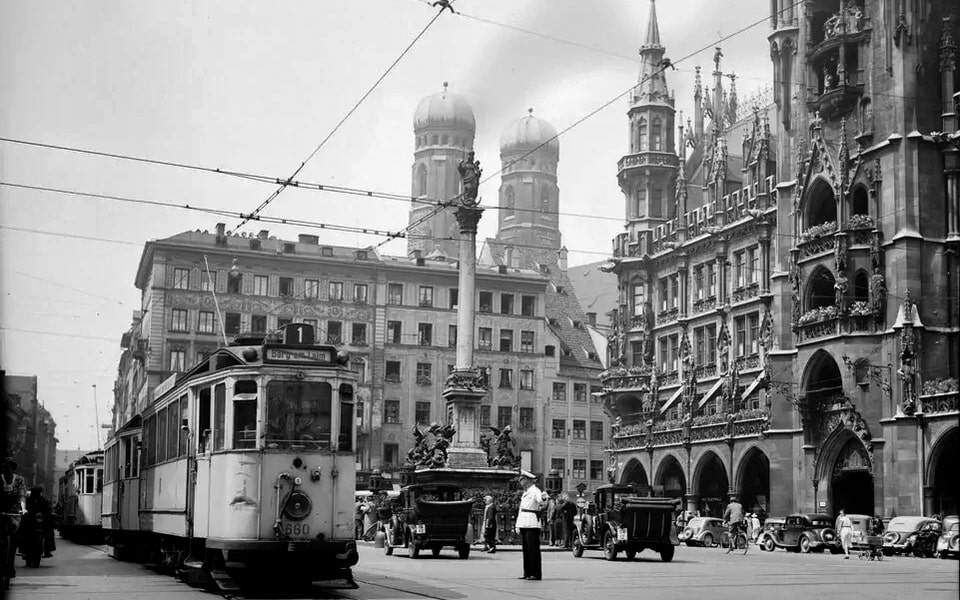
On the afternoon of November 9, 1923, a column made of 2000 to 3000 people walked across TAL Street and reached the MARIENPLATZ city square. On that very day, the square, which had been meant as the heart of Munich since the XII century, was full of people and looked like a human anthill. The putschists, who had already made their way from the Burgerbraukeller, now peopled the square with a thin trickle through the passage of the ‘Alte Rathaus’ (The Old Town Hall). Some of the putschists had temporarily seized the New Town Hall and even hung a swastika banner from one of the balconies. The participants of the march now faced hundreds of people, who were hypnotized by a speech of a speaker on an improvised stand just beneath the New Town Hall. His name was Julius Streicher, and the man was among the first apologists of the movement from Nuremberg. As the inspirer and editor of the infamous ‘Der Sturmer’ magazine (which had been published since April 1923), Streicher had a mind to win the support and hearts of the citizens of Munich using his flaming demagogy. Now the column of the putschists was reinforced with party members from Nuremberg and some people from the crowd. Among those present at the Marienplatz that day were Winifred (1897-1980) and Siegfried (1869-1930) Wagners, the son of famous composer Richard Wagner and his wife, nee Williams.
In front of the Munich City Hall Streicher was just delivering a speech from the top of a staircase; the crowd was large. How grave a juncture this was for Hitler can be measured from the fact that he, to whom the masses had rushed as “to a savior,” marched silently on this day.
JOACHIM FEST (HITLER, 1973)


Within the years 1933-1934, Munich witnessed the massive renovative works of the city center, and the ‘Altes Rathaus’ (The Old Town Hall) was also redesigned. The pedestrian passage, which was once used by the ‘Beer Hall’ putschists, was now enlarged. Years later, the April 25, 1944 air raid on Munich caused heavy damage to the MARIENPLATZ square, the Old Town Hall in particular. In December of the same year, the Germans dismantled the wrecking tower to avoid collapse, and the modern one was built only in the 1970s, resembling the appearance close to the original one of the XIV century. The ‘Neues Rathaus’ (New Town Hall) also suffered damage, and the last renovation works were finished in the last years of the XX century.



WEINSTRASSE AND MAX-JOSEPH-PLATZ: THE LAST CALM STRETCH
With the crowd inflow of unexpected reinforcement on the city’s main square, the column of putschists headed by Hitler continued their march along the narrow WEINSTRASSE. Once gained its grand-sounding ‘A street of wine’ name (WEIN – wine, STRASSE – street) after the wine merchants of the XIV century, it was to be characterized in the same way in 1923, welcoming the crowd with merchant stores and their customers, confused and excited with thousands of people, with rifles and banners, walking in front of the windows.
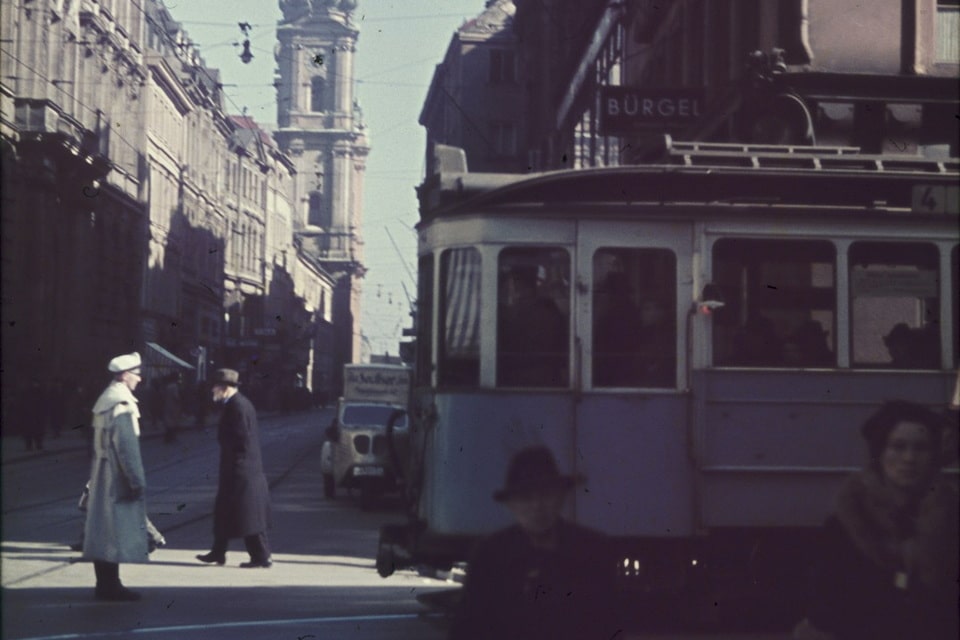

He had taken Scheubner-Richter’s arm as if he needed support; this, too, was an odd gesture, scarcely according with his image of a Führer. Amidst the cheering of the crowd, the procession swung haphazardly into the narrow streets of the Old City.
JOACHIM FEST (HITLER, 1973)


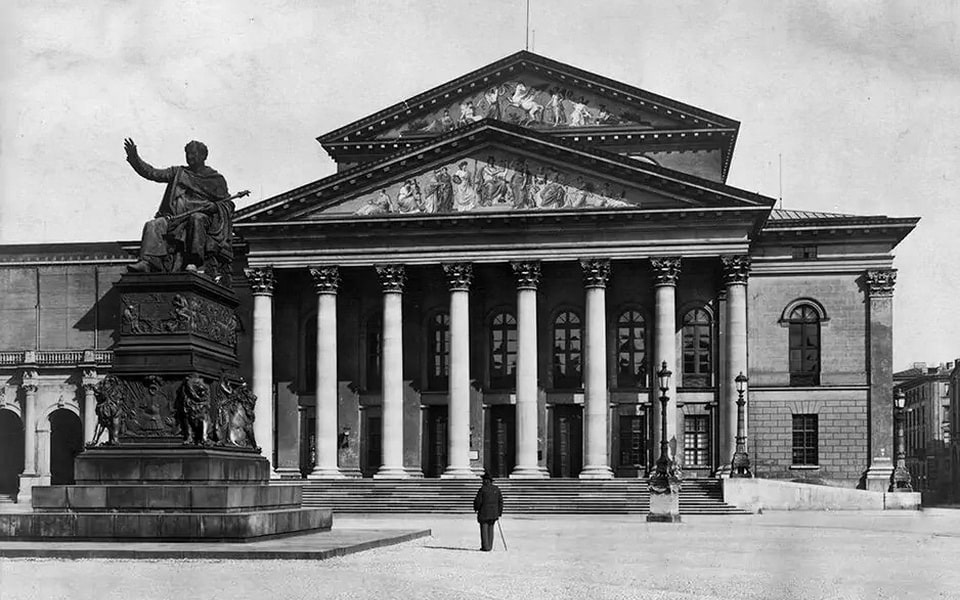
A few minutes later, the column of the revolutionaries reached the MAX-JOSEPH-PLATZ. Hitler had his history with the place, and the National Theater, once the first building on the square back in the 19th century, had inspired two paintings of young Adolf, harkening back to 1914 and his pre-war months in Munich. Years from that November day of the failed Putsch, the National Theatre, itself created in devotion to the Parisian Odeon theater, was a popular place in Munich during the years of the Third Reich. Hitler used to attend it from time to time while staying in Munich, with ‘Tristan and Iseult’ as one of his favorite operas. The square was badly damaged in the course of the October 3, 1943 air raid, which dramatically made the Theater, the Königsbau residence, and several buildings lie in ruins. In the 1960s, the construction of the underground parking paid no regard to the historical ruins of the medieval Franciscan monastery.

THE SHOOTING AT THE FELDHERRNHALLE: HOW THE PUTSCH ENDED ON ODEONSPLATZ
After streaming into narrow Residenzstrasse, the crowd of the putschists self-narrowed to a column with only a dozen people in every next row and Hitler, his bodyguard, Goering, and Ludendorff at the leading edge. Passionate ‘Heil’ callings, as well as ‘Deutschland, erwache! Erwache!’ (Awake, Awake, Germany) Extras from the ‘Sturmlied’ song (the song of the stormtroopers, preceding the infamous ‘Horst Wessel’), as well as “O Deutschland hoch in Ehren” (O Germany, high in honor) made little sense with the fact that the walking force of 2000 people now lost its quantitative superiority and mobility within a narrow Residenzstrasse. Another Bavarian police cordon, made of 130 policemen, had blocked access to the Odeonsplatz square just beneath the Feldherrnhalle memorial of the XIX century. The man in charge of the police cordon was First Lieutenant Baron Michael Freiherr von Godin (1896-1992), a man only twenty-seven years old who had served in the ranks of the Bavarian State Police since 1920. When Hitler took power in 1933, the Nazis arrested von Godin and put him into Dachau for eight months, and later he succeeded in leaving Germany. Upon returning to Munich from Switzerland in June 1945, he was appointed the first president of the post-war Bavarian Police Department and served in the position until 1959. It’s also interesting to note that Michael von Godin had an older brother, Emmerich Baron von Godin (1881-1934), who in 1918 was a temporary commander of the 16th Reserve Infantry Regiment, where Adolf Hitler had served since 1914. During his week in this position, on July 31, 1918, Emmerich von Godin proposed Hitler as a receiver of the Iron Cross First Class, an important element of Hitler’s later political career. In November 1933, the former Regiment commander met Hitler and showed him the original of his 1918 application, of which the German dictator was very pleased. Emmerich von Godin spent his last years in poverty and committed suicide in 1934.

Who marched at the front: the men who became the Nazi leadership:
The column that turned into the Residenzstrasse was led by men who would run Germany within a decade — and by others who did not survive the next two minutes.
— Adolf Hitler, thirty-four, dislocated his shoulder when Scheubner-Richter fell beside him; arrested two days later, sentenced to five years, released after nine months.
— Erich Ludendorff, the war hero whose name the whole enterprise depended on, walked straight through the police line untouched and was acquitted at the trial.
— Hermann Göring, commander of the SA, hit in the hip or groin; smuggled to Austria, treated with morphine, and addicted to it for the rest of his life.
— Max Erwin von Scheubner-Richter, shot dead at Hitler’s side — the most senior of the sixteen killed.
— Theodor von der Pfordten, a judge, killed with a draft of Hitler’s proposed constitution in his coat pocket.
— Ulrich Graf, Hitler’s bodyguard, took several bullets shielding him and survived.
— Rudolf Hess, who had taken hostages from the beer hall the night before, fled to Austria and returned to share Hitler’s cell at Landsberg.
— Heinrich Himmler, twenty-three, carried the flag at Röhm’s barricade outside the War Ministry — not in the main column, and photographed there that morning.
— Julius Streicher, who had been speaking to the crowd on Marienplatz an hour earlier and joined the march there.
— Hans Frank, then a young lawyer with a captured machine gun on the bridge, later Governor-General of occupied Poland and hanged at Nuremberg.
— Ernst Röhm, besieged at the War Ministry, released after the trial — and shot on Hitler’s orders eleven years later.
— Joseph Berchtold, who led the Stoßtrupp that disarmed the police at the bridge, and who a year later founded the SS.
Of the sixteen dead, fourteen fell here on the Residenzstrasse and two outside the War Ministry. Their names were cast on a bronze tablet on the Feldherrnhalle in 1933 and on the pylons of the Ludwigsbrücke; both were removed in 1945–1948.


The Odeonsplatz had a sacred meaning for Hitler, in some sense to a greater extent than any location in Munich. It was the very same square that greeted the outbreak of the Great War (First World War) on August 2, 1914, and young Adolf Hitler was on that day a part of the rampaging crowd of thousands. Nine years later, neither the up-in-arms callings of the Nazis nor the presence of the war hero Ludendorff had any influence on the Police squad. A solo gunshot from one of the opponent’s sides resulted in gunfire that lasted half a minute. Hitler and his column were spared from being machinegunned by heavy fire as the unit with a heavy weapon had left the square a few minutes before in the direction of the military headquarters. This moment was later made a legend in the Third Reich as one of the major events in German history according to the party line. The moment, for example, brought a myth of the ‘BLUTFAHNE’ (The blooded flag) to the world as the Nazi standard that the regime would later use to canonize the banners of the SS and SA formations by Hitler personally. Among the dead were Max Erwin von Scheubner-Richter and Theodor von der Pfordten. The latter carried a copy of Hitler’s new constitution in his pocket. Most killed or wounded were hit by ricochet bullets from stone pavements, including Hermann Göring, who was hit in his hip/groin area. General Erich Ludendorff was unhurt and simply went through the cordon with hands in pockets, while his valet Kurt Neubauer was killed on the spot when a bullet smashed a part of his head.
At the top of the Residenzstraße, as it approaches Odeonsplatz, the marchers, accompanied by the occasional ‘Heil’ from the crowd and trying to keep up their spirits by singing the ‘Sturm-Lied’ (Storming Song) composed by Dietrich Eckart, encountered the second, and larger, police cordon. hen shots rang out. Who fired the first shot was never fully clarified, but the evidence points to it being one of the putschists. A furious gun-battle lasting almost half a minute followed. When the firing ceased, fourteen putschists and four policemen lay dead.

With the advent of Hitler as the Führer and the NSDAP as the ruling and the only political force in Germany, this last stop of the failed revolution of 1923 gained the status of an iconic location. The eastern side of the Feldherrnhalle memorial was complemented with a stone figure of an Eagle, bearing a swastika in its clutches. Paul Ludwig Troost, the favorite architect of that time, made a design a stone tablet, set in stone with the names of the 16 fallen Nazis, 14 of whom died in this very place. In the years following years since 1933, the memorial had become the key, yet not the final stop, of the annual November 9 ceremonial march. The sacred place also listed the names of four fallen policemen and the party officials beyond Hitler, including Goering, Julius Streicher, Rudolf Hess, and Heinrich Himmler, who used to bring flowers to the memorial. After the failed attempt of Georg Elser to kill Hitler on November 9, 1939, the regime managed to carry on a ceremony with seven coffins of the victims of the explosion in Burgerbraukeller.


The Feldherrnhalle was created to honor the soldiers of the Bavarian army and was inscribed with another sense in the Third Reich. The SS ‘Guard of Honor’ used to be on constant watch beneath the memorial as well as to supervise the unspoken rule for the people to perform the ‘Heil’ movement while walking in front of the Feldherrnhalle. The silent insubordination and resistance to this dictated rule became history as some of the Munich citizens preferred to use a cozy VISCARDIGASSE alley to outwalk the memorial. In this historical sense, the alley has become known as the ‘DRÜCKEBERGER-GAßL’, which can be translated as the ‘Alley of those who balk at the obligations’. After the liberation of Munich in 1945, the added part of the memorial was dismantled in May 1945.

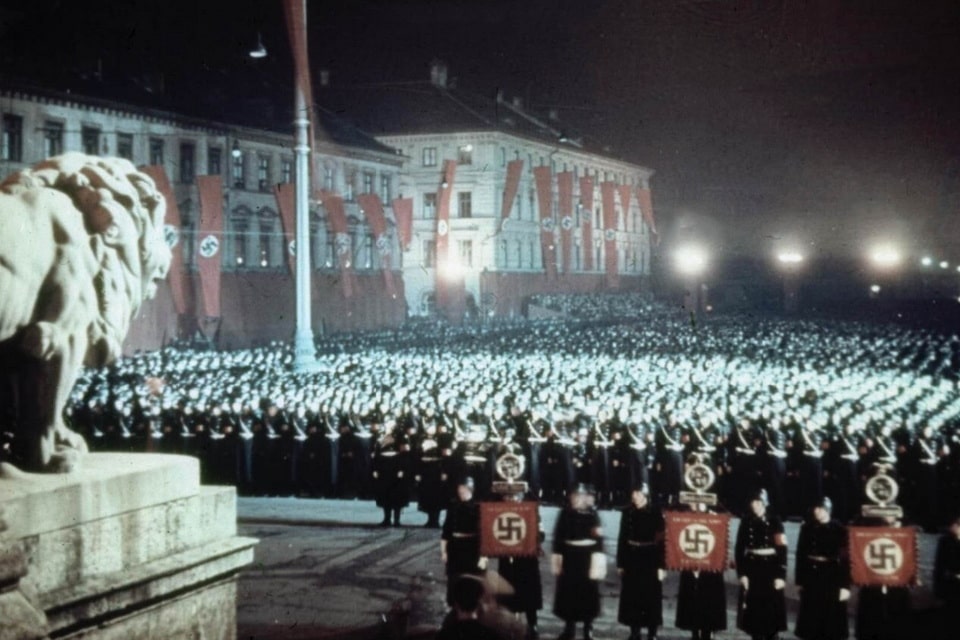


The spacious square behind the Feldherrnhalle memorial was named after the Odeon concert hall, which was almost completely destroyed during the Allied air raids on Munich. As far back as the 19th century, the open space in the heart of Munich was to be used as a ground for military parades and demonstrations. In the days of the Third Reich, Odeonsplatz had become a site to preside over the annual November ceremonies, devoted to the failed ‘Beer Hall Putsch’. The square witnessed parades by the SS and SA members, who gave their oath to their Führer Adolf Hitler, a man who eventually greeted the start of the First World War and now was pushing the world to a new one. The location was heavily damaged during the war years, yet now it resembles the pre-war state in detail. The stone sidewalk in the place of the 1923 gunshot includes a plate with the names of four fallen policemen.


THE WAR MINISTRY: ERNST RÖHM’S SIEGE AND THE OTHER TWO DEAD
At the time when Hitler used the red limousine to reach the Burgerbraukeller on the end of November 8, 1923, Ernst Rohm, the chief of the stormtroopers, was waiting for an order within a spacious hall of LOWENBRAUKELLER, another famous Munich beer-house. At approximately 9 o’clock, a phone call from the other side of the city announced the fall of the Bavarian government. The 2000 crowd of brownshirts and the members of Kampfbund went outside the beer hall with an assurance that their revolution was already consolidated by the Kahr-Lossow-Seisser triumvirate. A new semi-expected order from Hitler decreed to take the War Ministry in the center of Munich, a military patrimony of General Lossow and the actual headquarters of the whole VII military district of the Weimar Republic. In the years ahead, this military region, getting in line with the map borders of Bavaria, would be headed, among others, by Wilhelm von Leeb (The future Commander of the Army Group North) and Walther von Reichenau (The commander of the 6th army and the predecessor of Friedrich Paulus).

Only a part of the initial 2000 crowd, led by Ernst Rohm, marched across the Munich city center and succeeded in taking the War Ministry to the north of the Odeonsplatz. The administration building was captured without resistance, and the night-duty officers even kept the freedom to move around the cabinets until midnight. The putschists made a barbed wire cordon around the building and stationed the heavy machine guns and armed men in windows. Yet along with the capture of the Police department (also without violence), it was the only success of the revolutionaries in Munich that night. Since the rapid visit of Hitler and his return to Burgerbraukeller as well as General Lossow’s speech on the radio at 2:55 a.m. with a condemnation of aggression, the invaders of the War ministry were now in a siege, surrounded by squads of the Bavarian soldiers, put on the alert.
Röhm did manage to take over the Reichswehr headquarters, though amazingly failed to take over the telephone switchboard, allowing Lossow to order the transport to Munich of loyalist troops in nearby towns and cities. In a night of chaos, the putschists failed dismally, largely owing to their own disorganization, to take control of barracks and government buildings. The early and partial successes were for the most part rapidly overturned. Neither the army nor the state police joined forces with the putschists.
IAN KERSHAW (HITLER: HUBRIS, 1998)
By the time the column, led by Hitler and Ludendorff, moved off the Burgerbraukeller in the afternoon of November 9, Rohm’s men had been holding the perimeter defense since night. An attempt to liberate these besieged Nazis, as well as a chance to win the support of the police and soldiers, was the key cause for the column to make its way into the narrow Residenzstrasse towards the Odeonsplatz. After a disaster near the Feldherrnhalle, Rohm and his men were engaged in a gunfight with the troops around the War Ministry and lost two men, whose names would later be added to the fourteen who had been killed at Odeonsplatz. Shortly after the gunfight, the besieged stormtroopers capitulated, disarmed, and ingloriously convoyed to a place of detention along the streets of Munich.


THE ROUTE THAT NEVER HAPPENED: BRIENNER STRASSE TO KÖNIGSPLATZ
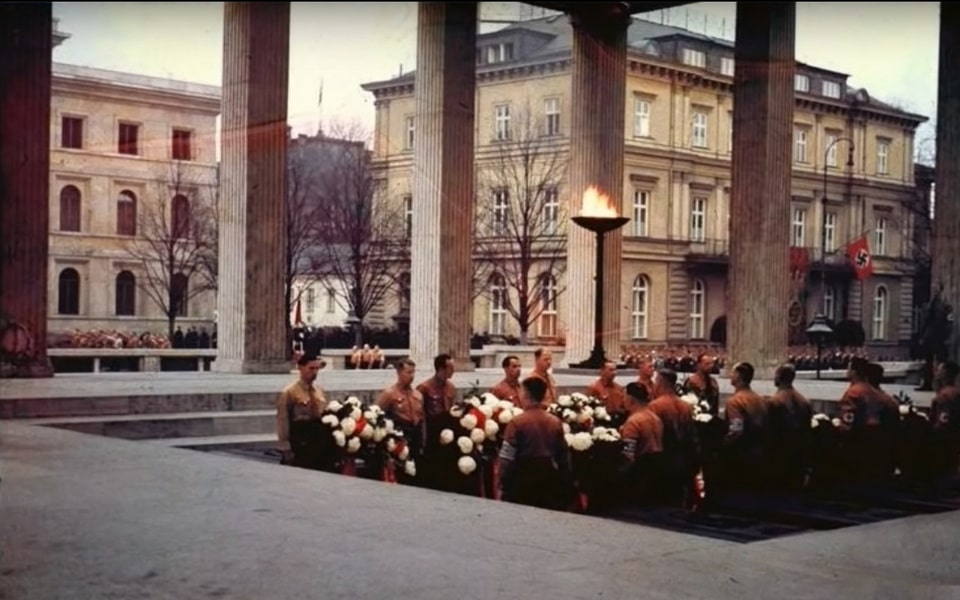
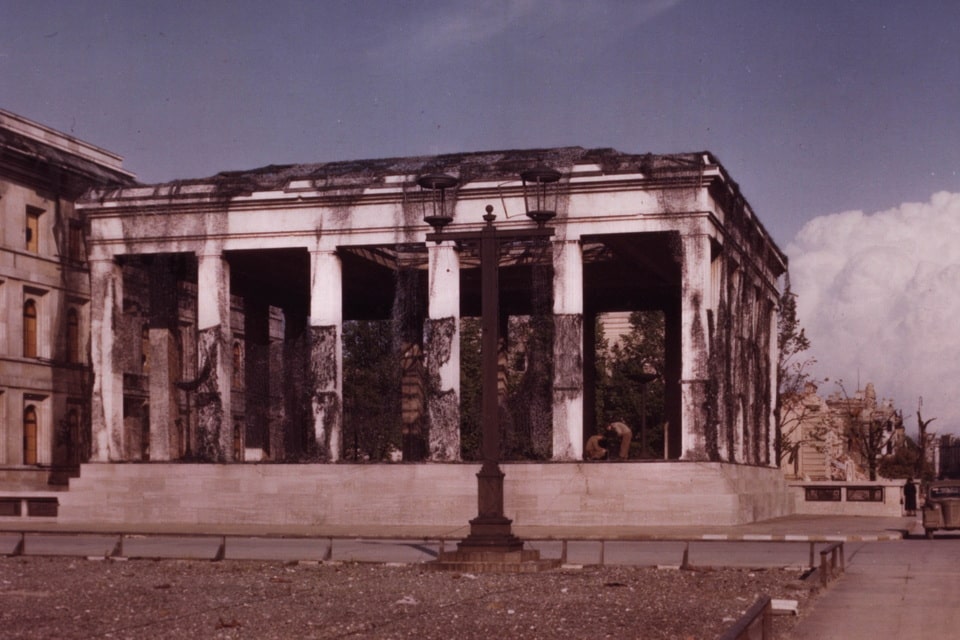
However, the suppression of the Putsch was not a question of if but when Hitler and Ludendorff smoldered a desperate belief to win the hearts of the citizens of Munich as well as the military troops of the Bavarian Army. As the next step to lifting the siege of the War Ministry, the column of the revolutionaries was meant to turn onto BRIENNER STRAßE, one of the main streets of the city, and march across the KAROLINENPLATZ square to reach the KONIGSPLATZ. In the years of the Third Reich, the annual November ceremonial column with Hitler atop used to continue their Beer Hall Putsch locations march route after the Odeonsplatz, a few hundred meters from the Munich War Memorial, and used to reach the ‘King’s Square’. In that period of German history, the KONIGSPLATZ was destined to become an important location for the Nazi regime, with several new buildings raised in the 1930s, including the so-called ‘Braunes Haus’ and the ‘EHRENTEMPEL’ (The Hall of Memory – a mausoleum for sixteen fallen Nazis). Both buildings were heavily damaged during the Allied bombardment of Munich and were later dismantled by the American troops.
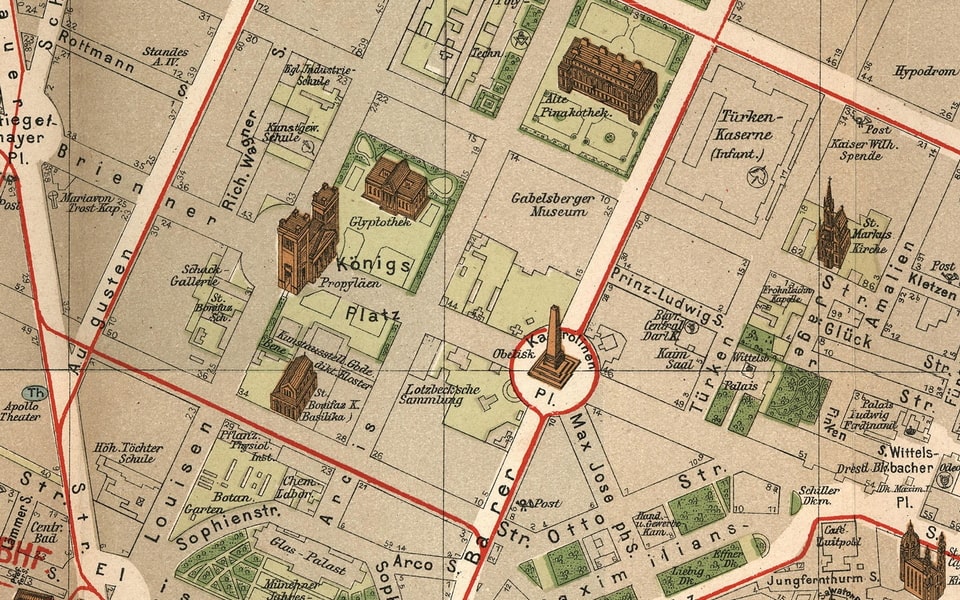


Already in 1931-2 he had collaborated with Troost on redesigning the Königsplatz in Munich, and when he came to power, these plans were put into effect. Adjoining were two characteristic expressions of the Nazi cult of the dead: temples of honor dedicated to the Nazis who had been killed in the 1923 beer-hall putsch. The huge grass arena of the Königsplatz itself was paved over with 24,000 square feet of granite slabs.
RICHARD J. EVANS (THE COMING OF THE THIRD REICH, 2003)



WALKING THE BEER HALL PUTSCH ROUTE TODAY: MAP, DISTANCE AND PRACTICALITIES
The march covered about three kilometres and took the putschists roughly an hour. Walking it today takes about two hours with stops, and every location except the starting point is still standing.
Start: Rosenheimer Platz S-Bahn station (S1–S8). The site of the Bürgerbräukeller is the square between the Gasteig and the GEMA building; the Elser plaque is set into the pavement there.
Finish: Odeonsplatz U-Bahn (U3, U4, U5, U6). If you continue along the unrealised part of the route to Königsplatz, add twenty minutes and one more U-Bahn stop.
Distance: 3.0 km to the Feldherrnhalle; 3.9 km if you finish at Königsplatz.
Time: around two hours at a walking pace with photo stops.
Direction: walk it west, the way the column went. Doing it in reverse from Odeonsplatz is easier for transport but loses the sense of the march narrowing into the Residenzstrasse, which is the whole point of the last stretch.
What is actually marked on the ground. Only three things. The Elser plaque at the start. The bronze plate in the pavement on the Residenzstrasse with the names of the four policemen killed on 9 November 1923 — set into the cobbles at the spot where the shooting happened, easy to walk past. And the line of golden cobblestones in the Viscardigasse, the alley behind the Feldherrnhalle that Münchner used to slip through to avoid saluting the Nazi memorial; the gold trail was laid in 1995 to mark that quiet refusal. Nothing else on the route carries any sign at all.
Nearby, if you have another hour. The Munich beer halls connected with the early Nazi movement are all within walking distance of the route, as is the Munich war memorial in the Hofgarten, a hundred metres from the Feldherrnhalle.

FREQUENTLY ASKED QUESTIONS
Where did the Beer Hall Putsch begin? In the Bürgerbräukeller on Rosenheimer Strasse, Munich, on the evening of 8 November 1923. The building was demolished in 1979; the Gasteig cultural centre, the GEMA building and the Hilton Munich City hotel now stand on the site.
Is the Bürgerbräukeller still there? No. It survived Elser’s bomb in 1939 and the Allied bombing, reopened as a beer hall in 1958, and was pulled down in 1979. The only marker is a small plaque to Georg Elser set into the pavement between the Gasteig and GEMA. Every other location on the route still stands.
How many people were killed at the Feldherrnhalle? Twenty in total: sixteen putschists and four Bavarian state policemen. Fourteen of the sixteen were killed on the Residenzstrasse in front of the Feldherrnhalle; the other two died in the fighting at the War Ministry the same day. This is why some sources say fourteen and others sixteen — both figures are correct; they count different things.
How long is the Beer Hall Putsch route and can you walk it? About three kilometres from the Bürgerbräukeller site to the Feldherrnhalle, or 3.9 km if you continue to Königsplatz along the stretch the column never reached. Two hours on foot with stops. No guide is needed — the map above marks every point.
Which beer hall was the Beer Hall Putsch in? The Bürgerbräukeller — not the Hofbräuhaus, which is the one most visitors assume. The Hofbräuhaus hosted the founding meeting of the Nazi party programme in February 1920, but the putsch of 1923 started at the Bürgerbräukeller, on the other side of the river.
Is anything on the route actually marked? Three things: the Elser plaque at the start, the bronze plate in the Residenzstrasse pavement naming the four policemen killed, and the golden cobblestones in the Viscardigasse. There is no memorial to the sixteen putschists — the Nazi tablet on the Feldherrnhalle and the pylon names on the Ludwigsbrücke were removed after the war.
Who took part in the march? Around two to three thousand men. At the front were Hitler, Ludendorff, Göring, Scheubner-Richter, Ulrich Graf, Friedrich Weber and von der Pfordten; Hess, Himmler, Streicher, Hans Frank, Röhm and Joseph Berchtold were all involved that day in different places. The section above lists what became of each of them.
What happened to Hitler afterwards? He was arrested on 11 November, tried in February–April 1924, sentenced to five years for high treason and released after nine months at Landsberg — where he dictated Mein Kampf. The trial gave him a national platform he had never had before, which is the reason the failed putsch is usually described as the making of his career rather than the end of it.