

Ian Kershaw’s Hitler: A Review of the Definitive Biography
Ask a historian of the Third Reich which single biography of Hitler to read, and the answer is usually the same: Ian Kershaw’s two-volume Hitler — Hubris, 1889–1936 (1998) and Nemesis, 1936–1945 (2000), together some two thousand pages, written over twelve years. This article is a close reading of that work: why Kershaw wrote it, which sources he trusts and which he throws out, and how it stands against the other five biographies people still buy.
What makes Kershaw’s book different is not new revelations. It is method. He opens by stating that he had never intended to write a biography at all — he was a social historian, sceptical of the genre — and that what interested him was never Hitler’s psychology but a different question: how was Hitler possible? Everything in the two volumes follows from that. German society is the subject; Hitler is the answer it produced.
That method also makes Kershaw unusually strict about evidence, and this is where the book is most useful to anyone checking a claim about Hitler. He refuses to cite Hermann Rauschning’s Hitler Speaks at all. He treats August Kubizek’s memoir, Reinhold Hanisch’s testimony, and Hans Frank’s Nuremberg statements as compromised. He dismantles the story of the Jewish grandfather point by point. Below I go through each of those cases with Kershaw’s own words quoted in full, so you can see exactly what he wrote rather than what he is said to have written.
If you are here to verify a specific quotation or claim attributed to Kershaw, the FAQ at the end addresses the ones that come up most often.
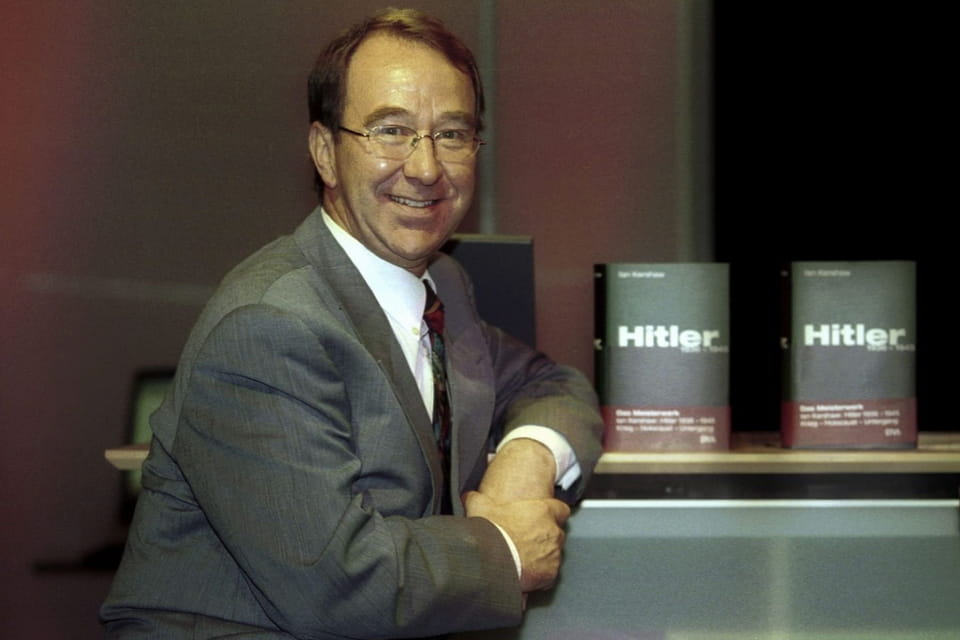
IAN KERSHAW’S HITLER: THE BOOK IN BRIEF
The book
— Volume I: Hitler 1889–1936: Hubris, first published 1998 (Allen Lane / Penguin in the UK, W. W. Norton in the US).
— Volume II: Hitler 1936–1945: Nemesis, first published 2000. Winner of the Wolfson History Prize (2000) and the British Academy Book Prize (2001).
— One-volume abridgement: Hitler: A Biography (2008), roughly a thousand pages including apparatus. This is the edition most readers now buy, and the one usually meant by «Kershaw’s Hitler» in a single volume — it is a condensation of the two volumes, not a separate study.
— Research period: begun in 1989, completed in 2000 — twelve years.
— Earlier related works: The «Hitler Myth»: Image and Reality in the Third Reich (1987) and Hitler: A Profile in Power (1991), a short précis of the argument later expanded into the two volumes.
The author
Sir Ian Kershaw (born 29 April 1943 in Oldham, Lancashire) began his career as a medievalist — his doctorate was on the economy of a thirteenth-century Yorkshire priory — and turned to modern German history after a conference in 1978. He was Professor of Modern History at the University of Sheffield from 1989 until his retirement in 2008, and describes the German historian Martin Broszat as his «inspirational mentor». He was knighted in 2002 for services to history, and has served as historical adviser on the BBC series The Nazis: A Warning from History and Auschwitz: The Nazis and the Final Solution. His later books include Fateful Choices (2007), The End: Hitler’s Germany 1944–45 (2011), To Hell and Back: Europe 1914–1949 (2015), Roller-Coaster: Europe 1950–2017 (2018) and, most recently, Personality and Power: Builders and Destroyers of Modern Europe (2022).
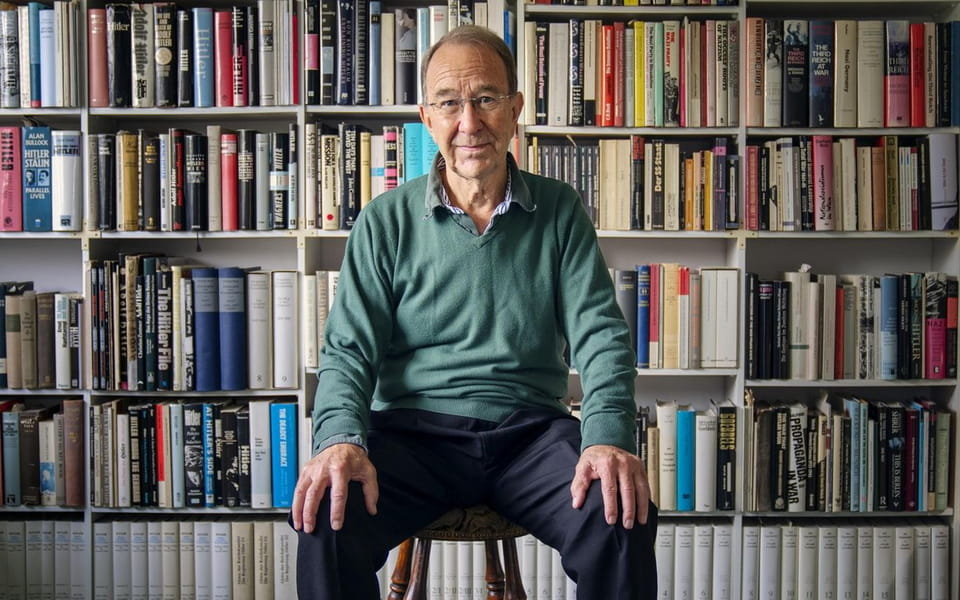
WHY IAN KERSHAW WROTE A HITLER BIOGRAPHY: TWELVE YEARS, 1989–2000
The first volume of Ian Kershaw’s study, Hitler 1889–1936: Hubris (1998), saw the light of day back in 1998, yet the research and writing process had already covered a period of ten years since 1989. The author would need another two years of involvement to fully complete his second volume, known as Hitler 1936–1945: Nemesis (2000). We should praise the fact that Ian Kershaw gained worldwide recognition for his studies about German history, the Third Reich, years before the well-known biography of Hitler. This academic involvement and devotion, along with a substantial body of collected materials, became a starting point for three decades of Kershaw’s historical activity and still shape his academic career. In this respect, I would define three phases of Ian Kershaw’s career as the recognized author and popularizer of military history.
I had never thought, until a few years ago, that I would write a biography of Hitler. Biography had never figured in my intellectual plans as something I might want to write. If anything, I was somewhat critically disposed towards the genre.

1980-1989. It was the Cumberland Lodge conference back in 1978 that motivated Kershaw to shift his academic focus from Medieval History to Modern History. While the recognized historians made approaches to studying Nazi Germany a hot topic of dispute, a young academic, still in his 30s, re-visualized his future career. During this period, Kershaw succeeded in presenting several works of pure academic nature about the Third Reich and the political mentality of the German people. It was at that time that he started writing about Hitler, an ‘inevitable’ character of any serious study on the topic. His first book completely devoted to Hitler was named ‘The ‘Hitler Myth’. Image and Reality in the Third Reich’.
1989-2000. Sophisticatedly detailed research of Adolf Hitler, covering two volumes, had occupied an impressive twelve-year span of time. At the same time, that’s not to say that Ian Kershaw gave up some other studies and books during these years. His academic recognition as the top-ranked historian of the Third Reich and Hitler was onward and upwards in the 1990s. Kershaw’s books of that period were challenged to examine the history of the rise and fall of the Weimar Republic, the ‘final solution’ (Endlösung) issue, and to parallelize Hitlerism and Stalinism. ‘Hitler: A Profile in Power’ book came out already in 1991 and can be characterized as the scaled-down pre-version of the future detailed two-volume research.
2000 – now. Once acquired the status of an academic star thanks to his two-volume monographs, Ian Kershaw still widely uses his best practice and sources to address German and European history. He gives us the book on the ‘July plot’ in 1944 and Hitler’s last weeks within the bunker near the Chancellery. Challenges to analyze the mentality of ‘acceptance’ of the Final Solution in Hitler, the Germans and the Final Solution (2008). Kershaw publishes a one-volume cut version of his famous ‘HITLER’ work on 1000 pages, including the appendix. Researches the final year of the Second World War in his ‘The End: Hitler’s Germany 1944–45’ and covers thirty-five years of European history in ‘To Hell and Back: Europe, 1914–1949’. After To Hell and Back, he completed the story of the continent in Roller-Coaster: Europe 1950–2017. His most recent book, Personality and Power: Builders and Destroyers of Modern Europe (2022), returns to the question that has occupied him since the 1980s — how much difference a single leader actually makes — through twelve portraits: Lenin, Mussolini, Hitler, Stalin, Churchill, de Gaulle, Adenauer, Franco, Tito, Thatcher, Kohl and Gorbachev. The Hitler chapter is, in effect, Kershaw’s own summary of his two volumes, written more than twenty years later, and it makes a useful companion to the biography.

It’s important to determine one obvious reason for the recognized historians to keep coming back to the topics they have already studied years ago, which is the ever-increasing accessibility of sources. It was more than just memoirs of Hitler’s surroundings, which were still published even 50 years after the end of the war. Professor Ian Kershaw makes his appeal to us to treat these sources with caution. The motive to write another detailed research on Hitler was the unprecedented amount of primary sources of information about the Weimar Republic, the Nazi movement, Hitler himself, and the Third Reich. By way of example, we can praise the multi-volume stenography of Hitler’s speeches during his political career, from the Munich beer halls to the bunker in a besieged Berlin. In many respects, Ian Kershaw’s Hitler biography work managed to become among, if not the best study of Hitler, with an incredible 120,000 works as a total.
From the early part of my scholarly career onwards, first as a medievalist, I had been much more drawn to social history than to a focus on high politics, let alone a focus on any individual.
BIOGRAPHY OR SOCIAL HISTORY: KERSHAW’S QUESTION, ‘HOW WAS HITLER POSSIBLE?’
Professor Ian Kershaw himself emphasizes the fact that he did not see any point in the years of work on the classic biography, some years before the initial phase of the work. To this extent, his two-volume study is academically close to the traditional work of Joachim Fest, which, on the other hand, was a means of motivation for Kershaw. The key empirical issue and the personal challenge for the author were How was Hitler possible.
What has continued in the writing of the book to interest me more than the strange character of the man who held Germany’s fate in his hands between 1933 and 1945 is the question of how Hitler was possible.

To search out those motivations and to fuse them with Hitler’s personal contribution to the attainment and expansion of his power to the point where he could determine the fate of millions is the aim of the study.
Kershaw examines German society to find his answers: what kind of person Hitler was, why he became the person we all know, and how his unrestricted power in Europe was possible. Professor Ian Kershaw examines German society as a tree, which bore a Nazi regime’s fruit. We can afford to keep underestimating the meaning of Hitler and simplify his image to the extent of a madman, an obsessed speaker, a hobo from Vienna, a Bohemian corporal, or just a fanatic or antisemite. The expanded personality of Hitler, according to Kershaw, could only be successfully examined through socio-cultural, historical, political, economic, and military aspects. In the same respect, these aspects in the 1930s and 1940s could not be studied ignoring Hitler.
Has this been Hitler’s century? Certainly, no other individual has stamped a more profound imprint on it than Adolf Hitler. The twelve years of Hitler’s rule permanently changed Germany, Europe, and the world. He is one of the few individuals of whom it can be said with absolute certainty: without him, the course of history would have been different.

While getting into the Empire, then into the Weimar Republic and the Third Reich, Ian Kershaw himself notes how important to respect a delicate balance when you deal with a specific personality. How big is the gap between empathy, essential for the attempt to understand the inner motives of Hitler, and sympathy for getting into a particular state of mind, his passions, fears, convictions, and the most flaming dreams? Kershaw attaches Hitler’s era to a paradigm of the whole XX century in several aspects.
- The pretense of a modern society’s high state status.
- The highest level of suppression of public opinion and violent actions against the citizens of the state.
- Mobilization of public consciousness through the media landscape on a never-before-seen scale.
- Constant cynical violation of the rules of international law and neglect of diplomatic ethics.
- Domination of far-right nationalistic judgments, including international policy. Strong racial intolerance and the destructiveness of the racial superiority theory.
- Gradual conversion of a high-cultural society into an inner and international aggressor.
Hitler and Nazism amount, unsurprisingly, to a lasting trauma for German society and of course, though in very different ways, for the regime’s millions of victims. But the legacy of Hitler belongs to all of us. Part of that legacy is the continuing duty to seek understanding of how Hitler was possible. Only through history can we learn for the future. And no part of history is more important in that respect than the era dominated by Adolf Hitler.

The answer Kershaw arrives at has a name, and it is the idea he is best known for: «working towards the Führer». He borrowed the phrase from a speech by a Nazi official in 1934, who told his audience that it was the duty of every German not to wait for orders but to anticipate the Führer’s wishes and act on them. Kershaw turned that remark into an explanatory model for the whole regime.
On this reading, the Third Reich did not function as a chain of command running down from Hitler. It functioned as a competition. Ministries, party offices, the SS and regional bosses all tried to guess what Hitler wanted and to get there first, each initiative more radical than the last, because radicalism was what won approval. Hitler could remain remote, lazy and vague about detail — and the system still moved in his direction, faster than any order could have pushed it. It is this mechanism, more than Hitler’s own personality, that Kershaw offers as the answer to «how was Hitler possible», and it is why his biography reads as a history of German society rather than a portrait of one man.
THE BEST HITLER BIOGRAPHIES COMPARED: KERSHAW, BULLOCK, FEST, TOLAND, MASER, HAMANN
Next to no time within the very introduction, Ian Kershaw mentions two outstanding biographies of Adolf Hitler. Still widely recognized and praised among millions of people, excited with the military history. ‘Hitler, a study in tyranny’ by Alan Bullock, published back in 1952, and the 1000-page-volume monumental HITLER by Joachim Fest (1973). Regardless of the tens of thousands of studies on the Third Reich, Nazi Germany, and Hitler, only a small number of books have gained a military bestselling recognized status and are worth looking at. In this respect, I would like to consider five classical biographies of Adolf Hitler with a correlation with Ian Kershaw’s study.
An attempt to undertake a new biography of Hitler, bold though it may be, found further encouragement (as well, it must be admitted, as some discouragement or even dismay) through the massive outpouring of first-rate scholarly research on practically all aspects of the Third Reich since the major biographies of Fest – even more so of Bullock – were written.
Alan Bullock, ‘Hitler: A Study in Tyranny’ (1952)
‘HITLER, A STUDY IN TYRANNY’ BY ALAN BULLOCK. Professor Kershaw makes it clear that he was fascinated with Bullock’s work in his student days. With great respect to his inspiration, Kershaw repeatedly emphasizes that the 1952 bestseller had inevitable historical limitations and weak points. Bullock did have a shortlist of primary sources at his disposal and used unreliable sources, such as Reinhold Hanisch’s testimonies and ‘Hitler Speaks. A Series of Political Conversations with Adolf Hitler on his Real Aims’ ( 1939) by Hermann Rauschning. Kershaw emphasizes that Bullock later reconsidered his approach to Hitler.
I had read as a student, with endless fascination, Alan Bullock’s early masterpiece. Alan Bullock, subsequently recognized that he had been mistaken, in the first edition of Hitler. A Study in Tyranny, in playing down the importance of Hitler’s ideas

Joachim Fest, ‘Hitler’ (1973)
‘HITLER’ BY JOACHIM FEST. Kershaw honors this more than monumental study, which once reconsidered Hitler in the socio-cultural context, as it was never done before 1973 when the book was published. We can feel the influence of Fest’s book all the way through Kershaw’s work. These two academic masterpieces have much in common in their format and orientation on social, political, and historical aspects of German and European history. Nevertheless, the ‘more modern’ work of Kershaw, by design, provides stronger authority, thanks to the recently revealed primary sources and paying great attention to doubtful sources, despite their awareness.
And on its appearance in 1973 I immediately devoured Joachim Fest’s new biography, admiring as all did its stylistic brilliance.

Werner Maser, ‘Hitler: Legend, Myth & Reality’ (1971)
‘HITLER: LEGEND, MYTH & REALITY’ BY WERNER MASER. Another recognized biography of Adolf Hitler from the 1970s. Kershaw frequently addresses Maser’s work, yet rather as an example of the usage of unreliable sources. Kershaw strongly examines a myth about the Jewish grandfather of Hitler, and falsified testimonies of Patrick Hitler, Adolf’s nephew. Maser’s book does not stand against critical analysis and should be treated with a pinch of salt.
Since the various forms of the name had evidently been for decades interchangeable, it is unclear why Maser, Hitler, 31, can be so adamant that Nepomuk (who himself had used more than one form) insisted at the legitimation upon ‘Hitler’ rather than ‘Hiedler’ as being closer to his own name of ‘Hüttler’.

Brigitte Hamann, ‘Hitler’s Vienna’ (1998)
‘HITLER’S VIENNA: A DICTATOR’S APPRENTICESHIP’ BY BRIGITTE HAMANN was published in the same 1998 year as the first volume of Kershaw’s work. This monumental study represents an incredibly detailed overview of Hitler’s life before 1913, including a sophisticated insight into his childhood and youth. Professor Kershaw expresses his deepest gratitude to Brigitte Hamann for assistance in his work. These two monumental studies treat doubtful sources of information with a reserve and, for example, cross-examine August Kubizek’s famous memoirs. The first chapters in Kershaw’s HITLER are academically similar to Hamann’s work, and they complement each other. The pre-history of the sociocultural environment, the history of particular historical places connected with Hitler, and the examination of the far-right movements of the period.
Brigitte Hamann, also dismissive of the Frank story, speculates that his motive, as a long-standing Jew-hater himself, could have been to blame the Jews for producing an allegedly ‘Jewish Hitler’

John Toland, ‘Adolf Hitler’ (1976)
‘ADOLF HITLER’ BY JOHN TOLAND. Another iconic biography of Hitler from the 1970s has gained a bestselling status and a Pulitzer Prize for its author. Kershaw repeatedly quotes from Toland’s work, as his inspirational figure has once managed more than 200 interviews with people who knew Hitler. In some wider sense, the book by Toland is alone a primary source. At the same time, Kershaw pays attention to the fact that some witnesses have changed their testimonies over the years, and a span of 30-40 years after the events left an indelible stamp. In this respect, any testimony should be treated with care.
In contrast, see Toland’s interpretation, which notably exaggerates the significance of the ‘Second Book’ as the point at which Hitler had ‘seen the light’ and ‘finally come to the realization that his two most urgent convictions – danger from Jews and Germany’s need for sufficient living space – were entwined’

WHICH SOURCES KERSHAW REJECTS: RAUSCHNING, HANISCH, FRANK AND KUBIZEK. DEBUNKING THE MYTHS ABOUT HITLER
The way Ian Kershaw’s 2000-page study is now considered to be the most authoritative biography of Adolf Hitler, for many of us it may be obvious that the book has to draw the final lines in several disputed issues concerning Hitler. The author challenges the established myths, intentional falsifications, mistreatment of sources, human components, and speculations. Professor Kershaw speaks his truth, that answers to some questions are unlikely to be found, and all we have in this case is to keep to the facts, approved sources, and the methodology of historiography.
Kershaw cross-examines the ‘classical’ sources about Hitler, especially dealing with his early years before 1919. In particular, the testimonies of Hans Frank, a former Hitler’s lawyer, and the general governor in occupied Poland do not withstand even a moment’s criticism. Words of Hitler himself about his niece Geli Raubal are a little more than Frank’s insinuations. Kershaw closely treats August Kubizek’s and Reinhold Hanisch’s memoirs, dealing with the Viennese period of Hitler’s youth, defining inaccuracies and intended distortions. Hermann Rauschning’s book is reasonably considered a historical falsification, which has nothing in common with reality, given the fact that Rauschning had meetings with Hitler, but the authenticity of his texts is dubious.
I have on no single occasion cited Hermann Rauschning’s Hitler Speaks, a work now regarded to have so little authenticity that it is best to disregard it altogether. Other sources, too, particularly memoirs but even the ‘table-talk’ monologues of the last months (the so-called ‘Bunkergespräche’), of which no original German text has ever been brought to light, have to be treated with due caution.

WAS HITLER’S GRANDFATHER JEWISH? KERSHAW ON THE FRANKENBERGER MYTH
Kershaw debunks a myth that Maria Schicklgruber, Adolf’s paternal grandmother, got pregnant by a young man from a Frankenberger Jewish family in Graz. Examining the historical documentation and doubting the rumors, the author gives us many arguments for the absurdity of this myth.
- There is no factual evidence that Maria Schicklgruber had ever visited the city of Graz.
- There were no Jews in the whole Styria area of the Austro-Hungarian Empire back in the 1830s, and this demographic tendency was not to be changed until the 1860s.
- The residential records of the city of Graz did reveal an Austrian Frankenreiter family, not a Jewish Frankenberger. The younger master of the family was only 10 years old when Alois Hitler was born in 1836.
- There is no single factual proof that Maria Anna Schicklgruber did maintain a decades-long mailing correspondence with some family, which used to send her payments to raise a son until his fourteenth birthday. Frankenreiter’s family suffered poor living conditions themselves and unlikely for them to ‘patronize’ a boy born outside marriage.
- The rumors on the so-called Jewish roots of Hitler originated from the opponents of the Nazi party back in the 1920s and later were chorused by the communists.
- The testimonies of Hans Frank, a former Hitler’s lawyer, which he revealed during the Nuremberg trials, do not hold up against the facts and critics. More specifically, the supposed dialogue with Hitler about Adolf’s paternal grandfather, secret investigation, and suppression of evidence is no more than Frank’s invention. By way of example, Frank stated that Hitler had revealed a conversation with the grandmother. Maria Anna Schicklgruber passed away back in 1847, 42 years before Adolf was born, and Hitler could not tell Frank such things.
- Frank’s testimonies about the so-called blackmail letter from Patrick Hitler, Adolf’s nephew, in the mid-1930s had nothing in common with the facts. A young man by no means could reveal such intimate family ‘truth’ about Adolf’s ancestor. Patrick had lived in Germany unarmed until 1938, and his later ‘insights’ to the French newspaper in 1939 contained no stories about Adolf Hitler’s grandfather or any blackmail.
- The Gestapo was ordered to manage a secret investigation of Hitler’s genealogy, and they failed to find any pieces of evidence that departed from the previously known facts.
The third possibility is that Adolf Hitler’s grandfather was Jewish. Rumours to that effect circulated in Munich cafés in the early 1920s, and were fostered by sensationalist journalism of the foreign press during the 1930s. It was suggested that the name ‘Hüttler’ was Jewish, ‘revealed’ that he could be traced to a Jewish family called Hitler in Bucharest, and even claimed that his father had been sired by Baron Rothschild, in whose house in Vienna his grandmother had allegedly spent some time as a servant.

ADOLF AND ALOIS HITLER: WHAT KERSHAW MAKES OF ‘MEIN KAMPF’
Professor Kershaw deeply puts to the test Adolf’s own words about his childhood and conflicts with Alois Hitler, as they were presented in ‘Mein Kampf’. The author puts in doubt the self-justifications of the future German Führer, which were once meant to correlate a poor performance in school to a protest against the father. Ian Kershaw examines Hitler’s school certificate, as well as August Kubizek’s recollections, Alois Hitler’s pan-germanic beliefs, and the image of Klara Hitler, and altogether acknowledges a strained relationship between Adolf and his father Alois. A disbelief in being a government servant indeed led Hitler to his future ambitions.
Whether the young Adolf, allegedly at the age of twelve, so plainly stipulated he wanted to be an artist may be doubted. But that there was a conflict with his father arising from his unwillingness to follow a career in the civil service, and that his father found fault with his son’s indolent and purposeless existence, in which drawing appeared to be his main interest, seems certain.

WAS HITLER HOMELESS IN VIENNA? THE MISSING MONTHS OF AUTUMN 1909
As it was with the early biographies of Hitler such as ‘Hitler, A Study in Tyranny’ by Bullock and ‘Rise and Fall of the Third Reich’ by W. Shirer, Hitler’s own words from ‘Mein Kampf’ were generally used to shape Hitler’s Viennese period. Nevertheless, more modern studies raise reasonable doubts and examine Hitler’s 1906-1913 years with greater caution. At the same time, Kershaw presents arguments that Hitler’s needy situation back in the Autumn of 1909 and a ration of dry bread and milk hold validity. The author hits on the idea that Hitler indeed had no permanent residency between September and December 1909.
- There is no documentary record about Hitler between September 16 and his first registered night at the Meidlung shelter in December of 1909, including any records within a police register, an obligatory means of the period in Vienna. This implies a strong possibility that Hitler did not have a registered accommodation within these three months of 1909.
- Adolf had received his orphan’s pension until 1911, and he was under an obvious obligation to inform Josef Mayrhofer, his guardian, of the actual address for the money (25 Kronen) to be sent to Vienna. This fact does not stand against the possibility of Hitler being homeless, as he could state any address to get money.
- Despite the doubtfulness in details of Reinhold Hanisch’s testimonies, his recallings of Hitler in Meidling have a basis using the cross-fact examination. As a matter of example, Hanisch’s words about Hitler who had to find lodging for the night within cheap cafes near the Westbahnhof railway station may be attributed to Hitler’s first two homes in Vienna locations (Stumpergasse 31 and Felberstraße 22), as well as the Merciful Sisters Hospital at STUMPERGASSE 13.
- Nazi’s legend on the Simon-Denk-Gasse 11 accommodation of Hitler in Vienna circumstantially gives credence to the fact that the German Führer indeed had bad times without constant accommodation back in 1909. The Anschluss of Austria, among other more obvious things, witnessed the taking of the residential register books by the NSDAP investigators. Later on, Hitler’s addresses in Vienna were not to be even mentioned by the ‘official’ press. Indeed, and not in name, Adolf Hitler had never lived in a house on Simon-Denk-Gasse 11, which he just couldn’t afford at the time. This building was a bit more convenient and closer to the city center than Hitler’s previous accommodations, which he had to live in because of the lack of money.
During the next months, Hitler did learn the meaning of poverty. His later recollection that autumn 1909 had been ‘an endlessly bitter time’ was not an exaggeration. All his savings had now vanished. He must have left some address with his guardian for his orphan’s pension of 25 Kronen to be sent to Vienna each month. But that was not enough to keep body and soul together.

HITLER AND SEXUALITY: WHAT THE SOURCES ACTUALLY SUPPORT
While making academic maneuvering between Hitler’s recollections, Kubizek’s memoirs, and some indirect sources, Kershaw admits that Adolf Hitler still had no sexual relations at the time of leaving Vienna back in 1913. Along with that, Ian Kershaw rejects the after-war speculations about Hitler’s homosexuality, sexual dysfunctions, or gender-based violence as myths that have nothing in common with reality.
- If to be of the view of August Kubizek, he had never seen Adolf with a girl within three years of their friendship in Linz and then in Vienna. Kubizek had once faced a long passage and frustration with Adolf when August took a student girl to their apartment. Kubizek also recollected Hitler’s voluminous stories about a girl from Linz, whose name was Stefanie, with whom Adolf was way in love. According to Kubizek, Hitler cast himself aside from homosexuality and masturbation and strongly criticized prostitution. Hitler ignored other girls in the opera shows and could talk for hours as a result of walking along the backyards of Vienna. At the same time, being self-suppressed from sexual relations, Hitler was fascinated with sexuality.
- The testimonies of former residents of the Männerheim (Meldemannstraße) — the municipal men’s hostel on Meldemannstraße in Vienna’s Brigittenau district — record a great deal about Hitler’s political arguments in the reading room and almost nothing about women. Hitler lived there for just over three years, from February 1910 until May 1913, when he left Vienna for Munich.
- Ian Kershaw analyzes a kind of Hitler’s intended celibacy through the prism of Adolf’s pan-germanic views, the Schönerer movement in particular, which had amazed Hitler during his Viennese years. Hitler considered this self-restricting of sexual activity, as well as alcohol and smoking, a means to harden the spirit.
- Ian Kershaw examines Reinhold Hanisch’s recollections as a doubtful source of information, which still can confirm Kubizek’s memoirs on Hitler’s sexual experience, a lack of one.
- The postwar version of Hitler’s sexual dysfunctions and the absence of one testicle, which resulted in his personality, should be considered no more than speculation and a myth. These yellow press statements were once based on the false Soviet sources of the ‘so-called’ autopsy of Hitler’s remains, which had never been true. These historical falsifications do not stand against facts and the actual medical testing of Hitler when he was alive.
It can be said with near certainty, then, that by the time he left Vienna at the age of twenty-four Hitler had had no sexual experience. In a city in which sexual favours were so widely on offer to young men as the Vienna of that day, who were widely expected to visit prostitutes while publicly upholding a strict moral codex, this was in all likelihood unusual. Probably, he was frightened of women – certainly of their sexuality.

WHEN DID HITLER BECOME ANTISEMITIC? KERSHAW’S CASE AGAINST THE VIENNA VERSION
Every recognized biography of Adolf Hitler faces a dilemma of the authenticity of his autobiographical passages on the formation of the racial vision already in the Viennese 1907-1913 period. The author examines this traditionally accepted conception by cross-examining the sources and socio-cultural life in Vienna. Whereas in contrast, the majority of books stand for Hitler’s earlier antisemitic nature, Kershaw determines a later period, after leaving Vienna in 1913.
- Ian Kershaw takes August Kubizek’s memoir with great accuracy to detail and authenticity and considers his passages on Hitler’s anti-semitic nature the most arguably within the whole testimonies. Almost every statement of Kubizek on the issue should be considered questionable. According to Kubizek, Alois Hitler, Adolf’s father, had strong pan-germanic views until he died in 1903, and Adolf had become a strong antisemite already in 1907. Kubizek all but certainly invents or exaggerates a story of visiting the Jewish synagogue and expands Hitler’s passages from the MEIN KAMPF, including the infamous story about a ‘Jew in black caftan’.
- In March 1938 and as an obvious aftermath of the Anschluss of Austria, the Gestapo confiscated some belongings of doctor Eduard Bloch from Linz, a man who had treated Klara Hitler until her death. The investigators found two 1908 New Year’s postcards of Hitler to Dr. Bloch with the warmest thanks for his care for Adolf’s mother. Thirty years after Klara’s death, Adolf Hitler, the German Führer, gave the order to protect Jewish doctor Eduard Bloch and to assist his emigration to the USA.
- Reinhold Hanisch’s testimonies, as was repeatedly stated before, should be treated with academic caution; in the meantime, they go to show that Hitler had no severe anti-semitic views back in his Viennese period. Adolf did make friends with some Jews in the Mannerheim hostel for men and spoke favorably of the Jewish art dealers, whose services he preferred. In due course of the heated debates within the Mannerheim reading hall, Adolf Hitler expressed his attitude on the racial matters of disputes, yet without hateful passages against Jews. This argument contradicts Hitler’s recollections of his strong anti-semitic nature already in 1910. At the same time, the accounts of Josef Greiner should not be considered truthful sources.
Here is, therefore, no reliable contemporary confirmation of Hitler’s paranoid antisemitism during the Vienna period. If Hanisch is to be believed, in fact, Hitler was not antisemitic at all at this time. Beyond that, Hitler’s close comrades during the First World War also recalled that he voiced no notable antisemitic views.

HITLER AND GELI RAUBAL: WHAT KERSHAW CONCLUDES ABOUT HER DEATH, 1931
Professor Ian Kershaw draws the line of maybe the most scandalous issue in Hitler’s biography. Indeed, there are no facts that Adolf Hitler had sexual relations with his niece, as well as the facts against this supposition. In this respect, the author examines rumors, in fact, sources of information, and dissociates history from allusions.
- Anni Winter, Hitler’s housekeeper of the apartment, which was a residence and the last suicide harbor for Geli Raubal in Munich, dismissed the argument that Hitler had had sexual relations with his niece. These rumors have roots in the criticism of Otto Strasser, Hitler’s political opponent.
- The postwar false sensation that it was either Hitler himself or the SS guards who killed Geli Raubal and fabricated the suicide to avoid the sexual scandal has nothing in common with the facts. Despite the anti-Nazi rumors, no additional traces of violence were found on Geli’s body, except the bullet hole. Hitler was in Nuremberg at the time of the accident and had a strong dependence on Geli, so it’s unlikely for him to order Raubal’s assault. The rumors that Geli was pregnant with a child of a Jewish student in Munich or of an officer are no more than inventions of Hans Frank and Bridget Hitler, the first wife of Hitler’s half-brother, Alois.
- The actual nature of Hitler’s relations with his niece would probably not be submitted in the long run, and all history has is doubtful accounts and speculations. At the same time, it’s beyond argument that Hitler had emotional dependence on a woman, Geli Raubal, for the first time in his life (apart from his love for his mother Klara)
It was different with Geli. Whatever the exact nature of the relationship – and all accounts are based heavily upon guesswork and hearsay – it seems certain that Hitler, for the first and only time in his life (if we leave his mother out of consideration), became emotionally dependent on a woman. Whether his involvement with Geli was explicitly sexual cannot be known beyond doubt

THE REICHSTAG FIRE, FEBRUARY 1933: DID THE NAZIS STAGE IT?
Despite the after-war speculations and the well-known historical ‘Reichstag fire’ euphemism, Ian Kershaw did not find strong proof that the sabotage on 27 February 1933 itself was fabricated by the Nazis. The book deepens into the issue and takes us to the conclusion that the Nazi powers used the accident and distorted the motives of Marinus van der Lubbe, who was a fanatic indeed. Hitler fell into a hysterical state and formed a myth about the communist revolution and an assault on German nationality, which in this respect has to be defended.
Diels tried to say that the fire was the work of a ‘madman’ (einen Verrückten). But Hitler brusquely interrupted, shouting that it had been planned long in advance. The Communist deputies were to be hanged that very night, he raged. Nor was any mercy to be shown to the Social Democrats or Reichsbanner.

FREQUENTLY ASKED QUESTIONS
Which edition of Kershaw’s Hitler should I read? If you want the full study, the two volumes — Hubris (1998) and Nemesis (2000). If you want one book, the 2008 abridgement Hitler: A Biography keeps the argument and most of the narrative in about a thousand pages. The abridgement is not a different interpretation; it is the same work, compressed by the author.
Is Kershaw’s the best Hitler biography? It is the standard one — the book other historians cite and the one most reading lists start with. Whether it is the best for you depends on what you want. Fest is the better stylist. Hamann is far more detailed on the Vienna years. Toland preserves interviews with people who knew Hitler and no one can now repeat. Bullock is a historical document in its own right. Kershaw’s advantage is that he had access to sources none of them had, and that he is the most rigorous of the six about which of those sources can be trusted.
Did Kershaw write that Hitler had no children? Kershaw’s biography does not treat the question as an open one. He states that Hitler had no sexual experience by the time he left Vienna in 1913, that his relationship with Geli Raubal cannot be shown to have been sexual, and that his later relationship with Eva Braun produced no children — but he does not devote a passage to «Hitler was childless» as a claim to be proved, because in the surviving record there was nothing to disprove. If you are checking a citation that attributes a specific sentence on this to Kershaw, the honest answer is that the two volumes discuss Hitler’s relationships and sexuality at length and do not contain such a sentence as a standalone assertion. Claims of unacknowledged children — the Jean-Marie Loret case in particular — have been raised outside Kershaw’s work and have never been substantiated.
Why does Kershaw refuse to use Hermann Rauschning’s Hitler Speaks? Because the conversations it reports are not considered authentic. Kershaw’s own words, from the preface to Hubris: he had «on no single occasion» cited the book, «a work now regarded to have so little authenticity that it is best to disregard it altogether». He extends similar caution to the Bunkergespräche monologues, for which no original German text has ever surfaced.
Was Hitler’s grandfather Jewish? No — Kershaw treats the Frankenberger story as a myth and sets out the reasons in detail: there is no evidence Maria Schicklgruber was ever in Graz, no Jewish community in Styria at the time, no Frankenberger family in the city’s records, and the account rests entirely on Hans Frank’s Nuremberg testimony, which is demonstrably false on its own terms. The section above goes through all eight points.
What is Kershaw’s «working towards the Führer»? His argument that the Nazi state radicalised itself from below: officials competed to anticipate what Hitler wanted rather than waiting for instructions, so the regime moved in his direction faster than any command structure could have carried it. It is the idea he is most cited for.
Who is Ian Kershaw? Sir Ian Kershaw, born in 1943, was Professor of Modern History at the University of Sheffield from 1989 to 2008 and is widely regarded as the leading authority on Hitler and Nazi Germany. He was knighted in 2002. He is still writing: his most recent book appeared in 2022.