

Kyiv WWII Memorial Complex: Ukraine in the Second World War
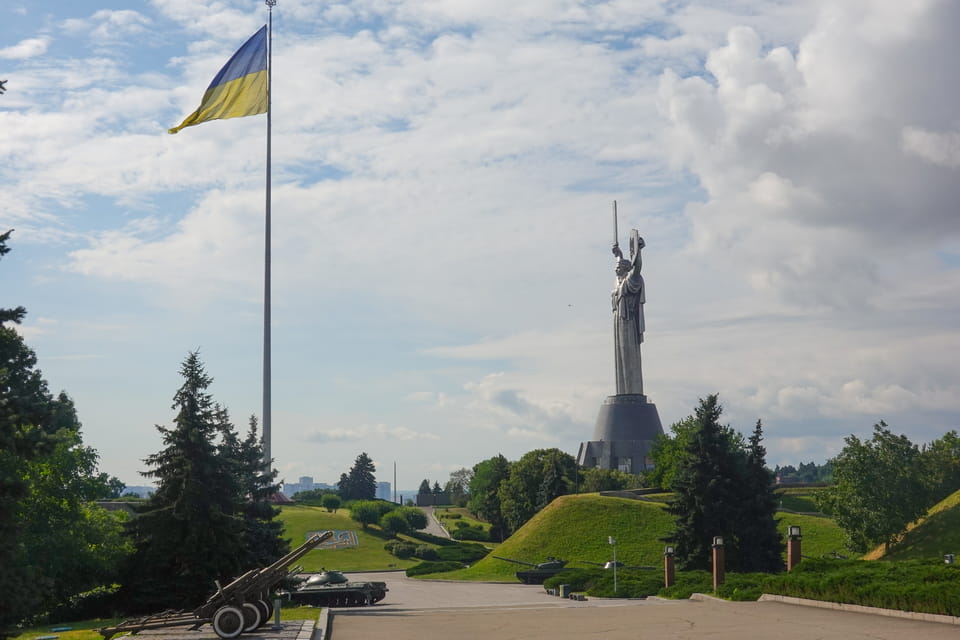
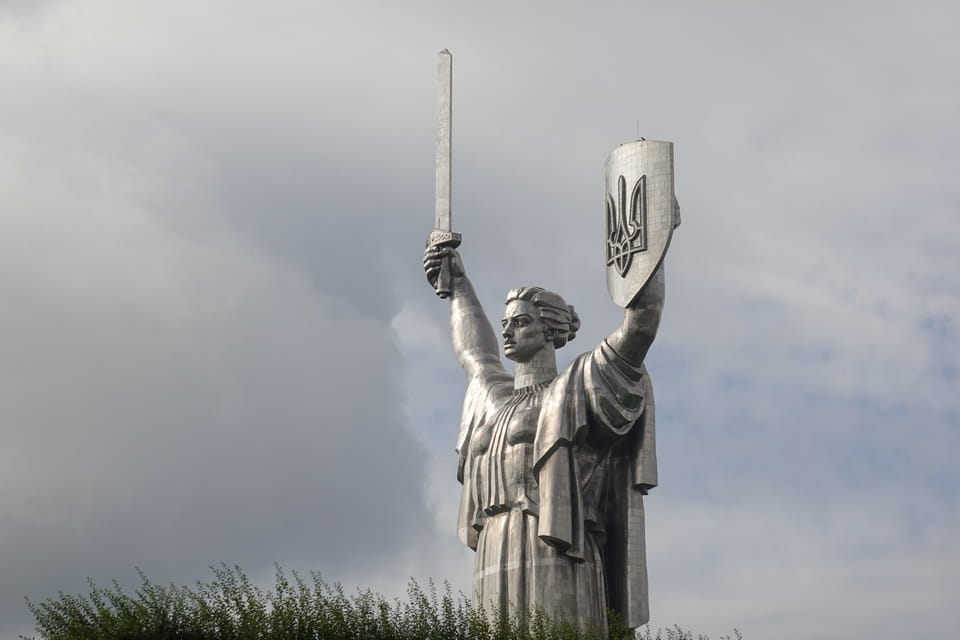
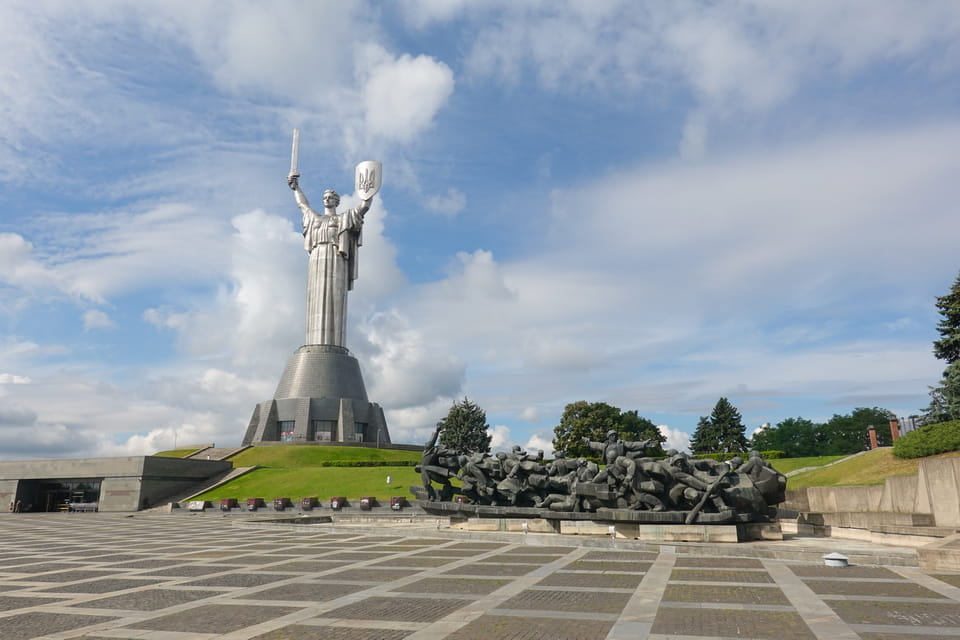
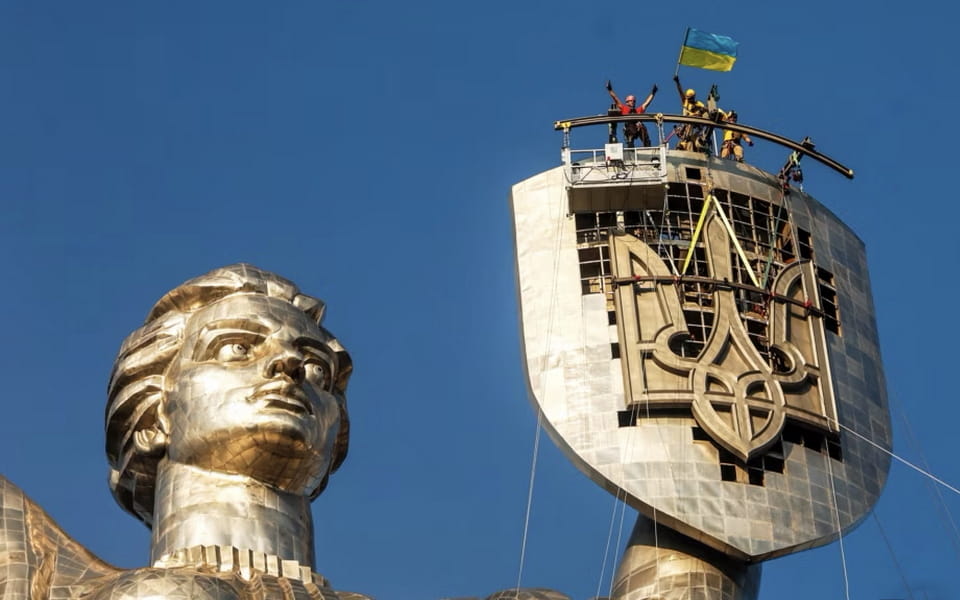
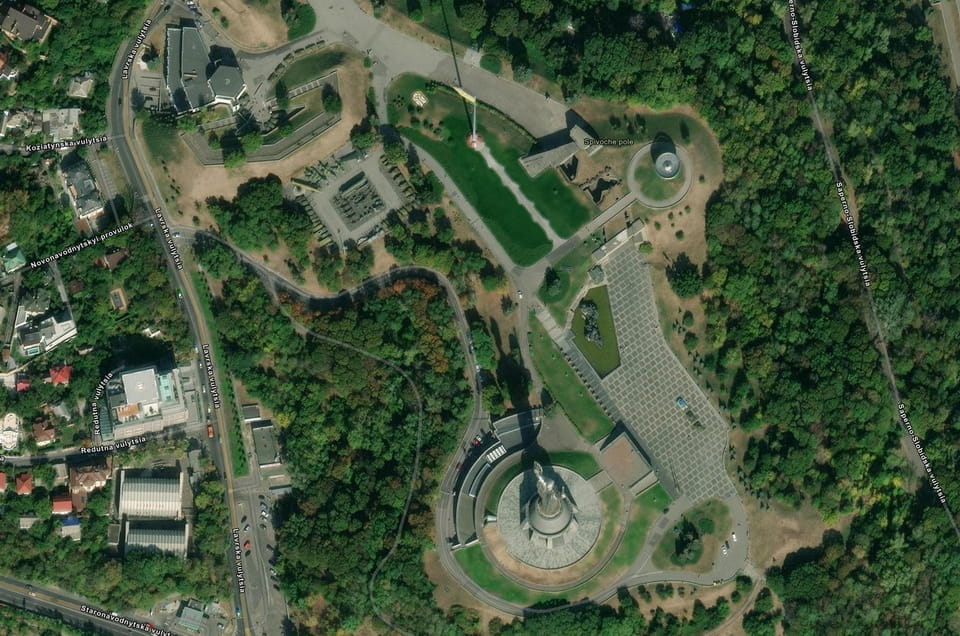
The National Museum of the History of Ukraine in the Second World War — widely known in Western sources as the Kyiv WW2 Museum or, in older references, the Kiev War Museum or Great patriotic War Museum Kiev — is a memorial complex at Lavrska vul. 24, on the Pechersk Hills above the Dnipro River in Kyiv, capital of Ukraine. The complex covers 10 hectares, holds an outdoor exhibition of over 60 pieces of military equipment (tanks, artillery, aircraft), and a museum of 400,000 items (17,000 accessible across 16 halls). Since its inauguration on 9 May 1981, the complex has received more than 30 million visitors from 150 countries. At its centre rises the Motherland Monument (Batkivshchyna-Maty) — a titanium statue 62 metres tall on a pedestal 40 metres high, totalling 102 metres and weighing 560 tonnes. In August 2023, the Soviet hammer and sickle on the monument’s shield was replaced with the Ukrainian trident (tryzub) — one of the defining acts of Ukrainian decommunisation.
A note on terminology: Western search engines and older publications still often use «Kiev» (the russian-era transliteration) and «Great Patriotic War» (the Soviet term for the 1941–1945 German–Soviet conflict). Ukraine has officially abandoned both: the museum was renamed in 2015, and the spelling «Kyiv» has been internationally recognised since Ukraine’s diplomatic note of 1995, broadly adopted after 2022. This article uses «Kyiv» throughout. Where «Kiev» appears in historical quotations, it refers to the same city.
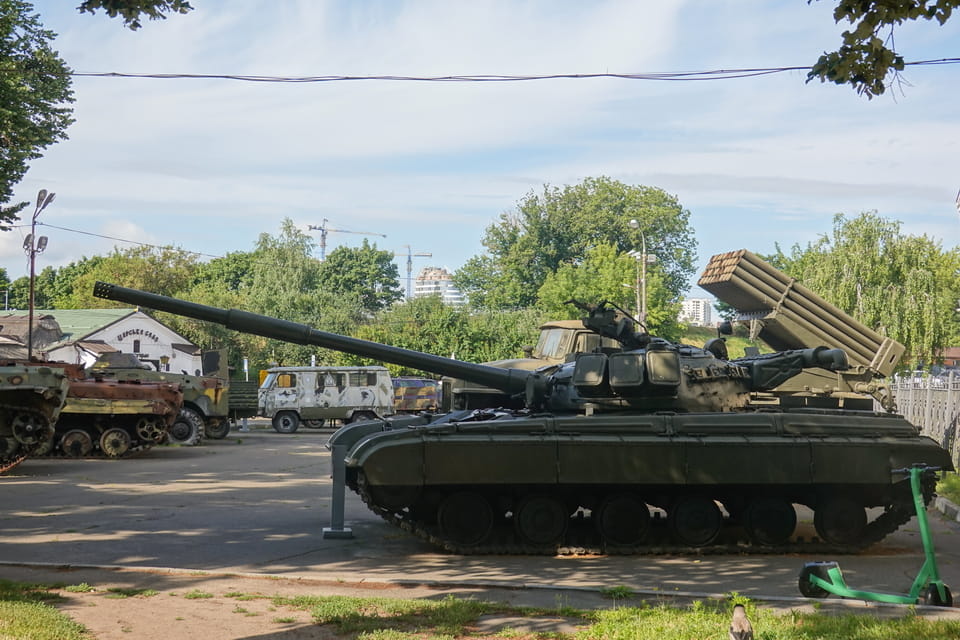
Today, the semantic focus of the museum has fundamentally evolved. Following the onset of russian aggression in 2014, and especially after the full-scale invasion in February 2022, the complex has transformed into Ukraine’s premier national platform for documenting the war crimes of the russian army. The outdoor exhibition areas, once dominated exclusively by WW2 relics, now feature the burnt remnants of modern russian military hardware — including destroyed tanks, airborne infantry fighting vehicles, and intercepted missile fragments — standing as tangible evidence of the successful defense of Kyiv. Inside the museum, exhibitions are continuously updated. Most notably, the «Ukraine – Crucifixion» (Україна – розп’яття) exhibition showcases artifacts gathered directly from newly de-occupied regions, ranging from the personal belongings of the invaders to shattered elements of civilian infrastructure. The site is no longer just a monument to the past, but a living archive of Ukraine’s ongoing struggle for independence.
KYIV IN THE HISTORIOGRAPHY OF WW2: THE BATTLE OF KIEV 1941 AND THE LARGEST ENCIRCLEMENT IN HISTORY (665,000 POW)
This was determined by decades, that ‘Western readers’ generally find little sense in multiple geographical names correlated anyhow with the ‘Barbarossa’ plan and the War in the East. The battle for Stalingrad has become an infamous historical symbol in military history. Yet, one and a half years before Field Marshal von Paulus had to prove his own identity to the stunned Soviet officers within the bunker, and four months before the panzer commands had to make fire under the bellies of the tanks near Moscow, Kyiv, the capital of Soviet Ukraine, had gained a few reasons to be mentioned with ‘the most’ comparative degree.
The historiography of the first months of the war between Nazi Germany and the USSR in the summer of 1941 was intimately connected with Kyiv. This initial phase of the War in the East has been exhaustively researched by every military historian of the Second World War over the last seventy years. I encourage you to take into consideration three historical matters, which generally ‘reveal’ Kyiv through the lens of the Second World War, especially for Western readers.
I would like to additionally provide my English-speaking readers with a few tips on the abbreviations and names, which could be useful:
- USSR – Ukrainian Soviet Socialist Republic, thus Ukrainian SSR is ‘more preferable’ in use
- USSR – Union of Soviet Socialist Republics
- The «Great Patriotic War» – Soviet equivalent of the war between Germany, the AXIS, and the USSR
- May 9 Victory Day Parade – Traditional Victory Parade in the Union of Soviet Socialist Republics
- ‘Crossing of Dnieper’ – Soviet equivalent of the ‘Battle of the Dnieper’
- Babyn Yar – a site of mass killings in the former ravine in Kyiv. Today is a memorial park, accessible to visitors
A third army group would drive south of the marshes through the Ukraine toward Kiev, its principal objective being to roll up and destroy the Soviet forces there west of the Dnieper River. Farther south German–Rumanian troops would protect the flank of the main operation and advance toward Odessa and thence along the Black Sea. Thereafter the Donets basin, where 60 percent of Soviet industry was concentrated, would be taken.
William Shirer (The rise and fall of the Third reich, 1960)

The advance of the Group Army ‘South’. This Group Army, commanded by the elderly field marshal Gerd von Rundstedt, was pre-planned to invade the Southern front. Three German and two Romanian armies were to gain control over Soviet Ukraine with its rich natural and production resources. Then advanced to the Volga River and eliminated Soviet combined forces.
The German Group Army ‘South’ by von Rundstedt made up of three armies and one panzer group, was in advance toward Kiev with a mission to eliminate Soviet forces in Galicia and Western Ukraine to the West of Dnieper river as well as to gain control over the river crossings over Dnieper near Kiev to keep offensive across the river.
Kurt von Tippelskirch (History of the Second World War, 1951)


The largest encirclement of troops in military history. Many political, military, ideological, and logistical factors, including Stalin’s order to hold Kyiv at any cost, finally resulted in ¾ million Soviet soldiers concentrated near the city. When this enormous amount of troops was finally outflanked, 665,000 soldiers and rebel fighters (according to the German official account) were taken as prisoners of war. It has become what is still known as the largest encirclement in military history. On September 19, 1941, the inspired soldiers of von Reichenau’s 6th Army marched the streets of Kyiv without any idea to be encircled in Stalingrad fifteen months from that warm Autumn day.
The five days of bloody battles resulted in the first yielding prisoners. By the time the whole territory near Kiev was suppressed, more than 600 000 of soldiers were taken prisoners of war. A little over of one-third of the Red army was annihilated. Germans were enthusiastic in classifying every item of the trophies.
Alan Clark (Barbarossa: The russian-German Conflict, 1965)
The scale of the Battle of Kyiv (23 August – 26 September 1941) in numbers:
— 665,000 Soviet soldiers taken prisoner by German accounts — the largest military encirclement in history
— Four Soviet armies simultaneously annihilated: 5th, 21st, 26th and 37th Armies
— 19 September 1941: 6th Army of Field Marshal von Reichenau entered Kyiv
— 43 days from the start of the encirclement operation to the fall of the pocket (23 Aug–26 Sep)
— Von Reichenau’s 6th Army — the same formation that surrendered at Stalingrad in February 1943, for 300,000 German and Axis troops


The mass killings in Babi Yar. Every authoritative research on the Eastern Front and the Holocaust leads its reader to this infamous event in world history and one of the largest crimes known. The tragedy of Babi Yar has become a tragic symbol of the Holocaust in the same historical way as Auschwitz and Treblinka in Poland.
The columns were directed towards Babi Yar where ‘an entire office operation with desks had been set up’. Thirty to forty at a time were processed, but their documents were simply discarded. Instead they were beaten and pushed to an area that was overlooked by German and Ukrainian guards. There they were ‘forced to strip naked: girls, women, children, old men. No exceptions were made. Rings were ripped from the fingers of the naked men and women, and those doomed people were forced to stand at the edge of a deep ravine, where the executioners shot them at point blank range.
David Cesarani (Final Solution: The Fate of the Jews, 2016)


KYIV UNDER NAZI OCCUPATION 1941–1943: POPULATION COLLAPSE FROM 930,000 TO 180,000 CITIZENS
By the break of June 22, 1941, at a time when more than 2000 km of the Eastern front was set on fire, Kyiv, as the capital of Soviet Ukraine, distanced as much as 500 km from the front lines, suffered its first air raids and first victims of the War, among the civilians. The next day witnessed the mass mobilization of the male population with only one demand: to be able to hold the rifle. Nearly the same number of their relatives, elderly persons, women, and children were ‘occupied’ in the works of building up the defensive line near Kyiv. The last pre-war population count made in 1939 featured 840,000 people, which would have been enlarged to 930,000 people on the dawn of June 22.
On September 19, 1941 the German forces penetrated Kreschatyk on two sides. The first column of these cheerful soldiers on trucks were moving from the Podol after they were previously greeted on Kurenevka. The second column were advancing the streets from Bessarabka. They were entering the city from the very battle field, being covered with mud and dust, smoked and invaded the sidewalks of Khreschatyk with clack sound and gasoline smoke.
Anatoly Kuznetsov (Babi Yar: A Document in the Form of a Novel, 1966)

At this point in the narration, I would make an additional clarification to the fact that in 1943, when Kyiv was liberated, only every fifth of the pre-war population was to be found within the city. Let’s fill the gap between 930,000 people in 1941 and only 180,000 in 1943.
- By liberation on 6 November 1943, Kyiv had experienced one of the most extreme urban population collapses in history:
— 930,000 inhabitants on 22 June 1941 (start of the German invasion)
— 180,000 remaining when Soviet forces re-entered in November 1943
— 200,000 men mobilised to the Red Army (a large proportion killed or died in captivity)
— 325,000 civilians evacuated east by train before the city fell
— 100,000–150,000 deported to forced labour in the Reich
— Up to 100,000 murdered: including 33,771 Jews killed at Babi Yar in two days (29–30 September 1941), further victims at Syrets camp and Darnitsa POW camp (Stalag 339), plus civilians who died of starvation and disease
— By May 1945, the population had partially recovered to 500,000
The other army has its own ground outside the city. The German war cemetery at Vita-Poshtova was laid out only after 1991 and holds the reburied Wehrmacht dead of the fighting in the region.
During the infamous murders at Babi Yar outside Kiev in September 1941, for example, a combination of soldiers from SS police battalions, Einsatzgruppen and local collaborators murdered nearly 34,000 Jews in just two days by shooting them. This was killing on a scale that no death camp ever matched over a similar period. What gas chambers offered was not a way of killing more people in a single day than shooting, but a method of making the killing easier – for the killers.
Laurence Rees (The Holocaust. A new history, 2017)


The devastation of Kyiv over the past two years also has its historical reasons. Battle for Kyiv itself in July-September 1941. The intentional devastations of the retreating Soviet troops, as well as the sabotage against the German occupation forces, and finally the battles for the liberation of Kyiv in October-November 1943. After the liberation of Kyiv and the ‘re-entry’ of the pre-war population, demobilization of soldiers, and recovery of the industry, the May 1945 victory parade witnessed a population of 500,000. I have a separate detailed material devoted to the German occupation of Ukraine and Kyiv through the prism of Alfred Rosenberg’s visit to Kyiv in 1942. What the memorial complex does not show is on the other side of the city. The ravine at Babyn Yar and the sites around it — the old Jewish cemetery, the anti-tank ditch, the Syrets camp — went almost entirely uncommemorated for the whole Soviet period.
Brilliant camouflage, deception operations elsewhere and a lack of Luftwaffe air reconnaissance led the Germans to overlook this particular threat. When the two armies burst out of the bridgehead they were able to encircle Kiev, which fell on 6 November, the day before the celebrations in Moscow of the anniversary of the Revolution. Stalin was exultant.
Antony Beevor (The Second World War, 2012)

HISTORY OF THE KYIV WW2 MEMORIAL COMPLEX: FROM SOVIET «GREAT PATRIOTIC WAR» MUSEUM (1946) TO NATIONAL MUSEUM OF UKRAINE IN WWII (2015)
It took almost two years and the efforts of half of the total forces of the Soviet army to regain the Ukrainian territory, which had been conquered in less than four months in the year 1941. In January 1943, at the time when the 6th Army of Paulus was on its last breath in Stalingrad, a new advance of the Red Army succeeded in liberating selected north-east areas of the Ukrainian Soviet Socialist Republic (USSR and should not be confused with the ‘Union of Soviet Socialist Republics’. On May 19, 1944, the Central Committee of the Communist Party of Ukraine approved the project of a pre-planned historical exhibition called ‘Ukrainian Partisans in their Fight against the German-fascist invaders’. Back then, the Crimean peninsula had been liberated, and the new front line was now close to the Romanian border.
By the middle of May 1944 the Soviet-German Front came to a relative standstill. Except for the enormous “Belorussian Bulge” in the middle, where the Germans were still nearly 250 miles inside Soviet territory, the Soviet-German Front ran in an almost straight line from the Gulf of Finland, near the former Estonian border, down to Northern Rumania
Alexander Werth (russia at war, 1964)

It took a while two years to establish the first large exhibition devoted to the Ukrainian SSR in the «Great Patriotic War» (the Soviet equivalent of the war between Germany and the AXIS and the USSR), which was finally opened on April 30, 1946. 19 theme-based halls included almost 15,000 of the exhibit units. The main idea of that first post-war exhibition was the importance of the Communist Party’s participation and Joseph Stalin’s personal involvement in the partisan movement, which was a half-truth in a way; it was misrepresented. The Communist-themed communique of the exhibition declared that it was ‘Comrade Stalin ’ who had invented a new strategy of the partisan war and ‘instructed’ Ukrainian fighters to perform his undeniable ideas, under the careful supervision of the local communist officials. Despite this patronal wrench of history, the museum was closed in 1950. Furthermore, the exhibition items were not lost but rather found their place on the dusty shelves.
The partisan movement of Ukraine gained unprecedented scale. This energy of the Ukrainian people in a struggle with the enemy was only able to be born in the name of out great cause and for the sake of triumph of the Communism ideas. The exhibition reflects the triumph of the Stalin’s national cohesion. The representatives of every nation of the multinational Soviet Union fought in the ranks of the Ukrainian partisan movement.
Exhibition guidebook, 1947

The partisan movement, sustaining armed resistance behind the German lines, began in June 1941 and became one of the most notable features of russia’s war. By the end of September the NKVD claimed that 30,000 guerrilla fighters were operating in Ukraine alone. It was impossible for the invaders to secure the huge wildernesses behind the front.
Mah Hastings (All Hell Let Loose. The World at War 1939-1945, 2011)
On October 17, 1974, at the lapse of a quarter of a century, «The Ukrainian State Museum of the History of the Great Patriotic War of 1941 – 1945» was officially opened in Klov Palace in Kyiv. This gorgeous building, built back in the 18th century and later ornamented by Ukrainian artists, was now dominated by the importance of the Second World War. The museum archives were constantly expanding with tens of thousands of items from all over the USSR. In a little while, the Academic Society of the Ukrainian SSR received approval from the Communist Party to create a full-fledged memorial complex to exhibit a large amount of the historical heritage.


As early as the conceptualization phase, a group of Soviet sculptors and architects agreed on an area of 10 hectares to be allocated for construction. In the course of tours across Kyiv, the experts agreed to create a new memorial complex on the banks of the Dnieper River to make the future parts of the composition, including the large statue, visible from any point in the city. In 1978, the members of the Ukrainian Politburo were initiated into the minutiae of the upcoming complex and gave their approval. It took three intense construction years to create a memorial complex on the Dnieper, and the opening was set on May 9, 1981.

Leonid Brezhnev, General Secretary of the Central Committee of the governing Communist Party of the Soviet Union, was the main guest at the upcoming event of great national importance. A day before, the leader of the state was ‘rewarded’ with his fourth title of Hero of the Soviet Union, and the artists now had to make stylistic amendments to his portrait with yet three stars, previously exhibited within the Hall of Fame. The leader of the Communist world, who at that time was destined to live only a little bit more than one year, cut the ribbon at the opening ceremony. The so-called May 9 Victory Day Parade of that year was celebrated with grandiosity.
To fully understand the origins of the memorial, one must view it through the lens of the Soviet occupation of Ukraine, which lasted until 1991. The complex was heavily utilized as an instrument of monumental propaganda, designed to cement the republic within Moscow’s ideological orbit. The memorial was officially inaugurated on 9 May 1981 by Soviet leader Leonid Brezhnev. Archival footage and photographs from the ceremony reveal a frail, decaying apparatchik who appeared largely disoriented and disconnected from his surroundings. This stark contrast — the colossal, imposing scale of the monument towering over a physically and mentally fading dictator — became a striking metaphor for the Soviet system itself: internally rotting, yet desperately clinging to its control over Ukraine. The tradition this complex belongs to began abroad rather than at home. The first great Soviet war memorial was built in Berlin’s Tiergarten in 1945, while the ruins were still being cleared.


The original Soviet name — «Ukrainian State Museum of the History of the Great Patriotic War» — reflected the political vocabulary imposed on Ukraine after 1945. The phrase «Great Patriotic War» (Velyka Vitchyznyana Viyna) was a Soviet construct designating the 1941–1945 German–Soviet war, designed to absorb the separate experiences of occupied nations — including Ukraine — into a singular, russia-centered «patriotic» narrative. Ukraine, which lost between 8 and 10 million of its people in the war — more than any other nation in Europe per capita — had no autonomous historical voice in this framing. The Ukrainian dead were mourned through the lens of Soviet victory, not Ukrainian loss.
In July 2015, Ukraine’s Verkhovna Rada (Parliament) passed the decommunisation laws, mandating the removal of Soviet names from public institutions. While WWII monuments themselves were exempted from demolition, the museum was officially renamed to the National Museum of the History of Ukraine in the Second World War — adopting internationally standard terminology and, critically, reframing the war from a Ukrainian rather than Soviet perspective.
Since russia’s full-scale invasion of Ukraine on 24 February 2022 — the continuation of a criminal war of aggression begun with the seizure of Crimea and the occupation of Donbas in 2014 — the museum has acquired an additional mission: the active documentation of russian war crimes on Ukrainian soil. The «Great Patriotic War» terminology continues to be weaponised by russia as an ideological cover for this attack, equating Ukrainian resistance with «Nazism» in a direct inversion of historical truth. This museum, and this article, reject that framing.
THE KYIV WWII MEMORIAL COMPLEX TODAY: 10 HECTARES, 400,000-ITEM ARCHIVE AND 30 MILLION VISITORS
From the very day Leonid Brezhnev cut the ribbon on May 9, 1981, the Memorial complex in Kyiv has been visited by more than 30 million guests from 150 countries. In the past decades, the archive collections of the WW2 museum beneath the ‘Motherland Monument’ (Batkivshchyna-Maty) have amounted to a fantastic 400 000 items, with only 5% to be exhibited now to the public. In 2015, the «Ukrainian State Museum of the History of the «Great Patriotic War» of 1941 – 1945» was renamed ‘National Museum of the History of Ukraine in the Second World War’. The modern territory of 10 hectares now houses imposing historical monuments, which can easily excite all interested in the Second World War, the Eastern Front in particular.

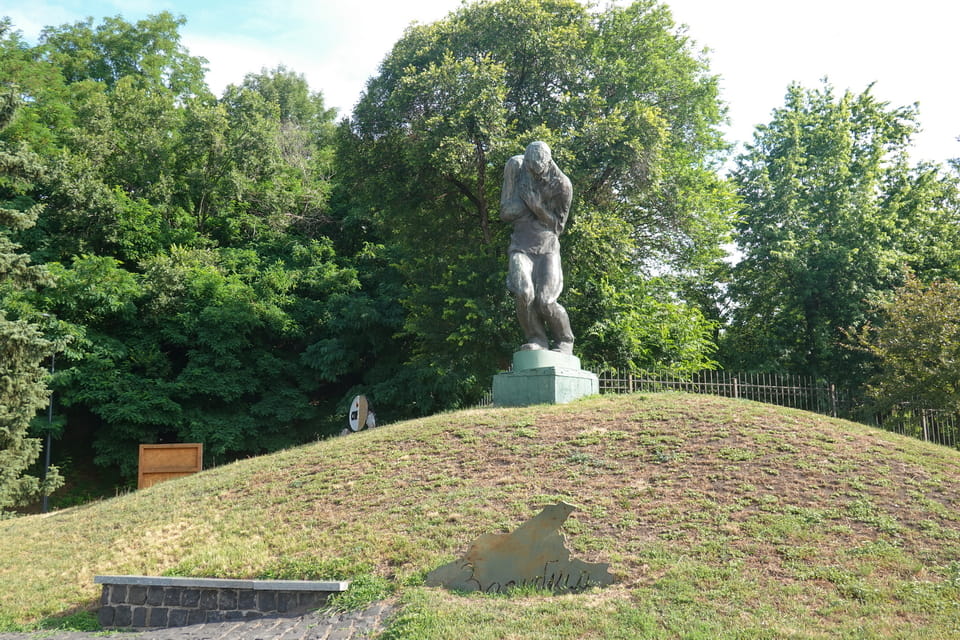
MONUMENT TO THE FALLEN SOLDIERS OF UKRAINE IN THE SECOND WORLD WAR (1939–1945): BRONZE FIGURE AND «ЗАГИБЛИМ» INSCRIPTION
In contrast to the more common historical image of the soldiers striking a combative pose, this four-meter statue is devoted to those millions of soldiers who fell before the end of the war and had no chance to celebrate the victory parade. This man, engraved with four meters of bronze, symbolizes the terrible loss of the Soviet soldiers who fell in the Second World War, were killed in combat, or died in the POW camps, such as the notorious Syrets concentration camp and Darnitsa camp. The statue reflects a man with a fatal wound. A metal plate in the form of a shell fragment, set in the ground, was inscribed with the ‘ЗАГИБЛИМ’ (FALLEN) inscription.
These men suffered the initial bloodletting and later brought the Red army to the win. The essential point to remember is that millions died on that way to gain glory, with the same talant.
David Glantz (Stumbling Colossus, 1998)


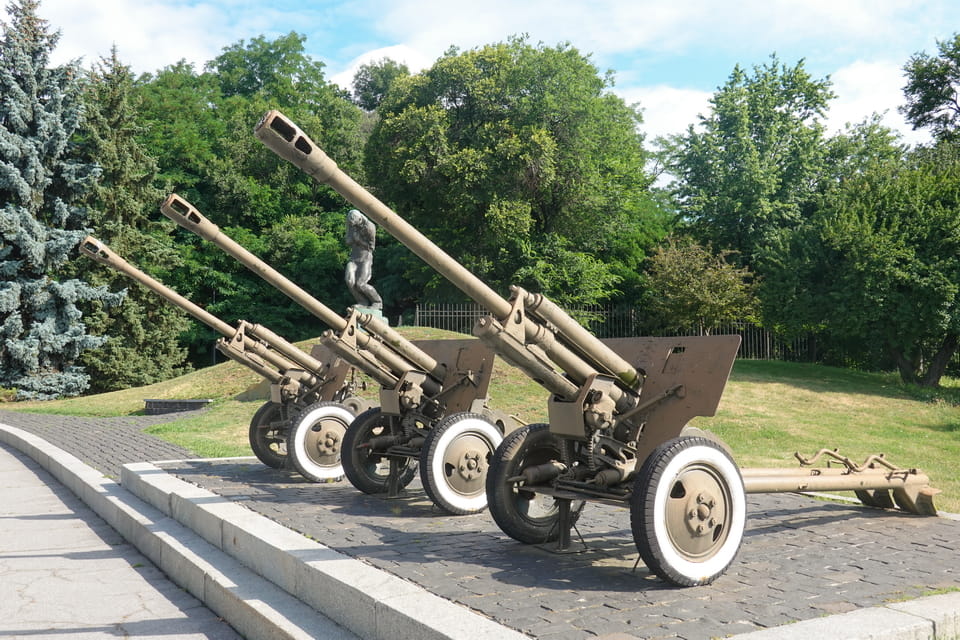
ZIS-3 FIELD GUNS OF THE EASTERN FRONT: OPEN-AIR ARTILLERY IN KYIV
Each of the three open sites, once placed on the come-down to the central part of the Memorial complex, exhibits three authentic artillery field guns of 1942. The most ‘production artillery gun’ of the Red Army has gained this historical status in large part because of the assembly line nature of production, which at that point was unique for the participants of the Second World War. ZIS-3 guns entered mass manufacturing back in February 1942 to become a standard-bearer of the artillery arms of the Eastern Front.
This particular model was poorly effective against modern German tanks such as Panzerkampfwagen VI Tiger and PzKpfw V «Panther», best-in-class in the Wehrmacht. On the other hand, mass production ensured quantitative superiority up to the end of the war. Although the artillery guns generally delivered fire from a distance, the Soviet soldiers also used these guns in direct combat on the battlefield to destroy the German tanks and manpower. The weighty guns were moved using horses or with bare hands. After the Second World War, ZIS-3 guns continued service far beyond the Soviet army within the third-world countries of the Communist world.
Progress was still slow for the first two days, but once again it was the Soviet heavy artillery and the katyusha rocket launchers which made the first breakthroughs possible. Iron-hard ground also made the shells much more lethal, with surface explosions.
Antony Beevor (The Fall of Berlin 1945, 2002)

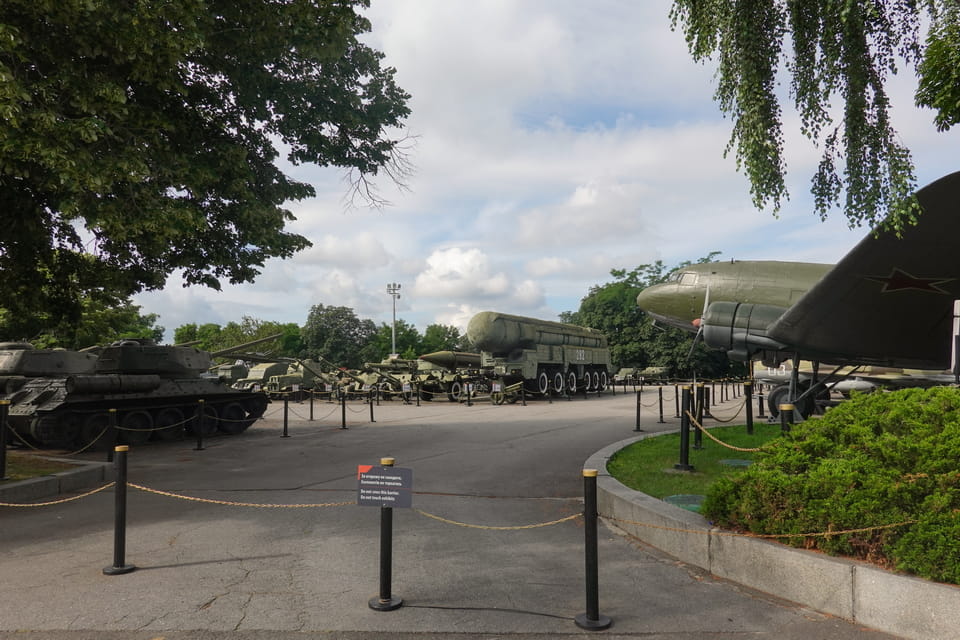
OPEN-AIR MILITARY MUSEUM KYIV: T-34, LI-2 AIRCRAFT, KATYUSHA AND 60+ WW2 PIECES
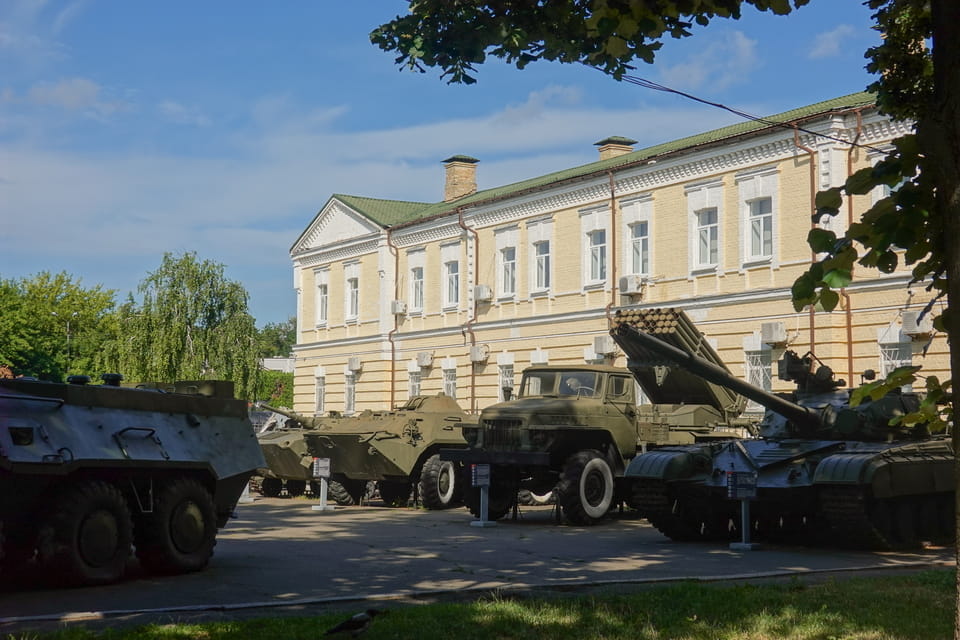
‘The National Museum of the History of Ukraine in the Second World War’ in Kyiv promptly involves its visitors with an open-air museum, modest in size, yet impressive with several pieces of military equipment and machinery of WWII and beyond. This historical walk, along with the ranks of the most recognized mechanical symbols of the Eastern Front, is accompanied by informational metal plates with short characteristics, yet only in Ukrainian. Devotees of military history would easily recognize tanks and tankettes of the period, with a legendary T-34 as the cherry on top of the exhibition. The right wing of the open-air site is dominated by planes, including the famous LI-2 cargo plane, which can be examined at a nominal charge. The exhibition goes ahead with some guns of the Eastern Front from 75 to 155 caliber: artillery pieces, field guns, mortars, armored vehicles, towing boats, trucks, and self-propelled guns, motorboats, and torpedoes, world-recognized ‘Katyusha’ rocket launcher, also known as Stalin’s organ.
In July the enemy suffered heavy losses of 3900 tanks which could not be recouped with a machinery they had produced between January and July. We can make the same conclusion regarding the August. In the context of the current production volume, russians have two possible ways of doing: to replace the losses of the forces or to create new 30 tank brigades.
Franz Halder (War diary, Volume 3: The russian campaign, 1964)


«TO THE HEROES OF THE FRONT AND REAR»: FOUR-GALLERY BRONZE COMPLEX HONOURING UKRAINE’S WW2 SACRIFICE
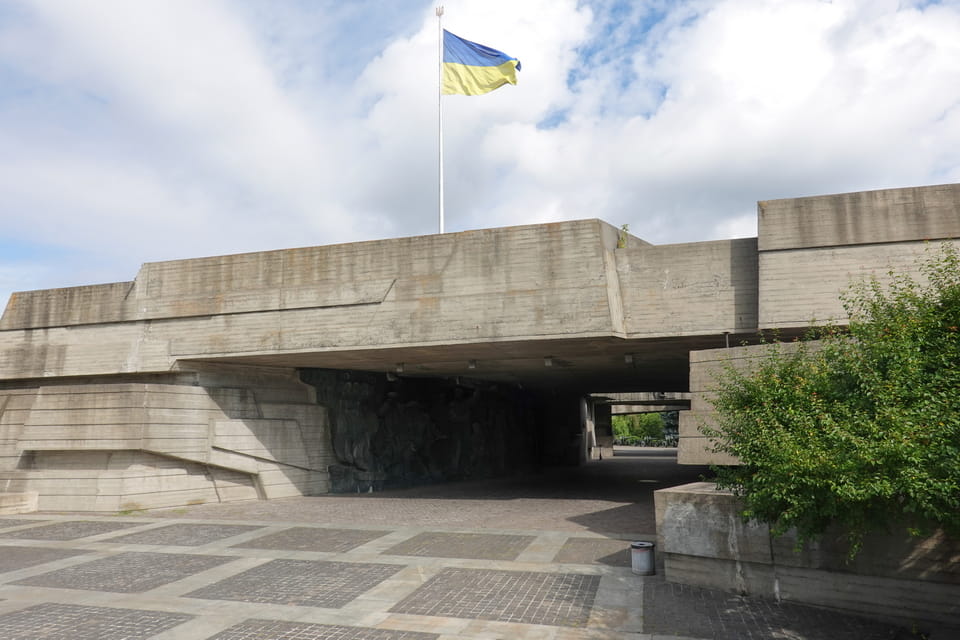
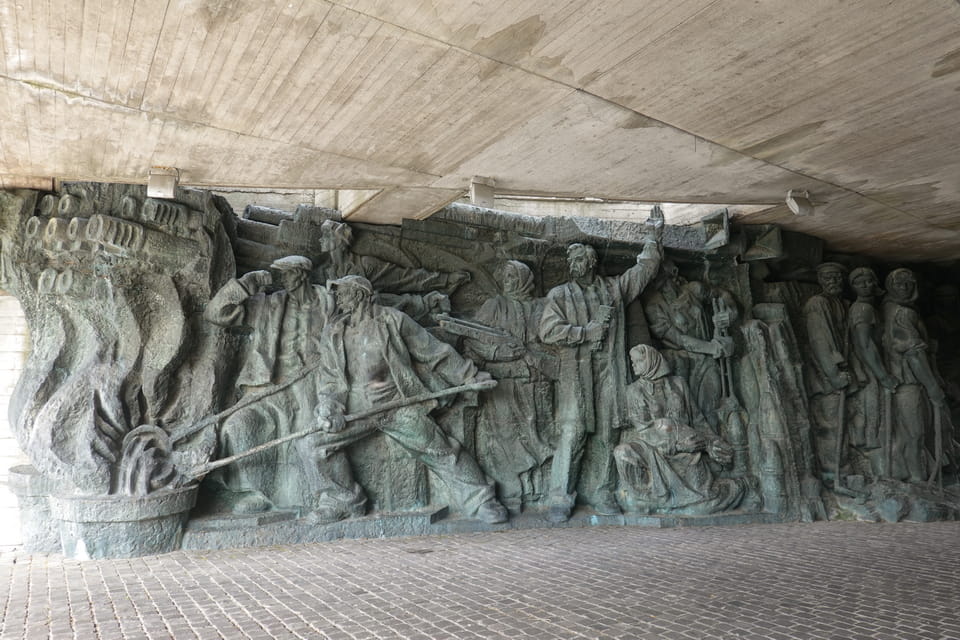
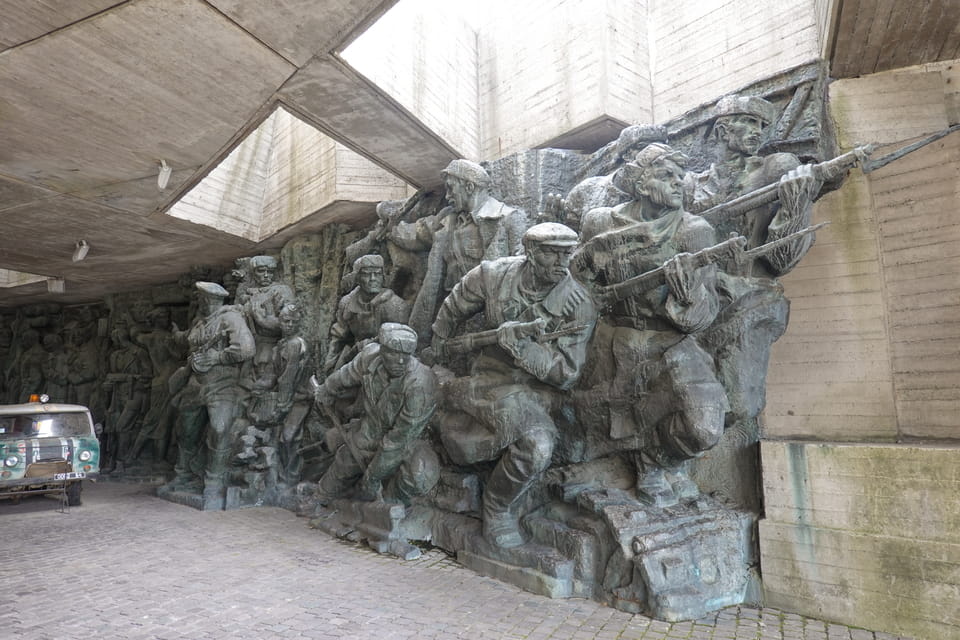
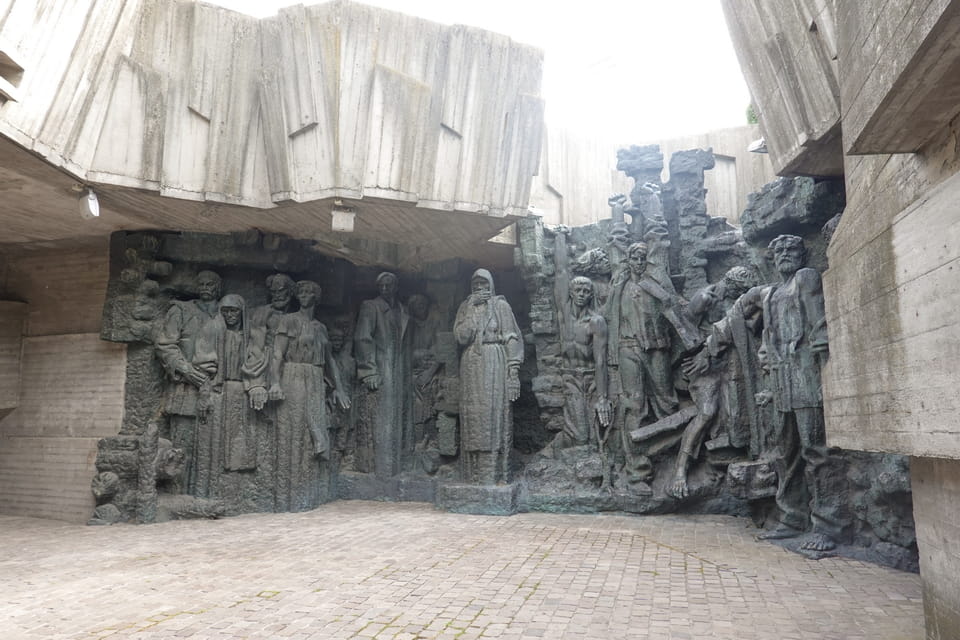
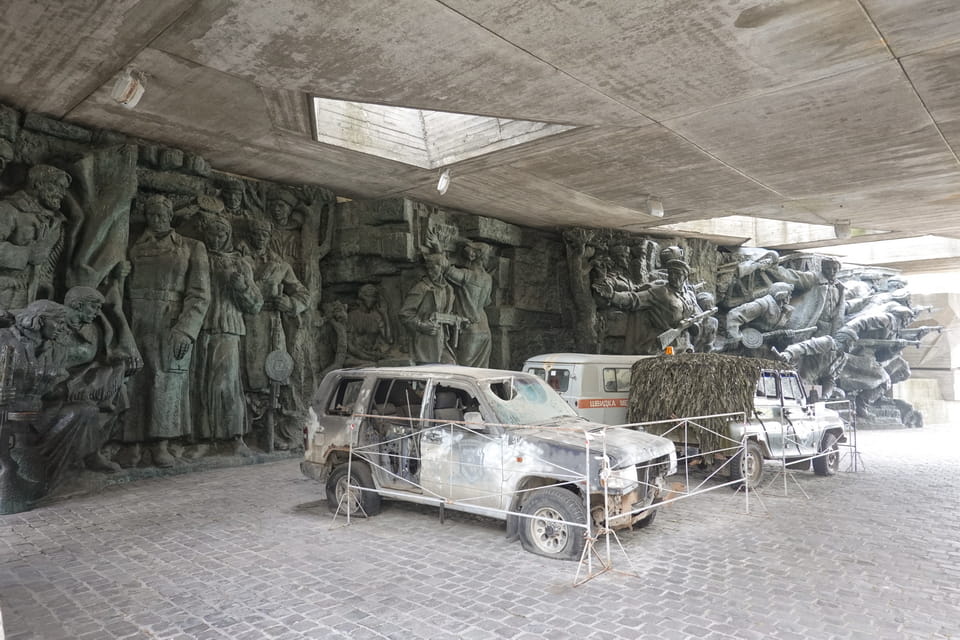
This impressive stone memorial was designed to allegorize a dug-out shelter that suffered critical damage to uncover a bronze gallery. Three separate stone inscriptions on the front side form one emotional statement. ‘Their heroic deeds would live forever. Their names are immortal’. The memorial itself includes four interconnected galleries with more than a hundred bronze statues up to 5.5 meters high.
Food from Ukraine was as important to the Nazi vision of an eastern empire as it was to Stalin’s defense of the integrity of the Soviet Union. Stalin’s Ukrainian “fortress” was Hitler’s Ukrainian “breadbasket.” The German army general staff concluded in an August 1940 study that Ukraine was “agriculturally and industrially the most valuable part of the Soviet Union.”
Timothy Snyder (Bloodlands: Europe Between Hitler and Stalin, 2010)
- THE FIRST FRONTIER BATTLES. A gallery symbolizes the courage of the frontier contact troops of the Soviet army, who suffered the German invasion within the first days of the war in the East in June-July 1941.
- UNBROKEN. Statues impersonate the spirit of the Soviet people, who were not broken under the occupation between the years of 1941 and 1944.
- RESISTANCE MOVEMENT. Bronze statues of men and women, young and senior, who took up arms to fight against the occupation, behind enemy lines at the expense of their lives.
- REAR TO THE FRONT. The most recognized statue of this very composition symbolizes a lone mother, distanced from the other figures, who gave her sons to the front. The gallery honors the great sacrifice of the civilians.
The German methods of administration, particularly the methods of Erich Koch, a Reichskommissar of Ukraine, turned Ukrainian people from our friends into enemies. Unfortunately, the military institutions failed to stand against these brutal policy, which had been implemented by the Party and local administration, generally without any involvement of the Wehrmacht.
Heinz Guderian (Panzer leader, 1950)
THE «FIRE OF GLORY» ETERNAL FLAME: 16-METRE CUP INAUGURATED MAY 9, 1981
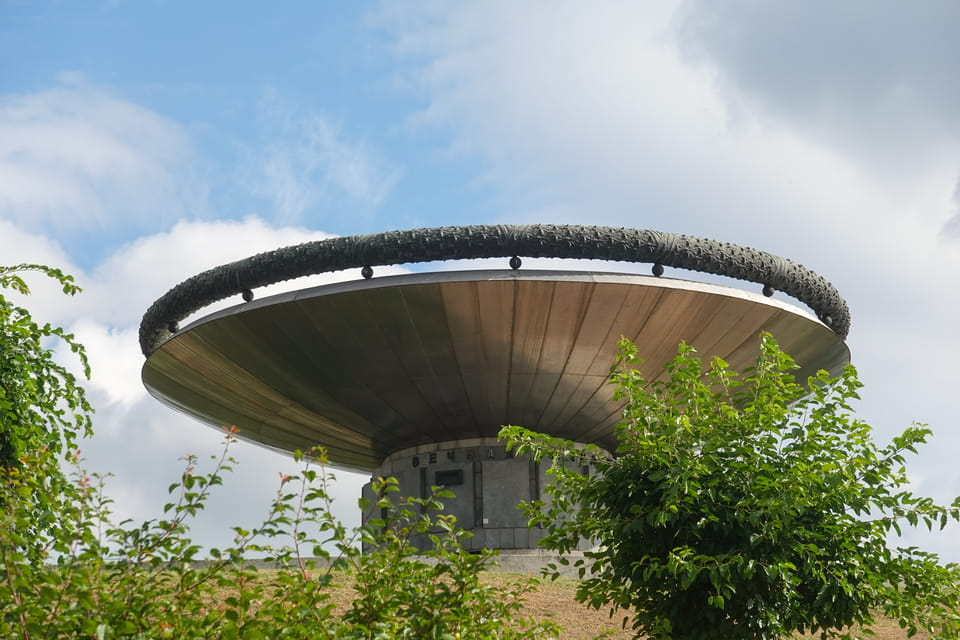
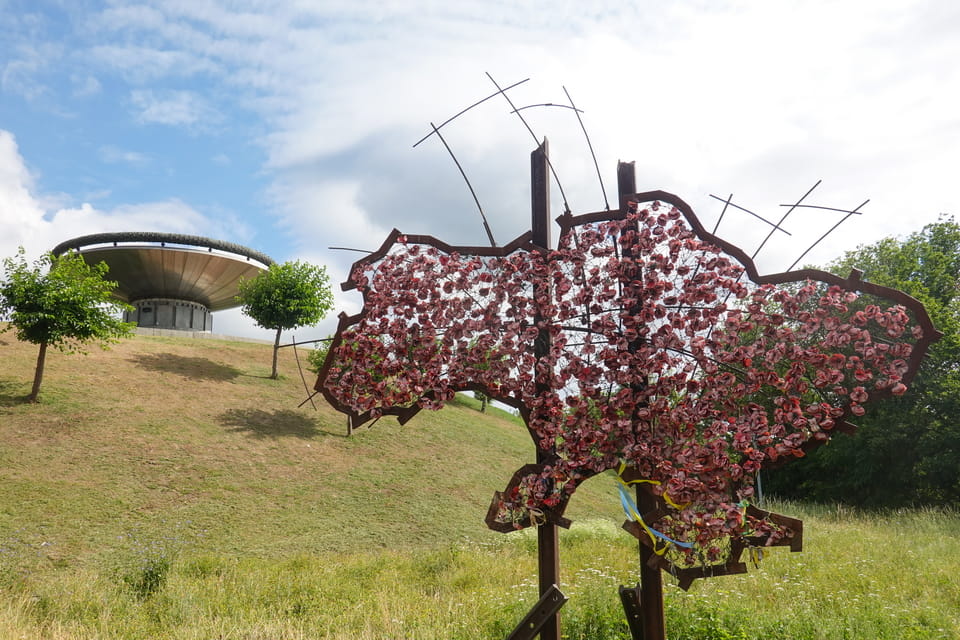
One of the high spots of the Memorial complex gives the visitors a panoramic view of the magnificent architectural composition, known as the ‘Fire of Glory’. This imposing cup, with a diameter of 16 meters, has an ‘Undying Glory to the Heroes’ inscription, which honors the tragic sacrifice that was made at the altar of great victory. The opening ceremony of this very monument was performed on the same day as the whole Complex was inaugurated. On May 9, 1981, the flame was brought here from the ‘Park of Glory’ and the Monument to the Unknown Soldier.
The bulk of the population was expected to be dramatically reduced by starvation. German estimates of the numbers run into millions as the cities in Ukraine and the whole food-deficit area in the north were to be deprived of food, which was seized for the German army or shipped to Central Europe. The surviving peasants were to work in a retained collective farm system producing food for the Germans. But what about their future?
Gerhard Weinberg (The World at Arms, 1994)

THE MAIN SQUARE AND «CROSSING OF THE DNIPRO» (BATTLE OF THE DNIEPER, 1943): 30,000 VISITORS CAPACITY
Once we walked through the Sculptural gallery, we found ourselves within the main square of the whole Memorial complex. Starting from the opening day back in 1981, this square has witnessed every one of the May 9 Victory Day Parades in Kyiv with mass marches, laying flowers in front of the monuments, and speeches of the Ukrainian presidents and foreign guests. The open site can accommodate more than 30,000 visitors at one time.
‘The Crossing of Dnipro’ sculptural composition stands apart from the spacious square. Made of two parts and fifteen bronze statues of soldiers, it honors one of the largest advancing campaigns on the Eastern Front. The battle for the Dnieper back in August-December 1943 cost half a million lives on both sides in total.
Despite the numerical superiority of the enemy, they failed to make use of a favourable moment to cross the Dnieper river on a distance from our own forces, who had pulled in troops on the banks. At the same time the fact that the enemy succeeded in capturing a number of base areas was not to be prevented.
Erich von Manstein (lost Victories, 1955)

HERO CITIES MARBLE WALL: 13 SOVIET CITIES AND THE CONTESTED LEGACY OF «HERO CITY» STATUS
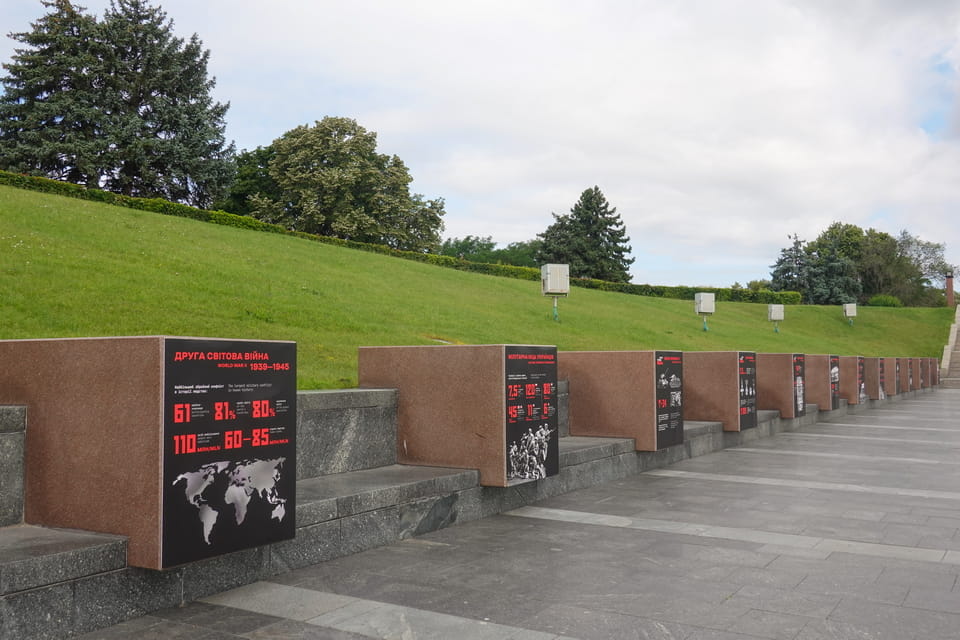
The visitors of the Memorial complex rarely pay historical attention to the marble wall beneath the imposing Batkivshchyna-Maty (Motherland Monument), which honors the names of the Soviet cities. An inscription next to the entrance to the Museum presents such words: GLORY TO THE HERO CITIES. The marble wall commemorates the glory of the 13 Soviet cities, which gained this historically prestigious title after the Second World War.
A highly controversial element of the original complex is the alley of Soviet «Hero Cities», which historically includes several russian cities. In the modern context — as the russian federation is internationally recognized as a state sponsor of terrorism — the presence of these names requires critical re-evaluation. The cities of a terrorist state, whose army is actively erasing Ukrainian towns from the map today, have historically and morally forfeited any right to a “heroic” status in the eyes of the civilized world. Furthermore, the paradigm of the current war has shifted: Ukraine is not only fiercely defending itself but is also successfully bringing the fight back to the aggressor’s territory. By launching precision strikes against legitimate military and logistical targets within these very russian cities, Ukraine is delivering a severe blow to the invader and proving its absolute capacity to defend its sovereignty. For the Ukrainian people today, the true Hero Cities are Bucha, Irpin, Mariupol, Bakhmut, and others that bore the brunt of the modern russian horde.

Moscow – Leningrad (Saint-Petersburg) – Volgograd (Stalingrad) – Kyiv – Minsk – Odesa – Sevastopol – Novorossiysk – Kerch – Tula – Brest fortress (not a city) – Murmansk – Smolensk.
It was fifteen minutes after four o’clock on the morning of 22 June 1941. At that moment, the German invasion of the Soviet Union began. In its first hours, German bombers struck at sixty-six Soviet aerodromes, destroying many of their aircraft on the ground. At the same time, five selected Soviet cities were subjected to aerial bombardment
Martin Gilbert (The Second World War, 1989)
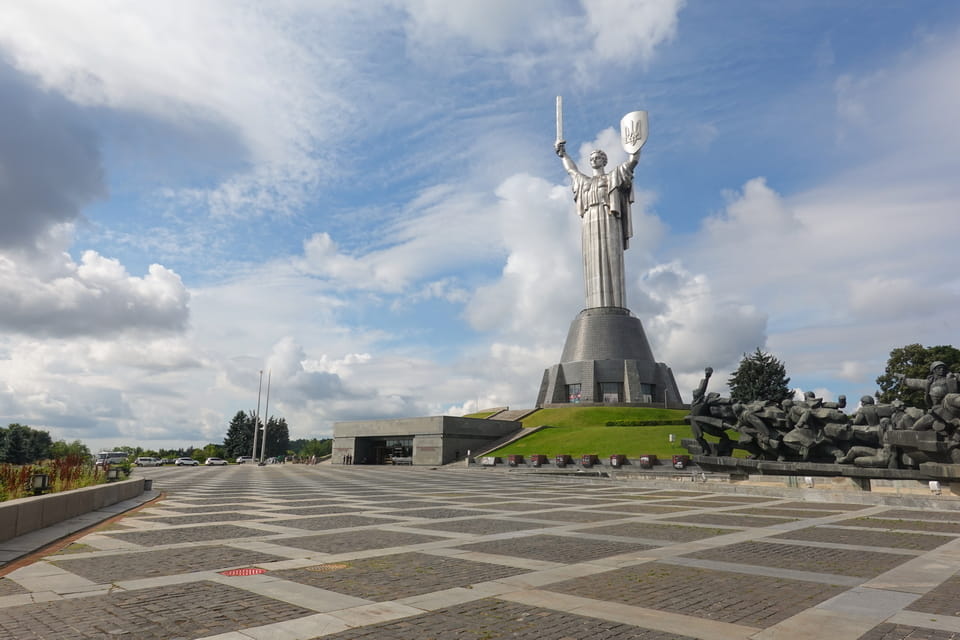
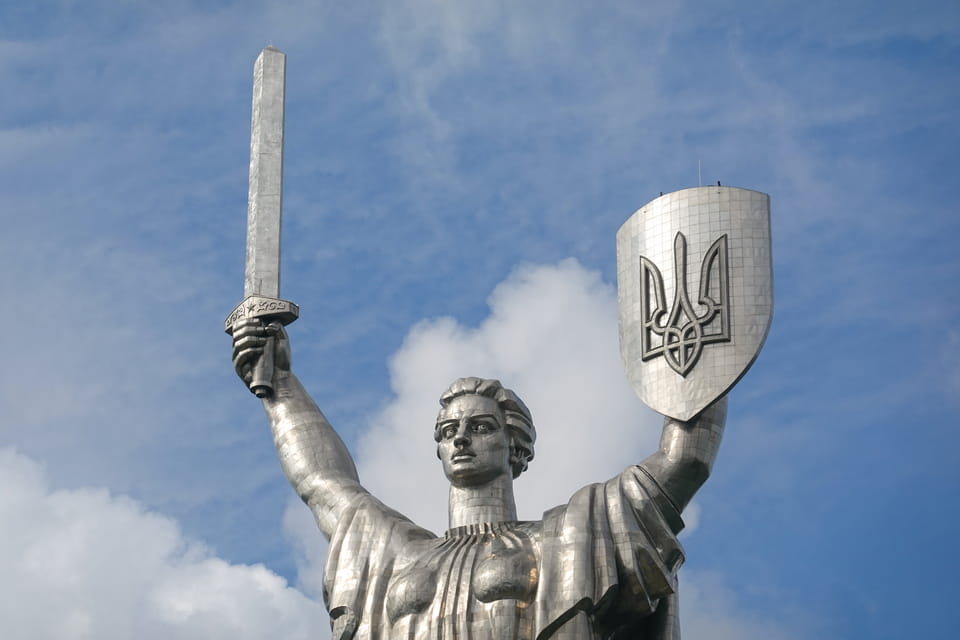
THE MOTHERLAND MONUMENT (BATKIVSHCHYNA-MATY), 102 METRES: SOVIET SYMBOL RECLAIMED — UKRAINIAN TRIDENT REPLACES HAMMER AND SICKLE (AUGUST 2023)
The highlight of the Memorial Complex in Kyiv, 102 meters high, has found its way among the tallest and most recognized statues all over the world. Once designed to be built on a hill over the Dnieper River, the Motherland Monument dominates the Kyiv panorama and can be noticed from almost any point of the capital. This legendary military statue was built to withstand an earthquake of magnitude 9. A figure of a woman of 450 tonnes, with a sword and a shield, is placed on a pedestal 40 meters high, with the ‘Museum of Ukraine in the Second World War’ beneath.
In its most symbolic way of understanding, the Motherland Monument protects Kyiv with its shield, with dimensions of 12*8 meters and a steel sword 16 meters long. The constructors of the statue had to build a 100-meter crane first to perform the assembling of the monument. The visitors can experience the panorama over Kyiv from two viewing points at 36.6 and 91 meters high, respectively.

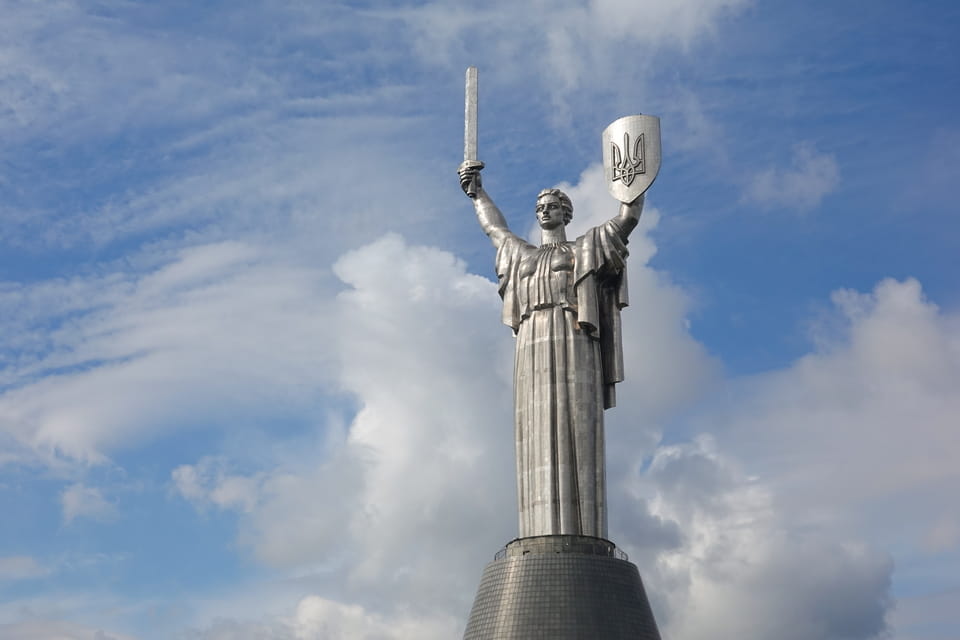
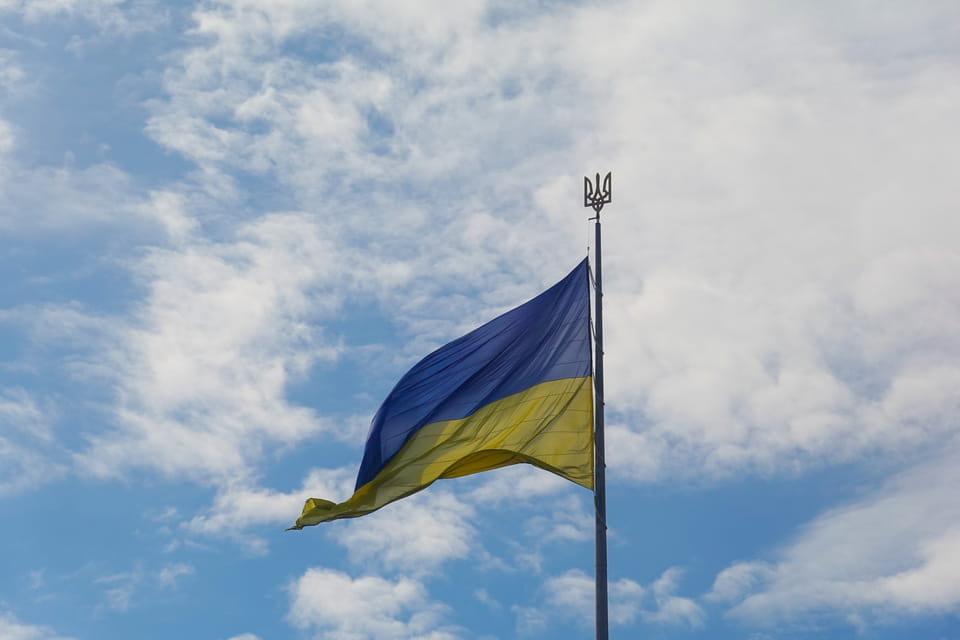
For four decades, the shield held by the Motherland Monument bore the coat of arms of the Soviet Union — the hammer and sickle — contested by Ukrainians for whom it represented occupation, famine, and cultural repression. The legal framework for removing it was created by Ukraine’s decommunisation laws of 2015, but the physical replacement came later. On 1 August 2023, workers began removing the Soviet emblem. The operation was completed on 6 August 2023, ahead of Ukraine’s Independence Day on 24 August. In its place, the Ukrainian coat of arms — the tryzub (trident, тризуб) — was installed: a 7.5-metre rendition of Ukraine’s national symbol.
«We believe that this change will be the beginning of a new stage in the revival of our culture and identity, the final rejection of Soviet and russian symbols and narratives,» stated Ukraine’s Ministry of Culture at the time. The monument is simultaneously being considered for renaming from the Soviet-derived Rodina-Mat to the Ukrainian Batkivshchyna-Maty — the form used throughout this article. It faces northeast toward russia — a symbolism that has acquired a new resonance since 2022.
THE NATIONAL MUSEUM OF UKRAINE IN THE SECOND WORLD WAR: 16 HALLS, 17,000 EXHIBITS AND DOCUMENTING RUSSIA’S 2022 INVASION
This Museum in Kyiv is among the largest military museums in the world and has an exhibit of 17,000 items accessible to the public, yet only 5% of the total 400,000 items. The sixteen halls of the historical exhibition make their way along with all the main events of the Second World War, with a focus on the history of Ukraine in particular. The exposition originates with the German territorial expansions in Europe back in the 1930s, the German and Soviet invasion of Poland, and the War in the West from 1939 to 1941. Each historical hall is accompanied by booklets in Ukrainian and English.

The museum collection indeed impresses with its historical variety and diversity and covers all sides of the war, including the AXIS countries and the ALLIES. You would be able to experience the trophy German machinery and weapons, pocket vocabularies and strategic maps of the Barbarossa plan of invasion, NSDAP party cards, pieces of uniforms, photo albums and badges, bullet standards, thousands of shells, empty gas bags, skeletons of the planes, cloth of the concentration camp prisoners, replicas of the bunkers. One of the halls turned out to be a ‘Hall of Memory’ for the victims of the Holocaust. The large marble hall on the upper floor of the museum, known as the ‘Hall of Fame’, honors the names of the Soviet heroes of the war.
Dnieper. What a magnificent river. The third longest river in Europe after Volga and Danube and the second in the European russia. It streams for 2283 kilometers and runs into a Black Sea. It is more than a river rather a line of life for a foodful Ukraine and a cradle for soviet nationhood.
Paul Carell (Scorched earth, 1966)


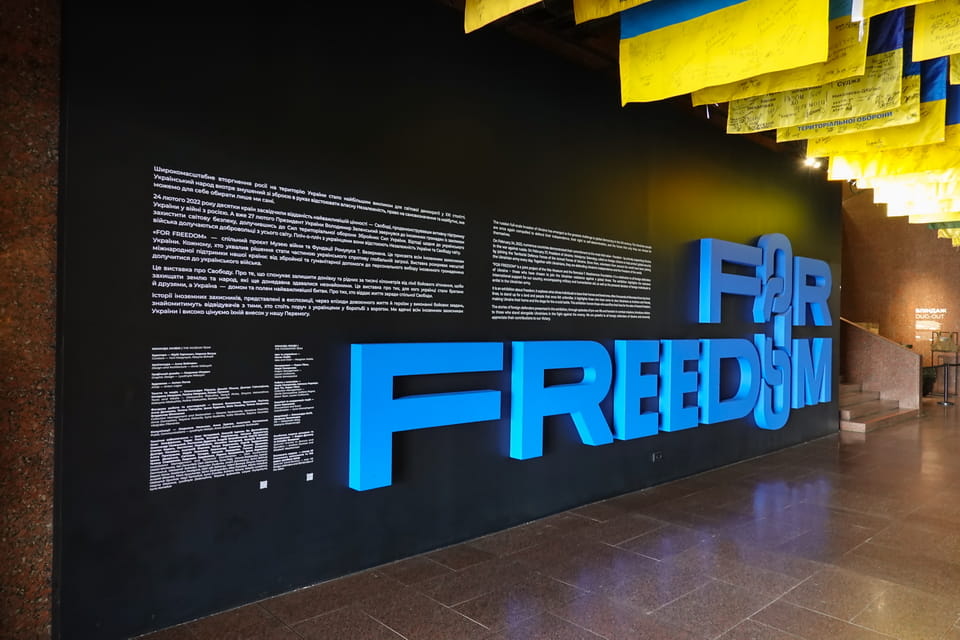
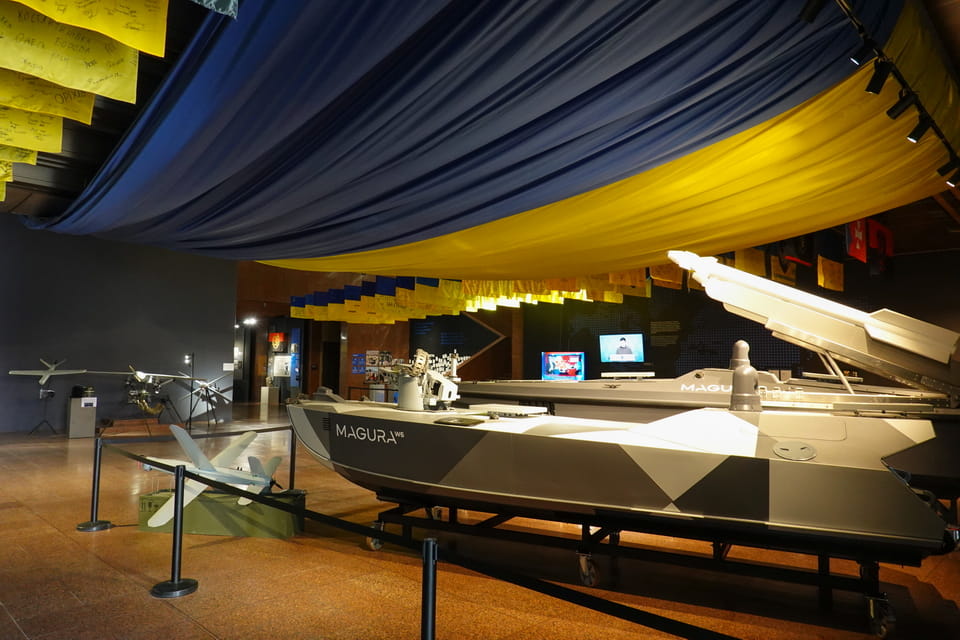
Since russia’s full-scale invasion of Ukraine on 24 February 2022, the National Museum has taken on an urgent additional mission: the documentation, preservation, and exhibition of evidence of russia’s ongoing war crimes on Ukrainian territory.
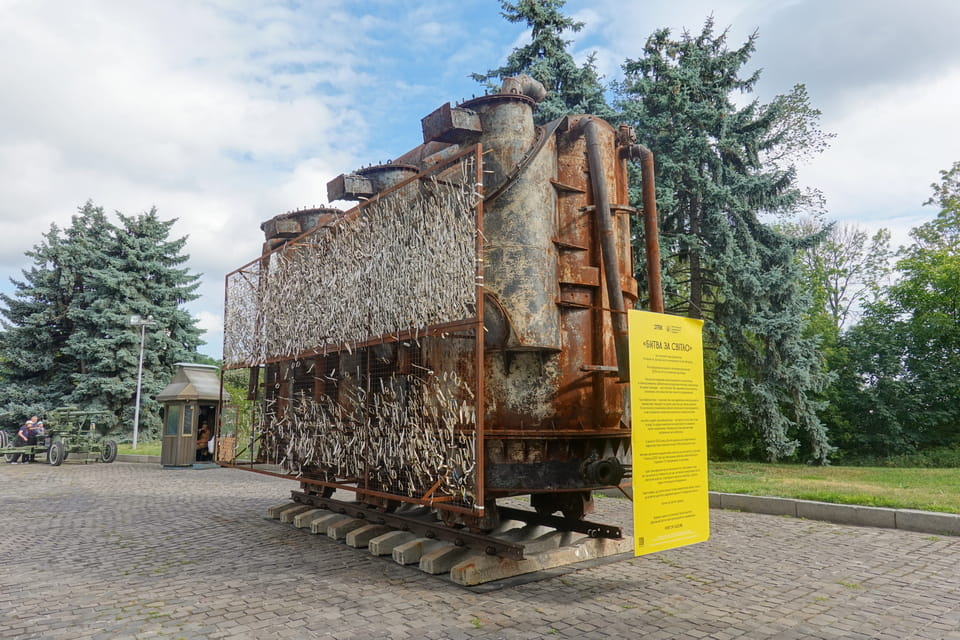
Museum teams have worked in de-occupied regions of Kyiv, Chernihiv, and Kherson Oblasts, collecting destroyed russian military equipment, personal items of fallen enemy soldiers, documentation of atrocities, and survivor testimonies. The exhibition «Ukraine — Crucifixion» (May 2022) was later shown in Riga, Tallinn, and the United States. russian military vehicles captured in the Kyiv region — including armoured personnel carriers and artillery pieces abandoned during the failed assault on Kyiv in February–March 2022 — are now displayed alongside the WWII-era outdoor exhibition.
The museum’s outdoor collection now spans eight decades of warfare: from the ZIS-3 field guns of 1942 to russian military hardware from 2022.
VISITING THE KYIV WW2 MEMORIAL COMPLEX: ADDRESS, HOURS, HOW TO GET THERE, AND PRACTICAL GUIDE
Address and location:
Lavrska vul. 24 (вул. Лаврська, 24), Kyiv 01015, Ukraine. The complex occupies the Pechersk Hills on the right bank of the Dnipro, immediately south of the Kyiv-Pechersk Lavra monastery. The Motherland Monument (Batkivshchyna-Maty) is visible from most of the city.
Opening hours and admission:
The outdoor memorial (monuments, open-air tank exhibition, main square): open 24 hours, 365 days. Free of charge.
Museum building: Daily, 10:00–19:00. Observation decks on the Batkivshchyna-Maty (former Motherland Monument) at 36.6 m and 91 m and aircraft entry, when accessible to the public, carry a separate nominal fee. Check before visiting — access may be subject to wartime security measures. Entrance fee is 100 hryvnia (UAH); guided tours for a group of up to 20 people cost 300 hryvnia per person and 700 UAH for foreign visitors (in English).
Getting there:
- Metro: Line M3 (Blue) to Arsenalna station (one of the world’s deepest, 105.5 m underground). Walk south-east along Lavrska Street for 20–25 minutes, past the Kyiv-Pechersk Lavra on your right.
- Metro alternative: Line M1 (Red) to Dnipro, then funicular to the upper station and walk south (~20 min). This route offers views of the Dnipro bend.
- Bus: Routes 38 and 55 stop on Lavrska Street near the museum entrance.
- Taxi: 10–15 minutes from the city centre.
Visiting tips:
Budget 1–2 hours for the outdoor area and 1-2 hours for the museum (16 halls). Booklets in Ukrainian and English are available at the entrance. The Motherland Monument decks (accessible to visitors aged 6+) offer panoramic views of Kyiv and the Dnipro bend; entry is ticketed separately. The best light for photographing the statue is in the morning.
Nearby sites of WWII and historical significance:
- Kyiv-Pechersk Lavra (Monastery of the Caves): the bell tower from which German photographers documented the burning city in 1941. UNESCO World Heritage Site, which was attacked by russia on June 15, 2026.
- Babi Yar (Babyn Yar): (~6 km north-west, 20 min by taxi or metro to Dorohozhychi): the ravine where 33,771 Jews were murdered in two days, 29–30 September 1941 — one of the largest single massacre sites of the Holocaust.
- Maidan Nezalezhnosti: (~3 km north-west): epicentre of the 2013–2014 Euromaidan Revolution, which directly preceded russia’s 2014 invasion and annexation of Crimea.
I am very grateful to war archives, museums, libraries, private collections, and writers for the historical photos in this article. To the extent that some author or a copyright owner may not want some of the above black-and-white photos to be used for educational purposes here, please contact me for adding credits or deleting the pictures from the article.