

Janusz Korczak in Warsaw: Orphanages, Addresses, Monuments
Janusz Korczak — born Henryk Goldszmit in Warsaw on 22 July 1878 or 1879 — was a paediatrician, a bestselling children’s author and, for thirty years, the director of Dom Sierot, the Jewish orphanage he ran at 92 Krochmalna Street together with Stefania Wilczyńska. He called it a «children’s republic»: the orphans had their own parliament, their own court and their own newspaper. On 5 August 1942 he walked out of the ghetto orphanage at Sienna 16 with his children and his staff, refused every offer to save himself, and was murdered with them at Treblinka.
Almost every place connected with him is in Warsaw, and most of the addresses can still be found. He was probably born at Bielańska 18; his family later moved to Krakowskie Przedmieście 77, Miodowa 19 and several other flats in the city centre. He worked as a doctor at the Bersohn and Bauman Children’s Hospital between Sienna and Śliska. His orphanage stood at Krochmalna 92 — today Jaktorowska 6, the same walls, still a children’s home, and now also the home of the Korczakianum research centre. Driven into the ghetto, the orphanage moved twice more: to Chłodna 33 in November 1940 and to Sienna 16 in October 1941, its last address.
This guide walks that whole route — every address, what happened there, and what stands on the spot today — illustrated with archival photographs and my own pictures taken in Warsaw in 2019. A full list of Korczak’s Warsaw addresses follows in the next section, and practical visiting information for the surviving sites is at the end.
WHO WAS JANUSZ KORCZAK: HENRYK GOLDSZMIT, THE ‘OLD DOCTOR’ OF WARSAW
The black-swan-kind visitor of the former Treblinka death camp in Poland sidesteps the heart part of the memorial complex. Made of bulked, untooled stones, with a total height of 8 meters, the monument is central to a symbolic cemetery of rocks: the final resting place for 750 to 850 thousand people (by various estimates), the forced victims of the ‘Endlosung’ (Final Solution). Thousands of small stones, 17,000, reveal no inscription. The larger ones pay honor to the Jewish communities, whose people were killed on this open site among the woods in the heartlands of Poland. As few as two stones amid the thousands of symbolic burials (as the victims of Treblinka were initially gassed and later burned to ashes; in wider terms, they had no graves) are generally given an isolated prominence. The one with the ‘WARSZAWA’ inscription bears the name of the city, which was fated to contribute the most dramatic figure to the abyssal death toll in Treblinka. Another piece of rock, the only personalized of Apr. 17 000 mortuary monuments, memorizes the lettering: JANUSZ KORCZAK. HENRYK Goldszmit i DZIECI (Janusz Korczak. Henryk Goldszmit and children).
Leaving behind the narrow-mindedness of the post-war communist beliefs, in our generation, the historical image of Janusz Korczak (Henryk Goldszmit by birth) is to be conventionally equated with Mother Teresa, Mahatma Gandhi, J.F. Kennedy, and Martin Luther King Jr. It must be said that the fame and awareness rather confounded the famous doctor as it was a little more than his care of children and the reshaping of the public mind towards parenting. Henryk himself was lucky enough to be born into a wealthy family of assimilated Polish Jews. However, in the face of the well-to-do income of the legal servant father, the presence of nuns, and material conditions, the Goldszmit family was far from being an island of homeyness. The oncoming pediatrician, a child himself at the time, had no way but to take hard on the standoff of his father, the semi-depressive conditions of his mother, and the standoffishness of a sister.

As if it wasn’t enough, Goldszmit Sr. sent Henryk to a private school with draconian means of education: another island of isolation for a boy, who now suffered from the gulf between adult educators and their immature fosterlings. The pupils were systematically exposed to punishments, and the Polish language was forbidden in this Russian school. These two (the lack of homeyness and the harsh school experience) patterns of early years would later assert a formative influence over the mindset of Janusz Korczak as an educator. After the death of Jozef Goldszmit at the age of fifty-two in 1896 (possibly by his own hand due to a longstanding mental disease), the eighteen-year-old Henryk had to undertake care of his mother and sister. It was now four years after the passing of his beloved grandmother, the only family member young Henryk had used to share his inner world.
In the years of medical studying, HENRYK GOLDSZMIT ventured into writing and went into private teaching for the Warsawian children of families from all walks of life, thus immersing oneself into the world of the poor and the rich with an insight into the means of parenting. The ongoing pediatrician and a man of letters: all in one, assumed a Janusz Korczak pseudonym. Years down the line, and being a headmaster of the children’s orphanages in Warsaw, the talented educator would be appraised with the by-names such as: ‘Stary Doktor‘ (An old Doctor), ‘Pan Doktor‘ (Mister Doctor), and ‘Father of Orphaned Children.’ Korczak championed equal rights for children in wider aspects of social existence. In his writings, he underlined the natural dependence of the young ones on the adults, providing his thoughts on the alternative means the grownups should use this privilege of parenting. As it would be manifested later on with his doings in orphanages, Janusz Korczak advocated an equal attitude towards any child regardless of the welfare of his family.

Warsaw was fated to become the Alpha and Omega for Janusz Korczak. Except for his military service and journeys to France, England, Germany, Switzerland, and Palestine, Henryk would spend the major part of his life in the capital of Poland. Bielańska 18 was Henryk’s first home (and probably the birthplace), close to the Warsaw Arsenal. Later, the birthplace of Korczak would be demolished to make space for the ‘PAWEŁ TARASOWICZ’ department store, therefore leveled in the 1950s. The young Henryk had no recollections of his birthplace as the Goldszmit family soon moved to Krakowskie Przedmieście 77, next to the corner with Senatorska. Two years later, the Goldszmit family moved again to Miodowa 19, attached to the Archbishop’s Palace complex, a few blocks from the previous place of residence. Later they lived for a while at plac Krasińskich, Nowosenatorska (Jana Moliera nowadays), Leszno. Originating from the public school at the age of seven, Henryk had been a supervisee of several educational institutions in Warsaw.

JANUSZ KORCZAK’S WARSAW ADDRESSES, 1878–1942: WHERE HE LIVED AND WORKED
Korczak spent almost his entire life in one city. These are the Warsaw addresses of Henryk Goldszmit — the private ones and the institutional ones — in order.
The family flats
— Bielańska 18 — the first family home and the probable birthplace, 22 July 1878 or 1879, close to the Warsaw Arsenal. The house is gone: the site was cleared in the 1950s.
— Krakowskie Przedmieście 77 — from 1881, on the corner of Senatorska. Henryk lived here with his parents, his sister Anna and his maternal grandmother, Emilia Gębicka.
— Miodowa 19 — from 1883, a seven-room flat beside the Archbishop’s Palace.
— Plac Krasińskich 3, then Nowosenatorska 6 (today ul. Moliera), then Świętojerska.
— Leszno 18, flat 10 — where his mother Cecylia sublet rooms to make ends meet after the death of his father, Józef Goldszmit, in April 1896.
The institutions
— Bersohn and Bauman Children’s Hospital, Sienna 60 / Śliska 51 — where he worked as a paediatrician from 1905 to 1912.
— Dom Sierot, Krochmalna 92 — the orphanage he directed from October 1912 to November 1940. Today the address is Jaktorowska 6: the street layout changed after the war, but the building is the original one.
— Chłodna 33 — the orphanage inside the ghetto, November 1940 to October 1941, in the building of the Roesler merchant gymnasium. Destroyed in 1944.
— Sienna 16 — the last address of Dom Sierot, October 1941 to August 1942.
— Umschlagplatz, Stawki Street — the end of the route, 5 August 1942.
Two more addresses belong to Korczak’s Warsaw without being his own: Mazowiecka 12, where Jakub Mortkowicz published his books, and Nowolipki 7, the editorial office of Mały Przegląd, the newspaper written by children that Korczak founded in 1926.
THE BERSOHN AND BAUMAN CHILDREN’S HOSPITAL, SIENNA 60 / ŚLISKA 51: KORCZAK THE PAEDIATRICIAN, 1905–1912
The discovered sense of purpose as a children’s writer and pediatrician of Henryk Goldszmit faced a new challenge. Following completing a medical degree in March 1905, he was drafted into the tsarist army, a call for a credentialed lieutenant to witness the horrors of war on the Far East front with Japan. In Goldszmit’s judgment, the war made nothing new than ‘anatomizing’ the pre-existing social illnesses. Upon returning to Warsaw in a little less than a year of service, the war-hardened lieutenant was now puzzled by his own assumed (in the months of absence) status of the acclaimed juvenile writer, praised as JANUSZ KORCZAK. The literary critics characterized the author as nothing less than a ‘voice of Polish literature’, who pleaded for necessity and social disparity. At that time, Korczak was being welcomed at the doors of the Warsaw intelligentsia: a privilege he would not take for granted for years to come. All while in a position to choose prestigious medical institutions in Warsaw and beyond and to take advantage of his literary star, the doctor reclaims his pre-war (Russo-Japanese) position at the Children’s Hospital, clamped between Sliska and Sienna streets in the heart of Warsaw.

The thought-starter to build a free hospital for caring for Jewish children could be traced back in history as far back as 1873, a year when two generations of a wealthy Jewish family purchased a plot of land between Sliska and Sienna streets. The new medical institution, with the good fortune to be opened in 1878, owed its gratitude to the members of two Jewish families. The elderly Bersohn couple and their daughter (Bersohn by birth, Bauman after marriage) with her husband Solomon Bauman. A medical hospital center included the main building (the one preserved today) and a sub-scale separate pavilion. Routinely, where it happens, a new-build institution was administered under the binary address of Sienna 60 / Sliska 51. Towards the time of giving employment to a young doctor, Henryk Goldszmit in early 1905, the medical complex had custody of an admission room, the infectious unit, and surgery with surgeries. Initially sized for caring for 27 patients at once, the Bersohn and Bauman Children’s Hospital has been constantly expanded to include seven hospital rooms with 43 beds, a laboratory facility, and even an open outpatient clinic free of charge for the children from families of any religious confession. The medical institutions were widely regarded as a mark of pride for the Jewish community in Warsaw.

Once resuming (after the military service) his position at the Children’s Hospital in early 1906, Janusz Korczak took the plunge into a medical routine. The little patients were largely treated for the symptoms of scarlet fever, dysentery, and even typhus and tuberculosis. Apart from pure medical treatment, doctor Goldszmit advocated (among his colleagues) for a completely new culture of treatment of children. The educator Korczak nullified the bygone taboo on toys within the hospital, with one’s eyes open to the existence of the mental state of his little care recipients apart from the physical. Pediatrician Goldszmit treated children for infections and injuries, as well as the educator Korczak advocated for caring for the mental condition, a factor which used to remain in place after release from the hospital and falling back on poverty, violent parenting, and even abuse.
In his rare free time, doctor Korczak invested time in putting things in order within a hospital library of 1400 volumes of medical records since 1878. The famous pediatrician would practice at Bersohn and Bauman Children’s Hospital, with a period of absence of seven years from 1905 until 1912. His doctor’s salary of 200 rubles annually would be complemented by dividends from the ongoing literary activity and a modest income from the private medical practice with house calls to treat sick children all around Warsaw. Before long, a good many wealthy families admired the idea of welcoming the famous doctor and writer as a guest, occasionally at a made-up pretext of their children as a means to lure Korczak.
On such not-that-rare occasions, doctor Goldszmit predominated over the public figure of Korczak and could be sarcastically rude to the ‘charlatans’. Along with that, the doctor charged a symbolic fee (Apr. 0.2 rubles) from needy families, conventionally a sum several times less than the cost of the horse carriage to get to a patient. In wider terms, Janusz Korczak acted as a ‘pediatrician Robin-Hood of Warsaw’, charging wealthy families and putting his time and talent into treating the ones in need. The doctor dropped distinctions in the social status of the families and treated children with parents of any professions (including offspring of doctors), confessions, and political beliefs.

The terrain of the hospital complex, sandwiched between Sienna and Sliska, had been constantly expanded to the extent that some adjusting buildings were to be incorporated. As late as the 1910s, the financial health of the Bersohn and Bauman Foundation decayed dramatically, and the hospital was to be closed in 1923. The collaborative efforts of the Warsaw pediatricians resulted in the transfer of the property to the supervision of the ‘Society of the Friends of Children’, consequently initiating a large-scale restructuring. The initial one-story main building dating back to the days of Janusz Korczak’s practice was now accompanied by three floors and ready to open and treat up to 150 patients as late as 1930.
The medical complex between Sienna and Sliska was spared the devastation of the Siege of Warsaw in 1939, although it would be included in the borders of the Warsaw ghetto in November 1940. At the height of the liquidation of the ghetto in August 1942, the hospital was moved to the infamous Stawki 6/8 facility next to the Umschlagplatz area. As for the buildings at Sienna/Sliska, they were partially damaged during the Warsaw Uprising, and some erections were fated to be demolished after the war. It took time to witness a children’s hospital in the same place, although another reconstruction was maintained not earlier than four decades later. In 2018, the former medical center was entrusted to the planned museum of the Warsaw ghetto.

DOM SIEROT AT 92 KROCHMALNA STREET, 1912–1940: KORCZAK’S CHILDREN’S REPUBLIC
Pediatrician’s office at the Children’s Hospital, private medical practice, and literary activity as a public advocate for mindful parenting: all these were not to become Korczak’s apogee of life. His treatment methods went outside the conventional curing of diseases to the extent that Doctor Goldszmit now cherished the idea of taking the helm over an orphanage. Within four years after his return (from military service in 1906) to Warsaw, the Warsaw intelligentsia, as well as acclaimed flag bearers of pediatrics, were puzzled by the rumors depicting Doctor Korczak as an educator of children from troubled homes. In contrast to the public belief of his contemporaries, Janusz Korczak renounced the idea that his choice was a sacrifice. Contrariwise, the supervision of the children’s institution pushed the boundaries of conventional pediatrics and potentially explored new horizons of caring for little souls in broader terms. Korczak masterminded his own diagnostic system to reveal the symptoms beyond physical diseases. In the same way, Doctor Goldszmit diagnosed intoxication, a fever, or typhus; educator Korczak seized room for applying pedagogy to educate a full individual.

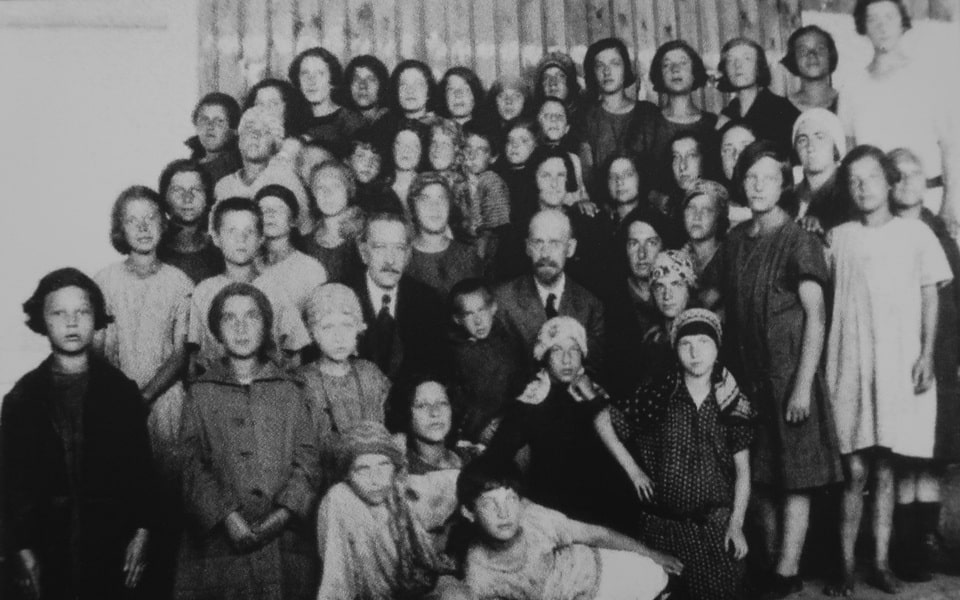
In the very year 1906, when Doctor Korczak resumed his interrupted practice at the Child Medical Complex at Sienna/Sliska, the “Aid for Orphans” society of Warsaw agreed upon the necessity to build up an orphanage. As early as May 12, 1910, a land plot at 92 Krochmalna was bought to fulfill the idea in the air. The acquisition of real estate demanded 24,000 rubles, yet the area was not appraised as an appropriate place for a children’s institution. The Krochmalna street, regarded as a troubled district at that time, took its name from the Polish word ‘Krochmal’, thus ‘starch’ in English, as a tribute to a starch factory dating as far back in history as the end of the XVIII century. The purchased plot of land with a cozy fruit garden was surrounded by warehouses, factories, workshops, affordable housing, little shops, and a catholic church nearby. The far end of Krochmalna Street, with much higher residential density, was infamously regarded as a hotbed for villainy and prostitution. The demographic image of the district had been historically formed with the working-class offshoots, with Polish and Jewish workers assimilated towards each other.

As late as the summer of 1907, doctor Goldszmit made his planned way to Germany, a country well-appraised for its sophisticated medical system and regarded as a center of academic enlightenment in Europe. The image would be tragically distorted in the years of the Third Reich. Apart from attending lectures as a moderate student in Berlin (he was only 29), doctor Henryk Goldszmit used to make visits to German orphanages, asylums, and juvenile detention centers. On the way back, he visited Zurich. After getting a chance to catch the practices of the foreign institutions, doctor Korczak now (upon return) enthusiastically dives into planning a new orphanage in Warsaw. Several times a week, he used to get acquainted with the architects and played a meaningful role in construction, the cornerstone of which was laid as early as June 14, 1911. The famous pediatrician craved to build an institution a state of art among the like establishments and spent another six months in Paris and London, gaining experience. The final cost of the orphanage at Krochmalna 92 totaled 114,000 rubles.

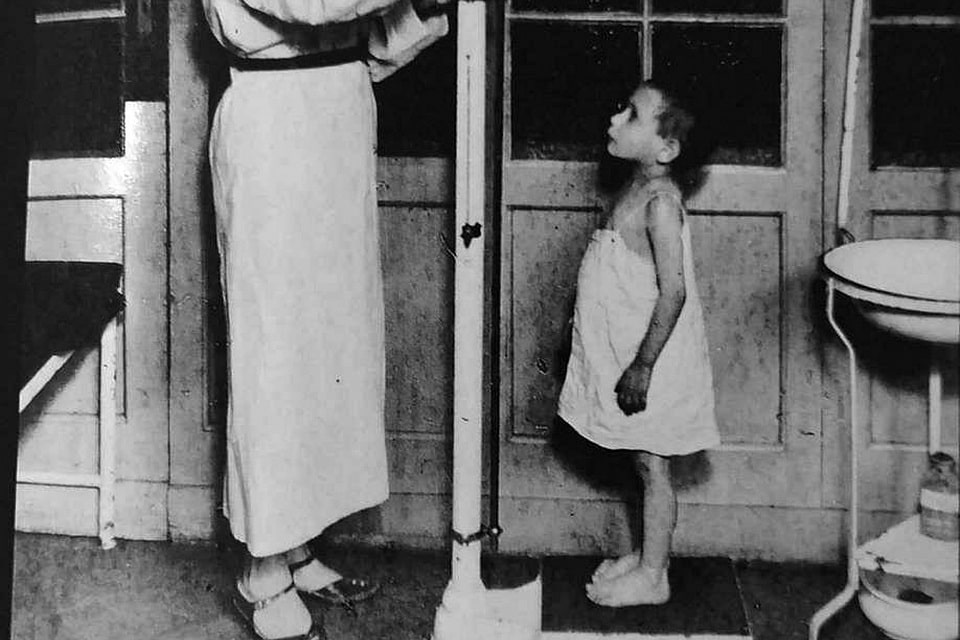
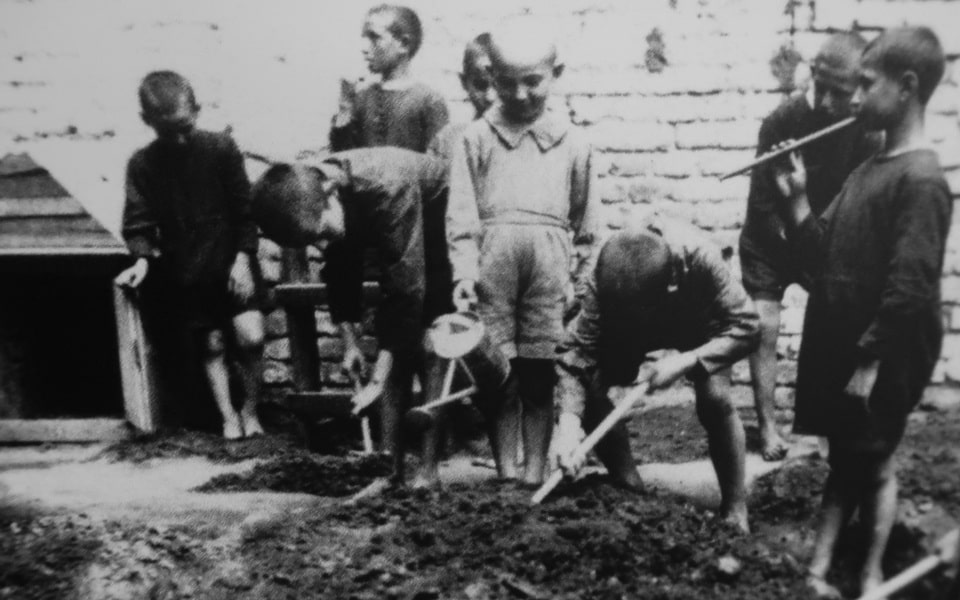

Given the fact that the construction effort of an orphanage for 106 children was behind schedule and over budget, few citizens of the Children’s Republic would be able to settle in in October 1912 at the earliest. Children were taken to a place at Krochmalna 92 at the height of a rainy October day with bags over their shoulders and sticks, belongings they possessed at the summer camp in the country. Doctor Korczak himself accommodated a small premise in the attic. Rainy-soaked children witnessed a new stucco four-story building, an image close to the fairy tales. They were welcomed to enter a spacious dining room on the first floor with a high ceiling, panoramic windows, and delicious dishes, cooked as if they were VIP guests. Children were amazed by brand-new classrooms and workshops, an administration office, and three floors of convenient bedrooms with heating, electricity, and hot water. Apart from these almost prestigious facilities for the first 85 pupils, the orphanage included a wing for families who were ready to adopt a child.
Korczak did not run the house alone. Stefania Wilczyńska (1886–1942), a young Warsaw-born teacher who had joined the «Aid for Orphans» society before the building was finished, became the orphanage’s co-director and stayed in that role for the next thirty years. In practice the division was clear enough: Korczak wrote, lectured, broadcast and raised money; Wilczyńska ran the daily life of two hundred children — the rotas, the meals, the sickroom, the endless small disputes brought before the children’s court. She turned down more than one chance to leave Poland, followed the orphanage into the ghetto, and was deported to Treblinka with Korczak and the children on the same August day.


Educator Korczak seized the advantages of a new institution to found what would be called a ‘Children’s Republic’. The young care recipients had an analogy of voting rights, the feasibility of voicing their thoughts within a newspaper or under the frame of a local parliament. The headmaster advocated a modernized treatment of children as personalities rather than little bread consumers, who could be useful as citizens for only years to come. In the course of the next twenty-seven years, several generations of Polish orphans would be lucky enough to become education recipients at Krochmalna 92 in Warsaw.
As for Doctor Korczak himself, he used to live in the attic until 1932 and moved in together with his sister in an apartment in the city center. Over these decades, Korczak had tough luck in another military service, early in the First World War and later at the height of the Russo-Polish War. As early as the first days of the Second World War in September 1939, the surrounding manufacturing area was exposed to air raids, and the orphanage building was slightly damaged and evacuated for a while. The sixty-year-old headmaster filed a request upon assignment to active military service, only to get a denial. In the months that followed, the number of little lodgers increased to a figure of two hundred to give house room to newly made orphans, whose parents had lost their lives during the siege of Warsaw.

In November 1940, the orphanage of Janusz Korczak was forced to abandon the long-time (for twenty-eight years) residence at Krochmalna 92. While waiting for a reply to his later appeal to the occupational authorities in Krakow (Korczak produced reasons for the orphanage to remain where it had been, beyond the borders of the ghetto), doctor Korczak was open to alternatives. He addressed the headmaster of the ‘Państwowe Gimnazjum Męskie Kupieckie Im. Roeslerow’ (State Merchant Male Gymnasium named after Roeslers) with an offer to interchange buildings with mutual respect for the estate. Four years from those weeks, the area around Krochmalna would be badly damaged during the Warsaw uprising, yet the former orphanage at Krochmalna 92 survived the war, in obvious contrast with most of the surrounding area.
Over the post-war years, several institutions were consequently rooted within the building, a journalist club in particular. The idea to restore the initial purpose of Krochmalna 92 would live as a tactless plan for years until it came true. The educational institution at the modern address of Jaktorowska 6 bears the name of Janusz Korczak and is located in the ‘Korczakianum, Pracownia Naukowa Muzeum Warszawy’ (Korczak’s Documentation and Research Center) museum, opened in 1993. The year 1979 witnessed the inauguration of a portrait sculpture to honor the famous pediatrician in front of the building.

EXPELLED INTO THE GHETTO: THE ORPHANAGE AT CHŁODNA 33, 1940–1941
The first year of the German occupation put a debilitating strain on the health of the Janusz Korczak orphanage’s care recipients: the provision gathering used to demand increasingly challenging efforts of its headmaster. In the late half of October 1940, the issued decree on lining up the segregated area for Jews within specific boundaries was followed by the sight of maps with the very outlines of the Warsaw ghetto. Whatever alteration of the map (on those days one could find at least a few variations of the upcoming borders, a fact which yet more frustrated the unwilling residents) caught Doctor Korczak’s eye, and the famous pediatrician and litterateur couldn’t fail to notice that the boundaries of the newly separated area would dissect Krochmalna street and leave the orphanage beyond the announced limits. The further operation of the institution for Jewish children in the same place would be regarded as the fault of the uncompromising German decree. The first thirteen months of the occupation witnessed minor disturbances towards the orphanage on Krochmalna 92. The period even witnessed the German educators at the door, who recognized (in parallel with a racial disdain) the experimental methods of the well-known Jewish pediatrician.

Without losing any time in waiting for the forced expulsion in November, doctor Korczak simultaneously adopted two alternatives. In the first instance, the orphanage headmaster appealed to the office of General-governor Hans Frank in Krakow. The inquiry was to be delivered on behalf of the Warsaw Judenrat along with other supplications. In his letter, doctor Korczak advertised the self-sufficiency of the institution, in particular the fact that the orphanage had used to raise its own staff from the educatees. The recognized pediatrician underlined the argument that his pupils used to keep the house (including the repair works after the siege of Warsaw) in order in line with sanitary regulations. Korczak brought the appeal to an end with a plea for assistance (he advocated the preservation of the Krochmalna 92 residence), which would never be granted other than a later rejection.

Minimizing one’s expectations of German sympathy, doctor Korczak made up his mind to find an alternative decision, namely an appropriate building within the uncompromised boundaries of the upcoming Jewish ghetto in Warsaw. The headmaster established contact with Szczepan Bońkowski, the chief educator of the institution at Chłodna 33, a few blocks to the East of the orphanage. ‘Państwowe Gimnazjum Męskie Kupieckie Im. Roeslerow’ (State Merchant Male Gymnasium named after Roeslers) faced the reverse challenge: to move out of the gymnasium beyond the bounds of the established area. The two principals agreed upon the exchange of the buildings with mutual respect for the entrusted property. For obvious reasons, the gymnasium had no case to contribute to the exact needs of the Children’s orphanage, notably concerning the enormous efforts that had been put into the construction of Krochmalna 92 twenty-eight years earlier. Doctor Janusz Korczak faced few alternatives in light of the delivered rejection of his appeal by the German authorities.

At the height of the chaos, while lining up in the Warsaw ghetto by the Germans, Doctor Korczak used to receive offers for himself to evade humiliating imprisonment (as a resident of the ghetto), yet he chose to proceed in giving care to his children. The move was scheduled for November 29, two weeks after the closure of the area, sealed from the outside world. Doctor Korczak got wise to the expulsion and made a play of the evacuation with a speech pronouncing the move as a new adventure, a quest for children. A column of adult personnel and children headed for the East with wagons of potatoes and coal at the rear, rare supplies of the Children’s Republic. Having come that far to reach Chlodna Street, the cavalcade got a glimpse of the brick wall and a barrier squad of Germans, whose soldiers took possession of the orphanages. A new residence was located one hundred meters distant from the crossroad with Zelazna Street and the not yet erected (January 1942) infamous ‘The Bridge of Sighs’ in front of Chlodna 23-26. Korczak’s revolt on the expropriation of the potato wagon produced no effect except his arrest and the few upcoming weeks at the Pawiak prison because he refused to wear an armband with a star of David.

Apart from the fact that the building at Chłodna 33 was not initially constructed for the needs of the children’s orphanage the same way as Krochmalna 92, a new residence was the best possible variant to move in. The construction of the structure facing Chłodna fell upon the years of the ‘Great War’ (First World War) to be fully finished as early as 1919, the year Poland resumed its independence. That same year, the ‘Roesler Foundation’, which had been patronizing primary schools since 1911, entrusted the Chłodna 33 building to a newly established educational institution. The first residential organization was inaugurated as ‘Powstała Państwowa Szkoła Kupiecka Męska’ (State Men’s Merchant School), later (in 1923) renamed to ‘Państwowa Szkoła Handlowa Męska im. J. i M. Roeslerów’ (State School of Commerce for Men. J. and M. Roesler) and finally (in 1932) ‘Państwowe Gimnazjum Męskie Kupieckie Im. Roeslerow’ (State Merchant Male Gymnasium named after Roeslers).
Throughout the years before the Second World War, an institution at Chłodna 33 had been notable not only for its modern architectural design but also for its improved comfort for the educatees. The erection accommodated laboratories, a fully equipped library, and a medical center. The educational program of three years of studying was aimed at engraining boys with merchant formation and encouraging them to start their businesses once they were adults. Just as in Korczak’s orphanage, the administration of the gymnasium used to encourage the inner parliament, coteries, and hobby clubs. After the move to Krochmalna 92, the gymnasium would operate until November 1942, and was finally closed down by the Germans. Many students and teachers chose the dangerous alternative and proceeded with their education in secret. The gymnasium would be accommodated at Nowogrodzka 58 after the war.


The days in constant need, a hard routine for the lives of the orphanage, did not go away after the move to Chłodna 33. In the early weeks of June 1941, the orphans, teachers, and Doctor Korczak himself witnessed, with rapt attention, the German troops marching across the center of the wards toward the Vistula River. Some of the tanks were covered with German letters, such as ‘Stalin, wir kommen’ (Stalin, we will come). The professor, a no stranger to world history, was confident in his belief that a gamble to conquer Russia would play hell with Hitler in the same way as with Napoleon one hundred thirty years before. In the next months, the news of German runaway successes in the East and the first accounts of the mass slaughter of the Jews in the USSR brought nothing more than frustration and depression to the streets of the Warsaw ghetto, drowned in the typhus epidemic at the time.
The same summer of 1941, the Germans unexpectedly permitted the opening of twenty schools for Jewish children in the ghetto, with six thousand pupils coming in. Korczak orphanage would leave Chlodna 33 as early as October 1941, and the building itself would survive the war to be demolished later. On August 6-7 1944, in the Warsaw Uprising, the Germans would take Chlodna Street with a massacre of two hundred civilians in the backyards of the former gymnasium. Their bodies would be burned in the open air in the same spot a few days later. In 1984, a stone memorial would be erected in the place of the former male gymnasium and temporary residence of Korczak orphanage from November 1940 until October 1941.
“In this place, in the building demolished in 1944 during the Warsaw Uprising, the State Merchant Gymnasium and Administrative Lyceum named after J. and M. Roesler stood, led by the educator of great heart and mind, Szczepan Bońkowski.”

THE LAST REFUGE: SIENNA 16, 1941–1942, AND THE KORCZAK MEMORIALS THERE TODAY
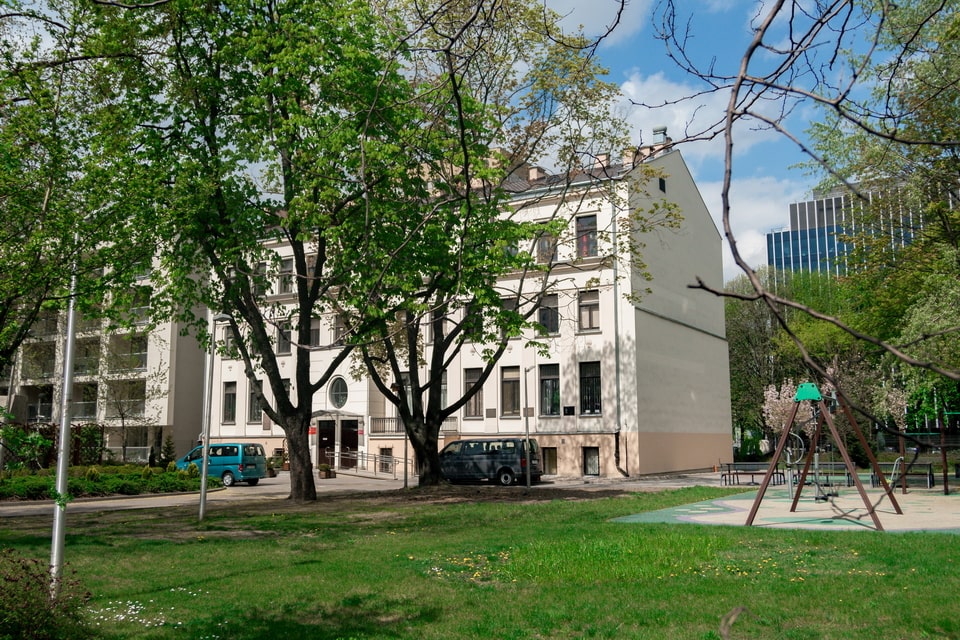
As late as October 1941, the eleventh month after the unwanted move from a custom-made orphanage at Krochmalna 92, Professor Korczak was now shattered with a piece of news. A month had passed since the German decree on reducing the territory of the Warsaw ghetto, and the current residence at Chłodna 33 was now, once again, beyond the undisputed boundaries. A new move was to be assembled within only four days: a far more challenging (than a year before, which had been presented by Korczak as an adventure) undertaking for two hundred exhausted children. The principal succeeded in finding an empty building at Sienna 16, the former pre-war residence of the ‘GMACH PRACOWNIKÓW HANDLOWYCH I PRZEMYSŁOWYCH’ (Union of Trade, Industrial and Office workers). Before the occupation, the area had been appreciated as a prestigious district in the center of Warsaw, now within the south limits of the so-called ‘small ghetto’. A new refuge was smaller and less suitable for an orphanage than the residence of the gymnasium at Chłodna 33 and in evident contrast with Krochmalna 92. The business club at Sienna 16 had only one bathroom for two hundred children and adults, yet Doctor Korczak worked out the inclusion of a small erection in the backyard for the personnel.

For all constrained conditions, abnormal malnutrition, and progressive dynamics of diseases, dedicated personnel fixed up the orphanage with minimal living conditions. A spacious premise on the ground floor of the former club was now reshaped into a dining room and an activity room during the daytime and a bedroom area at night. The educational program was scheduled with shifts. Young educated people used to render assistance within a small kitchen and lent helping hands in clean-up: for all these gaining points. They used to spend their free time playing with toys and singing in the choir. The professor had been progressively frustrated with the increasing infantile mortality in the Warsaw ghetto, and scenes with children passing away on the streets used to devitalize the old doctor in his middle sixties. In Korczak’s judgment, the little residents of the ghetto had a right to die with dignity at the very least, yet there was little dignity in dying of starvation and disease on the pavement. The Sienna 16 orphanage was neighbored by social services aimed to assist breastfeeding mothers. Professor Korczak used to observe some care recipients and provided his colleagues with studies, a passive means of contributing to medicine.

With the onset of May 1942, doctor Korczak, an elderly man exhausted by systematic malnutrition and psychologically depressed, set up a notebook. All while spending nights within a shared bedroom area next to his pupils, the professor used to make notes, conventionally much more philosophical than eventful. During the same period, Adam Czerniakow, the head of the Warsaw Judenrat, appealed to all adults to perform their best efforts to make sure the survival of children during these terrible times. On that very day, the Judenrat gave out the installation of children’s playgrounds within the ghetto, and as late as June 7, 1942, Janusz Korczak was among 500 attendees of the inauguration of the first playground next to the office of Judenrat. The first weeks of July witnessed an eruption of violence towards men and women, regarded by Germans as ‘smugglers’, in fact, the last tiny line of supply in the ghetto. It was the building at Sienna 16 that Doctor Korczak and his children left towards the infamous Umschlagplatz in the northern part of the ghetto in early August, on a one-way route.
Korczak’s notebook survived him. In the first days of August 1942, the manuscript was carried out of the ghetto and hidden in the orphanage building on Krochmalna, bricked up under the eaves. Korczak’s former secretary, the writer Igor Newerly, who had himself survived two years in Auschwitz, retrieved it after the war and handed it to the Polish Writers’ Union, where it sat unpublished through the Stalinist years — Korczak was then dismissed as a «bourgeois educator». It reached print only after 1956, in a four-volume edition of his writings, and is known in English as the Ghetto Diary. The original typescript, on thin blue rice paper, has since disappeared.

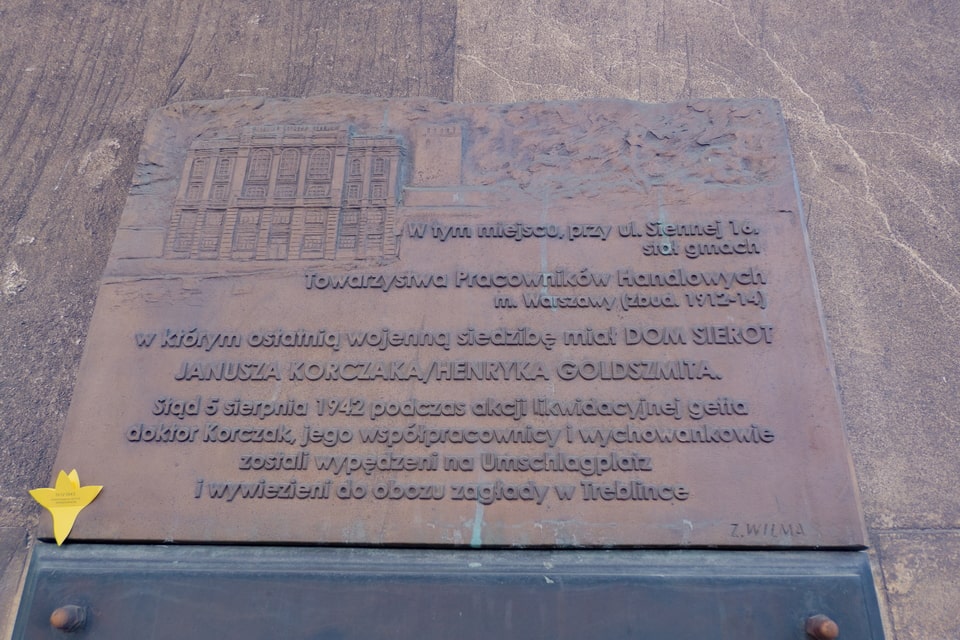
The construction survived (in contrast with the majority of the erections around) the Warsaw Uprising and the battle for Warsaw, and some public services would make use of it in the after-war years. As late as the 1950s, a whole city district would be demolished to make space for an upcoming building of ‘Pałac Kultury i Nauki’ (Palace of Culture and Science), the debated symbol of the communist era in Warsaw. At present, one can find several monuments next to the former location of the Sienna 16 building, which honors Janusz Korczak. On August 5, 2012 (the anniversary of the liquidation of the orphanage), a memorial plate was inaugurated within a wall of Laika Theatre.
W tym miejscu przy ul. Sienna 16, stal gmach Towarzystwa Pracowników Handlowych m. Warszawy (zbud 1912-1914) w którym ostatnia wojenna siedzibę miał DOM SIEROT JANUSZA KORCZAKA / HENRYKA GOLDSZMITA. Stad 5 sierpnia 1942 podczas akcji likwidacyjnej getta doktor Korczak, jego współpracownicy i wychowankowie zostali wypędzeni na Umschlagplatz i wywiezieni do obozu zagłady w Treblince.
At this place at ul. Sienna 16, stood a building of the Society of Commercial Workers for the City of Warsaw (built 1912-1914) in which was the last war-time residence of the DOM SIEROT by JANUSZ KORCZAK / HENRYK GOLDSZMIT. From here on August 5, 1942, during the liquidation of the ghetto, Dr. Korczak, his associates, and pupils were driven to the Umschlagplatz and deported to the Treblinka extermination camp.

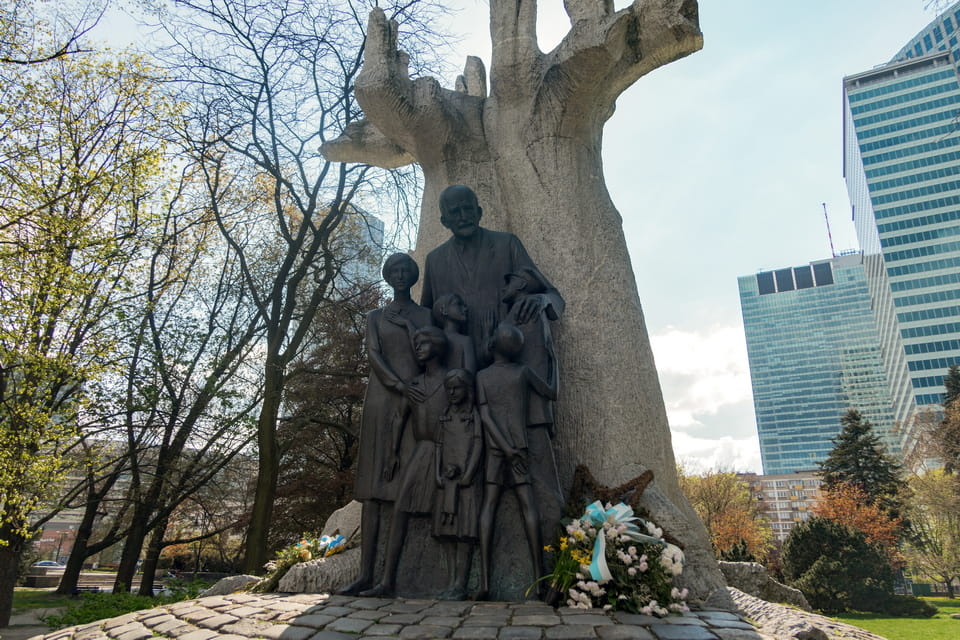
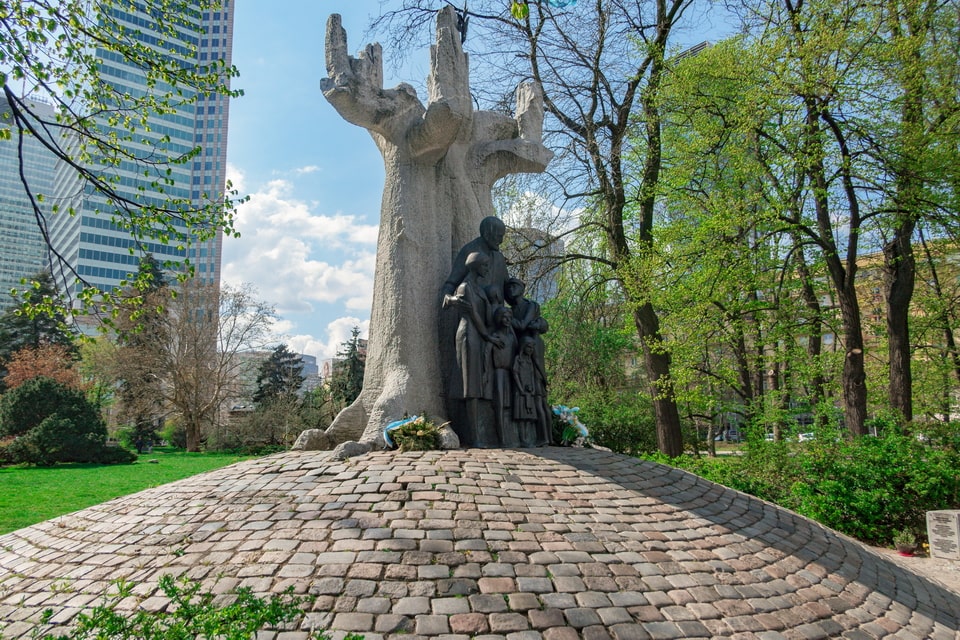
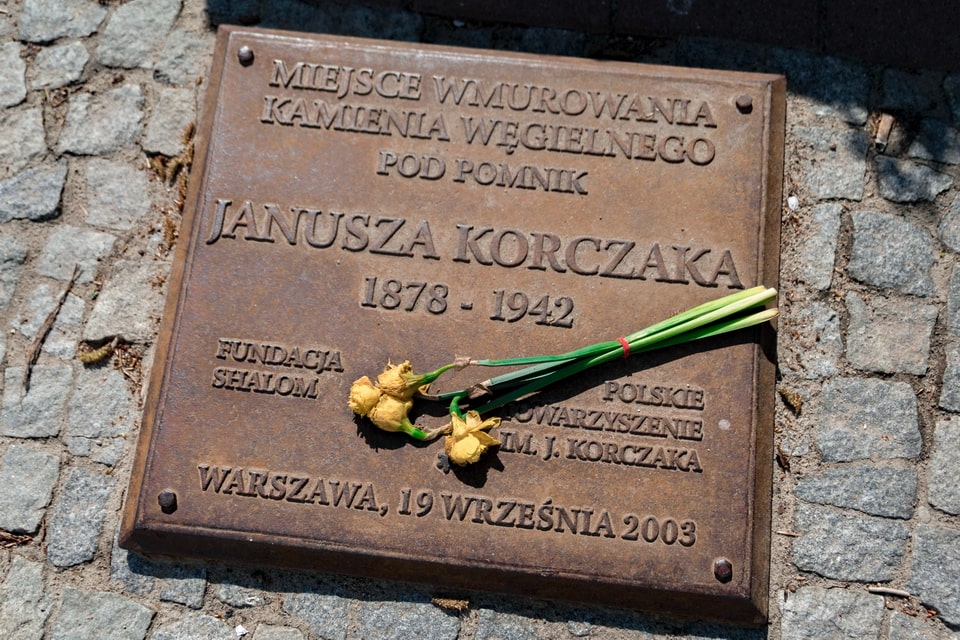
Two hundred meters distant from this memorial plate, another monument to Janusz Korczak in Warsaw, pays tribute to an appreciated pediatrician. The architectural composition, inaugurated in 2006 (Symbolically on June 1, International Children’s Day), depicts Professor Korczak with six children standing on a small hill, paved with bricks from the Warsaw streets. The doctor and his orphans stand beneath two symbolic trees, whose offshoots form a silhouette of a Jewish menorah.

THE LAST DAY, 5 AUGUST 1942: FROM SIENNA 16 TO THE UMSCHLAGPLATZ AND TREBLINKA
In the space of almost three years of occupation, the physical well-being of Professor Korczak had been materially worsening, and the age-related changes had become more intense under pathological malnutrition and psychological depression. An elderly doctor apprehended the approach of death, a fact he used to underline on the pages of his notebook. Along with that, Korczak hated the idea that his death would leave the orphans without care. On July 22, 1942, the birthday of Janusz Korczak, the head of the Warsaw Judenrat, Adam Czerniakow worriedly witnessed the siege of the so-called ‘small ghetto’ with armed units, and he accepted the German ultimatum to ‘send’ all the Jews in the ghetto, regardless of sex and age, ‘to the East’. All while the residents were trying to figure out the meaning of the crimeful nazi euphemism, the first list of 6000 doomed men, women, and children was to be executed. The Germans made an ambivalent response to Czerniakow’s appeal to exclude children from the evacuation lists.
In late July 1942 doctor Korczak had to experience a round-up at the height of one of the scheduled mass actions for deportation. The elderly professor had a close shave of being bustled into a cattle box unless a Jewish policeman picked him out of the crowd and assisted him in getting out. With one’s eyes open to the grave persistence of the day-to-day deportations by the Germans, Korczak gave it a try to incept an idea (with the help of his acquaintance in Judenrat) of forming a tailored enterprise with his orphans as workers. The very last day of the well-known pediatrician and literator did not slip into historical obscurity, since some witnesses (who survived the war and some who did not) have left recollections about the sorrowful march of Doctor Korczak and his orphans towards Umschlagplatz. Along with that, the date of this expulsion from Sienna 16 and the last trip to the Treblinka death camp is a matter of dispute between 5 and 6 August 1942.
On his last day, Professor Korczak awoke with the dawn as per usual. In dramatic contrast to 1939, 1940, and 1941 and the former German notifications in advance, the liquidation of the Warsaw ghetto was put into execution on a shocking basis for any taken area. On that day, the Germans made up their mind to ‘evacuate’ the child care center of the ‘small ghetto’. In this vein, a whistle and the German “Alle Juden Raus!” (All Jews out) were to be heard far beyond Sienna 16. The citizens of the ‘Children’s Republic’ were given fifteen minutes of closure time. A column of 192 children and about ten adults — the figure recorded by those who counted the orphanage’s own roll, though most eyewitness accounts and later histories simply say «two hundred children» — set off across the streets of the ghetto, with Doctor Korczak at its head. On his last day he wore his old army uniform.
A woebegone procession of the Children’s orphanage from Siena 16 cut across the so-called ‘small ghetto’ a few stone’s throw away from the ‘Bersohn and Bauman children’s hospital’ and made its way to the infamous wooden footbridge, known as the ‘Bridge of sighs’, to cross the Chłodna street, a few buildings next to their former shelter at Chłodna 33. Once found ourselves on the streets of the ‘large ghetto’, a little army of Korczak took course along Karmelicka, then Dzielna (passing the Pawiak prison) and Zamenhofa, and finally, crossed two cordons at Stawki street to be pushed to the ‘Umschlagplatz’. According to different preserved recollections on witnessing the column, the total march from Sienna 16 to the destination point lasted from two to four hours. The famous Polish pianist and holocaust survivor Wladyslaw Szpilman and Irena Sendler were among those who had come because of the event.
192 caretakers of Korczak’s orphanage were not the only children who were rounded up in narrow spaces in front of the pre-war transport depot. On that August day of 1942, up to 4000 pupils of the childcare institutions were forced to the extent of not guessing what would happen next. Doctor Korczak refused (an appeal of his acquaintance from Judenrat) to leave the Umschlagplatz to try to make a difference by administrative means. The elderly professor was not the man who could abandon his children. As the deportation routine ran on, the German officer in charge of the process commanded the ‘loading’ of Korczak’s Children’s Republic. One of the witnesses (Nachum Remba would be gassed to death on November 3, 1943) would recollect that children and adults calmly proceeded into the wagons of the train four abreast. None of the pupils or tutors on that trainload survived the Treblinka death camp to tell the world about the last hours of doctor Janusz Korczak, who, all but certain, did not leave his orphans until the last minute. The after-war years witnessed incredible stories and versions of the salvage of the professor, yet they all have been fated to be a little more than newspaper calls. The march to the Umschlagplatz became one of the defining images of the Warsaw ghetto, and it reached a mass audience through cinema: Polanski’s The Pianist, shot in Warsaw in 2001, reconstructed the same streets and the same square for the screen.
VISITING KORCZAK’S WARSAW TODAY
Dom Sierot — Jaktorowska 6 (formerly Krochmalna 92). The orphanage Korczak built still stands and still works as a children’s home. These are the original walls, not a reconstruction. Inside is Korczakianum, the Korczak documentation and research centre of the Museum of Warsaw, which holds original manuscripts, photographs and a library of Korczak publications from more than thirty countries, and keeps a permanent display in the building’s former main hall. Because the house is a working children’s home, visits are by prior arrangement only; there is no walk-in entry. In the courtyard stands a bust of Korczak unveiled in 1979. The attic where he lived, in a room with a distinctive semi-circular window, was never rebuilt after the war.
Sienna 16 and the monuments nearby. The building is gone — the whole district was cleared in the 1950s for the Palace of Culture and Science — but a memorial plaque marks the site on the wall of the Lalka Theatre, and two hundred metres away stands the 2006 monument showing Korczak with six children beneath two trees whose branches form a menorah.
Chłodna 33. Nothing of the building survived the Warsaw Uprising. A memorial stone placed in 1984 marks the site of the Roesler gymnasium and of the orphanage’s year inside the ghetto.
The Bersohn and Bauman hospital, Sienna 60 / Śliska 51. The main building where Korczak worked survives and has been assigned to the future Warsaw Ghetto Museum.
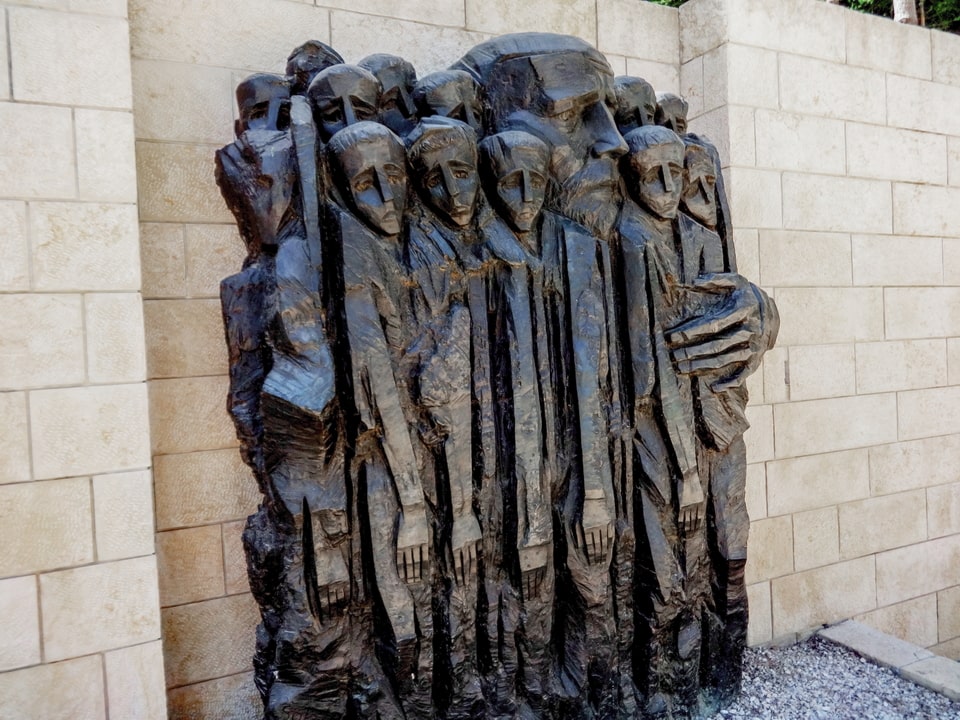
Further afield. There is a Korczak monument at the Jewish cemetery on Okopowa Street, where his father is buried; the symbolic stone at Treblinka, the only personalised marker among the seventeen thousand, reads «Janusz Korczak (Henryk Goldszmit) i dzieci»; and a memorial to Korczak and his orphans stands at Yad Vashem in Jerusalem.
One more address of the same kind survives on the other side of the Vistula. The villa of the Warsaw Zoo, where Jan and Antonina Żabiński hid several hundred people, still stands and is now a museum — like Korczak’s house, a working institution rather than a monument.
Frequently asked questions
Where did Janusz Korczak live before Krakowskie Przedmieście 77? At Bielańska 18, near the Warsaw Arsenal — the first home of the Goldszmit family and the probable birthplace of Henryk Goldszmit, the boy who became Janusz Korczak. The family moved to Krakowskie Przedmieście 77 in 1881, and on to Miodowa 19 in 1883. The house on Bielańska no longer exists.
What was Janusz Korczak’s real name? Henryk Goldszmit. «Janusz Korczak» was a pen name he first used in a literary competition in the 1890s and then kept for life. In Poland he was also known as Stary Doktor — the Old Doctor — the name he used on his radio broadcasts.
How many children were taken with Korczak to Treblinka? The figure most often given for the column that left Sienna 16 on 5 August 1942 is 192 children and about 10 adults, though eyewitness accounts and later histories more commonly round it to «two hundred children». No exact list survives: the orphanage records were lost with the ghetto, and nobody from that transport survived to correct the count.
Where is Korczak’s Ghetto Diary kept today? The manuscript was smuggled out of the ghetto and bricked up under the eaves of the orphanage on Krochmalna. Korczak’s former secretary, the writer Igor Newerly, recovered it after the war and passed it to the Polish Writers’ Union; it stayed unpublished through the Stalinist years and appeared in print only after 1956. The original typescript — written on thin blue rice paper — has since disappeared. What survives is the published text, and Korczakianum in Warsaw holds other original Korczak manuscripts.
Can you visit Korczak’s orphanage in Warsaw? Yes, but not casually. The building at Jaktorowska 6 is still a working children’s home; the Korczakianum centre inside it receives visitors by prior arrangement only. The exterior, the courtyard and the bust of Korczak can be seen at any time from the street.
Who was Stefania Wilczyńska? Korczak’s closest colleague and the co-director of Dom Sierot for thirty years — in practice, the person who ran the daily life of the house. She refused chances to leave, moved into the ghetto with the orphanage, and was deported to Treblinka with Korczak and the children on the same day.
I am very grateful to war archives, museums, libraries, private collections, and writers for the historical photos in this article. To the extent that some author or a copyright owner may not want some of the above black-and-white photos to be used for educational purposes here, please contact me for adding credits or deleting the pictures from the article.