

Warsaw Ghetto Then and Now: What Survived
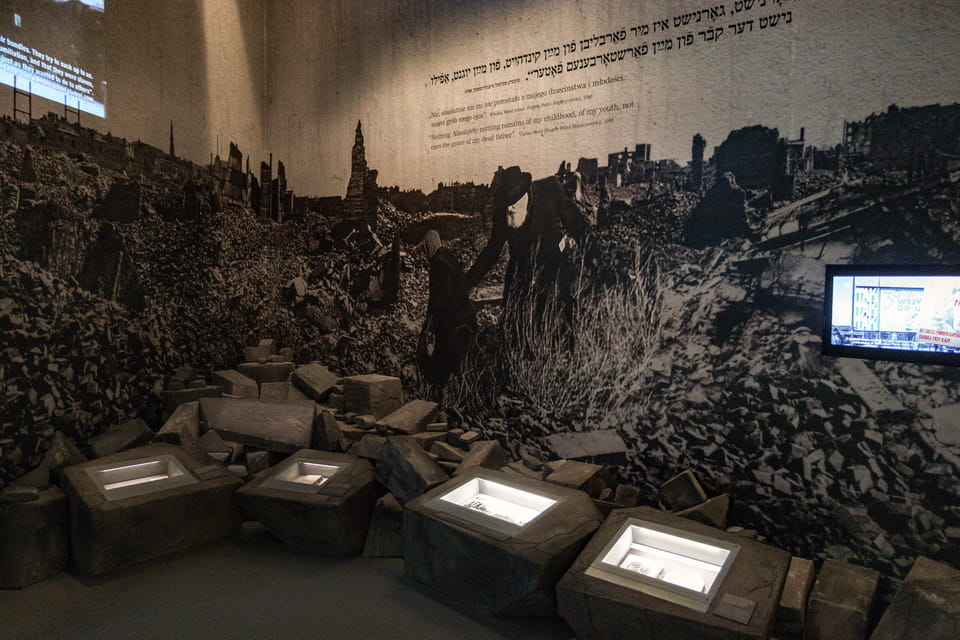
The Warsaw ghetto covered about four percent of the city and held over 380,000 people at its peak — the largest ghetto in occupied Europe. Almost none of it exists. After the uprising of April 1943, the Germans burned and dynamited the district building by building; by April 1944 they had carted away 22.5 million bricks from the site. What had been a dense quarter of tenements, courtyards and workshops became an empty field of rubble, and after the war a new district, Muranów, was built on top of it — on ground raised several metres by the debris of the old one.
So the honest answer to «what does the Warsaw ghetto look like today» is: almost nothing of it survives. But «almost» is the interesting part. A handful of buildings came through — St Augustine’s Church on Nowolipki, which stood alone above the ruins in 1945; the Nożyk Synagogue on Twarda, the only pre-war synagogue in Warsaw still in use; All Saints Church on Grzybowski Square; the Femina cinema building on Leszno; and the shot-through tenements of Waliców. Three fragments of the ghetto wall are still standing in courtyards, and the site of the footbridge over Chłodna Street is marked today by a light installation.
This guide explains how the district was destroyed — in 1939, in 1943 and in 1944, three separate waves — and then walks through every structure that outlived it, with archival photographs, 1945 aerial views and my own pictures taken in Warsaw. A map of the ghetto boundaries and a list of what to look for on the ground are at the end.
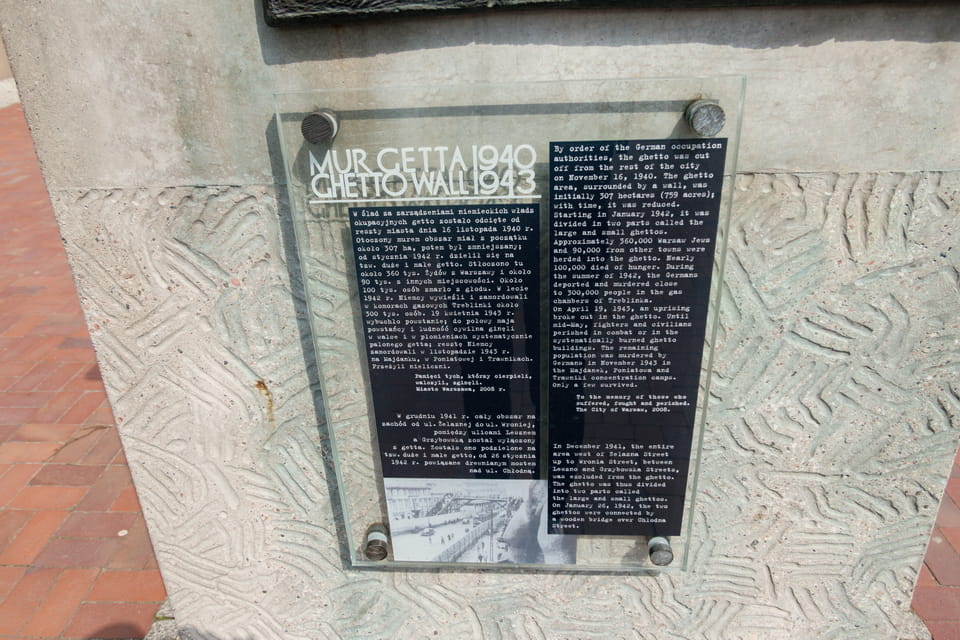
THE SIEGE OF WARSAW, SEPTEMBER 1939: THE FIRST 10% OF THE CITY LOST
Early on September 1, 1939, the German air fleet backed the devastating advance of the Wehrmacht, rushing off across the Polish border in three directions simultaneously. On this very first day of a new World War, several resting Polish cities: Lodz, Demblin, Sadomir, and Warsaw were subjected to the initial air raids, far beyond the front lines. The unforewarned citizens of Warsaw, as well as foreign diplomats, were dragged out of their beds with roars of dive-bombers, making their run over the streets (with no particular targets) at low altitudes. In actuality, the Polish capital happened to be one huge motionless target without appropriate air defense. Two days later, thousands of people gathered in crowds next to British and French ambassadors at ul. Ujazdowskie, singing ‘La Marseillaise’ and ‘God, save the King’ on the heels of the news that Great Britain and France had declared war on Hitler’s Germany. The governmental bulletin spirited people with fantasies of the counter-offensive, which ostensibly led the Polish cavalry into German soil.

Starting on September 1, Warsaw mayor Stefan Starzynski took on the task of day-to-day being on-air, urging the citizens of Warsaw to make a stand for the city. The chief of city administration also used to set people’s minds at ease, the victims of the air raids in particular. As soon as September 8, 1939, the forward detachments of the 16th and 4th Armored Divisions found their way to the city limits of Warsaw with the obstinate assistance of the aviation assets of the Luftwaffe. The 1.3 million citizens were called to dig trenches and erect barricades in the semi-improvised defense of Warsaw. Going deeper into the understanding of the demolition during the September 1939 ‘Siege of Warsaw’, we should recognize the fact that the city itself had become the frontline fraught with consequences to urban development and population. Independently, the day-to-day air raids did not make ruins of the city, yet the ever-increasing violence and the addition of artillery increased the death toll among the civil population. The capital was now surrounded from all directions and was permanently exposed to illicit artillery and air bombardments. All while the absence of ‘cheering news’ from the frontlines throughout Poland and any helpful assistance from the Allies, the citizens of Warsaw manifested distinguished discipline and moral courage to the possible extent.

In September 1939, the Warsaw radio was used to broadcast inspiring works of Frederic Chopin (performed by men like Wladyslaw Szpilman, the well-known pianist in pre-war Warsaw), through the German guns and air-to-ground aircraft directed up to 30 000 shells on the city every day. The city was now covered with clouds of dust, black and grey smoke fog, and tongues of fire. A mere few centralized air shelters had been organized before the outbreak of war, and now the improvised shelters conventionally below stairs of buildings were to become a deadly trap in the event of a direct hit of the bomb. People who had no physical ability to hide were now other victims of the ‘Siege of Warsaw’: on one occasion up to 700 patients and medical staff found their deaths beneath the ruins of the devastated hospital. The streets of Warsaw, as well as cozy pathways in parks and alleys, witnessed the bodies, which failed to be buried. The conventional historical estimates acclaim the figure of 18 000 fatalities among the civil population of Warsaw and its defenders. The accepted figure for wounded is 50,000.

The generally accepted 10% of the urban devastation in September 1939 and 40% of damages of less extent indeed gives a superficial understanding of the tragedy of hundreds of thousands of citizens of the besieged Warsaw. Apart from the buildings beyond repair (the well-known figure of 10%), practically every erection in the city witnessed a varying degree of blown-out windows. These tons of glass now covered the pavements, and people had no time to clean up the streets. The first four weeks of the War up to the capitulation of Warsaw on September 28 witnessed varying degrees of the demolition of hundreds of historical buildings and monuments of cultural heritage, including the ‘Royal Castle’ (Zamek Królewski), ‘Grand Theatre’ (Teatr Wielki) and ‘National Theatre (Teatr Narodowy). The devastating culmination of the Siege can be attributed to the September 25 air raid that would make its way in history as ‘Black Monday’. The largest air bombardment in history (then) with 1100 aircraft exposed the city to 560 tons of high explosives and 72 tonnes of incendiaries as well as heavy artillery fire. Adolf Hitler was accommodated to witness the raid from a convenient spot on the opposite bank of the Vistula River, which had been taken by the Germans two weeks before.

The massive devastation of the city infrastructure targeted not only the urban development and historical sights. The majority of the urban districts now lacked proper electricity supply and, more importantly, water supply. Since Warsaw had been besieged for weeks by the German forces, the delivery of supplies was unachievable: a fact that challenged people to experience malnutrition. Hitler proclaimed Warsaw ‘a fortress ’ that should be taken by means of armed force rather than siege. Along with that, hundreds of thousands of besieged people and rare defenders suffered deprivation and constant death anxiety in the course of September 1939. On nights when the German bombardments generally took a break, crowds of starving Warsawians populated the space in front of the bakeries, scheduled to be open in the early hours. As early as September 27, fearful citizens did not hear the frustrating whistle of German bombs for the first time since the outbreak of the war, and the next day witnessed the capitulation of the city. On their buoyant march into the city on October 1, 1939, the German soldiers walked beside the decaying corpses of people and horses, as well as next to the burned buildings.


THE WARSAW GHETTO UPRISING, APRIL–MAY 1943: HOW THE DISTRICT WAS BURNED DOWN
As early as November 3, 1939, less than a month after the so-called ‘Siegesparade’ (Parade of victory) for Adolf Hitler in Warsaw, an officer of a newly established local Gestapo darkened the door of the nascent ‘Judenrat’. The leaders of the Jewish community were issued with an ultimatum, assigning the establishment of a sealed Jewish ghetto in Warsaw in three days. All while the decree was postponed, the formation of a ghetto was to become a done decision. As early as March 1940, one year before the establishment of the Jewish ghetto in Krakow, some public walls within the central quarters of Warsaw with historically dense Jewish populations were pinned with ‘notices’ on the entrance to an ‘infected area’. The officials of Judenrat were presented with a fait accompli: the draft maps of this very ‘area’, shaped with approximately 4% of the total Warsaw urban area and now prescribed to be surrounded by a break wall. August 1940 witnessed the actual displacement of dozens of thousands of people to an area with pre-war high compaction of the Jewish population. At that period in time, the Germans used to avoid the usage of the ‘ghetto’ designation, using a euphemism: ‘Jewish Residential Quarter of Warsaw’. The whole city quarters, streets, and squares ended up within the issued boundaries. On November 16, 1940, the Jewish ghetto in Warsaw was sealed, and the coming demographic count figured 380,740 residents compared to 393,950 Jews in the whole Warsaw area back in September 1939, a third of the city’s total population at the start of the war. The scale of what happened here was first set out in full by Raul Hilberg, whose The Destruction of the European Jews reconstructed the machinery of the deportations department by department — and treated the Warsaw ghetto not as an exception but as the largest single node in a continental system.


On the heels of the mass deportations in the summer of 1942, the remaining residents of the ghetto were crowded into four separate enclaves of buildings within the reduced area, indeed a fraction of the November 1940 boundaries. In the course of the next half a year, dispiriting news on the liquidation of the Jewish ghettos in Poland had been circulating in the streets of Warsaw. In the aftermath of another wave of deportations in January 1943, the Germans initiated large-scale expropriation of equipment from the former factories of the ghetto. At that time, the liquidation of the remaining Jewish population of Warsaw was all but a surprise. The Germans initiated the final stage of the liquidation of the half-empty Warsaw ghetto as early as April 19, 1943, facing unexpectedly harsh armed resistance. By the time the fighting started, most of the ghetto’s population was already gone. Among those deported in the summer of 1942 were the two hundred children of Janusz Korczak‘s orphanage, who walked to the Umschlagplatz with their director on 5 August.
Whereas the special squads penetrated the territory of the so-called ‘central ghetto’, an area that looked like a ghost town as the vast majority of the residents were hiding inside the improvised underground shelters with entrances masked. Once challenged with an armed opposition to the ‘Endlosung’ (final solution), the Germans were now fraught with retributive determination to drown the JEWISH GHETTO UPRISING in blood. The Jews placed themselves beyond just being an ‘economic burden’: they had become enemies of the Nazi racial Empire, an enemy army with arms in their hands.


To understand the nature of the almost complete devastation of the urban area of the Warsaw ghetto (the ‘main part’, generally known as the ‘large ghetto’ back in 1940-1942), we should delve into the nature of the 1943 Ghetto Uprising and how it was fought. With no more illusions of miracle-kind evading the doomed fate in the hands of the Nazis, the Jewish population of Warsaw did not leave their shelters on the heels of the initial opposition on April 19, as well as the days to come. The defensive warfare of these underground bunkers was to become a vital element of the defense of the ghetto in total. The streets of the former ‘Jewish Residential Quarter of Warsaw’ were filled with bangs of rifles and pistols, two hundred German machine guns, 13 heavy guns, a cannon, and the blazes of the self-made Molotov cocktails. In contrast with a sophisticated network of spies reported to the authorities, a large-scale structuring and fortification of the bunkers beneath every second building happened to be a frustrating surprise for the advancing German forces. Along with that, a decision on the total devastation of the Jewish ghetto after the planned April 1943 liquidation was evident with the instructions of Heinrich Himmler ahead of time. On April 20, Adolf Hitler celebrated his 54th birthday.


In less than no time, the Germans shifted their advancing priorities from the street battles to an orderly elimination of the fortifications, which had been erected beneath the majority of the buildings, and had become a kind of fortress. In their offensive blow, the Germans placed reliance on the usage of fire, and the central ghetto was soon clouded with flames and suffocative smoke. Buildings were put on fire from the ground up one by one, and the refugees were often trapped in a fire pitfall. The forward instructions prescribed the preservation of a large working area with workshops next to Leszno Street, yet harsh combat actions and armed resistance foredoomed the fate of the area. The fighters of the Jewish resistance, in fact, a demographic fraction of still-alive residents of the ghetto, were often people with no military experience and nearly always with no appropriate weapon. In purely military terms, the rebellions had little to set against the sophisticated war machine of the SS. The insurgents were armed with pistols, self-made hand grenades, and Molotov cocktails, and with only ten rifles in total as well as a few machine guns, taken from the Germans in combat. The uprising broke out in a district that had already been emptied. Between July and September 1942, more than a quarter of a million people were sent from the Umschlagplatz on Stawki Street to Treblinka.


SS General Jürgen Stroop declared the success of the suppression of the Ghetto Uprising as early as May 15, 1943. Despite what one would think was an ‘achievement’ in combat, the whole campaign was treated by Germans as a blow, a possible forerunner of the Polish Uprising. The Ghetto uprising and its suppression were not featured in the German media, in contrast with the Polish newspapers. The acclaimed estimation figures out that up to 7000 people were killed in four weeks of fighting inside the ghetto. As follows to the German reports, 631 bunkers and up to 1000 buildings were devastated: figures which shut the door to future exploitation of the former Jewish area in Warsaw. Apart from no more than ten erections, the former Warsaw ghetto was totally demolished into ruins. Bricks and scrap metal were now the only ‘valuables’ to be taken away from here. As late as September 1943, the Germans brought forced Polish workers for the final annihilation of the erections: an operation that would demand the health of 4500 people. On April 19, 1944, exactly one year after the outbreak of the Ghetto Uprising, another German report would total 22.5 million bricks, taken from the area of the former ‘Jewish Residential Quarter of Warsaw’. A handful of buildings on the other side of the river came through all of it. The villa at the Warsaw Zoo, where the Żabiński family had hidden several hundred Jews, was the only brick building on the zoo grounds still standing at the end of the war.
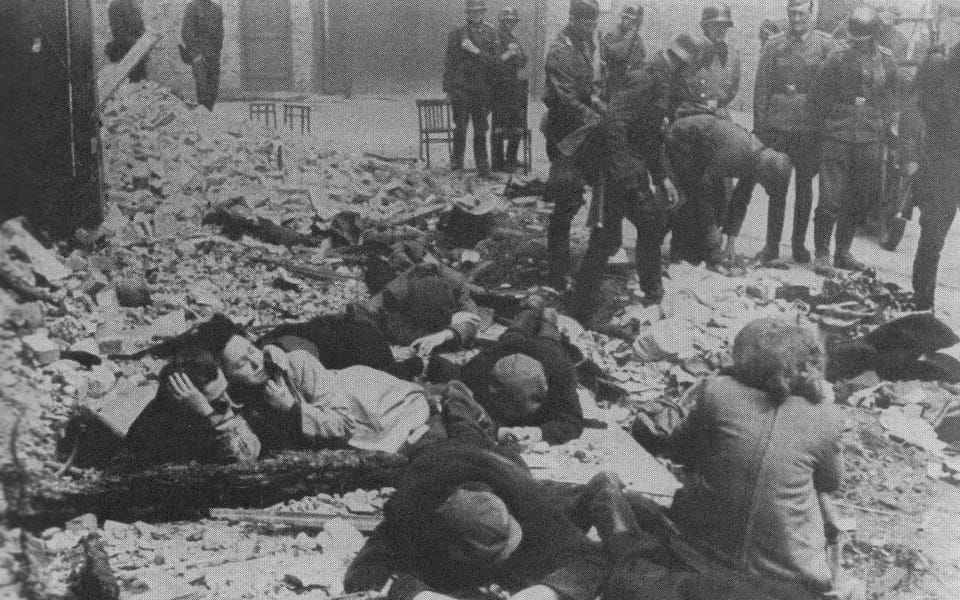


THE ANNIHILATION OF WARSAW, 1944: 22.5 MILLION BRICKS AND 10,455 BUILDINGS
By the summer of 1944, Poland and Warsaw, in particular, had been enduring the fifth year of the German occupation. The Western front witnessed a liberation of France, and the German armies in the East were to be pushed back as far as the Polish soil. More than this, the fighting front came close to the Polish capital and the liberation of Warsaw felt like a predetermined matter in the near weeks. In the late afternoon of August 1, 1944, the forward squads of the Polish insurgents, with a great share of ‘AK’ or ‘Armia Krajowa’ ( The Polish Underground Home Army), initiated a military-like operation to liberate a city from the hated invaders. In the minds of the rebels, the Warsaw Uprising was regarded more as a disarmament of the Germans, with a maximum of two weeks. On the heels of the Polish street advance, the intact occupational garrison was reinforced by up to 30,000 advanced soldiers, backed with tanks, heavy artillery, and aviation. More worryingly even than the armory was the decisiveness of Adolf Hitler to drown the Uprising in blood and to demonstrate one’s strength.
Hitler sealed the fate of the Polish capital as soon as the very evening of August 1, when the combatting sides in the streets were still reconnoitering the grounds. By that time, the Nazi Führer had lately lost his military initiative. Hitler suffered from the injuries in the aftermath of the July 20 assassination attempt, conclusively given up upon by his generals (he accused his officers of military setbacks, on the Eastern front notably), and was definitely in no mood to compromise with the Polish insurgents. In the course of World War II, the German Führer had repeatedly voiced open-ended monologues on the devastation of the Soviet cities to the ground: moscow, Minsk, and the besieged Leningrad and Sevastopol. Hitler shared his considerations (with his inner circle and high command) on the fact that multi-story buildings could weather the hit of the bomb, yet are shelterless against the intentional mine-laying operation.


Warsaw was fated to be ‘Glattraziert’ (leveled to the ground), and Reichsführer SS Heinrich Himmler conveyed instructions to General Heinz Reinefarth to the former capital of Poland. In the first instance, every captured insurgent was exposed to immediate annihilation regardless of the method of his resistance. Secondly (the second clause of the order), a part of the civil population of Warsaw, including women, children, and elderlies were to be executed as an act of vengeance for German casualties. In the third place, Himmler’s order (indeed as a means of rendering Hitler’s wish) included a clause on the total devastation of Warsaw: historical landmarks, urban development, and infrastructure. At that late stage of the war, just as the German army bled on all fronts, such increased focus on the badly armored uprisers in Warsaw seemed reasonable to Adolf Hitler. He craved to demonstrate the strength of the Third Reich and an example that any resistance to the Nazi empire would meet the same fate as the Poles.

While the Allied anti-Axis forces had close to total dominance on both fronts in the air, the Germans in Warsaw still enjoyed the advantages of the air forces above Warsaw. As early as August 1, the very first day of the Uprising, Ritter von Greim, the future Field Marshal and the successor of Hermann Göring in 1945, supported the German forces in Warsaw with air assistance. Apart from Stukas, the clouds above the capital were infiltrated with Messerschmitts and Junkers Ju-87D, which dropped 1580 tons of explosives in the first days of August and later called off after 200 mission sorties. The Luftwaffe enjoyed air dominance despite the advance of the Soviet troops, who had all the means to annihilate German airfields, an event that never happened. The last Soviet plane operated a flight over Warsaw on July 31, and the subsequent ones would be put into action only in October. The German pilots used to perform flights to hit the city districts starting from 6 a.m., with a break for lunch, up to 7 p.m. daily. Without any resistance in the air, the Luftwaffe could dive very low to support the land forces upon request. Only the Ju-87D performed 711 mission sorties to bomb the Old City of Warsaw.


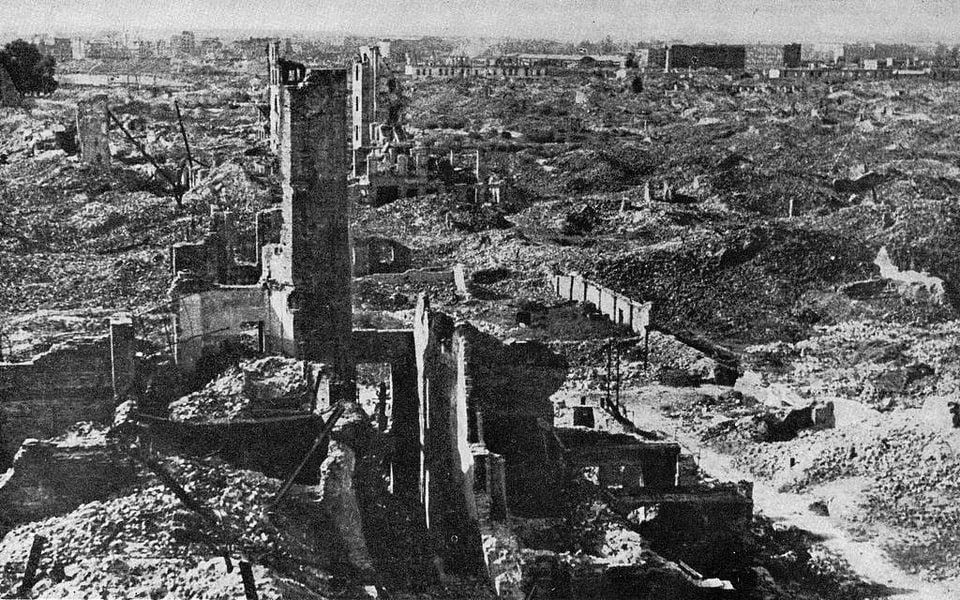
Apart from dominance in the air and lethal armament in the streets, the Germans took advantage of the heavy artillery for the gradual devastation of the city on a large scale. As much as anything else, the SS troops were now accompanied by two ‘Sturmtiger’, a giant-like assault gun of 68 tonnes, built based on the well-known ‘TIGER’ tank. These two armored monsters were stationed to fire on the shelterless Warsaw with shells of 380 mm, designed to destroy a whole multi-story building with one direct hit. ‘Sturmtiger’ gun did not exert influence on the course of WWII, yet it contributed to the ‘Glattraziert’ policy. The history preserved the footage of the German propaganda film, filmed on August 19, 1944, amid the Warsaw Uprising from the position of Kierbedź bridge, later (September 13) also demolished. The shots in the footage included the whistle of 379 kg shells, which fell on the city streets of Warsaw, one by one. In early August, the heavy artillery was accompanied by some heavy guns, which had been initially designed to destroy the Maginot Line in France. Now, the center of Warsaw was destined to suffer the same fate as Sevastopol, a vast part of which had been turned into ruins in the course of the siege and looked like a moon’s surface.


On October 2, 1944, Polish general Tadeusz Bór-Komorowski signed an act of capitulation of the remaining Polish forces in the presence of another general, the German Von Dem Bach-Zalewski. After the war, SS-Obergruppenführer, General der Waffen-SS, and General der Polizei would become one of the key witnesses at the Nuremberg trials. Bach-Zalewski would spend the vast part of his later life in custody, yet not for the war crimes on the territory of the Soviet Union, but for the suppression of the Warsaw Uprising in 1944. According to the terms of capitulation, Home Army soldiers would have to be treated under the Geneva Convention and the civilian population with respect. Summing up the dramatic statistics of the Uprising, the resistance lasted 63 days and demanded the lives of 18,000 Polish fighters and up to an enormous 200,000 civilians. The Germans lost 17,000 soldiers dead and 9000 wounded: the figures that left behind the casualties of the Warsaw Ghetto Uprising back in the spring of 1943.

While Heinrich Himmler had cultivated an idea of cooperating with the Poles in the mutual struggle against the communists, Hitler was of no compromise to the decision he had announced as far back as August 1, 1944. The final decision on the total devastation of the remnants of the center of Warsaw was issued as early as October 9, one week after the formal capitulation. For obvious reasons, the devastation of Warsaw included no military necessity and only piecemealed the dwindling reserves of the Germans. ‘Führerbefehl’ or ‘Führer’s decision’ was all but disputed. The operation of deliberate demolition of the already ruined city center was regarded as ‘Auflockerung, Räumung, Ladung und Zerstörung’ (dispersal, clearance, loading, and destruction). A special ‘Räumungsstabe’, or ‘evacuation staff ’, was called to devastate the remaining erection with explosives and flamethrowers. The reserves of the explosives soon gave out and were restocked without delay. In total, up to 30% of the devastation should be attributed to the period after October 2 and the last street fights.

In the course of ‘Glattraziert’ (leveling to the ground) of Warsaw, ‘Räumungsstabe’ (‘evacuation staff’) devoted special priority to the annihilation of the historic and cultural heritage of the Polish people. The list of 923 devastated buildings of historical significance included national archives, churches, and synagogues, and fourteen libraries. The consistent devastation was made relevant for the sphere of education by turning as few as 81 elementary and 64 secondary schools into ruins, as well as the University of Warsaw and the Warsaw University of Technology. The heritage was turned into dust not only with palaces such as Bruhl and Saski Palace but also with statues, hospitals, manufacturing facilities, and a large number of residential buildings.
In only six days from October 9 to 15, 1944, altogether 23 300 railway carriages with possessions and loot left Warsaw, including 1600 with grain. By January 1945 (the liberation of Warsaw), 10,455 buildings or 40% of urban development (of prewar 24 700) were irretrievably demolished beyond economic repair. A great part of the remaining 60% was affected to a different extent. The intended devastation of Warsaw happened to be an act of unparalleled outrage even in the context of World War II. In contrast to wordy commentaries from Hitler in the course of the war, Warsaw became a place for executing the idea of devastating entire cities.

WHAT REMAINS OF THE WARSAW GHETTO TODAY: THE SURVIVING BUILDINGS
One more building in the former small ghetto is about to change its meaning entirely. The complex of the former Bersohn and Bauman Children’s Hospital at Sienna 60 / Śliska 51 — built in 1876–1878 with money from two Jewish families, the hospital where Janusz Korczak worked as a paediatrician from 1905 to 1912, and one of the last places inside the ghetto where doctors went on treating children through famine and typhus — is being converted into the Warsaw Ghetto Museum, the first museum in the world devoted entirely to this ghetto. Construction began in October 2023; the buildings are due to be finished at the end of 2026, and the museum is scheduled to open to visitors in autumn 2027. Until then, the restored facades can be seen from Sienna and Śliska streets.
ST AUGUSTINE’S CHURCH ON NOWOLIPKI: THE TOWER THAT STOOD OVER THE RUINS
As far back as September 1943, the Germans herded together more than 4000 forced Polish laborers to the ruins of the former Warsaw ghetto for the benefit of extracting scrap metal and bricks. The major portion of the area had been regarded between 1940 and 1942 as the ‘large ghetto ’, including the 90% buildings within the 21/09/1942 boundaries, now laid in ruins. ‘Kościół św. Augustyna w Warszawie’ (St. Augustine’s Church) was now the highest and, in fact, one of the few buildings still standing. The history of the church goes as far back as the 1880s, when the city administration ceded rights for a plot of land with an old residential house and a small yard facing Dzielna for the sake of building a catholic cathedral.
The construction was donated by Countess Aleksandra Potocka, a former waiting lady of the Emperor’s family. Soon after the death of her husband back in 1867, Potocka lingered behind the scenes of public life and devoted her late years to charity, and the city of Warsaw was a recipient of such generosity. In the closing stages of life, the countess became a member of ‘The Third Regular Order of St. Francis’ and made up her mind to celebrate the 25th anniversary of the passing of her husband (in 1867) with the erection of a church in Warsaw, named after the order. Countess Potocka acquired ownership of two adjoining plots of land at Nowolipki, and the overall cost of the construction was finished as early as 1896 (the 29th anniversary of the passing of Count and four years after the death of Countess herself), which would amount to an enormous 300 000 rubles.

In the Autumn of 1940 and the output of a few versions of maps with the boundaries of the so-called ‘Jewish Residential Quarter of Warsaw ’, a German euphemism for a ‘ghetto’, the catholic priests of St Augustine’s Church found their patrimony in new circumstances. Regardless of the shot-down of the church by the Germans, its men of the cloth went along accommodating the place. In the two years to come, Leon Więckowicz (or Więckiewicz) and Father Franciszek Garncarek afforded aid to the Jewish population of the adjusting area, including forwarding some of the residents beyond the ghetto walls right to the liquidation of the ghetto in Spring 1943. Father Więckowicz was later arrested for his sympathy for the Polish and Jewish people killed: he was initially imprisoned in Pawiak prison and finally died in the German concentration camp Gross-Rosen in 1944. Father Garncarek was killed (shot on the spot) on December 20, 1943.


After the full-scale devastation of more than 1000 buildings of the former Jewish ghetto, the Muranów city district of Warsaw came to be an ocean of ruins with a 70-meter tower of St. Augustine’s Church, dominating the leveled area. The complete demolition of a whole city quarter glossed over the XIX-century cathedral on purely pragmatic grounds far beyond any historical or cultural significance. As early as the summer of 1942, on the heels of the mass deportations, the Germans turned one of the premises of the church into a warehouse for looted possessions, furniture in particular, and later used the building as a stable. Not to end the war history of the church here, as early as August 1944 the Germans organized a machine-gun nest in the tower, the highest point of the area at that time.
As early as August 5, the fifth day of the Warsaw Uprising, the bell tower was damaged in the course of the Polish attack on the neighboring Gęsiówka prison. The SS would intentionally set the roof of the cathedral on fire, and the better half, including the house of a vicar and a parish house, burned down. The plans to blow up the church were never put into practice. As the war ended, St Augustine’s church happened to be one of the few remaining buildings and the highest point of the Muranow district. The restoration of the cathedral would take six years and would be generally finished by 1953, though the territory was reduced to make space for new urban development.

THE NOŻYK SYNAGOGUE AT TWARDA 6: THE ONLY PRE-WAR SYNAGOGUE STILL WORKING
In the late decades of the XIX century, Warsaw was regarded as a city with the largest Jewish population in Europe. In this vein, the building of synagogues was a trivial process, and the erection of a new institution of such kind at Twarda 6 would take ten years. As far back in history as 1893, a Jewish haberdashery merchant, Zalman Nożyk and his wife Rywka took ownership of a piece of land at arm’s end from their home at Prozna 9. A new acquisition cost 157 000 rubles, and another 100 000 would be spent on construction, which would last from 1898 up to 1902. A new synagogue was designed to accommodate up to 600 religious believers, yet its patron had not much time to enjoy his creation: Zalman Nozyk passed away in December 1903 at the age of 57. Soon after the death of Rywka Nozyk in 1941, a synagogue was signed away to the Warsaw Jewish Community. One of the clauses of the last will included a proviso to preserve the name of the patrons in nomination: Nożyk Synagogue. The year 1923 witnessed the first renovation of the building, which had been erected only twenty-one years before. In contrast to more recent synagogues of the time, it was an Orthodox synagogue.

By September 1939 and the onset of the German occupation, the ‘Nożyk Synagogue‘ was reckoned among the five largest ones in Warsaw. As early as January 1940, months before the establishment of the Warsaw ghetto, the Germans shot down and looted the synagogue, surrounded by the buildings that had been heavily damaged during the Siege of Warsaw back in September 1939. For some time the building was used as a stable and food storage, although as early as May 20, 1941, the occupational authorities unexpectedly permitted a resumption of work of the three largest synagogues of Warsaw, including the one at Twarda 6. Admittedly, ministering was resumed as early as September.

The Nożyk Synagogue was not fated to operate for a long period, and the institution was closed amid the mass deportation to Treblinka in July 1942. The Warsaw Ghetto Uprising of 1943 generally set aside the area of the former so-called ‘small ghetto’, yet a synagogue at Twarda 6 was badly damaged in August-September 1944 in the course of the street fights at Twarda. The construction stood out, resumed its work in the late 1940s, and several renovations would last for four decades. In the aftermath of an ambitious reconstruction of 1977-1983, the synagogue was open once again on April 18, 1983, to commemorate the 40th anniversary of the outbreak of the Warsaw Ghetto Uprising. The Nożyk Synagogue is to be regarded as the only pre-war synagogue in Warsaw that survived the war and operates today, and is a landmark of the preserved part of the former Warsaw ghetto today.

ALL SAINTS CHURCH ON GRZYBOWSKI SQUARE: INSIDE THE SMALL GHETTO
As in the case of St. Augustine Church and ‘SYNAGOGA RYFKI I ZALMANA NOŻYKÓW’, the building-up of this particular place of religious attendance was made possible due to private patronage. As far back as 1857, Countess Gabriela z Gutakowskich Zabiełło donated 12,000 rubles, and her Warsaw residence at pl. Grzybowski Square for the construction of a catholic cathedral. Until the end of the XVIII century, the area had been assigned outside the city limits, yet in the middle of the XIX century, the density of the population increased to the extent that building a catholic church became a decided necessity. The erection of a new monumental building would be initiated as early as 1861 and would last for more than three decades until completion. The course of time included nine years between the actual opening (not a finished church) and the completion of two towers in 1892. Over the course of its eventful history, the church and its outbuildings were surrounded by dense urban development.
Restrained city development around the church suffered from the power of German aviation and artillery in September 1939. Despite the damage, the All Saints Church proceeded to work during the first phase of occupation and was assigned to become a part of the Warsaw ghetto already in November 1940. The building was now a part of the so-called ‘small ghetto’ at the arm’s end from the Judenrat as well as ‘SYNAGOGA RYFKI I ZALMANA NOŻYKÓW’ in the same area. The church was one of the three catholic institutions within the boundaries of the ghetto to be attended by the Jewish people, who had adopted Christianity: another example of the Nazi policy, which used to treat the Jewish population as a race rather than then representative of the alien religion. According to estimates, up to 2000 residents of a total 380 000 (November 1940) of the ghetto professed Christianity.

Catholic preacher Marceli Godlewski, a priest at All Saints Church since 1915, in the interwar years had been known for his hard-line publications against the Jews. In 1939, he made up his mind to retire, yet he decided to proceed with activity in new circumstances and to afford aid to the Jewish population. A free charity kitchen was organized in one of the outbuildings of the All Saints Church, and as many as one hundred refugees used to live here regardless of their confession. Father Godlewski was forced to leave the church and ghetto in July 1942 at the height of the mass deportations of the Jewish population to Treblinka and met his last days in December 1945 at the age of 80 beyond Warsaw, thus outlasting WWII for only half a year. In 2009, his name was included in the list of the Righteous Among the Nations.

The building was fated to survive the damaging events of the 1944 Warsaw Uprising when the Polish fighters made All Saints Church a local fort post in the area. By the end of August, the church was left in sad conditions with a partially collapsed roof and the inevitably lost massive organ and antiquity-like iconostasis next to a sanctuary. The majority of the outbuildings of the former palace, which had once given their space for the erection of the church and were still within the territory in 1944, were now devastated. By the way, reinforced walls and towers survived, and the building had better luck than an entire city quarter nearby, which witnessed the end of the war in ruins. The restoration of the church lasted four decades after the war, and some of the authentic erections (outbuildings) were demolished to make space for new residential buildings along Świętokrzyska Street; still, a good insight into the past comprising the former Warsaw ghetto then and now.
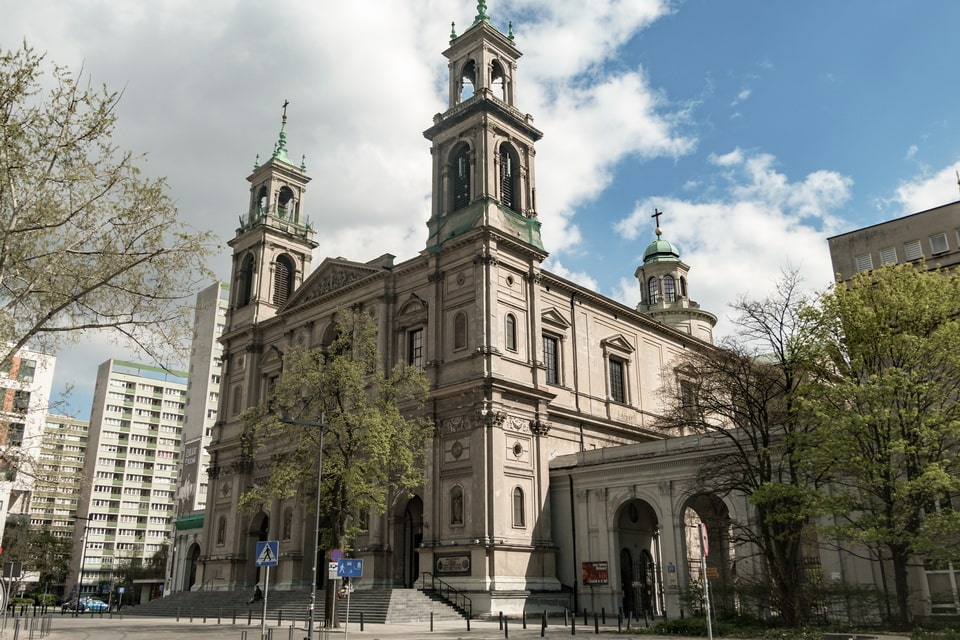


THE FEMINA CINEMA ON LESZNO 35: A GHETTO THEATRE, AND WHAT IS THERE NOW
In the years’ run-up to World War II, Chłodna and neighboring Wolska and Leszno streets had been appreciated as a sort of center of cultural life in Warsaw and a harbor for movie enthusiasts. Apart from cozy theatres and cinema halls, the 1930s witnessed a prime of at least five large cinematic theatres. ‘COMET’ with its 1500 seats was undoubtedly the largest film house in pre-war Warsaw. At that time it was accompanied by the ‘ITALIA’ cinema with 500 seats, ‘HELIOS’ with 300, and ‘Roxy’ with 180. However, a catholic church at Chłodna 9 operated its small cinema hall with an obvious accent on religious movies. The pre-war Warsaw cultivated another cinematic theatre, appraised as ‘FEMINA’ (‘woman’ in Latin). A nomination spoke for itself: women had been forming the better half of the audience, who enjoyed a repertoire with the dominance of melodramas. A pocket-handkerchief generally adhered to a ticket. ‘FEMINA’ accommodated itself within the ground floor of a seven-story residential house at Leszno 35. The building was put into use in 1935, and as early as 1936 the owner obtained permission to open a cinema hall on the ground floor, an event which would be fulfilled already in 1938.

With the sealing of the Jewish ghetto in November 1940, the building at Leszno Street, as well as the shot-down (in the aftermath of the capitulation of Warsaw) cinema inside, were caught inside the boundaries of the so-called ‘large ghetto’. Except for purely physiological needs of safety and security, accommodation, and nutrition, the residents of the Warsaw ghetto suffered a lack of social activities and alikeness of cultural life. Along with the unexpected occupational permission to open synagogues and twenty schools in May 1941, the Germans allowed the opening of a few cinema halls inside the ghetto. As early as June 20, 1941, the premises of the former ‘FEMINA’ cinema witnessed the inauguration of a theatre (not cinema) of the same name: a podium for gifted Jewish actors, singers, and dancers. The auditorium had been well furnished before the war and now could accommodate up to 900 attendees. Apart from its primary purpose as a theatre, it witnessed several fund-raising campaigns for those who starved within the ghetto.
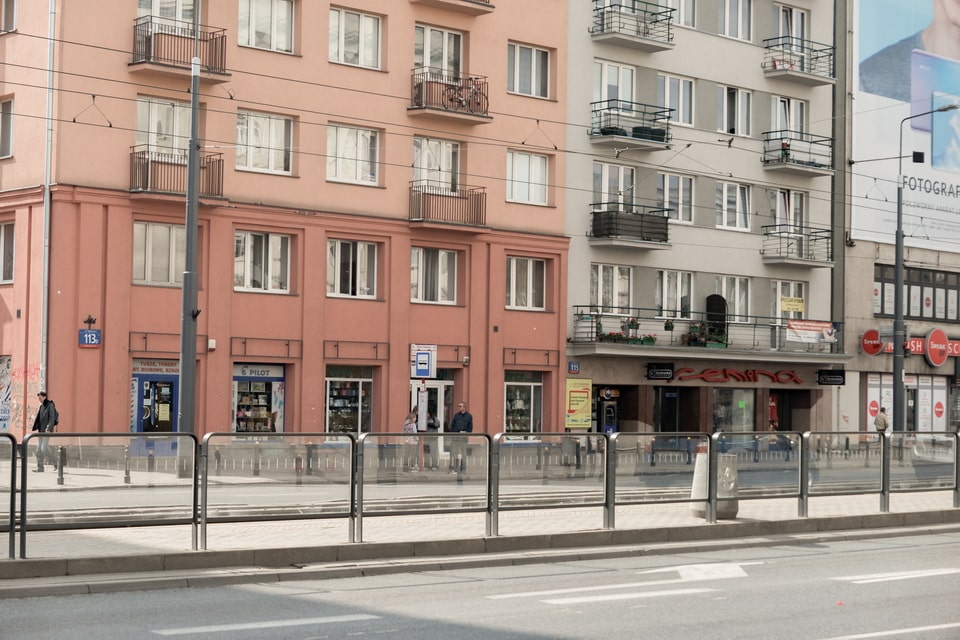
Apart from ‘FEMINA ’, another four theatres were allowed to be opened in the ghetto in the summer of 1941: ‘Eldorado’, ‘Na Polterku’, ‘Azazel’, and ‘Teatr Kameralny’, and an area of the Leszno and Nowolipki streets was appreciated as the ‘Broadway’. In a matter of thirteen months of operation, the ‘FEMINA’ theatre witnessed more than ten premieres, yet it was not fated to outlast the mass deportation in the summer of 1942. As early as September, the territory of the ghetto was significantly reduced, and a new boundary ran through Leszno, across the road of the former cinema and theatre. The abandoned building was to be used by the Germans as a warehouse until the summer of 1943 and the opening of the ‘Aryan’ ‘FIGARO’ theatre. Now located within an ‘Aryan part’ of Warsaw, it would operate until the outbreak of the Warsaw Uprising in August 1944. The exception of Leszno 35 from the territory of the ghetto indeed saved the building from the total devastation, which affected the vast territory to the North across the former ‘FEMINA’. As early as 1958, the new ‘FEMINA’ cinema hall was put into operation on the same spot with seats for 635 visitors. Moving forward in history, the particular part of Leszno Street was initially renamed Świerczewskiego and finally renamed Aleja Solidarności, now 115.
The Femina cinema outlived the war, the ghetto and the communist era, and closed in 2014. The hall where the ghetto theatre played in 1941 and where Warsaw children queued for Sunday matinees in the 1970s is now a supermarket. The building itself still stands at what is today Aleja Solidarności 115 — the section of Leszno Street was renamed twice after the war, first to Świerczewskiego and then to Solidarności — and the cinema’s name is still on it.
THE RUINED TENEMENTS OF WALICÓW: BULLET HOLES STILL IN THE WALLS
As far back in history as 1763, Bazyli Walicki, a Polish state and military figure of noble birth, leased out a large plot of land beyond the limits of Warsaw. In the course of the next two decades, the purchased ground was divided into 30 plots of land, and newly established streets were to be known since that time as Chłodna, Krochmalna, Grzybowska, Ceglana, and Waliców (named in 1770). By 1794, the area was incorporated into the boundaries of Warsaw. In the early years of the XVIII century, the area around Waliców Street was known for its breweries, and the local population had historically consisted of small entrepreneurs (often of German origin), employees of the breweries, and representatives of the working class. The area had been built by enterprises including a factory of soda water and some workshops. In the first half-century, urban development had been represented by mostly one-story buildings, yet the threshold of the XIX and XX centuries brought changes to Walicow Street.
Years before the outbreak of the ‘Great War’ (First World War) and the attainment of independence by Poland, Walicow Street witnessed the erection of several new multi-story residential houses. A new real estate development was marked by six- and seven-story buildings with inner courtyards and large panoramic windows on upper floors. The construction was supervised by the ever-expanding construction company of Józef Napoleon Czerwiński, a prominent Warsaw architect, whose son would be executed by the Soviet NKVD in the Katyn forest in 1940. The firm of Czerwiński and another prominent architect, Wacław Heppen, was well-regarded for skills in the construction of reinforced concrete structures, conventionally multi-story. In the period between 1910 and the outbreak of WWI, some new residential houses filled Walicow Street, including the one at number 14. Finished in 1912, it was open for renting as early as the summer of 1913. Spacious two-, three-, and four-room apartments with central heating, electricity, and gas stoves were to be rented, as well as commercial premises on the ground floor. Even though the advertising of new accommodation included the word ‘Christian’, the Jewish population had historically dominated the area.

The Walicow 14 building had been initially damaged during the days of the ‘Siege of Warsaw’ in September 1939. In the Autumn of 1940, it had become clear that the boundaries of the new ‘Jewish Residential Quarter of Warsaw’ would cut Walicow Street into buildings inside it (even numbers) and outside. In the aftermath of the expulsion of the Polish residents and accommodation of the Jewish population, the apartments in the №14 building were conventionally overcrowded. According to preserved records of the ghetto period, up to 14 people were accommodated in every apartment. On the heels of the mass deportations of the Jewish population in the summer of 1942 and the cut-off of the ghetto boundaries in September, a residential house at Walicow 14 happened to be within the ‘Aryan’ side of Warsaw, as the so-called ‘small ghetto’ ceased to exist.
The abandoned building was fated to witness another dramatic page of the German occupation of Warsaw. In August 1944, the Polish fighters turned it into one of the fortifications in the part of the city center, and the rear wall now became a natural barricade at the height of the street fights with superior German forces. In September, the SS brought two tanks to Walicow Street and succeeded in chucking out the ‘Sowinski’ battalion from their spots. The former residential house was damaged by the explosion of the German bomb and partially burned out. The forthputting of such sophisticated weapons as the ‘Goliath’ tracked mine (Leichter Ladungsträger Goliath) with a 60-kg explosive charge once again demonstrates the disproportion between the sides of the conflict during the 1944 Warsaw Uprising. The preserved municipal records made it possible for some pre-war residents to accommodate their flats at Waliców 14 after 1945.
The last residents left Waliców 14 in 2004, when the building was declared unsafe. It has never been formally turned into a museum: what you see is simply a ruin that was never repaired and never demolished, and the bullet holes in the walls survived exactly because, for decades, nobody had the money to plaster over them. The building is now listed as a heritage monument, and its future has been argued over for the past twenty years.

THE GHETTO WALL AND THE FOOTBRIDGE: WHAT YOU CAN STILL TOUCH TODAY
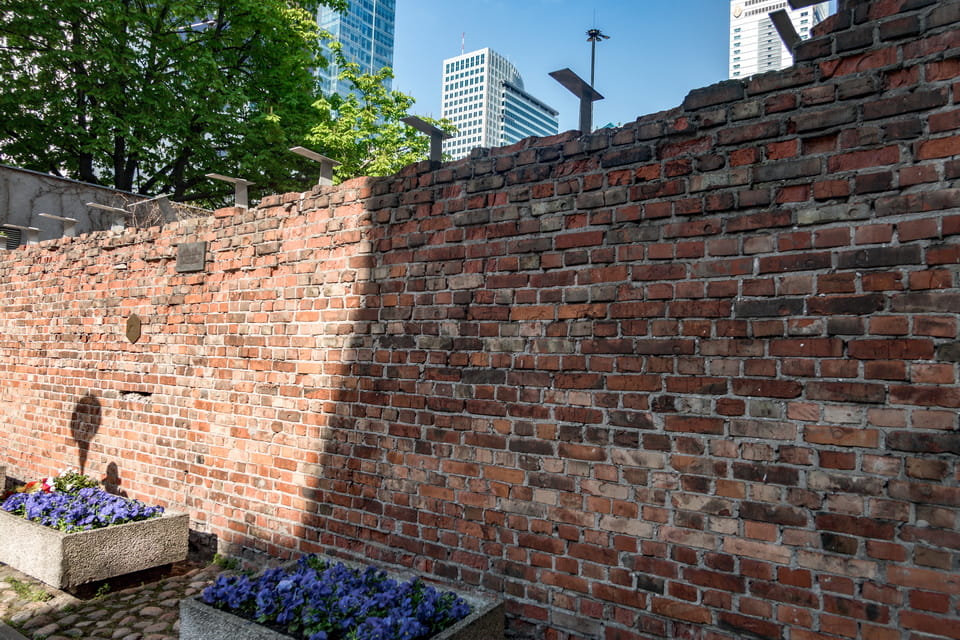
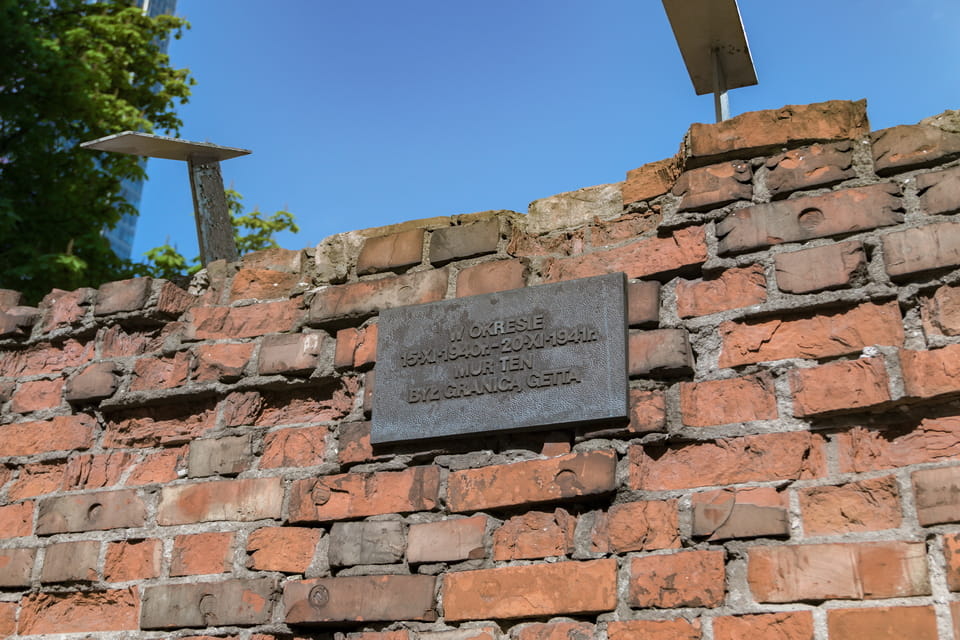
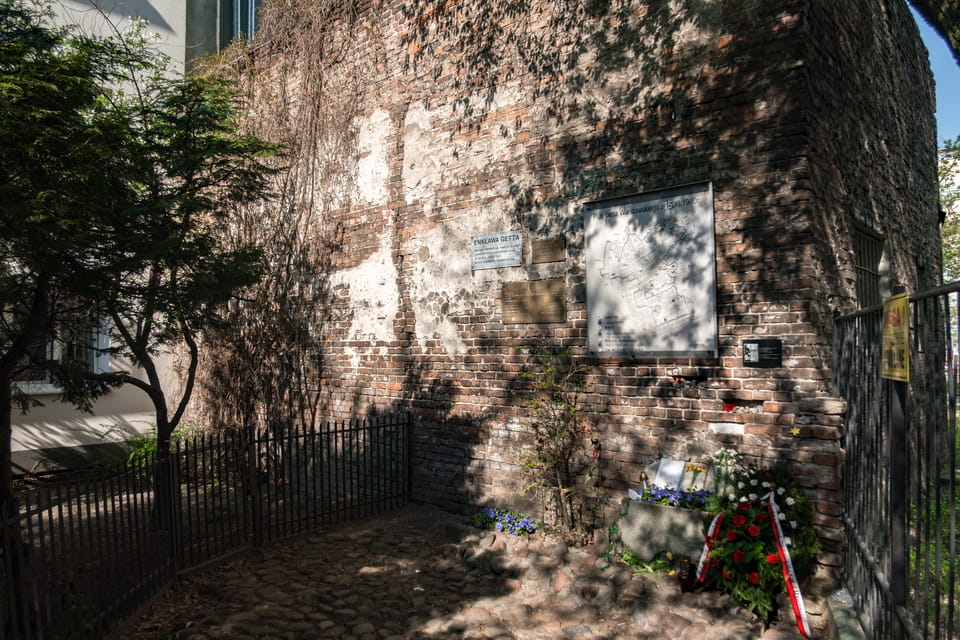
The wall. The ghetto was sealed by roughly 18 kilometres of wall, three metres high and topped with barbed wire, built in 1940 by the Jews of Warsaw at the expense of the Jewish community itself. After the war, it was pulled down along with everything else. Three fragments survive, all of them sections of pre-war buildings and courtyard walls that happened to form the boundary:
— Sienna 55 / Złota 62. The best-known fragment, in a courtyard reached from either street. The Sienna side is about three metres high; two bricks are missing from it — they were removed in 1989 and taken to the United States Holocaust Memorial Museum in Washington, which also holds a full replica of this section. Visitors leave small stones in the gaps. The Złota 62 side is a six-metre piece of a pre-war building wall with a commemorative plaque unveiled in 1992. On the «Aryan» side, in the courtyard of the XII High School, stands one of the ghetto boundary monuments, added in January 2010.
— Waliców 11. The surviving wall of the former Herman Jung brewery, a few steps from the tenement ruins at Waliców 14 described above.
— Żelazna 63. A fragment beside the former Duschik and Szolce ironworks, where one of the main gates into the small ghetto stood. Marks left by shooting are still visible on it.
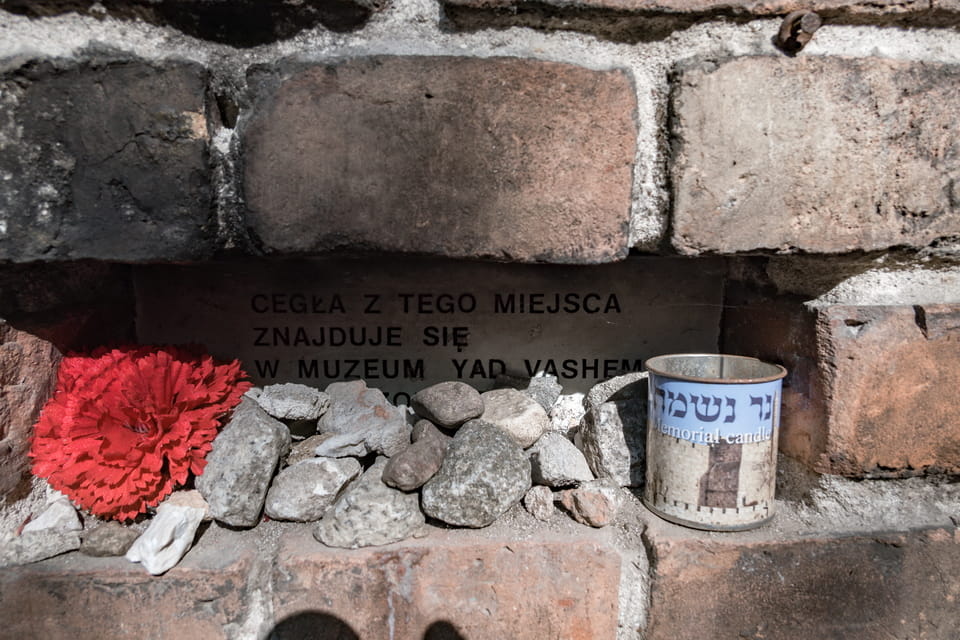
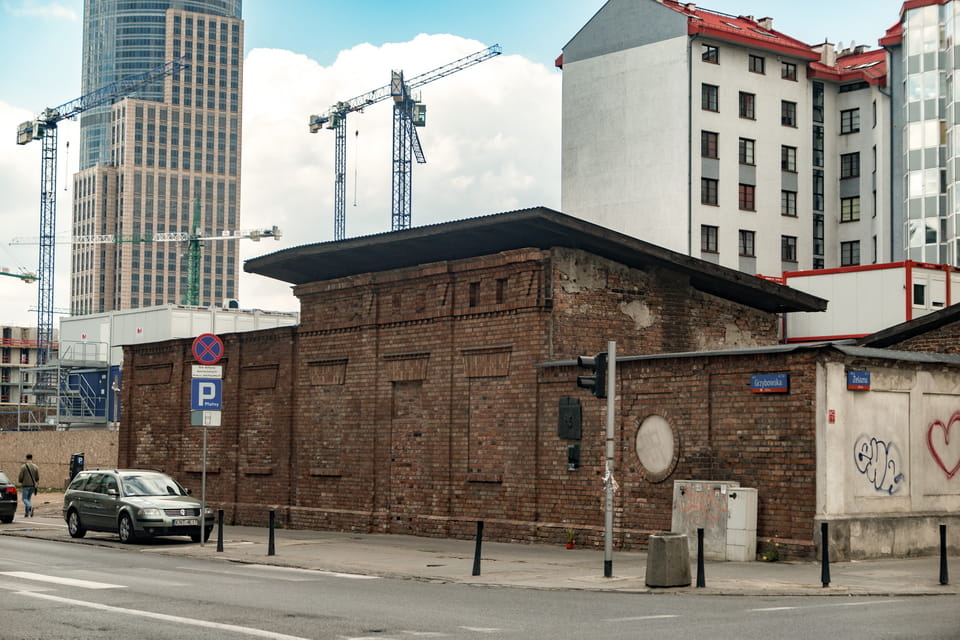
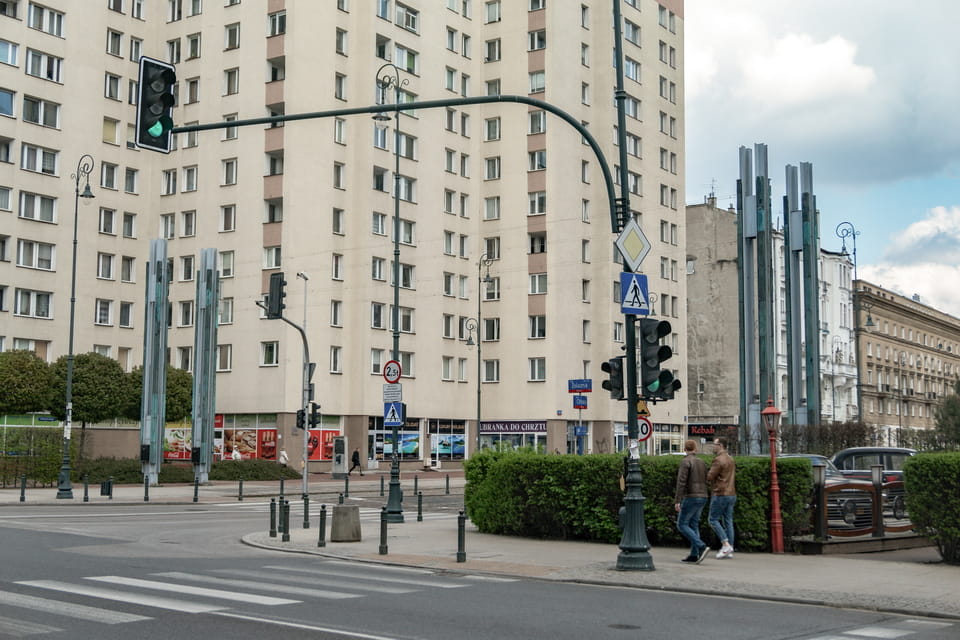
The footbridge over Chłodna. When the ghetto was sealed in November 1940, it included a narrow corridor along Żelazna linking the «large ghetto» in the north with the «small ghetto» in the south. In December 1941 the Germans excluded Chłodna Street from the ghetto — it was too important a traffic route — and cut the district in two. On 26 January 1942 a wooden footbridge was built between the tenements at Chłodna 23 and Chłodna 26, high enough for trams and German vehicles to pass beneath it, with about fifty steps on each side. It was the largest of the four footbridges in the ghetto, and the residents called it the «bridge of sighs», because from the top you could see the part of Warsaw you were no longer allowed to enter. It was demolished after the great deportation of August 1942.
The bridge became the single most recognisable image of the Warsaw ghetto: it appears in the German propaganda footage shot in May 1942, and a reconstruction of it was built for Roman Polanski’s The Pianist. Since 2011 the site at the corner of Chłodna and Żelazna has been marked by «A Footbridge of Memory» (Kładka Pamięci), an installation by Tomasz Lec: two pairs of steel poles connected by optical fibres that trace the outline of the vanished bridge in light after dark.
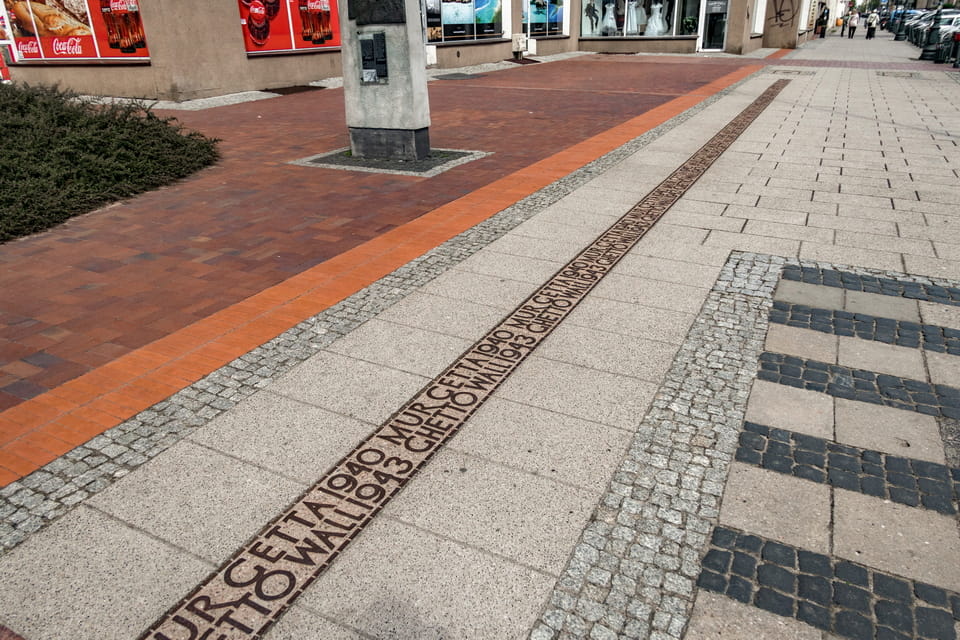
Along the pavements around Chłodna and elsewhere you will also see a double line of cast-iron markers set into the paving — the outline of the ghetto boundary, part of a set of 22 boundary monuments installed across the city in 2008 and 2010.
MAP: THE BOUNDARIES OF THE WARSAW GHETTO, 1940 AND 1942
The ghetto did not have one shape. Its boundaries were redrawn repeatedly: the district sealed on 16 November 1940 was already reduced by the summer of 1942, and after the great deportation the line of 21 September 1942 enclosed only a fraction of the original area, split into separate work enclaves. The map below shows both outlines over the modern city, together with the sites mentioned in this article — the surviving buildings, the wall fragments, the footbridge, the Umschlagplatz, and the places where nothing at all is left.
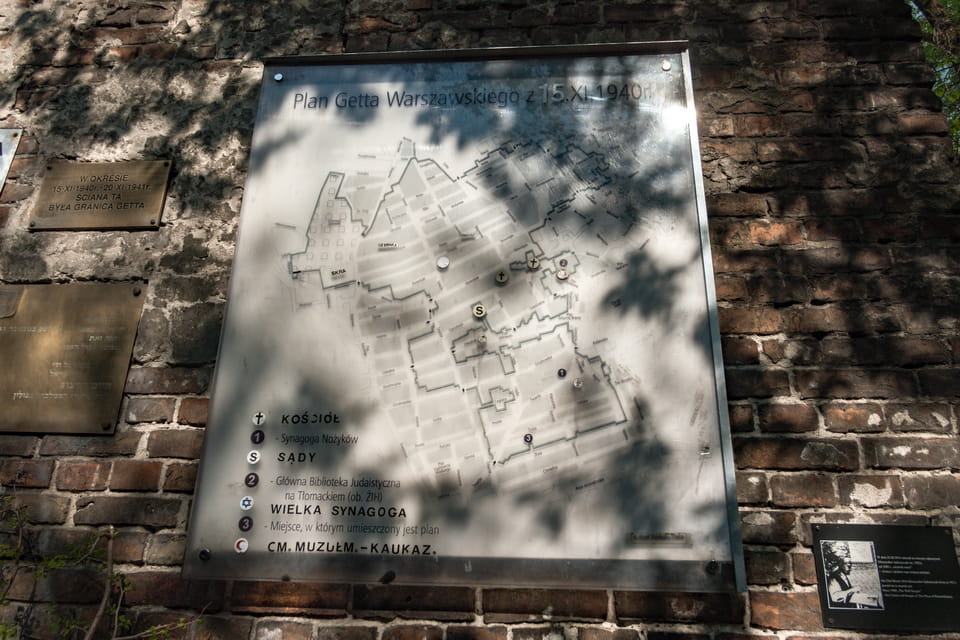
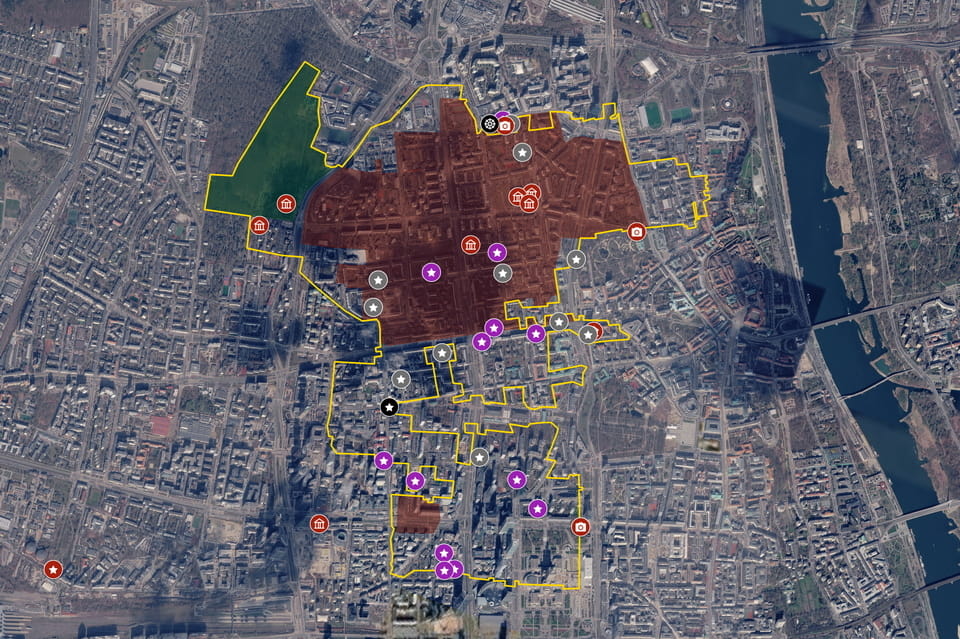
Most of what the map marks no longer exists above ground. The Judenrat building, the Great Synagogue on Tłomackie, Café Sztuka, the cellar where the Ringelblum archive was buried, the ghetto gates — all of them are addresses now, not places. That is the point of the map: it is the only way left to see the shape of the district on the ground.
FREQUENTLY ASKED QUESTIONS
Is anything of the Warsaw ghetto still there? Very little, and that is the honest answer. The district was deliberately levelled in 1943–1944, and the post-war Muranów estate was built directly on top of the rubble. What survives is a handful of buildings — St Augustine’s Church, the Nożyk Synagogue, All Saints Church, the Femina cinema building, the Waliców tenements — and three fragments of the ghetto wall.
Where can you see the Warsaw ghetto wall today? In three places: the courtyard between Sienna 55 and Złota 62, at Waliców 11, and at Żelazna 63. The Sienna fragment is the one most visitors go to; two of its bricks are in the Holocaust Memorial Museum in Washington.
Where was the Warsaw ghetto located? In the northern and western part of the city centre, in what are now the Muranów and Mirów areas, roughly between today’s Aleja Solidarności, Aleja Jana Pawła II, Stawki Street and the Jewish Cemetery on Okopowa. The boundary changed several times between 1940 and 1943 — see the map above.
Why does nothing look old in the former ghetto? Because nothing there is old. After the uprising, the Germans destroyed the district street by street and removed 22.5 million bricks from the site. The Muranów estate built in the 1950s stands on artificial ground raised by the rubble of the ghetto, in places by several metres — the earth under your feet is the district itself.
What is the footbridge on Chłodna Street? A light installation from 2011 marking the site of the wooden bridge that connected the large and small ghettos between January and August 1942 — the «bridge of sighs», the best-known image of the Warsaw ghetto and a scene in The Pianist.
Is there a Warsaw Ghetto Museum? Not yet. It is being built in the former Bersohn and Bauman Children’s Hospital at Sienna 60 / Śliska 51 and is scheduled to open in autumn 2027. Until then, the POLIN Museum of the History of Polish Jews and the Jewish Historical Institute both cover the ghetto, and the monuments along the Path of Remembrance can be walked at any time.
I am very grateful to war archives, museums, libraries, private collections, and writers for the historical photos in this article. To the extent that some author or a copyright owner may not want some of the above black-and-white photos to be used for educational purposes here, please contact me for adding credits or deleting the pictures from the article.