

Wladyslaw Szpilman in Warsaw: Every Hiding Place Then and Now
Władysław Szpilman survived the war in one city: Warsaw. Between February 1943 and January 1945, he moved through six hiding places on the «Aryan» side, all of them within a few kilometres of each other in the southern districts of the city — and five of those buildings are still standing today.
This article follows that route address by address: Noakowskiego 10, the artist’s studio where he spent his first two weeks as a free man; Puławska 83, the flat where he stayed almost six months; Narbutta 17, one desperate night in a stranger’s apartment; Fałata 2, the «Grey Houses» cooperative; Aleja Niepodległości 227/233, where he lived hidden for almost a year; and finally the ruined building at Aleja Niepodległości 223, where in November 1944 the German officer Wilm Hosenfeld found him and, instead of arresting him, kept him alive until the liberation. A bilingual memorial plaque marks that last address today.
Szpilman was the only member of his family to survive. His parents, his brother and his two sisters were deported from the Umschlagplatz to Treblinka in August 1942. Roman Polanski’s The Pianist (2002) turned his memoir into an Oscar-winning film, but the film compresses and relocates much of what happened — the real addresses are elsewhere, and I have written about the shooting locations separately.
I walked all of these places in Warsaw in 2019 and photographed them as they look now, alongside the archival images of how they looked then. What follows is not a retelling of the film. It is the real topography of one man’s survival, building by building, with real photos of every location, and it ends at his grave in the Powązki Military Cemetery.
THE SZPILMAN FAMILY AND THE UMSCHLAGPLATZ, AUGUST 1942
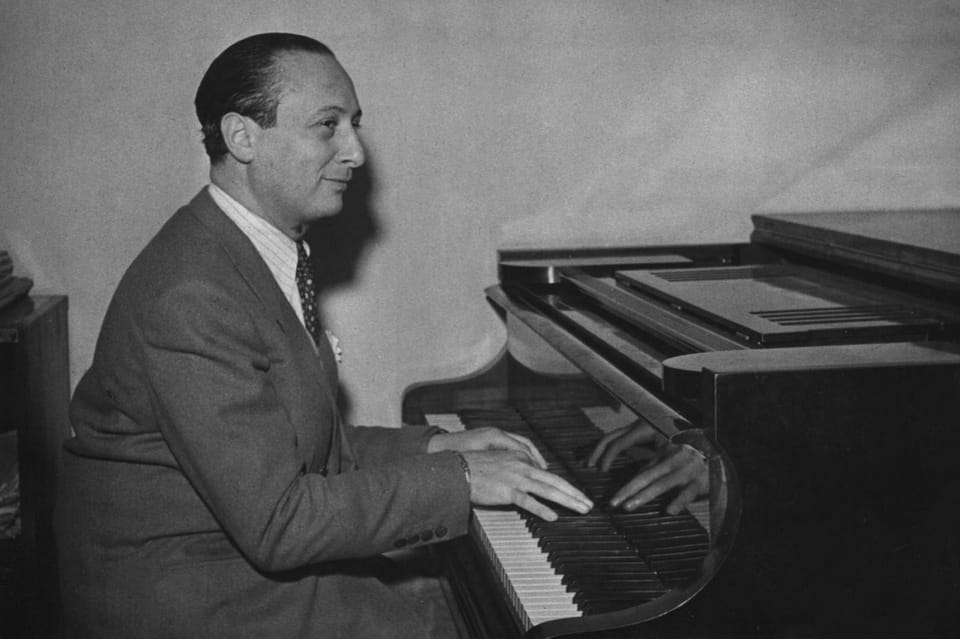
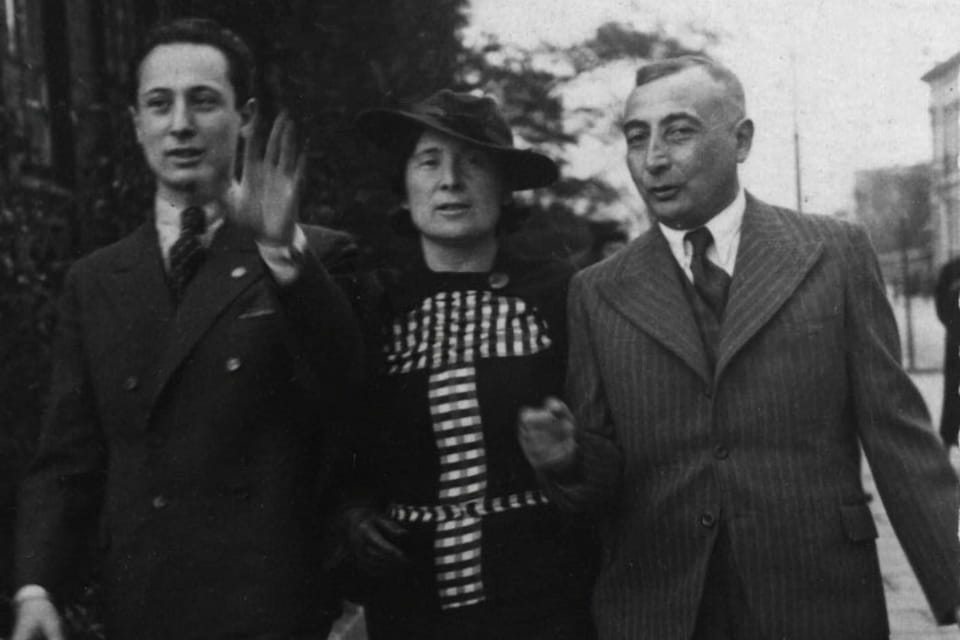
Władysław Szpilman was the eldest of four children of Samuel Szpilman, a violinist, and Estera née Rapaport (some sources give her name as Edwarda). His brother Henryk was born in 1915, his sisters Regina in 1913 and Halina in 1917. The family came from Sosnowiec and settled in Warsaw by the end of the 1930s, where Władysław had worked for Polish Radio since 1935. In 1940 all six of them were forced into the Warsaw ghetto, where he earned their living playing piano in the cafés on Nowolipki, Sienna and Leszno streets.
In the summer of 1942 the Germans began the Grossaktion — the mass deportation of the ghetto to Treblinka. Szpilman obtained work certificates for the whole family, and for a few weeks they held. In mid-August the certificates stopped working. On 16 August 1942 the Szpilmans were among the thousands driven to the Umschlagplatz on Stawki Street. Władysław was pulled out of the crowd at the last moment by a Jewish policeman who recognised him. His parents, his brother and both his sisters boarded the train. None of them survived. He never saw any of them again, and no grave exists for any of them.
Eleven days earlier, on about 5 August, Szpilman had watched another column leave the ghetto along Gęsia Street: Janusz Korczak walking to the same Umschlagplatz with the children of his orphanage. His description of that morning became one of the most quoted passages in his memoir.
For the next six months Szpilman survived inside the ghetto as a forced labourer, dismantling the ghetto walls. On 13 February 1943 he walked out to the «Aryan» side — and that is where this route begins. Being caught on the ‘Aryan’ side generally meant one of two destinations: a transport east, or Pawiak prison on Dzielna Street, where the German security police held and shot Poles and Jews throughout the occupation.
HIDING PLACE 1: NOAKOWSKIEGO 10, 13–27 FEBRUARY 1943
As far back in history as February 13, 1943, Wladyslaw Szpilman disregarded the vital necessity to put a yellow-star armband on his shoulder for the first time since December 1939 to his own surprise and fear. It hardly needs comment that by no means was the shabby laborer, previously forced to dismantle the walls of the Warsaw ghetto, building up the SS quarters and a villa for the SS and Police Leader of Warsaw, now to be recognized as a brilliant pianist. Following the dangerous walking across the streets of South Warsaw, Szpilman finally found his way to the first among his upcoming hiding places as a now free, yet sheltered Polish Jew, bordering on being hunted by the Germans.
‘Politechnika Warszawska’ (Warsaw University of Technology), an educational institution that had been opened again (renamed) within the last months of the previous (1942) year, now dominated the street across Noakowskiego 10, a residential house and a point of destination for an exhausted escapee. As far back as the threshold of the XIX and XX centuries, the area to the North of Polna Street was in the ownership of a wealthy Jewish family of Oppenheim, whose patriarch divided the terrain into land parcels for a residential quarter as late as 1905. New-built dwelling houses mounted the area before the outbreak of the Great War (WWI), including a residential house at Noakowskiego 10, ready to welcome his guests in 1913.

A dwelling-house with one address was by nature no less than a complex of erections, built around three spacious courtyards. The ‘main’ part of the building facing Noakowskiego Street, perfected in the manner of Art Nouveau (Modern), was to accommodate the most luxurious apartments, including the ones of the owners. The living space of every deluxe accommodation totaled 130 square meters with a ceiling height of 4 meters and included up to six rooms and premises for servants. Apart from the ‘boss’ apartment of the Oppenheim family and deluxe residences, this new dwelling-house at Noakowskiego 10 was home to dozens of middle-class families with apartments of more moderate size. One of the three courtyards was chosen to locate a small chapel.

Wladyslaw Szpilman was now very much indebted to his first hiding place within the ‘Aryan’ part of Warsaw to his friend Andrzej Bogucki and his wife, a singer Janina Godlewska. The spacious studio apartment was in the ownership of Piotr Perkowski (who survived the war), the famous Polish composer, director of a conservatory, and a member of the Resistance movement. Franciszek Strynkiewicz (who survived the war), a sculptor, was the previous roomer of the flat and had transformed it into no less than an artistic workshop. In contrast to the bed of boards for the forced laborers, Szpilman was now in a position to enjoy uninterrupted sleep, yet he tortured himself with constant anxiety. The owner of the apartment was due to find registered residents for the living space, and the refugee pianist had to hide inside a small bedroom without windows upon their encounters. As early as February 26, 1943, Wladyslaw Szpilman was accommodated in a flat of Marek Gębczyński, an engineer at the Polish radio, at the wing studio of the same dwelling. It was in this apartment that the former pianist had an opportunity to touch the piano keys for the first time since the liquidation of the Warsaw ghetto back in the summer of 1942. The next day witnessed a visit from Czesław Lewicki, a band director on the radio, who now agreed to accommodate the escapee within his unused one-room apartment.
All three of the people who organised Szpilman’s escape and his first shelters — Andrzej Bogucki, his wife the singer Janina Godlewska, and the radio director Czesław Lewicki, whose empty flat on Puławska hid him for six months — were recognised as Righteous Among the Nations by Yad Vashem in 1978. Szpilman himself was also helped, at several points along this route, by the Polish underground organisation Żegota, the Council to Aid Jews.

The residential house on Noakowskiego 10, a two-week serene haven for Wladyslaw Szpilman in February 1943, survived the war and occupation as well as its most famous refugee. After the end of the Second World War, the dwelling was destined to be nationalized and turned into a kind of sadly remembered residential commune. The former deluxe apartments were now divided into small dwellings with areas of common use such as toilets and kitchens. The form of shared accommodations was a kind of solution for the loss of a major part of the pre-war housing in Warsaw. Along with that, the communes were to reflect the residential politics of the Communist world, which deprived people of the right to private life. As soon as July 1, 1965, the former residential house of the Oppenheim family was put into the register of heritage-listed buildings.


HIDING PLACE 2: PUŁAWSKA 83, FEBRUARY–AUGUST 1943
Afterward, the first two weeks as a free (yet escapee) man, Wladyslaw Szpilman was now to trust in a former associate from the Polish radio and to reach a new hiding place at Puławska 83, two and a half kilometers away. The two men made their way to ‘Plac Unii’ square and made use of the services of a rickshaw. Regardless of the late hours, the streets of the occupied Warsaw were a dangerous place, especially for a refugee Jew. The dwelling with the number 83, their destination point, was on Pulawska Street, the second-longest transport artery of the Polish capital at that time. Its history goes back as far as the 1820s, when a Warsaw street was destined to become a part of the road to the South to the city of Pulawy. Almost a century would pass (1917) until the street within Southern Warsaw would be named after a city located 120 kilometers away in Lublin Province. As the Germans came into instant occupational power, Pulawska Street was renamed ‘Feldherrnallee’ (The avenue of the commanders). In wider terms, Wladyslaw Szpilman was now to hide inside a building on one of the largest streets in Warsaw, with the nomination to glory the power of the German armed forces.
In those late hours of February 27, 1943, the lobby of the dwelling-house was empty (even without a caretaker), and the two men (Szpilman and Lewicki) ran up the fifth floor to get into an empty apartment. Accommodation of a moderate size turned out to be cozy and inviting, with a big sofa, a commodious wardrobe, a couple of back chairs, a bookshelf, and a gas stove. The residential house was erected as far back as the 1930s on the spot of the previous one-story erection and a wooden gate, once an entrance to a courtyard plot of ground. The north part of the front side of the new building was inscribed with ‘WSK’ letters (preserved until today, thus underlining the initials of Władysław Kamiński, the owner of the estate. A member of the pre-war Polish Senate (parliament), he would later lose his life in the Battle of Monte-Cassino in Italy in 1944 at the rank of Lieutenant Colonel. ‘Instytut Higieny Psychicznej’ (Institute of Mental Hygiene, survived the war) was a neighboring estate to the residential erection on Pulawska.

In the grand scheme of things, Wladyslaw Szpilman was fated to spend almost half a year in a cozy apartment at Pulawska. Czesław Lewicki, the owner of the flat, was a constant visitor; if nothing else happened, two times a week, from time to time being accompanied by a friend, the wife of the Warsaw doctor. Szpilman used to take advantage of their conversations as well as reading, cooking the simplest dishes, and moving across the studio on the tips. The dwelling had thin walls, and the refugee was now to hear the bad-mouthings of a young neighboring couple next door. As early as April 1943, his caregivers brought news of the ‘Jewish uprising’ within the walls of the former Warsaw ghetto, and Szpilman had a chance to notice glimpses of a blaze far to the North while leaning out of the window. The well-known scene from the iconic ‘The Pianist’ movie by Roman Polanski shortened the distance from a few kilometers to no more than a hundred meters for the cinematic version of Szpilman (Adrien Brody) to watch the uprising first-hand.

As June 1943 came, Czesław Lewicki brought the bad news and appealed to a refugee to leave the apartment as soon as possible, yet Szpilman refused at that moment. In the upcoming weeks, the surviving routine at Pulawska 83 turned into a constant nightmare as the Germans conducted several raids and round-ups within the area, including this very residential building. In virtue of the raids, Czesław Lewicki was in no position to visit his person under care with supplies and news. Stricken by famine, Szpilman mustered the courage to go outside to buy bread nearby. This one loaf of bread, the remains of cereals, and beans were now the means of survival that was to be elongated for the next ten days. Once close to the edge of life, Szpilman was finally visited by Marek Gębczyński, a man who had sheltered him back in February. Both men now relied on another individual, who would indeed hide money collected for the resistance and Szpilman. In the issue, the refugee Szpilman was saved (either from yellow fever or starvation) by the wife of Doctor Malczewski, one of the caregivers in the past. As late as August 12, 1943, the rapping on the door necessitated Wladyslaw to pack one’s belongings and face the aggressive female neighbors, who tried to entrap the outlaw without a registration. Szpilman had no way except to leave this hiding place once and for all.

In dramatic contrast with almost every erection nearby, the dwelling house at Pulawska 83 survived the German occupation. The Mokotów district in Southern Warsaw maintained the status of a desirable place for living and was later subjected to a few waves of reconstruction and expansion, as well as the repair works of the previously semi-demolished buildings. As early as the 1970s, Pulawska Street was built just in front of the former hiding place of Wladyslaw Szpilman. As to the residential house itself, the total living space of 2300 square meters still accommodates the lodgings, and the first floor is being used for commercial purposes. The pre-war ‘WSK’ initials could still be easily noticed within the northern part of the front side, and the year 2017 witnessed the reconstruction of the attic space.
HIDING PLACE 3: NARBUTTA 17, THE BOŁDOK FAMILY, AUGUST 1943
On August 12, 1943, Wladyslaw escaped the fate of being entrapped and delegated to the Germans, yet found himself beyond his six-month refuge and now in the middle of a Warsawian street. He had dirty, tumbled cloth on and unbarbered hair, and multi-day scrub only underlined his ‘non-Aryan’ appearance. Along with that, his hunted and frustrated behavior did not have much in common with a pedestrian who has registration. A way back to Noakowskiego street was now too dangerous, and Szpilman recalled another colleague from the Polish radio, an engineer named Boldok. The shortest pedestrian route from Pulawska 83 and Narbutta 17 demanded 10 minutes of walking at the most, yet the disoriented escapee spent nearly an hour getting to the place. Scrambling between the desire to live and averseness to put these people in mortal danger (for hiding Jews), Szpilman finally rang the doorbell of the Boldok family with the pretext of using their phones. The calls had no effect, and the escapee could be sheltered no sooner than the next day. The Boldok family let Szpilman spend a night in an apartment one floor down, as they were previously left with keys from the Volksdeutsche.

The Mokotow city district, previously well-known to Szpilman by his own account, was made a part of Warsaw as far back as April 8, 1916. At the time of the merger (absorption by Warsaw), the area was characterized mostly as the former farm grounds with one-story erections. As far back as 1897, Georg von Narbut purchased a spacious plot of land in the city of Mokotow, and the street that would be named after him had become a transport artery of the area. Heedless of the fact that Mokotow was absorbed by Warsaw at the height of the Great War (1916), for years to come its streets were regarded as private cooperative ownership. As soon as 1928, the city officials decided to rename the street to NARBUTTA (thus, adding ‘T’) to shift the name of the former landlord into a Polish revolutionary Ludwik Narbutt, who had died back in 1863. It is worth mentioning that a street lamp with the authentic ‘Narbuta’ (with one ‘T’) inscription could still be found between buildings 9 and 10.
All while Narbutta Street was appreciated as a wished place of residence among the citizens of Warsaw, dwelling-house number 17 had always been a deluxe point of living in the years before the Second World War. The five-story residential house was laid out by a local female landowner and later finished by the members of the ‘CONCORDIA’ household cooperative in 1930. The presence of white collars during the consecration of the building was not out of the ordinary, as the major part of the 24 apartments were now in the ownership of the officials of two banks: ‘The Polish Bank’ and ‘Bank Gospodarstwa Krajowego’. The owners had a right to take part in the interior decor and furnishing of the flats with living space of up to 200 square meters. The kitchens were equipped with a garbage disposer, an indeed innovation of the period, and the total value of the lodgings was equal to an amount of money, enough to build a villa with its garden.

The dramatic history of the building at Narbutta 17 during the occupation turned over the first tragic pages long before the one-night sheltering of Wladyslaw Szpilman. As far back as the winter of 1939-1940, the Germans had plans to expel every resident of the house, not fulfilled by the virtue of one of the owners, who had cracked the heating system and thus ‘put a wet blanket’ on the ambitions of the occupational authorities. In the long run, only a few longings were emptied in favor of Volksdeutsche, one of whom Szpilman spent one night in August 1943. For several years during the occupation, the residents of the ‘CONCORDIA’ cooperative put themselves in the position of outlaws by hiding people without registration, producing soup, and even running underground printing. Unfortunately, at least nine of the former owners lost their lives in concentration and labor camps, and three were killed during the 1944 Warsaw Uprising. In 2004, the names of these twelve people were finally immortalized on the front side.
On August 17, 1944, in the midst of the Warsaw Uprising, the Germans forcibly dislodged the remaining residents of the ‘Concordia’ house and set the building at Narbutta 17 alight. While the majority of the apartments burned away, the massive architecture dissuaded the erection from collapsing, and the residential harbor of the pre-war cooperative held the fire up. It will take decades for the surviving owners and their descendants to restore ownership over their lodgings after nationalization and later accommodate troubled residents. The former spacious apartments were cut to dozens of small lodgings each, and it will take decades to turn back the tide. In our generation, some descendants of the ‘authentic’ owners of the pre-war apartments still live under the roof of Narbutta 17. As the Mokotów district was fortunate enough to be broadly preserved amid the devastated Warsaw city center, the area around one of Wladyslaw Szpilman’s hiding places could be easily recognized.

HIDING PLACE 4: FAŁATA 2, THE ‘GREY HOUSES’, AUGUST 1943
Upon a heart-pounding night at the accommodation of Volksdeutsche at Narbutta 17, Szpilman had nothing else to do but to wait for salvation from another former colleague from the Polish radio, Zbigniew Jaworski (who was killed in 1944), the specialist of radio auditions. The man took the mortal risk to shelter the escapee pianist for some time until finding a more continuous hiding place. The two covered one kilometer to the West across Narbutta, on the sidelines of the infamous Mokotów prison, and swerved to Juliana Falata street, once named after a prominent Polish artist and aquarellist, famous for his wintry landscapes and rural scenes. At Fałata 2, just across the street from the ‘Wyzsza Szkola Budowy Maszyn I Elektrotechniki’ (College of Mechanical Engineering and Electrical Engineering), they reached the grandiose residential complex, a new shelter for Wladyslaw Szpilman.


The Falata street, used to connect the neighboring Narbutta and Rakowiecka, was a home for two pre-war housing cooperatives, known as ‘Spółdzielni różowej’ (The pink cooperative) and ‘Szare Domy’ (The Grey houses). The second one at Falata 2 was erected as far back as 1928-1932 under the patronage of the Ministry of Interior Affairs, once stretching along Falata with two rows of buildings and an extensive courtyard. ‘The grey houses’ nomination could be attributed to the color of the front sides, covered with concrete (a typical approach in construction at the times of pre-war Warsaw. Szpilman was granted shower time and alcohol (he suffered liver pain afterward). The hosts reasoned that Wladyslaw should stay on here, yet he didn’t want to abuse the hostility and bring danger to the house (by his presence). Within an inch from despair, Szpilman got another good deal of luck in the person of Helena Lewicka, a young daughter-in-law of the current hosts, who challenged herself to shelter the pianist within an empty flat nearby. The Falata 2 residential complex survived the war undamaged and was expanded in the 1990s. The entrance to the building now gives notice of a plate with the name of an architect, Jan Stefanowicz.


HIDING PLACE 5: ALEJA NIEPODLEGŁOŚCI 227/233, AUGUST 1943 – AUGUST 1944
As soon as August 21, 1943, Wladyslaw Szpilman had to change his hiding area for the last time over the next one and a half years, limited to three buildings, in front of each other, at Aleja Niepodległości (Avenue of Independence). The avenue, 5 kilometers in length, was put on the city plan of Warsaw as far back as the 1930s as Włodarzewska at that time. Helena Lewicka, a woman who took Szpilman’s story to heart, accommodated the escapee in her flat at Aleja Niepodległości 227/233. The dwelling-house was put in use in 1929, and the area was now characterized as the heart of the ‘German’ Warsaw, a notion which had been adopted back in 1939 with the seizure of Warsaw.

Water Filter Station (rebuilt after the war) to the West used to supply Warsaw with drinking water since the 1880s. The whole military quarter, ‘WOJSKOWA SZKOŁA INŻYNIERII’ (Military School of Engineering, most of the erections survived the war), was just across the street to the North and included dwellings, educational buildings, and offices. ‘POLITECHNIKA WARSZAWSKA’ (Warsaw University of Technology, next to Szpilman’s first shelter at Noakowskiego 10) was visible across the street in the northeast direction. In wider geographic terms, after half a year of hiding in the southern part of Warsaw, the refugee pianist completed a kind of circle.

Wladyslaw Szpilman was fated to spend almost a year in a row in a spacious room on the fourth floor of the tenement house at Aleja Niepodległości 227/233. He had a survival minimum in his possession, including a gas stove and electricity, yet without a water tap inside the premises, which forced the refugee to conduct short outings to the hall. The window faced Aleja Niepodległości and the unfinished building of ‘SZPITAL OKRĘGOWY IM. MARSZAŁKA JÓZEFA PIŁSUDSKIEGO’ (District Hospital named after Josef Pilsudski) across the avenue. In great contrast to the aggressive population at Pulawska 83, the new neighbors were mostly from the intelligentsia, including the members of the Resistance movement, who were rarely at home. The long days and months of 1943-1944 used to come and go, and Wladyslaw was now fully indebted to a host, who used to visit the flat once a week with news and basic supplies. The other day, she took a doctor, who diagnosed Szpilman with cystitis. The secret roomer was now on a diet and used to spend his time reading and learning English.


Helena Lewicka had become Szpilman’s window to the world, with the news of the Fall of Mussolini (Summer 1943) and later on the opening of the second front in Europe (June 1944). More than that, as early as July 1944, the sheltered pianist used to have the sense of hearing the distant roars of the Soviet advance to the East of Warsaw. The Germans launched, leaving their permanent places, lofty perch since 1939, and the gigantic building of the hospital across the street was now also abandoned. On August 1, on the very first day of the Warsaw Uprising, Helena Lewicka persuaded Szpilman to leave the place, yet he once again refused and would spend the next two weeks in breathless expectation. During the days of August, Aleja Niepodległości witnessed the dramatic scenes as the surrounding area was steadily put on fire, block after block. Finally, Wladyslaw had no other option than to leave his hiding place after the Germans dispossessed all the residents and set the lower floors on fire. Once frightened by the prospect of being caught or burned alive, Szpilman took a handful of sleeping pills, which failed to kill him, and he finally left the building. After two weeks of hiding within an abandoned hospital building, the refugee would once again accommodate Aleja Niepodległości 227/233 as soon as August 30, 1944. Szpilman would spend another three months hiding inside some abandoned apartment and later the attic.

HIDING IN THE ABANDONED HOSPITAL: ALEJA NIEPODLEGŁOŚCI 218, AUGUST 1944
Anxiety by fear of being burned alive inside the lodging, Wladyslaw Szpilman made a desperate decision to cross Aleja Niepodległości Avenue and find shelter inside a gigantic erection of the unfinished hospital, which now seemed to be abandoned by the Germans. On his way across the road, the refugee would have to play dead (another memorable scene from the ‘Pianist’ movie) next to the bodies of people who had been lying there for days. Wladyslaw would spend another two days without water and food, hiding in the garbage at the far end of the complex. Once succeeded in avoiding the Germans (who were seeking the valuables), he managed to find dirty water and a handful of orzo, a transient means to sustain living until the decision to come back to Aleja Niepodległości 227/233 across the road.

The giant-like complex of the military hospital was put into construction as far back as 1936 with the ambition to erect one of the largest institutions of that kind in Poland. The construction agenda implicated the erection of a large medical center to replace the overcrowded or closed hospitals in the area. The architects chode a spacious spot of land, sandwiched between Aleja Niepodległości to the West, Nowowiejska to the North, Filtrowa to the South, and Topolowa (modern Lekarska) to the East. The new complex was conventionally divided into four Gargantua wings with a monument to Marshal Pilsudski at the main entrance, the namesake of the place. The building was damaged and partially devastated (mostly from fires) during the Warsaw Uprising, yet stood up to the end of the war and was later repaired, among others, by the hands of the German prisoners of war.


HIDING PLACE 6: ALEJA NIEPODLEGŁOŚCI 223 — WHERE WILM HOSENFELD FOUND SZPILMAN
As soon as November 1944, Szpilman was impelled to leave the residential house, his hiding place, and home for the last fifteen months (with one August interval of absence). Across the narrow Sedziowska street, next to a dwelling-house, he now could observe dozens of abandoned or burned-out cottages within the ‘Staszic Colony’ area, once named after Stanisław Staszic, a Polish scientist, philosopher, and public figure of the early XIX century. Back in August (already in the height of the Uprising), the pianist was frustrated with the residents of one of the cottages, who were spending their measured time as if nothing had ever happened. Now that balcony was as empty and obscure as the others. After sizing these abandoned cottages, Szpilman decided to find a lodgement inside another large residential house, located just steps from his last shelter, on the opposite corner of Aleja Niepodległości to the South. The experienced refugee set up a new home in the attic premises, which was a little warmer in contrast to the previous attic. The central part of the building was set afire during the Uprising soon after the residents were forcibly evacuated, and some of them were even killed.


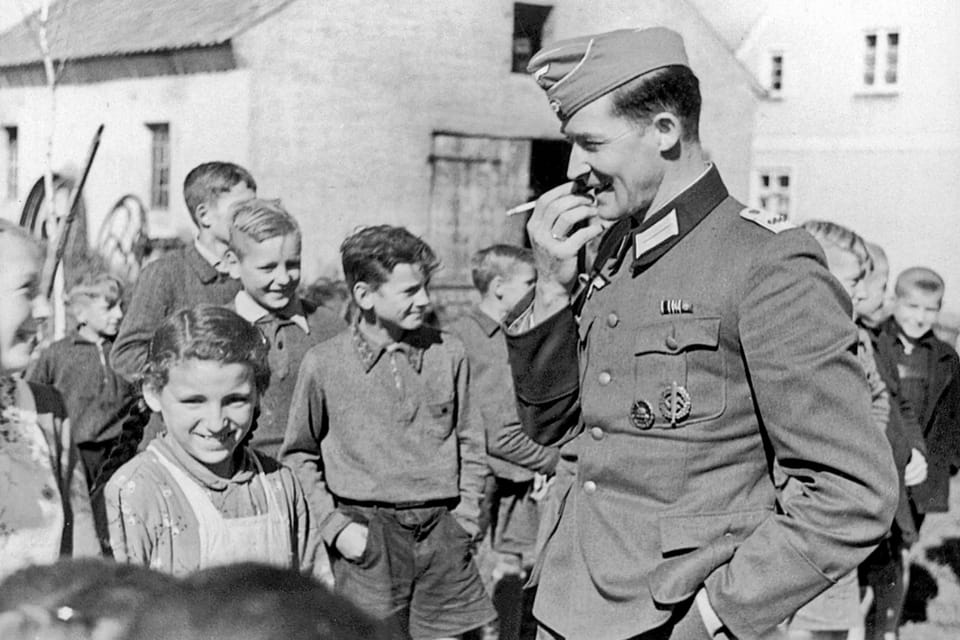
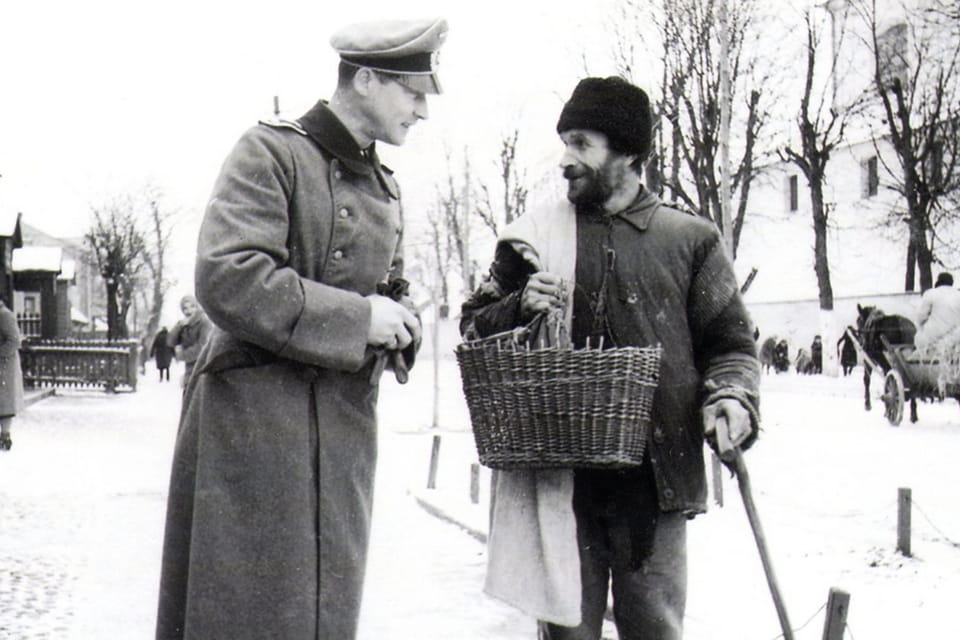
It was this very Aleja Niepodległości 217-225 building that witnessed the well-known fated encounter between Wladyslaw Szpilman and Wilhelm Hosenfeld. Inside a four-story residential house, the remaining wing of which was now accommodated by a German headquarters. The refugee could hear the measured walking of the watch guards around the building and notice the German soldiers, performing their routine without knowing the former Polish pianist above their heads. On December 12, 1944, the two (Szpilman and Hosenfeld) encountered each other for the last time, and the refugee had to spend the next weeks in a wide-open waiting for the liberation of Warsaw. As soon as January 17, 1945, more than five years after the outbreak of the war, the survival within fear and hardships, Wladyslaw Szpilman, was finally free and was granted a chance to take a shower inside the Soviet barracks.
In the post-war years, the middle part of the building was restored, and the year 2011 witnessed a commemoration of a plaque next to the Aleja Niepodległości 223. The building is a long one and covers street numbers from 217 to 225, but the address that matters is Aleja Niepodległości 223: that is the entrance beside which the memorial plaque was unveiled on 4 December 2011, and it is the address by which this place is known today. The plaque, in Polish and English, records the names of Władysław Szpilman and Wilm Hosenfeld and the meeting between them, and also notes the three Academy Awards won by Roman Polanski’s film. The unveiling was attended by Szpilman’s widow Halina, his son Andrzej, and Hosenfeld’s daughter Jorinde Hosenfeld-Krejci.


What happened to Wilhelm Hosenfeld? In January 1945, he was taken prisoner by the Red Army. On 7 May 1950, a Soviet military tribunal in Minsk sentenced him to twenty-five years. Szpilman learned his rescuer’s name only that same year, from another man Hosenfeld had saved, and went to Jakub Berman — then the most powerful man in the Polish security apparatus — to ask for help. Berman came to his flat a few days later and told him there was nothing to be done: the Soviets believed the officer had served in intelligence and would not release him. Wilm Hosenfeld died in Soviet captivity on 13 August 1952, in a prison hospital near Stalingrad, at the age of fifty-seven.
Szpilman applied to Yad Vashem on his behalf in 1998, two years before his own death. The case took a decade to verify. On 25 November 2008, Wilhelm Hosenfeld was posthumously recognised as Righteous Among the Nations, and in June 2009 Israeli diplomats presented the award to his son Detlev in Berlin. A year earlier, in October 2007, Polish President Lech Kaczyński had posthumously awarded him the Commander’s Cross of the Order of Polonia Restituta.
The two men met for the last time in December 1944. They never saw each other again.
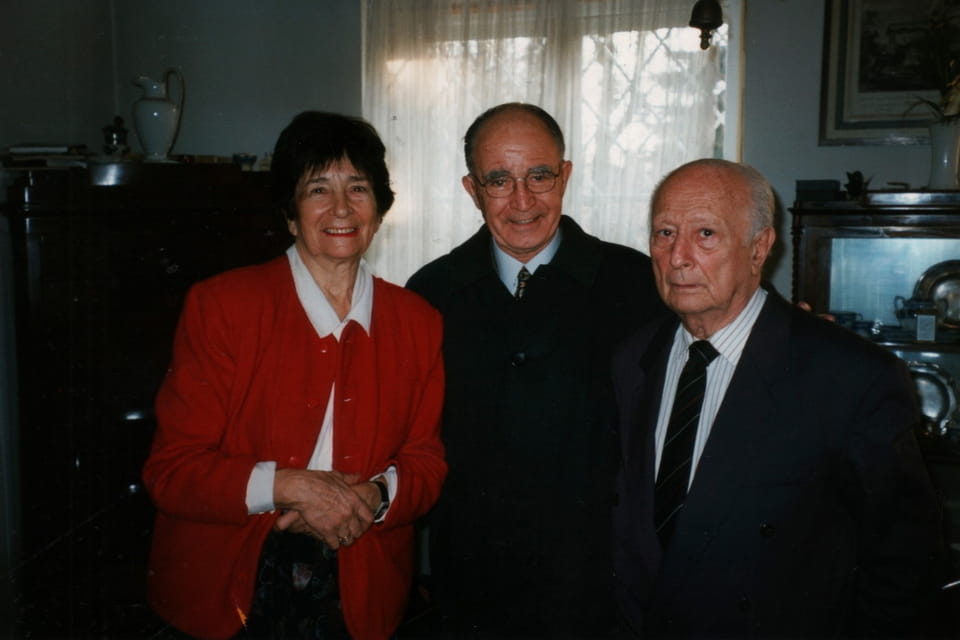
THE GRAVE OF WŁADYSŁAW SZPILMAN: POWĄZKI MILITARY CEMETERY, SECTION A3
Władysław Szpilman was happy enough to live an eventful and joyful life after the end of the Second World War. He shared the world with his wife Halina and two sons and passed away in the year of the golden (50-year) anniversary of their marriage. The famous Polish composer and Holocaust survivor left this life on July 6, 2000, in the same city of Warsaw, where he had lived and survived the hardships of war. Szpilman was buried at ‘Powązki Military Cemetery‘ in the northwest of the city center, in the presence of his family, friends, colleagues, and the Polish president Aleksander Kwaśniewski. The grave of Szpilman is easy to find not far from the entrance of Powązkowska Street, within the A3 sector.


Initially, Cmentarz Wojskowy was not a final resting place for the Polish soldiers. Inaugurated back in 1912, the cemetery served as a burial place for the Russian soldiers, who had been quartered in Warsaw. At the height of the First World War, the Germans turned an empty plot to the North into a huge war cemetery for those who had lost their lives on the Eastern Front, with an amount totaling 20,000 graves. During the interwar period, the cemetery was expanded, and as soon as the Autumn of 1939, thousands of Polish soldiers and civilians were buried there. During the years of occupation, the Germans once again used the place to bury their soldiers, and the post-war period witnessed the burials of the victims of the Warsaw uprising.


WALKING SZPILMAN’S WARSAW TODAY: THE ROUTE, THE PLAQUE AND THE GRAVE
All six hiding places lie within about three kilometres of one another, in Mokotów and around the Warsaw University of Technology. Readers of this article have walked the whole route in a single day; here it is in order, with what you will actually find.
— Noakowskiego 10 — the Art Nouveau tenement of the Oppenheim family, listed as a heritage building since 1965. Private housing; the courtyards are visible from the street.
— Puławska 83 — still a residential block with shops on the ground floor. The pre-war «WSK» initials of the owner are still on the northern part of the facade — the easiest detail to find on the whole route.
— Narbutta 17 — the «Concordia» cooperative house. On the facade is a plaque with the names of twelve residents who were killed in the camps and in the 1944 Uprising, placed in 2004.
— Fałata 2 — the «Szare Domy» (Grey Houses) cooperative, undamaged by the war. A plaque commemorates the architect Jan Stefanowicz.
— Aleja Niepodległości 227/233 — where Szpilman lived hidden for almost a year. The courtyard is worth entering.
— Aleja Niepodległości 223 — the last hiding place, and the reason most visitors come. A bilingual memorial plaque in Polish and English, unveiled on 4 December 2011, marks the spot where Hosenfeld found Szpilman. It was unveiled in the presence of Szpilman’s widow Halina, his son Andrzej, and Hosenfeld’s daughter Jorinde. Directly across the avenue stands the huge former military hospital at number 218, where Szpilman hid for two days in August 1944.
— The grave — Powązki Military Cemetery (Cmentarz Wojskowy na Powązkach), section A3, a short walk from the Powązkowska Street entrance. Note that this is the military Powązki, not the older and better-known Powązki Cemetery next to it.
Two related places are worth adding if you have time: the Umschlagplatz monument on Stawki Street, where his family was put on the train, and Studio 1 of Polish Radio, named after Szpilman in September 2011. One more address belongs to the same story from a different angle. Across the Vistula, the villa of the Warsaw Zoo sheltered several hundred people through the same years, and it too is now a museum you can visit.
Frequently asked questions
In which city did Szpilman hide? Warsaw — he never left it. Between February 1943 and January 1945, he moved between six hiding places, all of them in the southern part of the city, within roughly three kilometres of each other.
What happened to Władysław Szpilman’s family? His parents Samuel and Estera, his brother Henryk and his sisters Regina and Halina were deported from the Warsaw ghetto to the Treblinka extermination camp in August 1942 and murdered there. Władysław was the only one of the six to survive: he was pulled out of the crowd at the Umschlagplatz by a Jewish policeman minutes before the train was loaded.
Was Halina Szpilman his sister or his wife? Both names are real, and they belong to two different people. Halina Szpilman (born 1917) was his younger sister, murdered at Treblinka in 1942. Halina Szpilman née Grzecznarowska was his wife: they married in 1950 and were together for fifty years, until his death.
Did Szpilman and Hosenfeld ever meet again? No. Their last meeting was in December 1944. Hosenfeld was captured by the Soviets a month later and died in captivity in 1952; Szpilman learned his name only in 1950 and was unable to help him. Hosenfeld was recognised as Righteous Among the Nations in 2008, after Szpilman’s own death.
Can you visit Szpilman’s hiding places? Five of the six buildings still stand and can be seen from the street; all are private housing, so there is nothing to enter. The memorial plaque at Aleja Niepodległości 223 is on the facade and freely accessible. His grave is in the Powązki Military Cemetery, section A3.
Is the film accurate about the locations? Not literally. The Pianist was shot largely in Praga and on a purpose-built set, and several scenes compress distances — the window from which Szpilman watched the ghetto uprising was kilometres away, not a hundred metres. The real addresses are the ones listed here; I have written about the film’s shooting locations separately.
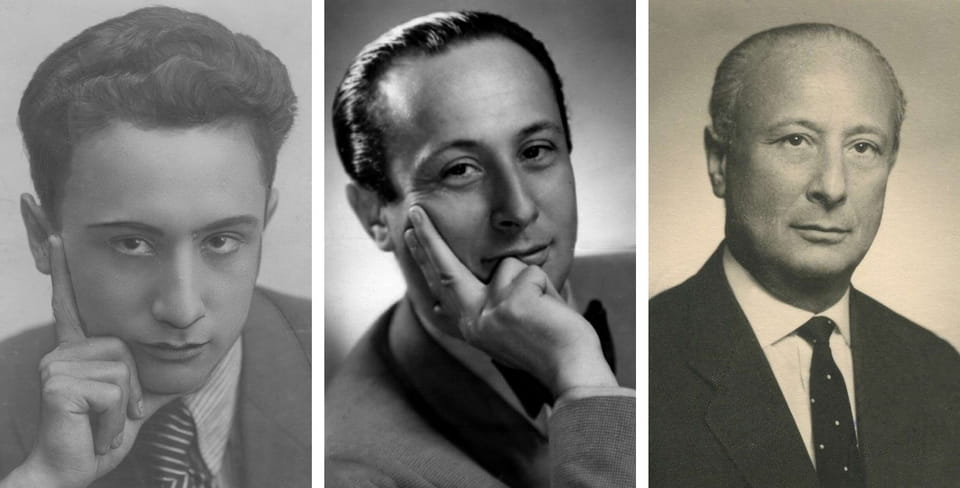
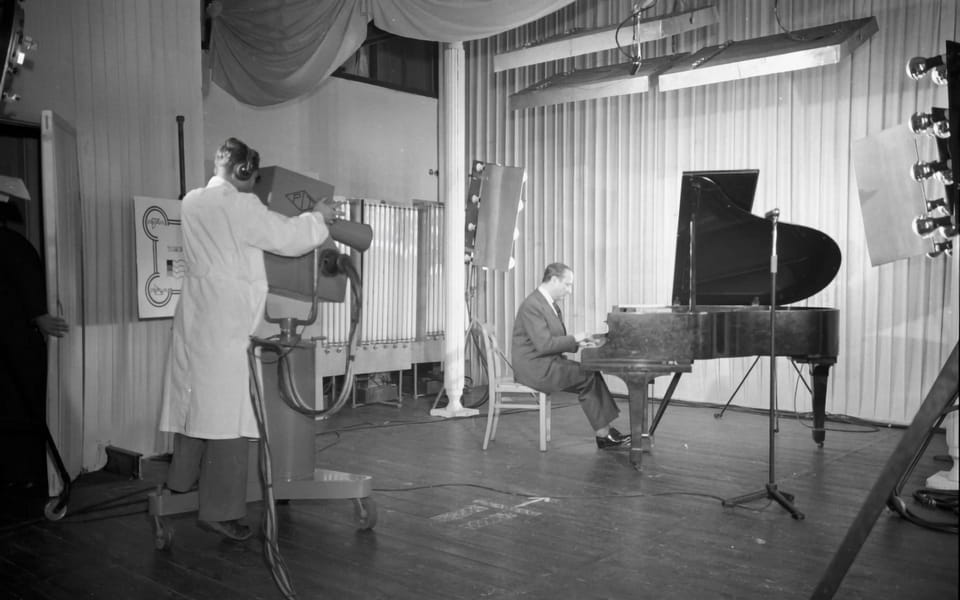
I am very grateful to war archives, museums, libraries, private collections, and writers for the historical photos in this article. To the extent that some author or a copyright owner may not want some of the above black-and-white photos to be used for educational purposes here, please contact me for adding credits or deleting the pictures from the article.