

Where was the Pianist filmed
Two questions are generally asked about The Pianist by Roman Polanski, and they have different answers. Where is it set? Warsaw, between September 1939 and January 1945 — the Szpilman family’s flat, the ghetto on both sides of the wall, and the ruined city Władysław Szpilman survived alone in the last winter. Where was it filmed? Partly in Warsaw, but not where you would expect, and partly four hundred kilometres away in Germany.
Polanski shot the interiors — and an entire ruined district — at the Babelsberg studio near Potsdam, from 19 February 2001. The Warsaw work took eleven weeks after that. And almost none of it happened in the streets where the events actually took place, because those streets no longer exist: the ghetto was levelled in 1943 and what stands there now is post-war housing.
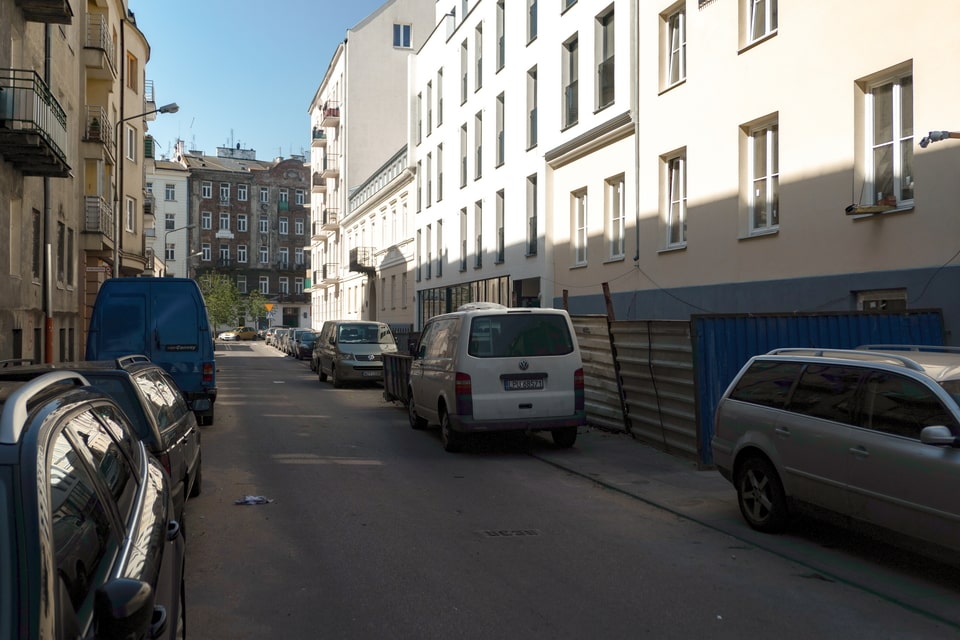
So the ghetto in this film is Praga-Północ, on the other bank of the Vistula, which the war barely touched. Two narrow streets — Stalowa and Mała — were dressed as the Warsaw ghetto: the gate, the wall, the wooden footbridge over Chłodna, the liquidation. In the centre, Kozia Street played itself, Krakowskie Przedmieście took the German entry into the city, and a burnt-out tenement on Plac Bankowy became Café Capri — which in reality was called Sztuka and stood somewhere else entirely.
One more thing worth knowing before you start: Kraków does not appear at all. Polanski grew up in the Kraków ghetto and had already turned down Schindler’s List for exactly that reason.
Below: every location, scene by scene, with the frame from the film and my own photograph of the same angle taken on the spot. The full list of addresses is at the end.
ROMAN POLANSKI: A HOLOCAUST SURVIVOR. WHY HE REFUSED SCHINDLER’S LIST AND MADE THIS FILM INSTEAD
The future iconic director came into the light of the world, driven by national tension, the aftermath of a devastating economic crisis and doubts about collective security, and the failed chance to ‘end all wars’, after the greatest of all. The peasants of Ukraine, metamorphosed into ‘war communism’, collectivization, and now exposed to a mastered man-made famine, were gathering ‘The harvest of sorrow’ (as it would be named by a historian, Robert Conquest, years later) with up to 4 million dead and 500 000 of the unborn population. In Italy, the authority of ‘Casa Savoia’ (the royal dynasty of Savoy) was practically narrowed to a national symbol and a banquet host, all while the actual power over the state was put in the hands of charismatic fascist leader Benito Mussolini. In Germany, the seven-month reign of Chancellor Adolf Hitler brought the dissolution of the Reichstag, the so-called ‘Law for the Protection of People and State’, the establishment of the Dachau concentration camp, the first boycotts of Jewish businesses, the formation of the Gestapo, the infamous book burnings, and the ban of any other political party except the Nazi Party.
Raymond Polanski was born on August 18, 1933, in Paris, France. His father, Ryszard, a Polish Jew, later changed his last name from Liebling to Polanski, and his mother, Bula, already had a child from her first marriage, a girl named Annette. The born boy, a child in common, and tightened the wedlock. The son Roman (Polish-style) was named Raymond after the manner of the French language, and the Polanski family would spend the first three years of his life in Paris. Never fully assimilated in a strange land, the father of a family (Ryszard) took his family to Krakow, his native town, and a residence of relatives and friends. Back in 1936, the decision (that would hold far-reaching consequences) sounded safe. Despite the mass emigration of the German Jews leaving the Third Reich and the evident red flags of the upcoming World War, Poland and Germany had signed a non-aggression pact, theoretically valid until 1944.

For the first little while, Raymond had no more progress in assimilation in Krakow than his father had previously experienced in Paris. The young Polanski stood out from the crowd of Polish boys with his foreign accent, brittle body, and his blonde shoulder-long hair. As soon as the outbreak of the war in September 1939, Ryszard did not let the grass grow under his feet and moved his family to Warsaw, a city farther from the border with the aggressor. Having looked enough at the horrors of the air raids, the Polanski family made their way back to Krakow, initially to a grandmother’s flat in the historically Jewish district of Kazimierz and later on, by a forced decree, within the borders of the Krakow ghetto. The Polanski family were agnostics, yet under the same rule and humiliation obligations to wear a yellow armband with a ‘Star of David’. Sixty years later, the director would share his own story of making these bands with some failed attempts. Another reality of the ghetto, which Polanski would interpret in his ‘The Pianist’, is the building of the wall. A need to feel freedom and not be bound by limitations would become Roman’s breath of life. In a purely artful sense, the future director would use space and walls within the frames of his works.

In the teeth of a temporary return to school and generally ‘normal’, yet constrained existence, Roman was now an eyewitness of a man-made dehumanization of the Jewish population at the hands of the occupational forces. The brick wall and physical separation from Krakow, the obligatory wearing of the armbands, a puppet-like administration by ‘Judenrat’: all these were dramatically accompanied by acts of material humiliation. As a vivid example, the scene with Wladyslaw’s father and a German officer, who slapped the face of an elderly man, came from the memory of Polanski himself. In pretty much the same way as the Jewish boys in the movie, young Roman did find a breach in a wall to conduct short, yet full of fear, outings beyond the ghetto.
As early as 1942, his father Ryszard managed to arrange shelter for his son in the home of the WILK family. Young Roman would spend the days of the first mass round-up and mass deportations of the Krakow Jews to the Belzec death camp in June 1942. Roman’s mother was tragically among the victims of that mass action, and years later it would be too painful for him to admit her death. Apart from the mass deportations of June 1942, the young Polanski would witness and wonderfully evade another one. The Polish man, assigned to deportations, led two boys (Roman and his friend) to go back home to take food. A moment after they rushed from the spot, he murmured, ‘Don’t run’. This painful childhood memory would be later reflected in a movie adaptation of Wladyslaw Szpilman’s story.

As late as March 1943, the liquidation of the Krakow ghetto (depicted in the iconic ‘Schindler’s List’) put another painful seal on the childhood of Roman Polanski. His father Ryszard assisted his son in breaking out of the ghetto, and later on, when the boy noticed his father within a column of rounded people, Ryszard would shout ‘Get out of here’, thus saving Roman’s life. Ryszard Polanski survived the war, yet they would hardly ever discuss the war experience and the fate of the mother. To that moment in time, Roman lived under the last name of Wilk and even had a chance to watch public movies, yet the repertoire in the occupied Krakow had been reduced to German propaganda-like footage. Once changed the patronage of another Polish family, Roman found himself in a rural area far from the city, being the fourth child of the Buchala family. As the war moved to an end, the young Polanski recognized the importance of coming back to Krakow, the city of his childhood and his tragedy. Polanski survived the Kraków ghetto as a child, and the camp its inhabitants were sent to — Płaszów — is where Spielberg’s Schindler’s List was largely set nine years earlier. Polanski turned down the offer to direct that film.

WHERE THE PIANIST WAS FILMED: WARSAW, POTSDAM AND WHAT WAS BUILT IN A STUDIO
In the late 1990s, the world celebrated the ‘golden’ anniversary of the end of the Second World War, yet Roman Polanski, a prominent director, had not filmed a movie which may be proudly inscribed on his gravestone. The master of play used to find little enthusiasm in shooting a story on the Holocaust; only Szpilman’s story embodied Polanski’s own survival experience as an artist in the thick of war. In wider terms, the director took advantage of the adaptation to gain a cinematic resource for sharing his emotional upheaval to the best he could. It also became an emotional challenge for the filming crew and for the leading man (Adrien Brody as Wladyslaw Szpilman) to work with a man who had experienced roughly the same survival story years before most of them were born. Among other matters, Polanski had no necessity to come to the streets of Krakow (the main reason why he had previously diverged from directing ‘Schindler’s List’, a story about the Krakow ghetto). One of the formative ideas of a new production initially was to make the most of the exterior Warsaw locations, where was The pianist filmed. Some of what the film only implies had a precise address. Arrests on the ‘Aryan’ side generally ended at Pawiak prison on Dzielna Street, the German security police jail that stood inside the ghetto boundary.

Wladyslaw Szpilman parted from life on July 6, 2000, literally at the height of the production process, passing half a year shy of the start of shooting. The prominent Polish composer and pianist was impressed with the scale of cinematic production with his own story at the heart of all. The joint Polish-British-French-American-German production amalgamated the efforts of hundreds of experts and actors. The shooting was planned to be held both in Poland and Germany and was fated to be appreciated as one of the most ambitious motion picture works in Europe. The actual shooting began in Germany on February 19, 2001, within the pavilions of the world-renowned ‘Babelsberg studio’ in Potsdam, the centuries-old residence of the Prussian monarchy. The place is widely known as a consequence of the July 1945 conference between the Allies. The studio sets included almost every interior scene of the movie, with the building of a whole city district on top of that. Looking further forward, Szpilman’s ‘scenes from the windows’ of the second half of the story were mostly recreated far from Warsaw, on the set in Potsdam. Filming on authentic ground is rarer than it looks. Of the wartime sites I have written about, only one production was ever allowed to work inside the place where the events happened: Valkyrie, in the Bendlerblock courtyard in Berlin.
At the time, when the Potsdam plains resounded with the blizzards of tanks and machine guns on the Babelsberg open-air set, Allan Starski, the chief stage designer, used to make almost an everyday trip from Berlin to Warsaw. Hereaway, Starski (whose father once worked with Szpilman after the war) supervised the makeover of some of the Warsawian locations. Some scenes were to be shot within the historical center, as well as in Kobylka, a suburb of Warsaw, and the sadly remembered (due to the Warsaw Uprising massacre) Wola district. ‘Akademia Obrony Narodowej’ (National Defence University) within a distant Rembertow district (separate city until 1957) was to be staged as the ‘Umschlagplatz’. For all that, the Praga-Północ quarter anticipated the most ambitious makeover after weeks of shaping the image of the Warsaw ghetto. The scenery and prop department fulfilled the formidable task of creating hundreds of details of wartime Warsaw, including street nameplates, wooden banisters, street lamp posts, elements for the interior scenes, costumes for actors, and hundreds of extras, even replica advertisement banners. The design department examined as closely as possible any accessible archive footage and photos of the Warsaw ghetto and closely cooperated with the ‘Jewish Historical Institute’. The major shooting in Babelsberg studio was finalized as early as March 25, and the next four days witnessed a formidable migration of men and equipment. The primary work in Warsaw would take another eleven weeks until the very June 2001. Warsaw’s other great wartime rescue story reached the screen fifteen years later: The Zookeeper’s Wife (2017), about Jan and Antonina Żabiński, was set in the same city in the same years — though, unlike Polanski’s film, it was shot almost entirely in Prague.
CAFÉ CAPRI: PLAC BANKOWY 1, THE HOTEL SASKI THAT PLAYED CAFÉ SZTUKA
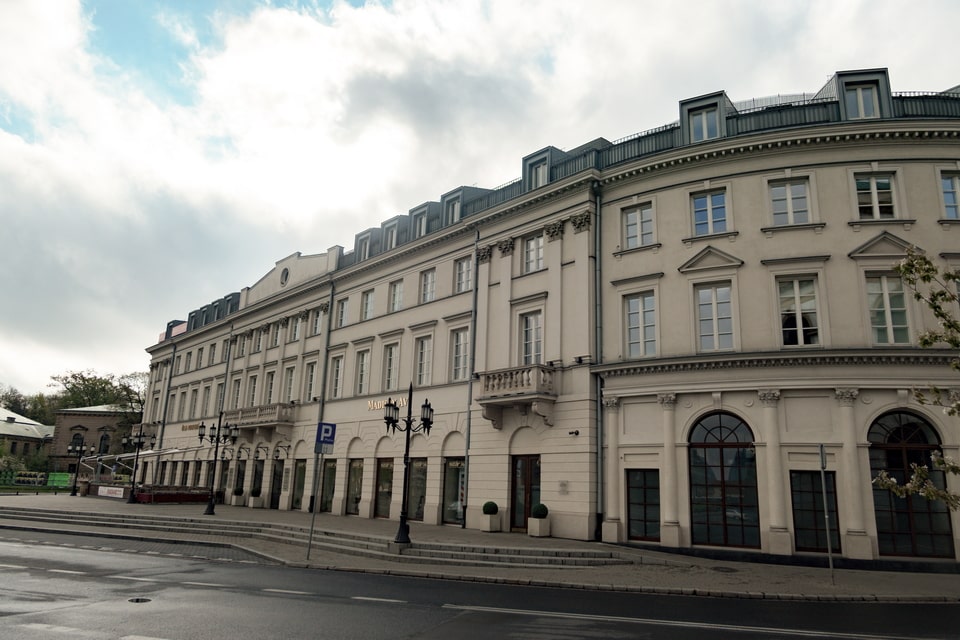
Despite the conventional belief, not every building in the historical center of Warsaw was devastated in 1945, and a part of the pre-war architecture was later repaired and renovated. The modern PLAC BANKOWY, to the West of ‘Ogrod Saski’ (The Saxon Garden), could be regarded as one of the ‘housing survivors’. In contrast to the general desolation of the surrounding area, the surviving triangular open space included: 1) The building of the Bank of Poland and the Stock Exchange; 2) The Treasury Ministry palace; 3) The Ministry of Industry and Trade; 4) The former Kossecka tenement house. It was this, the fourth, one in the southern part of the square and facing the modern Elektoralna, to be chosen as one of the Pianist filming locations. To be perfectly blunt, the architecturally sophisticated building of two centuries of history was praised only for the interior scenes, depicting the ‘CAPRI’ cafe, a workplace for Wladyslaw Szpilman until the liquidation of the Warsaw ghetto.

The decorated restaurant location occupies the frame sweetly, emphasizing the hands of the prominent pianist, who masterfully conducts the ‘Steinway & Sons’ piano keys. Wladyslaw makes eye-contact overtures to a young woman and later fulfills the caprice of some wealthy clients. In a scene, when his sister delivers the dismaying news, one could notice a banner with two men’s profiles and names: ‘Wladyslaw Szpilman / Andrzej Goldfeber ‘. The interior of the staged location, created under the careful supervision of Allan Starski, the set designer immortalized by his work on ‘Schindler’s List’, is evidently full of such tiny historical details, rendering the associates with the occupied Warsaw. Szpilman would later come to find shelter inside the cafe at the height of the deportations to Treblinka and soon after the loss of the whole family. All while the movie takes the ‘CAPRI’ title, in fact, the place refers to the image of the ‘SZTUKA’ cafe, the actual work seat of Wladyslaw Szpilman. It’s important to note that the factual place was once located close to the filming site, across the spacious square on Leszno Street, and played a significant part in Szpilman’s memories.


Back in the spring of 2001, the filming crew had little difficulty coming to terms with the owners of the building at Plac Bankowy 1 to turn the first floor into a cafe dating back to the days of the Warsaw ghetto. The thing was that at that moment (at the turn of the century) the fate of the two-century-old building was up in the air. Back in the 1820s, the whole surrounding area witnessed marked changes with the building of a triangular square in the place of the previous Baroque palace. The governmental buildings were accompanied by a residential house, built for Barbara Kossecks and later named (the common practice) after the landowner. The building was slightly damaged during the first years of the war but was burned out during the Warsaw Uprising in August 1944.
As the wooden beams (abutment of the floors) collapsed, no more than brick walls witnessed the end of the War. The renovation was put into operation soon after (in 1947) and finished in 1950, reshaping the former residential house into ‘Saski Hotel’ (Saxon hotel, thus referring, as the neighborhood park, to the Saxon kings of Poland). Toward the end of the 20th century, the hotel was already in a semi-emergency state and closed down to be later (1997) sold to an Austrian estate company. It is worth noting that Allan Starski, a man who put his mastery into designing the scenes of ‘The Pianist’, would be (in 2004) hired as an architect to repair the estate. The renovation process would last another eight years and cost 25 million Polish zloty to turn the building into an office estate.
KOZIA STREET: WLADEK AND DOROTA, AND THE «NO ENTRY FOR JEWS» SIGN
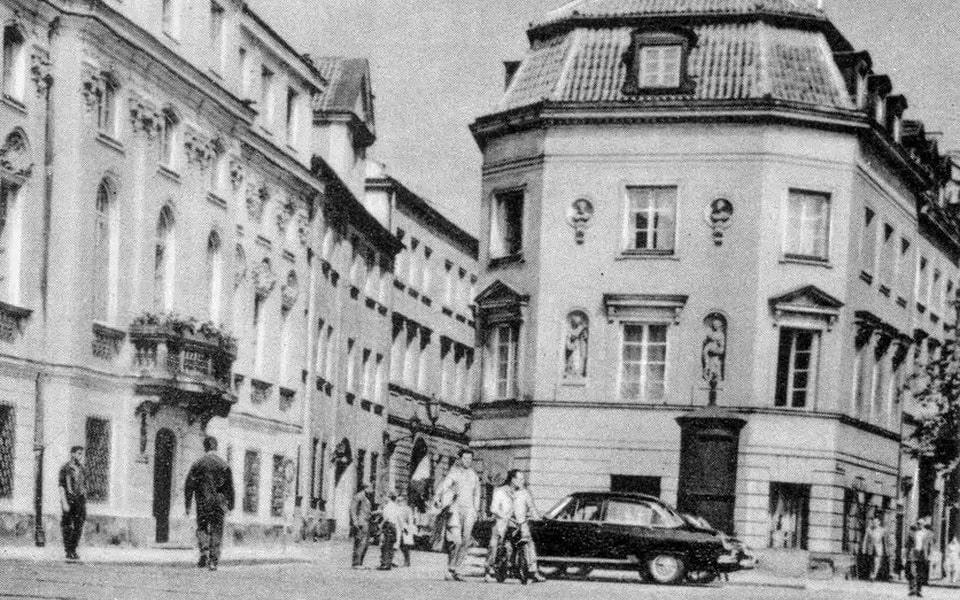
The cozy promenade-like ‘Kozia’ street was another location within the city center of Warsaw to be chosen as the location where ‘The Pianist’ movie was filmed. The passage between Senatorska and Krakowskie Przedmieście provided the background for Wladyslaw and Dorota’s walking within the first weeks of the German occupation. The design department did not switch street nameplates, as Kozia Street is not so different from its pre-war appearance. Their way to a desired cup of coffee is to be headed off with the humiliating ‘Żydom wstęp wzbroniony’ (No entrance for Jews) sign. Dorota is Polish, and she is filled with indignation toward such a policy. The couple takes a minute at the cross of Kozia and Krakowskie Przedmieście, and the horse-drawn cars in the background foster an illusion of the Warsaw of 1939. We could identify the green colors of the ‘Adam Mickiewicz’ square behind Dorota.


KOZIA Street not only survived the devastations of the Second World War, but its history dates back more than six centuries. As time went on towards the XVIII century, the place was built up with buildings we could still see today. At one period of time, the very district on the outskirts of the palace (to the West) was known for its brothels. As early as the mid-XIX century, the reputation of Kozia Street improved to a degree, becoming one of the all-time favorite places to have coffee in Warsaw. Speaking about the particular structures, the noticeable arch over the street (Wladyslaw and Dorota walk under it) was built as part of the ‘Hotel de Saxe’ (another reference to the Saxon Kings), the largest one in Warsaw in the middle of the XIX century.
The cafe, which was renamed (in the movie) to ‘PARADISO’ in a scene, actually known as ‘Telimena’, is located within a residential house of 1836. It is of interest to note that its predecessor, the ‘Brzezinska’ cafe (the name originated from the Polish word ‘brzoza’, which means ‘birch’ and would later be notoriously known because of the Brzezinka village and thus ‘Birkenau’ extermination camp), was one of the favorite leisure sites of Fryderyk Chopin. During its multi-century history, the street had switched several titles, from ‘Kozla’ to ‘Kozlow’ and to Junkierska (named after the neighboring school of military junkers) until 1919 and the attainment of the modern one. The area was badly damaged during the Second World War, but the majority of the buildings along Kozia were repaired, including the statue of Adam Mickiewicz in a park nearby.


How much of Dorota is real?
Less than the film suggests, and this is one of the places where Polanski departs most clearly from the book.
In Szpilman’s memoir, the cellist Dorota is a passing figure. In the film she becomes a thread running through the whole story: the walk down Kozia Street in 1939, the encounter years later, and finally the flat above the German hospital where she and her husband hide him. Polanski expanded her into the film’s only sustained relationship — the counterweight to a story that is otherwise about a man alone in rooms.
The same question is worth asking about Majorek, the man on the footbridge who smuggles weapons into the ghetto — he is in the book, and he was real.

KRAKOWSKIE PRZEDMIEŚCIE: THE GERMAN ENTRY INTO WARSAW, SHOT IN FOUR ANGLES
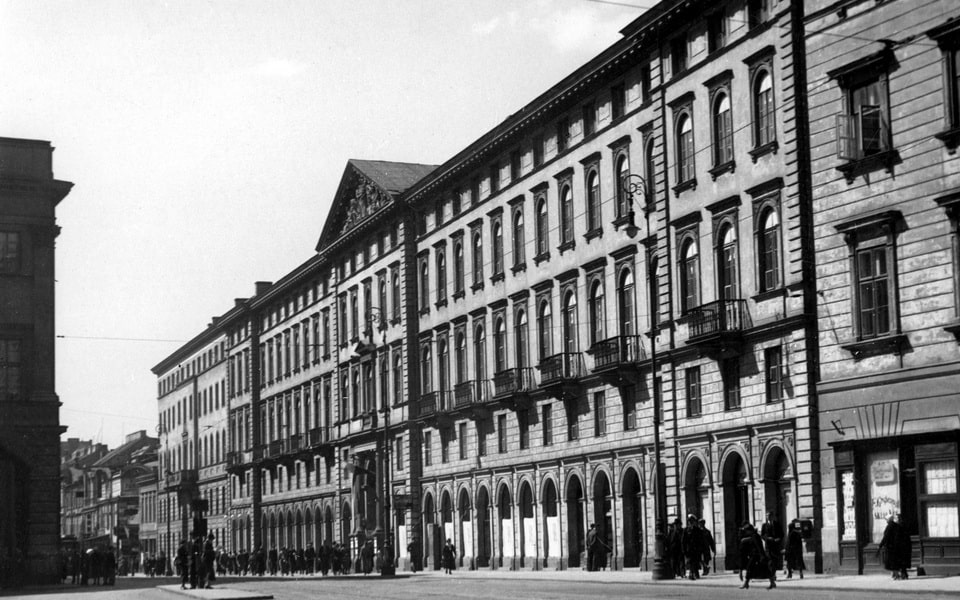
Apart from the remarkable scene at Kozia Street in the heart of Warsaw, the Krakowskie Przedmieście obtained another cinematic incarnation. Immediately following the news that Great Britain and France declared war against Germany, the Szpilman family is happy enough to satisfy a tableful until the next scene reveals the contrasting reality. Poland is now occupied, and the German soldiers deliver the military march across the streets of Warsaw, a scene witnessed by Wladyslaw, his father, and brother Henryk. The experienced viewer should not be confused by the semi-devastated appearance of the buildings, as these shots have been enhanced with special effects. Along with that, the actual location of the scene is easy to identify.

- We see the German soldiers marching beside the body of a horse (faked) and a building with an imposing entrance and a balcony. The very place is ‘The Secretariat of the Institute of European Studies’, put into a scene from the perspective of ‘Palac Staszica’.


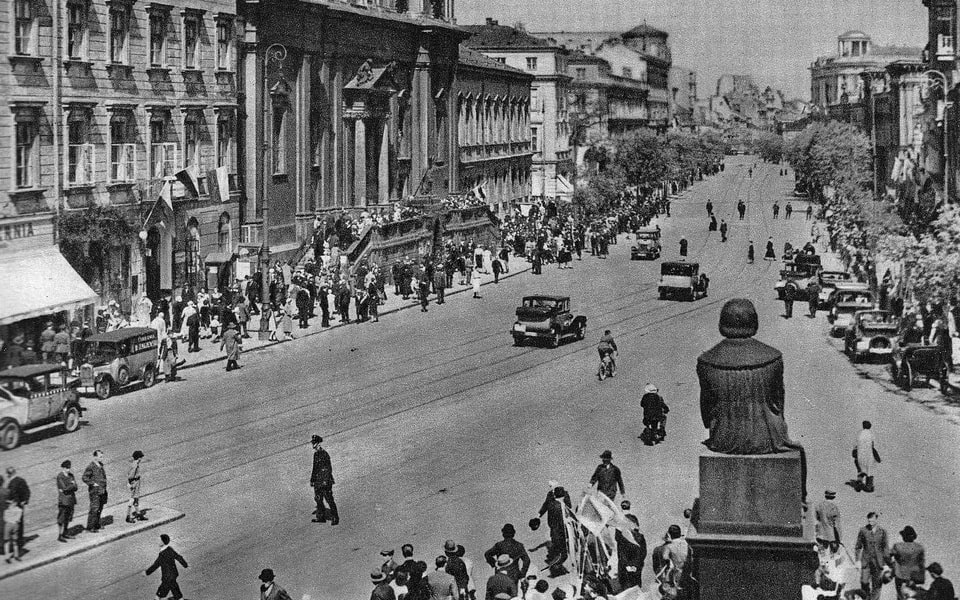
- The camera focuses on Wladek, Henryk, and the father. We could easily recognize the statue of Nicolaus Copernicus in front of the same ‘Palac Staszica’. The background includes the semi-damaged (with the help of post-computer work) building of ‘Mieszkanie Wokulskiego’.

- The next shot was taken from the perspective of the entrance to ‘Kościół Świętego Krzyża’ (The Holy Cross Church) and its famous statue of Christ and the stairs. The very statue of Copernicus is visible in the background.

STALOWA STREET IN PRAGA-PÓŁNOC: FIVE SCENES, INCLUDING THE GHETTO GATE AND THE BRIDGE
In parallel with the building-up of the large-scale sceneries at the ‘Babelsberg studio’ in Potsdam and a quest to find the ‘appropriate’ ruins for the final scenes (Szpilman finds himself within the devastated ghetto. The former military barracks were granted for cinematic use before the complete demolition), one of the Warsaw districts was to be made over into a Warsaw ghetto of the 1940s. The written records on Praga-Północ as a settlement date back to the XV century. Five hundred years and some wars later, the now-rejoined district of Warsaw would be slightly damaged during the Second World War. Within the first weeks of the war (September 1939), the area witnessed the battle for the city with little to no destruction. In the months that followed, every part of Warsaw on the Eastern bank of the Vistula River was even envisaged as an area for the Jewish ghetto (as we all know, it was spared from such fate).
Amid the ‘Warsaw Uprising’ (August 1944), the streets of Praga witnessed some local fights, but the cut-off insurgents were soon forced to evade direct collisions. The coming of the Soviet troops and occupation of the district generally preserved it from devastation. It should be stated that no less than 150 000 people among 180,000 of the ones who remained in Warsaw (who had not been previously killed or deported) welcomed the end of the war within the Praga district. For once being the center of post-war Warsaw, the old area would later be withdrawn to the shadows along with the restoration of the historical center of the city on the opposite bank of the Vistula River.

The Praga-Północ area still includes the major share of the preserved pre-war buildings, and STALOWA street was once destined to be transformed behind the cameras of ‘The Pianist’ movie. The main and the longest street of the district gained its name from the Polish word ‘stal’ (steel) as far back in history as 1891. The steel factories (‘Stalowni Praskiej’ in particular) on this bank of the Vistula used to be among the suppliers for the well-known Trans-Siberian Railway. The area came into focus in the 1880s with the creation of a great share of the urban development, which we can still appreciate today. The year 1894 witnessed the first horse-drawn tram, followed by the electrified version some decades later. Stalowa Street was historically appreciated as the heart of the area and a desirable place of residence for the workers, and the initial one-story structures were steadily replaced with residential houses, as well as pavement originating from the first years of the 20th century.

Stalowa 10-12: Wladek’s father is slapped
One of the scenes is brought in from the corners of the memory of Roman Polanski himself. Wladyslaw’s father is slapped by a young German officer and forced to drop off the pavement into the mud. The scene was shot beside Stalowa 10-12, the street plates of which could be easily recognized. We should also pay attention to the Warsaw tram, which fills the scene with the additional historical dimensions of the era. The filming crew obtained four disused but live trams from the local tram depot. Their appearance was as authentic as possible, and the production design department did not need to ‘put years’ on the transport set to fit the 1940s.


The march into the ghetto, 31 October 1940
October 31, 1940. The dramatic perspective of the scene is filled with the woebegone columns of the Jewish residents of Warsaw, who conduct their doomed cortege, similar to the well-known scene from “Schindler’s List. The Szpilman family is part of this procession, and Wladyslaw takes a few steps closer to his friend Dorota, who is frustrated to see all this. The production design crew filled the transformed area with the designed nameplates and commercial banners, ‘LEKI ZIOŁA KOSMETYKI ‘, for example.



The ghetto gate at Stalowa and Konopacka
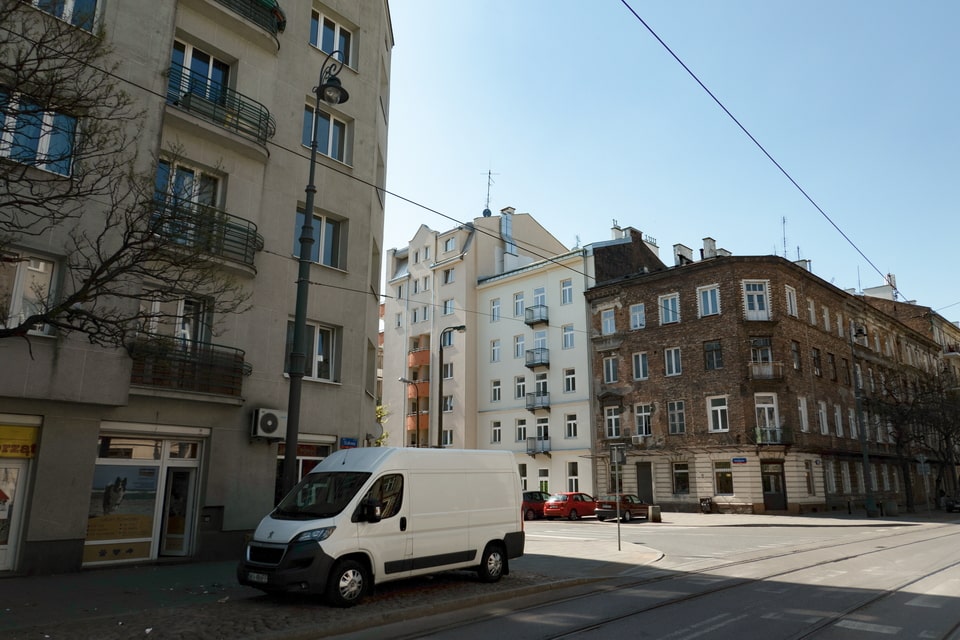
Another page of the dark history was recreated with photographic accuracy based on the preserved pictures of the Warsaw ghetto. The factual corner of Chlodna and Zelazna streets (within the actual ghetto) was built (by the Germans) with the so-called ‘gates’, a transition from one part of the ghetto (known as ‘large ghetto’) and the other one (known as ‘small ghetto’). We could see Wladyslaw and Henryk waiting for the lineup to cross the gates. The cinematic version was recreated on the corner of Stalowa and Konopacka streets in Praga. One would notice a replica of the ghetto wall, lined up alongside Konopacka. The tram line (as it is today) goes along Stalowa Street. The building behind the gate was accompanied by the ‘BAR DLA WSZYSTKICH’ (Bar for everyone) sign.


The «Bridge of Sighs» rebuilt on Stalowa
The sadly remembered overhead passage across Chłodna Street, widely known as ‘The Bridge of Sighs’, was recreated at the very Stalowa Street, at arm’s end from the crossroad of Stalowa and Konopacka and the ‘gates’ as well. The built-up wooden structure reflected the historical transfer between two parts of the Warsaw ghetto, the 52 stairs which (on each side) once opened the panorama over the street between the ‘small’ and ‘big’ ghettos. The wooden bridge is depicted in some scenes in the movie. Henryk Szpilman collapses from exhaustion, and later Wladyslaw meets his friend and gets acquainted with Majorek on the same bridge. In another memorable shot, the story gives us a glimpse of the German filming crew, capturing the daily life of the Warsaw ghetto. Roman Polanski once emphasized that he was absorbed with the image of such cameramen, almost routinely doing his job as well as the other Germans.



Stalowa 11: the first hiding place
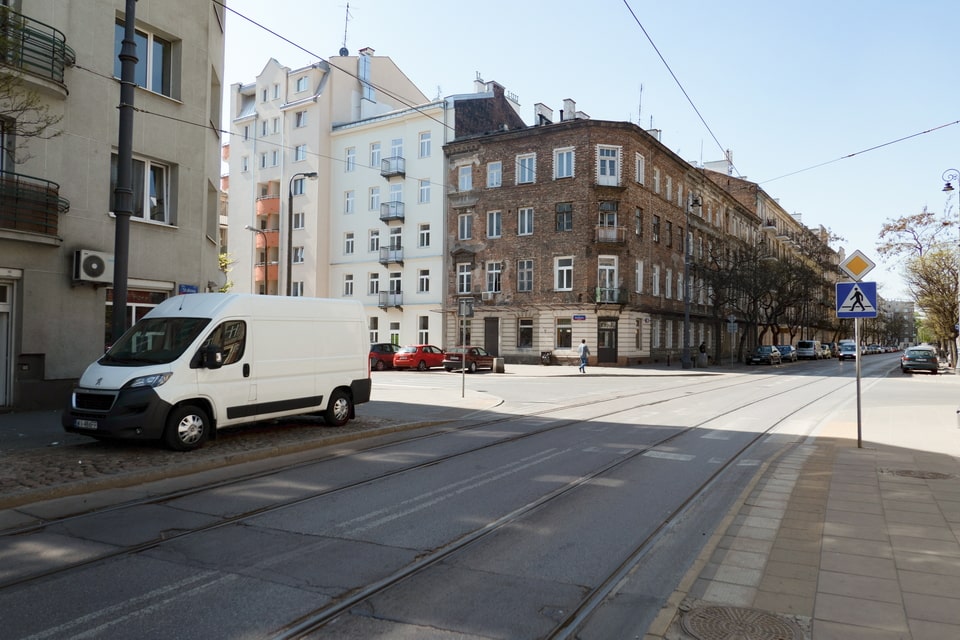
On the day of his escape from the working camp, Wladyslaw makes his way to the given address and meets people who assist him in accommodating ‘the Aryan’ side of Warsaw. Two men use the horse-drawn carriage to get to a temporary refuge. The former prominent pianist would have to spend a night in a concealed back room with legs tucked. On the morning of the next day, Wladyslaw played the role of a ‘free and easy’ Polish man, taking a tram. The scene was filmed at Stalowa 11.


MAŁA STREET: THE GHETTO WALL AND THE LIQUIDATION SCENES
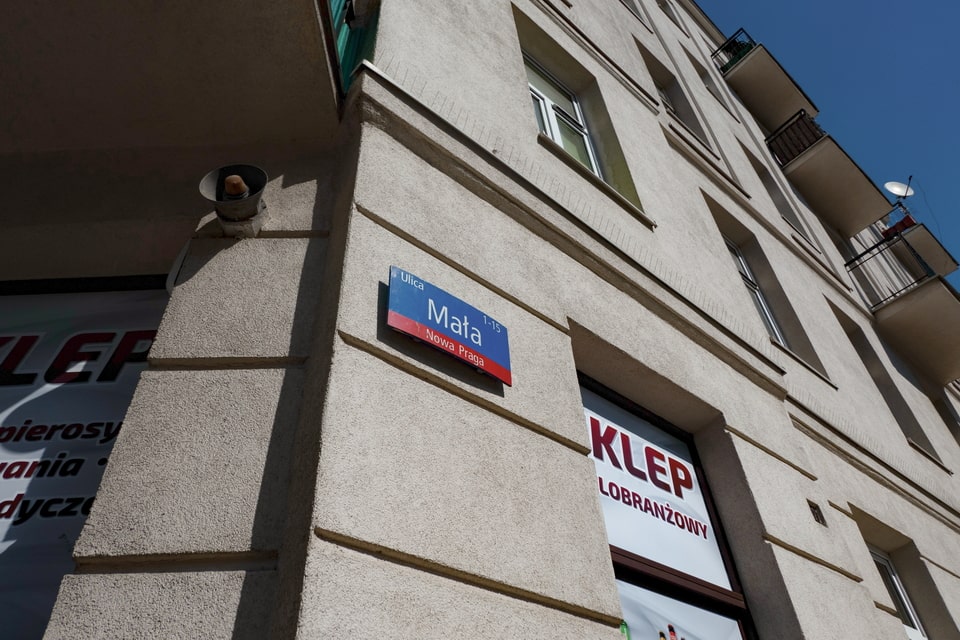
At the time, when Stalowa Street had already secured its place in the city plan of Warsaw, an unused plot of land to the South was still in the ownership of a local landlord. Soon after executing the agreement on cession, and the rights to a city, this blind spot of the Praga area was destined to become a street. The real estate development of the place, initiated in 1880, was all but immediate and would last for another thirty years. Within this interval of time, this cozy narrow street with the self-explanatory name ‘MALA’ (Small) was built in two-, three-, and later four-story residential buildings. The surrounding area was scarcely damaged in the years of the Second World War, and the authentic historical appearance has been preserved in the production of ‘The Pianist’ movie. Admittedly, some buildings have been restored in the last two decades. Back in the time of the shooting, the filming crew was concerned with two major issues. On the one hand, they self-restricted themselves to the necessity not to produce inconveniences for the locals, with the creation of the replica ghetto wall within a narrow street in particular. On the other hand, Polanski would later acknowledge that the neighborhood was inhabited by ‘hard-boiled’ people, which, indeed, made a little problem for the production, except for a couple of drunk men.
The wall and the boy
The first sequences to be shot were focused on the scenes with the ghetto wall. We could see Wladyslaw walking along the wall and trying to save a little Jewish boy, beaten to death for his smuggling activity.


Mała 10-12: Wladek returns to the emptied ghetto
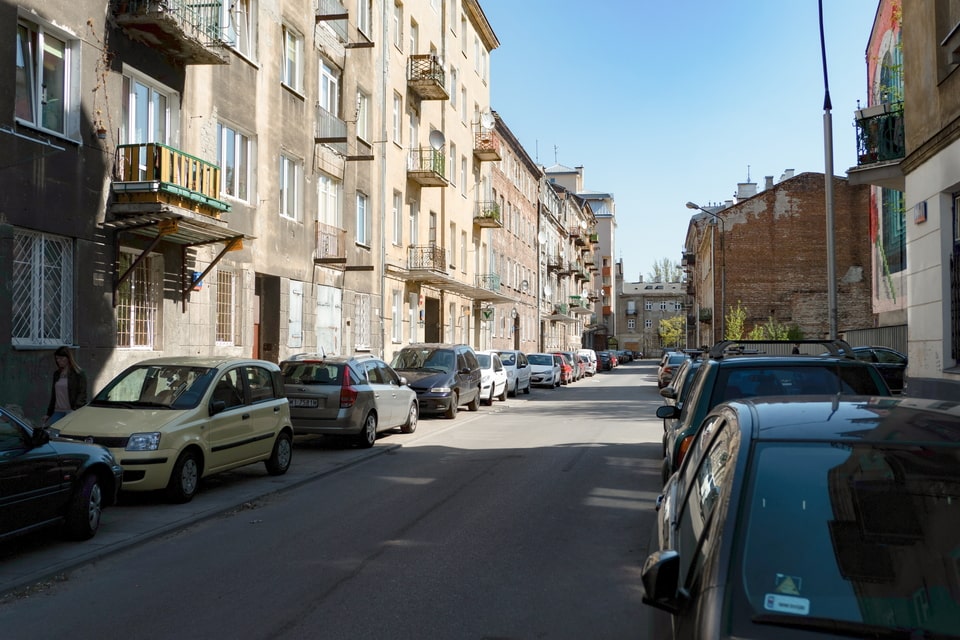
In another memorable, yet sadly remembered scene, the protagonist Szpilman makes his way back to the ghetto soon after evading the fate of being deported to Treblinka. He is crying and completely devastated while walking across the left belongings. This perspective was shot near 10-12 Mala Street in the direction of the corner with Konopacka. Building number 10 is the one with the open window shutters in the movie. Speaking of the changes, a spot of land covers the place of the wooden structure from the scene.

Mała 6 and the corner with Zaokopowa
Several scenes depict the forced workers and rare survivors during the liquidation of the Warsaw ghetto, including Wladyslaw Szpilman. The movie reflects wooden gates (a means for the workers to be taken outside) and a section of the wall. These scenes were staged at the crossroads with another pocket-sized street called Zaokopowa (behind the trench). The actual empty spot of land between buildings 8 and 10 was post-processed to add ruins of another construction. At the same time, Mala 6 is to be easily recognized within all scenes, including the one with the murder of the former Capri’s owner.


Another night scene depicts Jewish workers, who make their way beside the preserved section of the ghetto wall. The location is the same Mala Street, yet the shots had been filmed early, in the early spring of 2001, before the demolition of the replica wall. In wider terms, the same Mala Street has been styled to fit some locations within the cinematic version of the ghetto to expand its maiden geography.


ALL THE PIANIST FILMING LOCATIONS: THE FULL LIST
In Warsaw
— Plac Bankowy 1, the former Hotel Saski — interiors of Café Capri, where Szpilman plays until the ghetto is sealed. In reality, the café was called Sztuka and stood on Leszno Street, across the square.
— Kozia Street, between Senatorska and Krakowskie Przedmieście — Wladek and Dorota’s walk, and the «no entry for Jews» sign. The street plates were not changed: Kozia looks much as it did.
— Krakowskie Przedmieście — the German troops marching into occupied Warsaw, shot from four positions around the Staszic Palace, the Copernicus monument and the Holy Cross Church.
— Stalowa Street, Praga-Północ — five scenes, including the ghetto gate at the corner with Konopacka and the reconstructed footbridge.
— Mała Street, Praga-Północ — three scenes: the wall, the return to the emptied ghetto, and the liquidation. The whole street is under three hundred metres long.
— Rembertów, the National Defence University — staged as the Umschlagplatz.
— Kobyłka and the Wola district — additional scenes.
In Germany
— Babelsberg Studio, Potsdam — almost every interior, plus an entire ruined district built on the backlot. Most of Szpilman’s «views from the window» in the second half of the film are Potsdam, not Warsaw.
— Former military barracks, granted for filming shortly before demolition, used for the final ruined-city sequences.
Not used at all: Kraków, where Polanski himself survived the ghetto, and Prague, where much of Polish-set wartime cinema is shot. The Zookeeper’s Wife, set in the same city in the same years, was made in Prague fifteen years later — Polanski’s film was not.

WALKING THE LOCATIONS TODAY
All the Warsaw locations are walkable in an afternoon, but they fall into two clusters on opposite banks of the Vistula.
The centre. Plac Bankowy, Kozia and Krakowskie Przedmieście are within ten minutes of each other in the rebuilt old town. Plac Bankowy 1 is now an office building — you can see the facade from the square. Kozia is a pedestrian passage and looks essentially as it does in the film. On Krakowskie Przedmieście, the four camera positions are all within sight of the Copernicus monument.
Praga-Północ. This is where the film’s ghetto is, and it is a different city: the district came through the war largely intact, which is exactly why it was chosen. Stalowa and Mała are five minutes apart. Mała is under three hundred metres end to end — you can stand where the ghetto wall was built and see both ends of the street. Nothing is marked, and the neighbourhood is ordinary and lived-in; the same is true of the buildings, which are people’s homes.
Getting there. Praga-Północ is one stop across the river on the M2 metro line — Dworzec Wileński is the station for Stalowa. Trams run along Stalowa itself, as they did in 2001, when the production borrowed four disused but working cars from the local depot.

FREQUENTLY ASKED QUESTIONS
Where does The Pianist take place? In Warsaw, between the German invasion in September 1939 and the arrival of the Red Army in January 1945. Most of the story happens in the Warsaw ghetto and, after Szpilman’s escape, in a series of hiding places on the «Aryan» side and in the ruined city.
Where was The Pianist filmed? In two countries. The interiors and an entire ruined district were built at the Babelsberg studio near Potsdam, Germany; the exteriors were shot in Warsaw over eleven weeks in spring 2001. The ghetto scenes were filmed in Praga-Północ, on the east bank of the Vistula, because the real ghetto no longer exists.
Which street in Warsaw is in The Pianist? Two: Stalowa and Mała, both in Praga-Północ. Stalowa carries five scenes including the ghetto gate at the corner with Konopacka and the reconstructed footbridge; Mała, under three hundred metres long, carries the wall and the liquidation scenes. In the city centre, Kozia Street and Krakowskie Przedmieście appear as themselves.
Was The Pianist filmed in the real Warsaw ghetto? No — it could not have been. The ghetto was destroyed in 1943, and the area was rebuilt after the war as housing estates. Praga-Północ was used instead because it survived the war almost undamaged and still has its pre-war streets.
Was it filmed in Kraków? No. Polanski survived the Kraków ghetto as a child and had already turned down Schindler’s List partly for that reason. He shot nothing for this film in Kraków.
Is Café Capri a real place? The café in the film is filmed in a former tenement on Plac Bankowy 1 — later the Hotel Saski, today an office building. The café Szpilman actually played in was called Sztuka and stood on Leszno Street inside the ghetto. Three different places: the name, the reality, and the location.
Is The Pianist a true story? Yes. It follows Władysław Szpilman’s own memoir, first published in Poland in 1946. Szpilman died on 6 July 2000, half a year before shooting began.
Was Dorota a real person? Only partly. She appears briefly in Szpilman’s book; Polanski expanded her considerably for the film. The section above explains what changed.