

Syrets Camp, Kyiv: History, Topography & Today
The Syrets concentration camp (officially: Arbeitserziehungslager Syrez, or AEL — «labor education camp») was a Nazi forced-labor facility established in April 1942 on the north-western outskirts of Kyiv, Ukraine, on the former grounds of the Tsarist-era Syrets military garrison. Situated just 300–400 metres west of the Babi Yar ravine — where approximately 33,771 Jews had been massacred in September 1941 — the camp operated until October 1943. Approximately 10,000 people passed through the camp during its eighteen-month existence, including Soviet POWs, Ukrainian civilians, partisans, Jews who had survived the initial mass killings, and members of the Kyiv intelligentsia. At least 5,000 prisoners died from starvation, disease, and direct execution. In the summer of 1943, inmates were forced to exhume and cremate the mass graves of Babi Yar under Paul Blobel’s Aktion 1005 — and a group of prisoners escaped on the night of 29 September 1943, with survivors later testifying at Nuremberg. Today, the entire site of the former camp is built over with Soviet-era residential buildings.
Despite being commonly referred to as a «concentration camp» — both in Soviet post-war documentation and in much subsequent historiography — the Syrets camp was formally designated by the German administration as an Arbeitserziehungslager (AEL, or «labour education camp»). Unlike the SS concentration camp system coordinated from Berlin, AEL camps were typically run by the Gestapo and theoretically designed to detain workers for limited periods (weeks to months) as a disciplinary measure for alleged labour violations. In practice, and certainly at Syrets, this legal distinction was meaningless: the camp was a site of systematic murder, starvation, and terror operating under the same logic of Nazi racial ideology. The German documentation recorded Syrets as a subcamp of Sachsenhausen from July 1942 until spring 1943 — on paper only, as fewer than half a dozen German prisoners were ever sent there. The AEL classification, however, remains significant in historiographical and archival terms, as it explains why Syrets is not always listed among «official» Nazi concentration camps and why detailed documentation is harder to access.
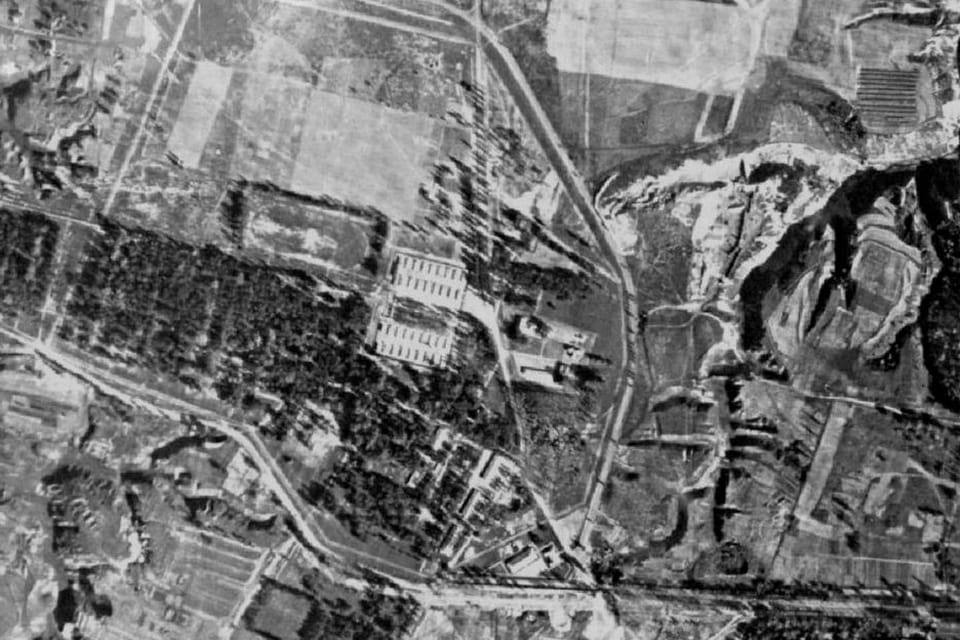
This article provides the most detailed English-language topographic reconstruction of the Syrets camp, with the 1943 aerial photograph mapped onto the modern street plan of Kyiv, personal photographs of the surviving memorial sign and the nearby German POW cemetery, and a guide to visiting the site today.
SYRETS MILITARY CAMPS (1840s–1941): THE HISTORY OF THE SITE BEFORE THE CAMP
The catchment area basin of the river SYRETS (at present classified as a stream) in the North-Western part of Kyiv, the capital city of modern Ukraine, geographically aligns with the Southern border of the mixed coniferous forest zone. In large part, being entrenched in drainage sewer canals, the still open-air segments trail their headway through downward shaggy ravines as the river did centuries ago. The etymology of the word ‘syrets’ goes as far back in history as the tradition of the Kyivan Rus of titling the locality in virtue of the trivial everyday characteristics. A derivative of the Ukrainian word ‘сирий’ (modern linguistics prefers ‘вогкий’), meaning ‘damp’ or ‘moist’, the title ‘syrets’ has historically defined the surrounding area as deep-grassed ravines with tactile humidity. In years to come, the word ‘syrets’ would also be used to characterize a particular sort of clay and a brick-making process known for not using baking, thus preserving moisture. In the latter half of the XX century, it would be a snowballing growth of the brickworks to reshape the landscape of the Babi Yar Ravine and the surrounding area once and all.

Being known for its shallow depth and width, the Syrets River inspired the locals to entitle the region around the middle part of the basin in the same manner. The word ‘Syrets’ dates back to the written document of the year 1240 as an area beyond the city of Kyiv to be granted to Kyivo-Pecherska Lavra, a sanctuary of the Slavic world. In the next five centuries to come, the ‘Syrets’ area as a village on the edge of Kyiv, would change hands several times, with its rural housing formed of homesteads along the Syrets River basin. This farming suburb of Kyiv took its place on a city map as early as 1799. In a century ahead, the locality, originating from a basin of a shallow river, making its way through the shaggy ravines, would experience a commercial and production revolution. The archaic wooden water-driven mills gradually made space for alcohol-distillation productions, breweries, and brickworks: the latter succeeded in working out the local clay of a distinctive green color, now also designated as ‘syrets’.

As early as the 1840s, the vast open grounds to the East of the Syrets river basin were fated to be appreciated by the military men as summer camps for military exercises. It would take another quarter of a century until the year 1869, when the Kyiv authorities officially enacted an immense territory for infrastructure development. Then and there, all next editions of a city map of Kyiv would include ‘Армейский лагерь’ (a military camp), conventionally called ‘Сырецкие военные лагеря’ (Syrets military camps) once again in virtue of an area and a river to the West. Summing up, the succession of the naming would be inherited from a city area, once called after a river, therefore named after moist ravines. The establishment and operation of the military camps would dominate the area next to the Babi Yar ravine in the next century. As early as the beginning of the XX century, the neighboring streets would be called ‘Lagerna’ (also known at that time as ‘tabirna’, a derivative from the Ukrainian word ‘табiр’ or a ‘camp’) and Tiraspolska: the latter named after the Tiraspol regiment, the former detachment of the Tsar’s army within the Kyiv military district.

The lands, designated for the building up of a ‘Military camp,’ occupied an area of Apr. 3-quarter kilometers. Relatedly, this new topographic formation in Kyiv slightly changed the nature of the Syrets area, a rarely populated edge of the city, dominated by single-family residential neighborhoods and the challenging terrain of the Syrets river basin and Babyn Yar ravine. The time ticked by, and the Syrets military camps steadily mounted the designated territory of the former green fields, now transformed into wooden barracks, training grounds, and firing ranges.

The year 1895 witnessed the building of a wooden Orthodox church in the Eastern part of the camp next to the upper spurs of the extensive Babi Yar ravine. The sanctuary had no official naming, apart from ‘дивизионная’ (divisional) in common terms, and welcomed the soldiers of different military detachments, accommodated at the camp at varying times. With the advent of the autocratic communist regime in the 1920s, the parish was relocated to another city district, and the current wooden church was destroyed. As late as the XX century, the ‘Syrets camps’ would be accompanied by large artillery ranges, firing grounds, and even an airfield. In the course of the years from 1895 to 1916, a small tram depot to the South used to serve as a terminus station of a tram line between the camps and Lukyanivka Square to the northeast (the September 29, 1941 assembly point). Regarding the Great War and the ‘coup d’etat’ (shift of power), the Syrets’ military camps were destined to preserve their nature as armament training camps, notably for mechanized combat units. A serving crew of mechanical material maintenance workers had their works at the cross-section of Melnikova and Lagerna streets until September 1941. The Germans would force thousands of Jews to follow the death route to Babi Yar next to the mechanic garages of this work, and thousands were fated to spend their last night before the execution. Syrets was not the only camp the Germans set up on the site of a pre-war Soviet military installation. On the left bank of the Dnieper, the old Darnytsia barracks became Stalag 339, one of the deadliest prisoner-of-war camps in occupied Ukraine.

SETTING UP THE SYRETS ARBEITSERZIEHUNGSLAGER (AEL): APRIL 1942 AND PAUL RADOMSKI
As early as March 1941, three months before the German invasion and six months before the mass killing in Babi Yar, one of the complementary directives of the ‘Unternehmen Barbarossa (Operation Barbarossa) included procedures for establishing concentration camps on the conquered Soviet territories. As Kyiv fell into German hands and the Soviet army grouping ceased to exist, hundreds of thousands of POWs (the established 665,000 figure is to be debated) found themselves inside hastily created camps in the open. As winter 1941-1942 set in, the deficiency of warm clothing and appropriate incarceration conditions, notably malnutrition and the outbreaks of diseases, all factored into the highest mortality rate in the history of the wars. It was not until the upcoming January 1942, in the aftermath of a military setback at Moscow, that Hitler estimated the possible use of the Soviet POWs as a workforce for the sake of the Third Reich. Along with that, the ever-increasing broad sample of the civil population would be subjected to incarceration, including the families of captives, Jews, members of the communist party, undergrounders, and men and women of active working age.

It would take the Germans another half a year after the ‘Gewisse Volkspolitische Aufgaben’ (Certain ethnic tasks, a euphemism for mass murder) in Babi Yar to set up a concentration camp for Soviet citizens next to the Western border of the ravine. The building up of the camp was put into actual practice in April 1942 upon the site of the former armament training camps of the Kyiv garrison in the Syrets area, neighbored by the upper spurs of Babi Yar. The order on construction was issued by SS-Obersturmbannführer Erich Ehrlinger, the former SD top-ranking officer in Warsaw, the former commander of the Einsatzkommando 1b death detachment in the Baltic states, and now (since December 1941): ‘Kommandeur der Sicherheitspolizei und des SD und Zum SS- und Polizeiführer (SSPF) in Kiew’ (Commander of the Security Police and the SD and SS and Police Leader (SSPF) in Kyiv). The man responsible for the operation of death squads in the occupied territories now directed the setting up of a concentration camp in Kyiv.

The larger half of these first April 1942 prisoners were brought to the site of the former military camps from the Gestapo prison at Korolenko 33 (modern Volodymyrska). In the previous months (since winter), the Germans from that prison used to deliver (on lorries) inmates to be shot within an anti-tank ditch nearby (in parallel to Lagerna Street next to military camps) twice a week. The designated workforce was now fated to demolish a number of the pre-war erections, stub out a field, double-fence the assigned territory with a barbed-wire perimeter, and build up new buildings, including the so-called ‘Wachstube’ (guarding post, similar to the practice of the pioneer concentration camps in the Reich, such as Dachau), the watchtowers, and barracks for prisoners to come. The forced workers were in narrow means, lucky to be brought to the site during the warm season, as the guards provided them with no shelter until June 1942, when the inmates themselves set up a small living zone with dig-outs inside the perimeter. As far as the German documentation assigned the ‘Syrets camp’ as a subcamp of the Sachsenhausen (on paper from July 1942 until spring 1943), as few as half a dozen German inmates would be brought to Kyiv. These handful of felons were ‘transferred’ here to assist in lockpicking the Soviet vaults in Kyiv. The main Syrets camp was not the only German detention facility in Kyiv administered under the same command structure. A branch camp in Myshelovka (now the Holosiivo district of Kyiv), located on the southern outskirts of the city, held prisoners used as agricultural labourers on nearby collective farms. Evidence of the Myshelovka branch is documented in the records of the US Holocaust Memorial Museum and in post-war Soviet investigative reports.

The man assigned to command the ‘Syrets concentration camp’ was no other than SS-Sturmbannführer Paul Otto Radomski. Known as a protege of the notorious Reinhard Heydrich, Radomski had been regarded as ‘Alter Kämpfer’ (Old Fighter) among the Nazis. This could be traced to his №96,942 party card (Radomski joined the NSDAP as far back as 1928) and the №2, 235 in the ranks of the SS (joined back in January 1930). Radomski, who would be released from his position in February 1943 because of his intimidation toward personnel and his excessive drinking, was known as a brutal and imperious commandant, at first hand responsible for numerous executions in Syrets camp. As the war had ended, the Ukrainian authorities were left in the shadow of Radomski’s fate for sixty years until the year 2005. The office of the public prosecutor in Hamburg handed over the documents on the circumstances around the death of Paul Radomski as far back as March 1945 in Hungary.
The contingent of the guarding personnel of a newly-established Syrets camp was mainly formed of the German SS and members of the Ukrainian Auxiliary Police, mainly former Soviet POWs. For the most part, up to 150 men with dogs figured the day-to-day guarding brigade inside and outside the perimeter. Throughout its operation until October 1943, the Syrets concentration camp at different times served as incarceration for up to 3000 inmates at one time. The administrative geography of the camp contemplated the division of all prisoners into the so-called ‘сотня’ or ‘sotnia’ (one hundred) and further into brigades, everyone ruled by their jailer among the inmates, an equivalent to ‘capos’ with full authority over his or her section.

The prisoners of the Syrets camp were conventionally exposed to back-breaking work with extensive working hours between 5 am. and the last roll call at 9 p.m. Men and women incarcerated in the camp were forced to cut down trees to stock up on firewood for the winter, repair the existing barracks and build new barracks and warehouses, make a stock of coal, and spend days in workshops. Another portion of the work involved inmates demolishing the erections within the former Soviet military camp, including wooden barracks and even a brick water tower. The food ration was mainly limited to a muddy similarity to coffee for breakfast, a meatless pottage, and 200 grams of bread and grains throughout the day, with no supper. The pathological malnutrition forced prisoners to entrap rats, stray dogs, and cats, and to eat roots and grass. The fatigue offered prospects of being relocated to the so-called infirmary, in fact, a separate dugout barrack with no medical assistance, whose patients had mainly become victims of physical executions, from time to time, by the hands of Commandant Paul Otto Radomski himself. A slight part of the inmates were lucky to receive delivery from the outside world, their relatives among the locals, who used to deliver parcels to the wood line nearby, mainly depleted by the guards as a bribe.


THE TOPOGRAPHY OF THE SYRETS CAMP: 1943 AERIAL MAP vs KYIV TODAY
Similar to the former quarters of the Polish army in Oswiecim, the Germans in Kyiv took advantage of the existing pre-war infrastructure of the former military camps in Syrets. In one respect, the great proportion of the existing erections, largely wooden barracks of the XIX century and separate brick constructions such as an elevated water tower, were to be steadily demolished. On the other hand, the former Northern part of the Syrets military camps, roughly between modern Shchuseva and Ryzhska streets, was reorganized into a workshop and warehouse zone. Related to these two coverts, as late as spring-summer 1942, witnessed the outline periphery of the Syrets concentration camp spreading to the North and assimilating the former green fields of Syrets. For the space of almost a century of its operation, the former Tsarist and later Soviet military camps had neighbored the giant-like ravine of Babi Yar. In the year 1942, Lagerna Street (modern Dorohozhytska) besided the old military cemetery (which has not been preserved) and the Lukyanivka Ordhofox cemetery, further merging into an unsurfaced road to the North, matching the modern Olena Teliha Street. Consequently, the German Syrets concentration camp, similar to its Tsarist and Soviet predecessors, was topographically separated from the Babi Yar ravine by a road.

The survivors among the prisoners of the Syrets camp would later estimate the territory from two to three square kilometers, apparently by including the vast working zone to the North, beyond the fenced perimeter, yet a frequent place of work. The German aerial photographs of September 1943, indeed a priceless factual document dealing with Babi Yar and Syrets camp, provide certain credence in defining the limits of the whole site, in particular, 3.5-4 kilometers as perimeter length and 0.55 square kilometers of actual fenced territory. Hog-backed rectangle, the fenced area used for the run-up to the modern Syrets metro station to the West, modern Olena Teliha Street to the East, Volodymyr Salskoho Street to the North, and Ryzhska Street to the South. Using the labor of the first inmates in the Spring of 1942, the Germans fenced the camp with two rows of barbed wire with an electric line between them. Construction materials were swiped from the remnants of the defensive installations of Kyiv, among those 30 kilometers of razor wire, which had been vainly erected in 1941 to protect the city from the invasion. At night, the whole territory of the Syrets camp was illuminated with spotlights, mounted upon the watchtowers, and therefore guarded with machine guns.

The MAIN ENTRANCE to the camp was set up roughly at the site of the crossroad of modern Olena Teliha and Dorohozhytska streets. To the West, it used to neighbor the upper spurs of the Babi Yar ravine, and to the South, with a huge anti-tank ditch, another notorious site of the mass executions. The open field further to the South of the camp and to the West of the Lukyanivka Orthodox Cemetery had a terrain covered with shell craters, ditches, and trenches that had been previously made by the soldiers of the summer military camp. The gates had a form of simple wooden construction, additionally lined with barbed wire similar to the notorious gates of the Plaszów concentration camp in Kraków, Poland. To the immediate rear of the entrance to the left, the Germans forced inmates to build up the so-called ‘WACHSTUBE’ (a guarding post), next to which the newcomers were generally exposed to first humiliation. Over a distance of 50-70 meters from the main gate, deep into the camp, there was another entrance to the immediate territory of the Syrets camp, fenced with barbed wire as well. The first-timers were beaten and forced to cover the distance between these two gates on their hunkers or their bellies. Once found inside the main perimeter, the doomed people saw a road further forward. To the right, they faced the women’s living area and, further to the left, the men’s section of the camp: both once again fenced.

Either of the two ‘residential zones’ within the notorious ‘living area’ (men’s and women’s) was additionally completed with a double fence barbed wire perimeter with a separate guarding post next to each, similar to Auschwitz-Birkenau. Summing up the density of guardianship, the prisoners were separated from the Kyiv locality with three separate perimeters in total. The so-called ‘men’s camp’ consisted of two rows of dugout barracks for inmates to live in. These improvised underground living facilities were dug by hand, wrapped over with logs of wood, and covered with a layer of earth, and the protected door was used to lead inside the barrack. Such a moist, dark temporary structure could accommodate up to 80 men at once. In the early months of the Syrets camp operation, the prisoners dug sixteen such barracks, and another two parallel rows were implemented later, which brought the total number to 32.

The open site in the middle of the men’s section used to witness stringent day-to-day roll-calls, operated by the ‘capos’ and supervised by a German officer. Taken as a whole, the German guards favored visiting the ‘residential zone’ as rarely as possible (they feared outbreaks of infections), notably at night when almost every prisoner was there. The living area was strictly exposed to its hierarchy, with privileged prisoners in charge of the barracks and brigades. The ‘men’s camp’ used to include the so-called ‘Judenblock’ (Jewish barrack. The practice was universally used by the Naziz, for example, at the Mauthausen, yet the unspoken status of the ‘deadliest’ place in the Syrets camp was entitled to the ‘infirmary’. A separate dig-out barrack with, in fact, no medical assistance or proper nutrition was fated to become a place of executions, particularly by the hand of Paul Radomski, the commandant of the Syrets concentration camp.


The women’s living zone was built close to the main entrance to the camp, next to the Western perimeter of the site and the upper spurs of the Babi Yar ravine in particular. As opposed to the initial formation of the male contingent as early as the construction phase (starting from April 1942), the female section of the Syrets camp was assembled as early as September 1942. The living conditions for women were minimal for temporary survival, and the area was made up of a few wooden barracks. Not unlike the ‘men’s camp,’ this residential barrack area was exposed to a tight hierarchy. Elizaveta Loginova, who would be tried as a war criminal after the war, used to take advantage of her privileged role as a jailer of the women’s area by giving her gruel to the female inmates. Her daily routine included day-to-day reports personally to Commandant Radomski or his deputies on the total number of female prisoners, medical cases, or fatigue. Forasmuch as the women’s area was located nearest to the exterior perimeter of the camp and less than 100 meters from Babi Yar, the female inmates used to become witnesses to the mass actions in the ravine.
THE LAST MONTHS OF SYRETS CAMP: AKTION 1005, PAUL BLOBEL AND THE SEPTEMBER 1943 ESCAPE
With the onset of summer 1943, the loss of the war proactively by the Third Reich and the large-scale retreat from the occupied territories in the East resulted in the Germans’ decision to eliminate the traces of the mass crimes, particularly in Kyiv. The ‘operation’ was initially stamped with the ‘Geheime Verschlußsache’ (top secret) seal and the code term ‘AKTION 1005’ (Action 1005) with PAUL BLOBEL as the high executive officer. The man in charge was no other than a former commanding officer of Sonderkommando 4a, a death squad directly responsible for mass executions in Babi Yar back in September-October 1941. The retention of some of the former executioners provided a clear factual understanding of the site and notably of the mass graves to be exhumed and burned to ashes.

At the time when the German soldiers among the SS and the Order Police occupied the former cemetery administrative office (Melnikova 44), the immediate dirt job was fated to fall on the shoulders of the inmates of the Syrets concentration camp nearby. As early as August 18, 1943, the Germans picked up approximately one hundred prisoners, including female Jews, and escorted them to the upper spurs of the Babi Yar ravine. The inmates, who had already been exposed to back-breaking work and unbearable living conditions, were now cuffed with rugged anklets and faced the task of scraping a dugout within a bank of the ravine. Over the next six weeks, all the way to a mass escapade on September 29, more than three hundred inmates were forced to exhume mass graves, dragging out the remains with shovels and crooks and burning the corpses in mass on huge open fire furnaces. The larger share of the escapees was later captured and shot on the site of their later ‘work,’ and less than two dozen inmates succeeded in escaping. The last among the survivors passed away in 2003.

In parallel to the annihilation of the traces of the crimes in Babi Yar and the neighbor anti-tank ditch to the South (the primary killing site after October 1941), the Syrets camp itself was now subjected to the termination. While the Soviet army would enter Kyiv as early as November 1943, the German administration made preparations beforehand, starting in September. On September 22, 1943, about a week before the end of ‘AKTION 1005’, the camp entered the stage of controlled desolation. Whereas hundreds of inmates were for the moment left in Kyiv for loading the expropriated goods onto the rail transport, the larger share of the Syrets contingent was expelled from the camp at the end of September. Apart from men as a working force, at least 600 females, the former residents of the ‘women’s area’, were loaded on the trains to Germany, with a number of them succeeding in escaping and later testifying. The given edification before the ‘evacuation’ was limited to the voiced chance of ‘manifesting oneself for the sake of the Reich’ and to the threat of being killed on the spot in case of escape. In actual terms, the Syrets concentration camp existed until the end of October 1943. The last prisoners, as their predecessors, were loaded into rail transport, and the guardian personnel were dispatched and transferred to the Ukrainian city Rivne apr, approximately 300 kilometers to the West.


AFTER THE NAZIS: GERMAN POW CAMP, KHRUSHCHEV AND THE URBAN ERASURE OF SYRETS (1943–1961)
In less than a week after the complete desolation of the Syrets concentration camp, the city of Kyiv was to be liberated by the Red Army. During the final weeks of ‘retreating’ to the West, the German army units used to move in parallel with the forced evacuation of the working population, the expropriation of the resources, and the annihilation of the traces of the crimes. In contrast to some of the death camps in Poland and many working camps, the Germans did not assign an objective of the total demolition of the former camp in Syrets. The first days after the liberation witnessed the operation of the investigating body, whose reports would later give a grounding to the tribunals of the war criminals.


‘The extraordinary state commission for the establishment and investigation of the atrocities of the German fascist invaders and their accomplices and the damage they caused to citizens, collective farms, public organizations, state enterprises, and institutions of the USSR’ or simply the ‘Extraordinary state commission’. This country-wide governing body was supervised on the local level by regional administration, and as applied to Kyiv, was composed of a civil chairman, a female teacher, a pastor, as well as forensic pathologists. The latter was called to investigate the sites of the mass executions within the territory of the camp, as well as in Babi Yar (Babyn Yar) and the notorious anti-tank ditch. Apart from the members of the ‘Extraordinary State Commission’, the Soviet war correspondents, the authorities made an unprecedented decision. In November 1943, the Kyiv Syrets camp was visited by a delegation of Western combat correspondents, who also factualized the physical evidence of the crimes and interviewed witnesses and survivors.


Apart from the compelling investigation within the Babi Yar ravine, with bone-chilling revelations of human remains, clothes, personal belongings, the remnants of the open-air crematoriums, and dig-outs for the ‘sonderkommando’, the Commission intimately examined the territory of the former Syrets concentration camp. The medical examiners disclosed the sites of the mass graves within and beyond the barbed-wire perimeter, including six unmarked common graves with bodies, which had not been exhumed and burned in the course of ‘Aktion 1005’. The official report of November 27, 1943, included an extensive examination of the human remains of 650 bodies found, particularly within the perimeter: pathological malnutrition and attenuation, the cases of absence of cloth, and, for the most part, violent causes of death. It is worth noting that the total death toll for the period between Spring 1942 and October 1943 at the Syrets camp was calculated as 25 000 victims, which is itself a source of contradiction. The report included the number of bodies from the anti-tank ditch near the camp, which was cremated in August-September 1943, according to the witnesses. The point is that approximately 10,000 passed through the Syrets camp during its operation, and the estimated death toll is 4000-5000. The greater proportion of the victims buried in the anti-tank ditch near Babi Yar were Soviet POWs and the victims of the camps in Kyiv. Relatedly, the greatest proportion of the executions and mass graves is attributed to the sites beyond the perimeter of the camp: the large anti-tank ditch in parallel to the Southern side and the upper spurs of the Babyn Yar ravine to the West. When it comes to the ‘death toll of Babi Yar’, the research-backed figures between 65 000 and 70 000 conventionally include the 25 000 figure regarding the anti-tank ditch near both the ravine and the Syrets camp, though only a share of this figure were directly the prisoners and the rest were Soviet POWs and the victims of the German terror in Kyiv throughout the occupation.

Before the threshold of the year 1944, the former German Syrets concentration camp, a site of the mass detention of Soviet citizens, was fated to be turned into a Soviet camp for the incarceration of German prisoners of war. As opposed to a common historical misconception, by no means did all the German POWs happen to be kept within the Siberian camps. Including but not limited to, the devastated Ukrainian cities challenged the necessity of reconstruction, and the captured Germans would serve their big-picture and concurrently dramatic role in light of the high death toll among the POWs and a slight fraction of those who would see Germany once again. On August 17, 1944, Nikita Sergeevich Khrushchev, the future opponent of President Kennedy, sent an internal memorandum personally to Josef Stalin.
At that time, the First Secretary of the Communist Party of Ukraine (Ukrainian Soviet Socialist Republic, should not be confused with the Soviet Union as a whole), Khrushchev, reported on the fact that 36 918 German prisoners of war were orchestratedly convoyed through the streets of Kyiv. In the space of five hours, the exhausted POWs were driven to cover at least 20 kilometers across the city with at least 150,000 citizens to witness the march, accompanied by tirades of verbal abuse. At the close of this procession, the greatest majority of these prisoners, as Khrushchev reported, were sent to the NKVD camps, yet roughly 7500 were to be left in Kyiv for the sake of the reconstruction works. Thousands of these and the upcoming German POWs would be incarcerated in the Syrets camp, which would last until 1949 or 1950. It was used, apart from its primary purpose, as a transportation point for Hungarian, Romanian, Czech, Austrian, and Yugoslav POWs on their repatriation to the West. The Syrets POW Camp had eight subcamps in the city of Kyiv with a total capacity to detain up to 18 500 inmates, while in actual terms, in the peak of work in 1947, all its subcamps included 28 717 pows, with only a part of them being detained in Syrets directly. In the years after the war, at least 70 cemeteries for German prisoners of war would be set up and later mostly demolished for those who failed to survive imprisonment. One of the few such cemeteries may still be found next to the modern Syrets metro station, just about the former Western perimeter of the Syrets concentration camp. The Germans who ran and guarded these camps left their own traces in the region. The Wehrmacht cemetery at Vita-Poshtova, opened after 1991, now holds the reburied dead of the fighting around Kyiv.


As early as 1944, the resurrected (after two years of German occupation) Soviet administration of Kyiv set up a Gargantua plan for the recuperation of the city, whose infrastructure had notably lain in ruins. Kyiv anticipated the comeback of hundreds of thousands of evacuated citizens and the lasting urbanization of the Ukrainian peasantry. The first five post-war years witnessed progressive industrial production growth. As early as 1945, a giant-like motorcycle production of 45 hectares was put into construction next to Kagatna (modern Hohlov family) street, a site which had witnessed the dramatic events back in 1941: the Jews were forced to give their valuables and documents here, and thousands spent the night of September 30 in the garages of the former repair works. In 1948, the local functionaries submitted to Khrushchev a plan for road construction of Kyiv, which included, among other passages, the upcoming reconstruction of Lagerna (modern Dorohozhytska) and road laying in Syrets. By 1950, when these road-building plans had already been mostly accomplished, the surrounding area of Babi Yar and the former syrets concentration camp made use of 36 enterprises of the local and countrywide character.

In the course of the 1950s, when Babi Yar ravine had already been subjected to being washed off with the clay pulp from the neighboring brickworks (the process was put into practice in 1954), the Syrets and Kurenevka localities witnessed the building up of some new streets. As early as 1953, the city map of Kyiv was complemented with Ryzhska Street, which almost completely aligned with the southern perimeter of the former syrets camp. Still in 1953, Shchuseva Street crossed the center of the former camp territory from East to West. In 1957, a new Olena Teliha (at that time titled Novookruzhna) street filled the space between the former outlines of Babi Yar ravine and Syrets camp at the site of the old unsurfaced road to the North. Still, in the same year, the former concentration camp site was cut down by Grekova Street, a place where, in 1964, the construction workers would reveal the remains of Dynamo football players.


As early as 1959, the chief administrators of Kyiv acted out a building up of a new Syrets residential area of 75 hectares, which would later grow to the modern Syrets park, all beside the historical outline of Babi Yar and Olena Teliha Street way far to the North. By the time of the 1950s-1960s, the larger half of the urban development in Kyiv may have accounted for new large residential areas, built on the recently undeveloped locations and in the place of the vast single-family residential neighborhood. Then and there, the historical one-story houses steadily gave way to new five-story brick and prefabricated block buildings. In the literal sense, there is no sign left of the former Syrets concentration camp, now surrounded by residential buildings.


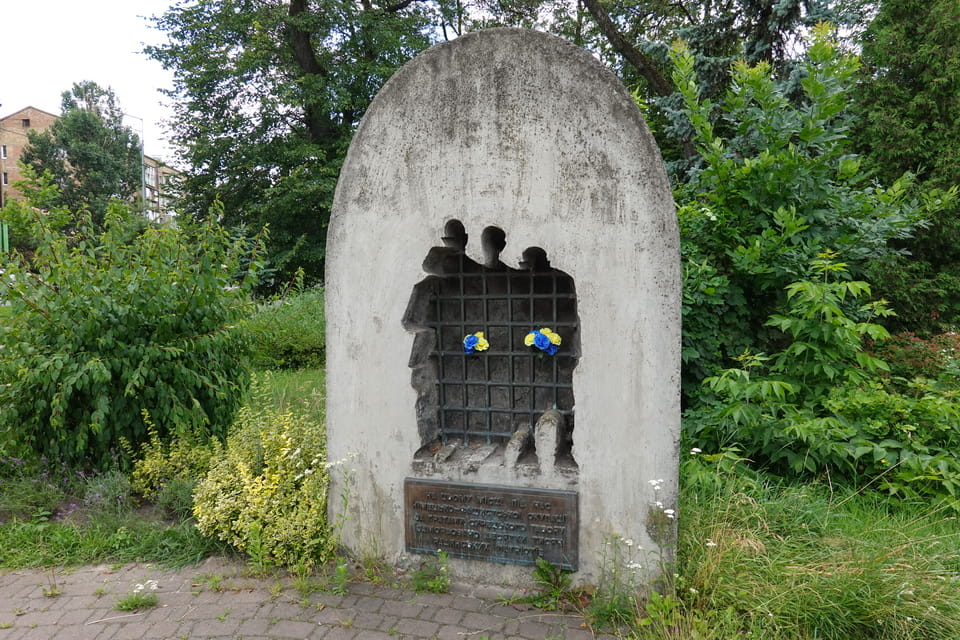
Back in the 1960s, the area was predominantly populated by the workers of the neighboring enterprises, and the 1970s complemented the contingent with a ‘layering’ of the intelligentsia, due in no small part to the construction of the TV center on the site of the demolished Jewish cemetery. As early as 1963, a school №24 was put into work roughly at the site of the former road to the ‘men’s area inside the camp. In 1991, a ‘Memorial sign to Syrets concentration camp prisoners’ was commemorated to the South of the actual perimeter of the Syrets camp (in fact, just beyond it: it should not be regarded as an error), and the year 1999 witnessed the inauguration of the memorial to Dynamo players at Grekova street.
SYRETS CONCENTRATION CAMP TODAY: WHAT REMAINS, MEMORIALS, AND HOW TO VISIT
What remains today
Of the Syrets concentration camp today, which covered approximately 0.55 square kilometres between what are now Olena Teliha Street (east), Dorohozhytska Street (south), Volodymyr Salskoho Street (north), and Ryzhska Street (south-east), nothing physical survives. The entire territory is covered by five-story Soviet residential buildings constructed between 1953 and 1965, as well as a park and the Syrets metro station (opened 1980). The former main gate stood at the intersection of modern Olena Teliha Street and Dorohozhytska Street. The approximate centre of the former fenced perimeter is now a residential courtyard bounded by Ryzhska, Olena Teliha, and Shchuseva Streets.
The Memorial Sign (1991)
A memorial sign was erected in 1991 to the memory of the Syrets concentration camp prisoners, located just to the south of the former camp perimeter — on the corner of Dorohozhytska Street and the park path, near the Dorohozhychi metro station. GPS coordinates: 50.470093°N, 30.443303°E. The sign, photographed in this article, bears an inscription in Ukrainian and is accessible year-round, free of charge.
German POW Cemetery near Syrets Metro Station
Approximately 350 metres north-west of the Syrets metro station, near the former western perimeter of the concentration camp, a small German POW cemetery survives. It is one of the few remaining of the 70 German prisoner-of-war cemeteries established in the Kyiv area between 1944 and 1949. The cemetery contains simple, uniform stone markers and is kept in quiet, maintained condition. I visited in person during research for this article and found no other visitors.
Getting there:
- Metro: Dorohozhychi station (Line M3, Green Line) — 5-minute walk to the memorial sign. Syrets station (Line M3) — 10-minute walk to the former camp perimeter and the German POW cemetery.
- By foot: from Babyn Yar National Historical and Memorial Reserve, approximately 15 minutes east along Olena Teliha Street.
Nearby WW2 sites to combine:
- Babi Yar Memorial Complex (5 min walk)
- Dorohozhychi Cemetery and Lukyanivka Orthodox Cemetery (adjacent)
- Jewish Cemetery on Melnikova Street (10 min)



I am very grateful to war archives, museums, libraries, private collections, and writers for the historical photos in this article. To the extent that some author or a copyright owner may not want some of the above black-and-white photos to be used for educational purposes here, please get in touch with me for adding credits or deleting the pictures from the article.