

Triumph of the Will analysis: Riefenstahl’s Cinematography
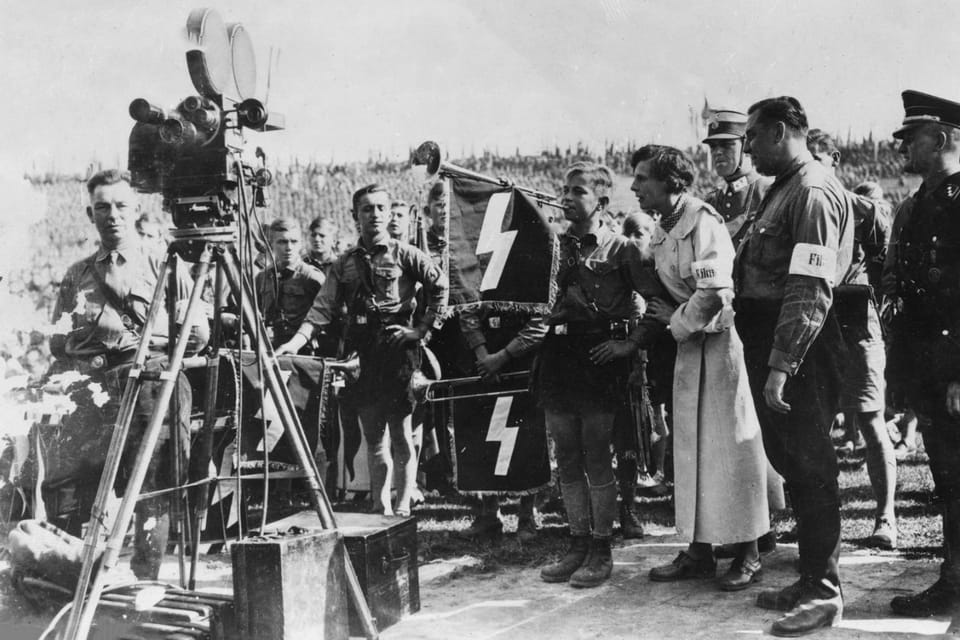
Leni Riefenstahl had thirty cameras, 172 people, and a city rebuilt for filming. The 1934 Nuremberg rally was designed around her lenses: pits were dug for low angles, a lift was built up a flagpole, rails were laid so cameras could move with the marching columns, and the Nazi Party’s own architect drew the arena as a set. She came back with 61 hours of footage and spent five months alone in the cutting room before Triumph of the Will saw the light.
What she produced is the reason this film is still taught. Not because of what it says — Hitler’s speeches in it are unremarkable — but because of how it looks: the camera almost always below him, the crowds always geometric, the cutting always on movement. Everything that later became the visual grammar of political spectacle is here, invented or perfected in six days in September 1934.
This article goes through the film in order, twelve sequences with timecodes, and asks of each one the same question: what was it built to do? Before that, three chapters on how the film came to exist — who Riefenstahl was, how the shoot was organised, and the three motifs the whole thing rests on: Hitler as a figure descending from the sky, the nation as a single body, and strength as the proof of legitimacy.
It won the German Film Prize, the gold medal in Venice in 1935, and the Grand Prix in Paris in 1937. It was banned in Germany after the war and is in the public domain in the United States.
WHO LENI RIEFENSTAHL WAS: DANCER, ACTRESS, AND THE DIRECTOR HITLER CHOSE
Helene Bertha (hence Leni) Amalie Riefenstahl was born on August 22, 1902, in Berlin. As early as being a young woman, she linked her life with educational art, but her dreams were directed toward presenting herself on a stage as a professional ballet dancer and actress. Leni was so talented and passionate about art that she succeeded in composing her own dance variations and even sewing costumes for performances. This talent did not go unnoticed, and young Leni Riefenstahl fell under the spotlight of Max Reinhardt, an iconic theater director, who later made her a celebrity thanks to performances at the ‘Deutsches Theater‘. By the age of 24, Leni, as her relatives and colleagues already used to call her, had managed to sell out concert halls in all major theaters in Europe. However, a serious knee injury cast an ominous shadow over the future of Riefenstahl as a professional dancer, who now had time to think about her perspectives elsewhere.
While getting through this challenging period of her life, driven by depression and existential thoughts about the future, Leni Riefenstahl came to see one of the so-called “mountain films.” Representing a combination of a documentary on skiing and adventure history, these films delighted and inspired the young creative nature of Riefenstahl. When the clouds of uncertainty cleared away, the young woman an offer from the very same director, Max Reinhardt, to try herself as an actress in the romantic tragedy called ‘Penthesilea.’ Despite the obvious prospect, Leni favored making her debut as a film actress in the production of a new “mountain film” directed by Arnold Fanck.
Although the director preferred to work with professional athletes, Leni Riefenstahl’s athletic character and dance experience made her an undisputed favorite for leading female roles for Fanck. Over the next six years, from 1926 to 1931, Leni Riefenstahl performed key parts in five “mountain films”, the documentaries by Arnold Fanck. The experience gained was invaluable in shaping the creative perception of her mindset. The very contrast of the physical and spiritual components of the “mountain films” of the 1920s will help to form a similar directorial vision in “Triumph of the Will” (Triumph des Willens) and especially “Olympia” years later.

Having gained confidence in her creative powers, Leni Riefenstahl, a twenty-nine-year-old actress and former dancer, founded her own film company already in 1931. The debut work, which materialized as early as the next year, was the ‘Das Blaue Licht” (Blue Light) mountain film, which transformed an established genre of entertaining melodrama into a creative breakthrough of Riefenstahl’s camera, directorial, and editing genius. It was because of this very debut that Leni Riefenstahl, as a director, came to notice Adolf Hitler, who fought actively for unitary power in Germany that year, against the backdrop of a severe economic crisis.
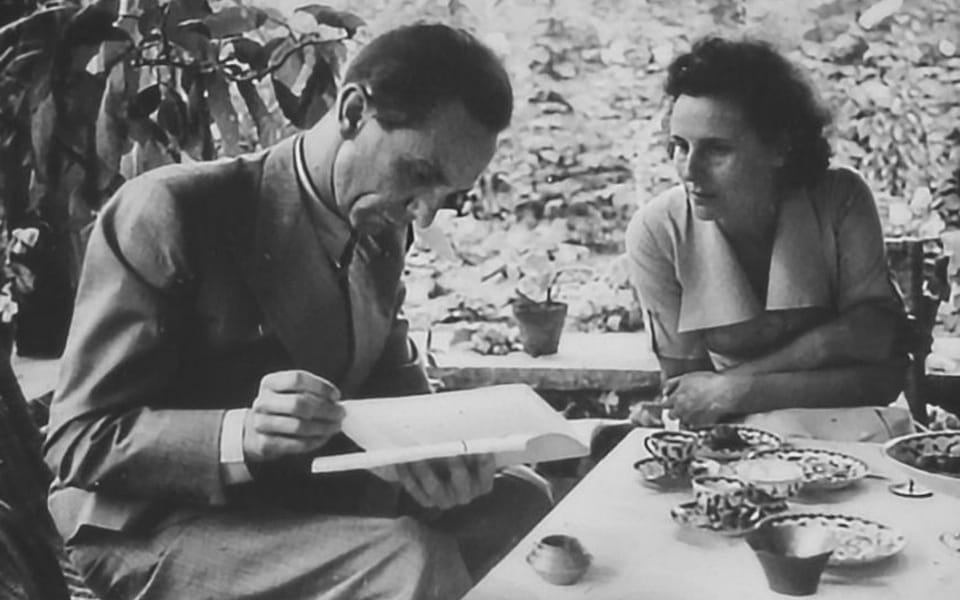
By that very moment, Adolf Hitler stood in the window in front of the public as a new German chancellor on January 30, 1933; he had arranged several meetings with a young woman director, discussing her ”Das Blaue Licht”. Director Leni Riefenstahl believed in the promise of a new leader to lead the country to prosperity, but enthusiasm coexisted with the fear of becoming the victim of the destruction of independent German cinema. The newly created Ministry of Propaganda, supervised by Joseph Goebbels, established a full dictatorship over the whole German filmmaking process within a short time. The young creator had a choice to leave her homeland in search of creative freedom or to remain in Germany. Leni Riefenstahl chose the second option, retaining, as time will tell, almost complete freedom of professional self-realization. The fact that Riefenstahl’s documentary films, including “Triumph of the Will” (Triumph des Willens) and ‘Olympia ‘, were released by an independent film company with her name in the title is amazing, and Leni herself had not put her on a Nazi party badge.

BEHIND THE SCENES OF THE ‘TRIUMPH OF THE WILL’. HOW IT WAS SHOT: 30 CAMERAS, 172 PEOPLE, 61 HOURS OF FOOTAGE
In late August 1933, just a few days before the upcoming Congress of the Nazi Party in Nuremberg, Leni Riefenstahl was invited by Hitler to discuss her directing role in the filming of the upcoming event. This short preparation time stemmed from Minister Goebbels’s prejudice against a young and, as he saw it, insufficiently experienced and not controlled enough female director. Goebbels ignored the request of his Führer to bring Riefenstahl to cover the event. Without the party’s help, Helena, young and full of creative ambition, shot several kilometers of film in Nuremberg. Despite her objections and dissatisfaction with the quality of the material, Hitler ordered the editing of the film; however, through the Ministry of Propaganda. This little-known film called ”Sieg des Glaubens” (Victory of Faith) was completed by December 1, 1933, and the name of Riefenstahl, at her request, was not even mentioned in the credits. Due to the participation of Ernst Röhm, now both ex-national hero and present traitor, all copies of the ‘Victory of Faith’ film were subsequently seized after the ‘Night of the Long Knives,’ and the only copy was accidentally discovered and made public only in 1986.
This first kind of failure in the arena of big German cinema only confirmed the determination of Adolf Hitler to entrust Riefenstahl with the creation of a film about the next Party Congress in 1934. The film was supposed to be created entirely through the documentary studio of Leni herself, according to the assurances of Hitler, with the full support of power and without the intervention of Goebbels. The director was also granted complete control over the final editing.

The upcoming Nazi Party Rally in Nuremberg in 1934 was to become the largest event in German history and attract more than 700,000 guests to this city, ‘saturated’ with the spirit of national history. Given the number of events and their scope, it is surprising that Leni Riefenstahl, as a director, had only two weeks to prepare for the shooting of the Triumph of the Will (Triumph des Willens). It was her later version, though she actually got the order five months before the start of the shooting. An impressive crew of 172 people was assembled, who were to use 30 cameras for the film. The cameramen were dressed in SA uniforms so that they would not stand out from the crowd in the panoramic shots. Hereafter, there is a more detailed list of all the people involved in the filming of Leni Riefenstahl’s Triumph of the Will.
36 cameramen and assistant camera operators
9 aerial photographers
10 technical staff responsible for the equipment
29 members of the newsreel team who filmed additional material
17 lamp men
2 photographers filming the process of working on the film behind the scenes
26 drivers
37 security guards from the SA, SS, and police
6 office workers.

Even at the recruitment stage, Leni Riefenstahl had to rely on the personal experience and intuition of her cameramen. Before the filming of The Triumph of the Will (1935), the director gave the advice to rely on creative flair and to focus on key events, leaving low-level events out of the frame. Within the following seven intensive days of work, there was no clear coordination between the different parts of the film crew, and often the cameramen were left to themselves. Despite the assurances of the full support of the event organizers, Riefenstahl faced a mass of bureaucratic obstacles, and individual solutions became possible only through the personal intervention of Rudolf Hess, deputy Führer, who provided the installation of camera cranes and rails.
With the involvement of an incredible effort, 61 hours of material were filmed from almost all possible angles and perspectives, including airplanes, airships, cranes of fire engines, and moving cars. The amazing artistic intimacy of the individual shots that burst into the personal space of the participants of the Nazi Party Rally in Nuremberg remained unknown to most of them. The process of editing Triumph of the Will took Leni Riefenstahl a full five months to complete the documentary. All the music was recorded within the studio in just three days, with only a small part of the speech of Julius Streicher having to be re-recorded to complete the sound design.
The total expenses of filming the Triumph of the Will (Triumph des Willens) were 280,000 German marks. The premiere took place on March 28, 1935, within the largest Berlin theater called UFA-Palast am Zoo. It was attended by senior government officials, and for Adolf Hitler himself, this was the first viewing of the finished material. The film distribution was carried out by the UFA film company, which sympathized with the new Nazi government, but was outside its direct control. Although the premieres in the major cities of Germany were successful, ’Triumph of the Will’ (Triumph des Willens) did not have a wide resonance among the German people and was not actively used for propaganda purposes for years. Despite the biased attitude and the unwillingness of Joseph Goebbels to provide active support, he recognized the work of Leni Riefenstahl and, on May 1, 1935, awarded the film the National Film Award.

Why the film is called «Triumph of the Will»
The rally itself had a different name. The sixth NSDAP congress, held in Nuremberg from 5 to 10 September 1934, was officially the Reichsparteitag der Einheit und Stärke — the Rally of Unity and Strength — and that is the name under which it appears in the party’s own documents and in the Bundesarchiv captions to this day.
The film’s title came from somewhere else. Hitler chose it himself, and he chose it as an allusion to Nietzsche’s Wille zur Macht, the will to power. The Nuremberg Documentation Centre states it flatly — the title comes from Hitler — and German film scholarship treats the Nietzschean reference as the accepted account of it.
That matters for how the film reads. «Will» here is not personal determination and not Riefenstahl’s word for her own effort. It is a claim about the nation: that what the viewer is watching is not an event being staged but a collective act of will made visible, and that the man on the podium is its embodiment rather than its author. Every technique described above serves that claim. The low angle makes him larger than the frame; the moving camera makes the crowd a single body; the editing makes both look inevitable.
The title also completes a sequence. Riefenstahl made three rally films, and Hitler named them in a rising order: Der Sieg des Glaubens — the Victory of Faith — about the 1933 congress; Triumph des Willens about 1934; and Tag der Freiheit! – Unsere Wehrmacht, the Day of Freedom, about the army at the 1935 congress. Faith, then will, then freedom. Read in order, the three titles are a compressed political programme, and the middle one is the point at which the party stops asking to be believed and starts claiming to have already won.
The cinematography: what Riefenstahl actually did
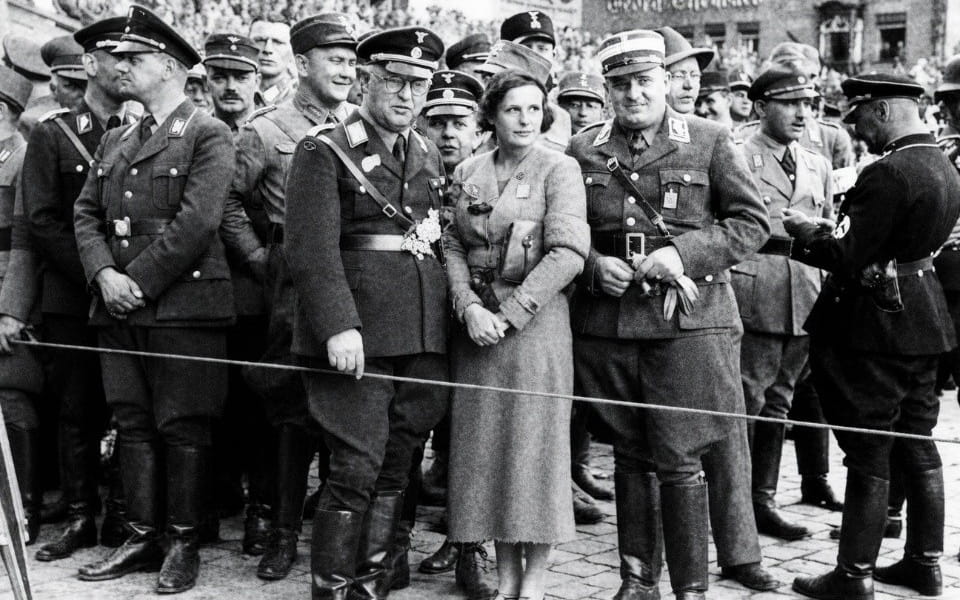
The reputation of Triumph of the Will rests on its camerawork, and almost every decision about that camerawork was made before a frame was exposed. Hitler commissioned the film in April 1934, five months before the rally. That lead time is the single most important fact about the production, because it meant the event could be built around the cameras rather than filmed as it found them.
Albert Speer, who was designing the rally grounds, and Riefenstahl worked to the same plan. Pits were dug in front of the speaker’s platform so that a camera could shoot Hitler from below the level of his feet. Rails were laid along the parade route and around the podium. A small lift was fitted to one of the flagpoles on the Zeppelinfeld, so a camera could rise and fall beside the standards during the massed scenes. For one of Hitler’s speeches, a circular track was built so that the camera could travel around him while he spoke — a solution to a problem the material itself created, since the speech, as Riefenstahl later said, had only two themes and nothing in it moved.
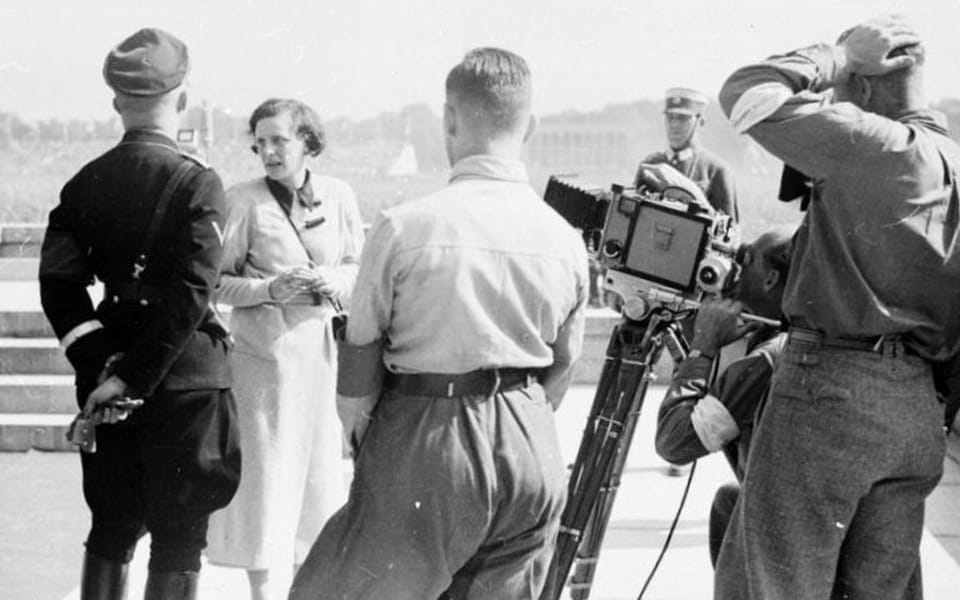
The crew. Photographic direction was in the hands of Sepp Allgeier, who had shot the mountain films Riefenstahl acted in for Arnold Fanck and knew how she thought about landscape and figures. Under him were eighteen cameramen — among them Walter Frentz, later Hitler’s personal cameraman — and their assistants, thirty-six people in the camera group alone out of a total crew of 172. Thirty cameras were in use. The operators wore SA uniforms so that they would not break the geometry of the panoramic shots, which is itself a directorial decision: the film was to contain no evidence that it was being made.
Five techniques, and what each was for
1. The low angle. Hitler is filmed from below in almost every sequence in which he appears, and the pits made the angle steeper than a tripod on the ground could achieve. The effect is not subtle and was not meant to be: the viewer is placed in the position of the crowd, looking up. What makes it work is the consistency. Where the camera does look down — on Göring, on Goebbels, on the massed columns — it does so from Hitler’s own eyeline. The hierarchy of the regime is encoded in the height of the lens.
2. The moving camera. By 1934, tracking shots were not new, but nobody had used them at this scale on a documentary subject. The rails let the camera march with the columns instead of watching them pass; the flagpole lift let it climb out of the crowd. The effect is that the viewer is never a spectator at the edge of an event — always inside it and always moving with it.
3. The telephoto lens. Long lenses were used to pick single faces out of crowds of a hundred thousand — a young man in the Labour Service ranks, a woman at a window, a child on a shoulder. The famous intimacy of these shots was a product of distance: most of the people isolated in close-up had no idea they were being filmed. This is the technique that gives the film its unsettling quality, because it makes an anonymous mass out of individuals and then reaches back into it to pull one face out.
4. The aerial and elevated positions. Cameras were mounted on aircraft, on an airship, on the ladders of fire engines and on moving cars. The opening sequence — the plane descending through cloud over Nuremberg — is the most quoted result, but the elevated positions matter most in the parade and arena scenes, where they turn a hundred thousand men into a pattern.
5. The editing. Sixty-one hours of material became 114 minutes, a ratio of about thirty-two to one, over five months in the cutting room. Riefenstahl cut it herself. The clearest evidence of what she was after is the parade sequence of the eleventh scene: she gave it to an assistant, looked at his version, judged it too static, and recut it from scratch. In the released version, the angle changes almost every time the composition threatens to settle, and something is in motion in nearly every frame — the marching men, the camera, or both.
The sound. Almost nothing you hear was recorded where you see it. The score is by Herbert Windt, one of the most sought-after film composers in Germany at the time, and it was recorded in a studio in three days, weaving party songs, folk melodies, and Wagner into a continuous line. Only a fragment of Julius Streicher’s speech had to be re-recorded to complete the sound design. The crowd noise, the boots, the cheering — all of it was assembled afterwards. The film’s soundtrack is a construction of the same order as its images.
What Riefenstahl did not invent. This is worth saying plainly, because the film’s reputation tends to swallow the question. Rhythmic montage of masses was Eisenstein’s, and Riefenstahl had seen his work. The city symphony — a day in the life of a place, cut to music, built from movement — belonged to Walter Ruttmann, whose Berlin: Symphony of a Great City came out in 1927. Ruttmann is credited as a co-writer on Triumph of the Will; he shot a prologue on recent German history that was cut from the final version. The worker silhouetted against the sky, the low horizon, the body as landscape — those came from the mountain films Riefenstahl had spent six years acting in for Arnold Fanck.
What was new was the scale, and the fact that the event existed to be filmed. Eisenstein reconstructed history after it happened. Ruttmann photographed a city that was going about its business. Riefenstahl was given a city rebuilt to her specification, a hundred thousand people willing to stand where they were told, and five months to plan it. That is the thing that has never been repeated, and it is why the film is still on the syllabus.
THE THREE MOTIFS: HITLER AS MESSIAH, THE NATION AS ONE BODY, STRENGTH AS PROOF
THE PRESENTATION OF HITLER. The presentation of Adolf Hitler is the key narrative motive of the Triumph des Willens movie. Just as in the works of Wagner, who inspired the Nazi movement and the Führer himself, Riefenstahl plays on heroic motives, showing life as a sublime heroic struggle. Adolf Hitler appears to the audience as the MESSIAH, the embodiment of the ancient Germanic myths, which will lead his nation to the greatest glory within the following centuries of world history. The ‘main character’ of the film appears from the clouds, and some shots of him are taken against the sun’s rays or with the moving clouds. Riefenstahl represents this contrived world of the country’s leadership, similar to the mythical Valhalla – the palace- where Hitler and his entourage appear as gods.
The musical accompaniment accompanying Hitler through the scenes of the film is a creative mix of party songs, folk art, and explicit inspiration from Richard Wagner. Hitler is shown at the same time as a man of the people, who do not forget to mention this in his speeches, and as a man above the people at the same time. The Führer speaks in the stands, towering above the heads of those present and even his closest party circle. He is represented by hundreds of thousands of participants, and they, in turn, are represented by the Führer. The camera almost always captures Hitler from the bottom up, while the crowds and the Nazi elite most often form the upper angle.

NATIONAL UNITY. While the key motive of Leni Riefenstahl’s Triumph of the Will 1935 movie is the presentation of Hitler as the spiritual and political leader of the German people, the nation itself is represented by a single and coordinated desire to find that very heroic future. Throughout the ‘Triumph of the Will (Triumph des Willens) film, diverse groups of people appear within the frame. Marching soldiers, SA stormtroopers, and SS soldiers. Citizens of the city of Nuremberg are looking out from the windows. Peasant families brought the fruits of their labor to the Party Rally. Boys, the flower of a nation that will lead it into a bright future. The fighters of the Labor Front, who will provide Germany with their future zeal, with a shovel in their hands. Even women in a crowd of pedestrians on the streets watch the action.
According to the film, the 1934 Party Congress (known as the Nazi Party Rally) was not a platform for resolving political issues, a referendum or debate, or the announcement of specific decisions that may influence the nation soon. This second Congress, after Hitler came to power in 1933, was challenged to demonstrate national unity and specifically the approval of national socialism by the whole nation. This cinematic effect is achieved by a variety of groups of people in the film, demonstrating where someone came from. And, of course, the speeches of the party officials, and especially Hitler, are replete with assertions about this very national unity, which, in their opinion, has already become a reality.

STRENGTH. This motive of the film is inextricably linked with the presentation of Hitler and the picture of the unity of the nation. On the one hand, we see the Führer, who demonstrates his unquestioning will in front of his subordinates and the whole nation. No matter how well people know Göring, Goebbels, Hess, or Lutze. Hitler stands above them all. Architects such as Albert Speer are making incredible efforts in the design of the territory of party conventions. Images of the eagle and the swastika often dominate the scene in monumental constructions and stone forms, referring the viewer to the ancient myths about heroes and history, such as the best times of the Roman Empire.
Despite the fact that at the time of the party’s congress in September 1934, the German rearmament program was only at its initial stage, the parade of the armed forces makes the viewer understand that the country will once again have unparalleled military power. Although the military criticized the work of Riefenstahl, as it seemed to them, an insufficiently heroic image of the German army, we see enough scenes that show the still-limited Reichswehr in the best light. Even the parade of 52,000 Labor Front soldiers symbolizes the future military force, as if their tools were not shovels, but rifles. The multi-thousand parades of the SA and SS fighters are also called upon to demonstrate the inner strength of the system, the party, and Hitler personally, to whom all these formations are faithfully loyal and devoted.

TRIUMPH OF THE WILL, SCENE BY SCENE: THE FULL ANALYSIS
PROLOGUE. The introduction of the film is the only example of a voice-over explanation of what is happening with the narrator’s participation. Inscriptions of the documentary narrative appear on the stone slab.
A documentary film about the 1934 Party Congress
Created on the Führer’s personal order.
Movie by Leni Riefenstahl
September 5, 1934
20 years since the beginning of World War
16 years since the beginning of the sufferings of the German people
19 months after the start of the revival of Germany
Adolf Hitler flies to Nuremberg to greet the columns of his loyal followers

The party congress of 1934 (Nazi Party Rally), which received the loud designation as the “Congress of Unity and Strength” (Reichsparteitag der Einheit und Stärke), was held from 5 to 10 September 1934. Four main days, from the arrival of Adolf Hitler in Nuremberg to the closing of the event by Rudolf Hess, were included in the Triumph of the Will 1935 movie. In addition to the introduction, it is customary to make a Triumph of the Will analysis through the twelve key scenes.

SCENE 1. THE OPENING SCENE: HITLER’S PLANE OVER NUREMBERG
The opening prologue, with inscriptions appearing on a stone, an eagle, and a swastika, under the variation of the Nazi song ’ Horst Wessel’, proceeds to an airplane appearing within the frame. The viewer does not see the pilot, especially his high-ranking passenger. With the means of emotional symbolism, director Leni Riefenstahl brings together the images of the EAGLE, the SWASTIKA, and the FUHRER. While the air transport of Hitler dominates over the clouds and sunlight, the editing is replaced by shots of the crowds of people flocking to Nuremberg. The culmination of this scene is the shadow cast by the plane, symbolically an eagle and the Führer himself upon the German people, welcoming the followers.
After the shots of the airplane filled with mysticism and symbols, we can observe Hitler himself, facing the public. The visual narration presents us with its main character – the central part of the entire Nuremberg Congress. In a scene when the Führer motorcade moves through the streets of the city of Nuremberg, he is presented as the long-awaited Messiah of the German people, receiving enthusiastic applause, smiles, and even flowers from a little girl. Sunlight breaks through his palm raised in the Nazi salute, and it seems that even a cat on the windowsill of one of the houses is waiting for a chance to see the leader of the nation.
Whether during the movement of the convoy, the crowd in the background was mostly out of focus of the camera, shifting the focus of presence on Hitler; now we see his soldiers. The new leader of the nation and the future dictator of the Third Reich enters Nuremberg like a CONQUEROR, welcomed by not only ordinary citizens but also his soldiers, on whose loyalty and strength he relies and hopes in the future. In these scenes at the Hotel Deutscher Hof, the effect of the presence of the Führer only increases.

SCENE 2. NIGHT AT DEUTSCHER HOTEL IN NUREMBERG
Night scene at the same Deutscher Hof hotel, where the crowd of people raging with delight continues to fill the street. The cameras of Leni Riefenstahl depict flags in the light and shadow that appear from the windows of houses. In this scene, “Triumph of the Will” (Triumph des Willens) focuses on another symbol of the national mood, in addition to the swastika and the eagle. Hitler, along with his retinue, listening to a musical performance, standing on the balcony, and the people marching with torches below identify those hundreds of thousands who will, in the following days, take part in the party congress.

SCENE 3. Morning in Nuremberg and the Camps
After the solemn meeting of his Führer and the night, the city of Nuremberg awakens. With the music of Richard Wagner, the camera wanders among the monumental buildings, hung-out party flags, and reflections of ancient architecture in the waters of the river. Then the perspective is replaced by shots of the tent camp, which received hundreds of thousands of guests arriving in Nuremberg these days. With the awakening of men, their morning routine, and mutual assistance, the atmosphere of national unity is growing – one of the key leitmotifs of the Triumph of the Will movie by Leni Riefenstahl. The panorama of men is replaced by youth activity and games, and afterward by good-natured German residents, who express their support for what is happening, not only by their presence but also by the gifts of the harvest. In the following scenes, when Hitler receives gifts from his enthusiastic followers, Riefenstahl conveys the symbolism of their devotion and work in the name of Germany and the Führer personally, which is now becoming one concept. Hitler’s shaking hands symbolize that he is not only a NATIONAL LEADER but also one of them, a MAN OF THE PEOPLE.

SCENE 4. A MANIFEST OF POLITICAL SPEECHES
The fourth scene of Leni Riefenstahl’s Triumph of the Will slows down the pace initiated in the introductory part, in favor of a measured atmosphere of political speeches. Each of the speakers of the Nazi Party, declaring before his faithful colleagues in the Congress Hall of Nuremberg, expresses his vision of national politics and unity. These speeches do not give voice to revolutionary ideas, no calls for revolution, and no hint of racial and military policy, which Germany will soon embark on.
The first speaker is Rudolf Hess, the Führer’s party deputy. He opens the 6th Party Congress with words of reverence for the deceased president and former field marshal Paul von Hindenburg, who had passed several months earlier. Shots with Hess, dressed in the form of stormtroopers, are contrasted by images of banners, flags, eagles, and swastikas, which covered the walls of the Congress Hall. He is followed by ten more Nazi speakers, each of whom builds his speech on the themes of UNITY, hopes for PROSPERITY, and recognition of the national PROGRESS by the means of the NSDAP. It is noteworthy that the final montage has included the performances of the ten Nazi elite speakers not only from this first session but also on the other days of the 6th Party Congress. Here is a list of speakers who spoke after Rudolf Hess.
Adolf Wagner. Gauleiter of Munich and Bavaria. SA Obergruppenführer.
Alfred Rosenberg. Party ideologue. Head of the Foreign Policy Department of the NSDAP
Otto Dietrich. The chief of the press and the press secretary of the Nazi Party.
Fritz Todt. Inspector General for the construction of roads.
Fritz Reinhardt. State Secretary of the Ministry of Finance. Head of the oratory school at the NSDAP
Walther Darré. Minister of Agriculture. Head of the Department of Agrarian Policy of the NSDAP.
Julius Streicher. The publisher of the “Der Stürmer” right-wing magazine. Gauleiter of Franconia
Robert Ley. The leader of the Labor Front.
Hans Frank. Minister of Justice
Joseph Goebbels. Minister of Propaganda.
Konstantin Hierl. Head of the Imperial Service of Labor.

SCENE 5. Reich Labour Service (RAD) Rally on the Zeppelinfeld
The speeches of the party leaders within the large building of the Congress hall are followed by the majestic arena of “Zeppelin Field”, where soldiers of the Imperial Labor Service were called to form. Konstantin Hierl, their functional superior, accompanies Adolf Hitler to the podium and announces that 52,000 Labor Service soldiers are awaiting orders from the Führer. Whereas we see shovels in their hands, the general mood of the scene, given the nature of the organization itself (each young man in the future will have to spend half a year in the Imperial Service of Labor), remains militant. Hitler and Hierl are watching the verbal roll call of individual soldiers who came from different parts of Germany: Bavaria, Pomerania, Königsberg, Silesia, Dresden, and then from the bank of the Danube. After honoring the memory of those killed in the Great War (First World War), Hitler assured young people that their service forms the basis of the new Germany and that every German would take the honor of participating in their ranks soon after.

SCENE 6. SA Night Rally: Torchlight Parade and Viktor Lutze’s Address
And again the night scene imprints party symbols, banners, flags, and marching rows of stormtroopers with darkness and light. As the dramatic atmosphere grows, Adolf Hitler and the new leader of the SA, Viktor Lutze, both emerge from shadow and light. Within a short speech, Lutze assures the assembled comrades that he remained the same stormtrooper who had marched with them in the first years of the movement. At the same time, Lutze, the survivor of ‘The Night of Long Knives’, towers above his fellows, and Leni Riefenstahl depicts this superiority of the leader over the crowd. The emphasis is shifted to the dominance of fire, as a symbol of the blood brotherhood of the Nazi stormtroopers, which was mysteriously tempered and historically forged in the fire of revolution. A variety of pyrotechnics elaborates on the mysticism of what is happening.

SCENE 7. Hitler Youth Rally at the Stadium: Hitler’s Speech to the Youth
A dark and gloomy night scene with the torch marches of the SA stormtroopers gives way to the German youth meeting full of sunshine. Unlike the ‘old-timers’ of the party, hardened by the revolution, we see blond youths of Aryan appearance, with young, fresh faces who had not experienced the trenches of the Great War and street fights during the Nazi party’s struggle for superior power in Germany. After the public enthusiastically welcomes the appearance of Adolf Hitler, Baldur von Schirach, the Fuhrer of the Third Reich youth, introduces Adolf Hitler to his young admirers. The leader of the nation appeals to the youth, emphasizing their role in building a great future of prosperity and dignity. It should be noted that Hitler addresses young men and women, yet we don’t see female faces within the crowd.

SCENE 8. The Reichswehr Review: Cavalry and Armoured Vehicles
After the previous scene and thoughts about a bright future and peace, Hitler, Goering, and General Blomberg (Field Marshal since 1936) overview a military parade in Nuremberg. The shortest scene in the propaganda Triumph of the Will by Leni Riefenstahl was edited to be short-lived due to the bad weather and the transience of the event itself (not due to some personal anti-military beliefs of Riefenstahl). The contrast between cavalry and soldiers in modern combat vehicles reflects the interwar years and the upcoming large-scale rearmament program. In one of the few moments within the film, Adolf Hitler smiles and even laughs, watching the armed forces that are still far from gaining power but who had recently brought him a personal oath of allegiance.

SCENE 9. Night Rally of Political Leaders: Albert Speer’s Cathedral of Light
At the end of the same day, 180,000 party members and a quarter of a million guests from all over Germany packed Zeppelin Field, uplifting an incredible number of 21,000 standards with a swastika into the air, welcoming their Führer Adolf Hitler. The propaganda refers directly to one of its key motives – the personality of Hitler, as the leader of the nation and the Messiah. The Führer dominates the scene and the faceless mass, hidden by darkness and flags, from his high pedestal. We see a wooden eagle behind him. Adolf Hitler appeals to the nation and refers to PROVIDENCE and FATE, which joined the ranks of the Nazi Party for the sake of a bright future for Germany. Hitler ended his speech with an appeal to take an oath from now on, every day and every hour, to think about Germany, the Reich, and the people. His last words are ‘Sieg Heil’’.
While the list of affairs of Hitler at the Party Congress was limited to meetings with the Nazi elite and speeches, Riefenstahl gives us a picture of the leader of the nation. A man who does not just fly on a private plane to Nuremberg, settle in a luxury hotel, take a motorcade, and speak from the podium. Within the movie, he gives the nation a VISION of their future, gives a MEANING to their existence, and puts OATHS in their hearts and heads. The camera depicts the speaker from various angles, most of which are lower. We rarely see Hitler full-length within the film. He delivers his speeches on a large tribune, towering above the faceless dark public, and the camera looks up at him, snatching a palette of emotions from a pretentious seriousness to the charm of a man of the people. The long distance to the microphones seems to demonstrate that the Führer does not need them to loudly reach out to hundreds of thousands of people present.

SCENE 10. Memorial Ceremony at Luitpoldarena: Honoring the WWI Fallen
With the onset of the next morning, a mass ceremony gathers at the Luitpold Arena, in the western part of the territory of the Nazi Rally in Nuremberg. Ehrenhalle, a memorial hall for soldiers killed in World War I, shapes one side of the field. On the other, there is a grand stage for performances decorated by Hitler’s architects (in particular, by young Albert Speer) with three large banners with a swastika, reliefs in stone, smaller party flags, and eagles.
The camera depicts the panoramic grandeur of 97,000 members of the SA and 11,000 members of the SS in black uniforms gathered here at the calling of their Führer. Only three months earlier, the “Night of the Long Knives” eliminated the danger for Hitler from the stormtroopers, and the Luitpold parade once again testifies to the unity of the nation. While the camera focuses on the far background, we see three figures crossing the arena from the podium towards the Ehrenhalle memory hall. Even though the Triumph of the Will camera shoots them only in a distant panoramic perspective, the viewer recognizes Adolf Hitler, SS head Heinrich Himmler, and the new head of the SA, Viktor Lutze. The columns of one hundred thousand men form an open path in the middle of the arena, and the three leaders give honor to those killed in the Great War. The final montage includes frames shot by Leni Riefenstahl herself with one of the cameras.
After laying wreaths on the war memorial, Hitler, Himmler, and Lutze slowly return to the podium on the other side of the Luitpold field, and the soldiers turn to face their new location. The leaders of the SA and SS occupy a seat on the sides of the main tribune, where Adolf Hitler reviews a parade of his loyal formations. Lutze appeals to Hitler with the assurance that the members of the SA movement will proudly fulfill any order of their Führer. Then Hitler himself addressed the assembled public. In abstract terms and meaning, he refers to those who unsuccessfully thought to shake the greatness of the SA and speaks about that great shadow that hung over Germany but was overcome.
Following his speech, Adolf Hitler proceeded to the flag consecration ceremony. He moved along the line of the stormtroopers with his standard, known as the ‘blood flag‘. This part of the Nazi party legend refers to the failed seizure of power in November 1923, known as the “Beer Hall Putsch”. Hitler personally touches the corner of the standards with his flag, looking into the eyes of every soldier who holds the symbol. The drama of the scene distinguishes these men from the total faceless mass that holds their flags. Shots are then followed by scenes of shots from the guns.

SCENE 11. The Grand Military Parade Through the Streets of Nuremberg
Nazi Rally celebrations again move the primary location from the territory of party rallies in the south of the city to the streets of Nuremberg itself. The emphasis remains on Hitler, but no longer as the spiritual leader of the nation and the unquestioning inspirer of the party, but as the MILITARY LEADER. The Führer is once again separated from other people, including the Nazi officials and party comrades, by an open space behind him. Holding his hands close to his chest, Adolf Hitler reviews endless rows of marching admirers, first from a moving car, and then in a state of static contemplation. The camera perspective shows the Nazi elite, including Göring and Goebbels, who are visually ‘under’ Hitler, and the cameraman shot them from the upper point. The Führer always appears above the crowd, and the camera follows his movements and facial expressions bottom-upwards.
Leni Riefenstahl, as a director, was busy at all stages of the production of the Triumph of the Will, commissioned the editing of this parade scene to one of her assistants, but later abandoned his variant in favor of her own. The director considered the suggested variant too static – not what she wanted to achieve. The final version of the montage involves a constant dynamic change of angles. The cameras not only allow the viewer to watch the parade within the streets of Nuremberg but also to become its participant. The perspective of shooting is constantly changing, from different angles, from windows, at eye level, above and below, and from moving machines and cranes. Moreover, the composition of the frame itself is also in constant motion.
Hitler reviews a parade of his army, his stormtroopers, members of the Labor Front, and SS soldiers, who, through an endless march (as the movie wants to show), parade near their leader. Just as at the beginning of the movie, we can observe the residents of Nuremberg and thousands of guests who watch the procession and support it out of the windows, from sidewalks and hills. Remarkably, the frame shows an artistic contrast between courageous men, members of the procession, and women and civilians, who are watching them with awe and admiration, standing on both sides of the road. Of course, the parade scene symbolizes the UNITY of the nation in consensual support of what is happening.

SCENE 12. Closing Ceremonies and Hitler’s Final Speech at Luitpoldhalle
The final part of the Triumph of the Will analysis reflects the final mass meeting and closing ceremony of the NSDAP Party Congress in 1934 in Nuremberg. The Eagle dominates the frame as one of the symbols of the Nazi movement, along with Hitler himself and his retinue of those close to him. The Führer moves toward the tribune of a large-scale Luitpoldhalle Congress hall to deliver the final speech, which should be the apotheosis of the whole event. We hear a favorite march of the Führer called “Badenweiler Marsch”, and the leader of the movement smiles, but his expression also expresses concentration and tension.
During the closing ceremony, Hitler referred to the old fighters of the movement and linked them to the times when it was difficult and dangerous to say that someone was a national socialist. He proclaims that when there were only seven people in the party, they had already proclaimed two strict principles: loyalty to ideology and the desire to become the only political force in Germany. The Führer proclaims that today the best representatives of the nation have come to power, an elite of the country’s political leadership. That the future is in their hands and that the decisions of today will live for thousands of years. Also, Adolf Hitler anticipated the unification of the political and military wing, the party, and the army for a common great future. Hitler ends with the words: “Hail the National Socialism, Hail Germany.”
Within the final editing of the film, Riefenstahl has decided to emphasize the exceptional nature of the moment and focus the viewer’s attention only on Hitler himself, without using contrasting footage of those present in the hall or party symbols, as we have previously seen. The Führer’s measured, unimpassioned speeches earlier at the Congress are not to be emotionally compared to this speech, when Hitler appears as a politician and orator, and not so much as a spiritual and military leader. The camera captures the increase of the emotional tension, from the assumed seriousness at the beginning to appeals to the public at the final stage. Hess, the Führer’s deputy, proclaims the closing of the Congress with the following words: ‘The party is Hitler, Hitler is Germany, and Germany is Hitler. Hail the Victory. Hail the Victory. Hail the Victory’.
The last minute of the Triumph of the Will movie originates from the Horst Wessel Nazi hymn, which has ‘opened’ the Triumph of the Will as well. Initially, the music is performed by the orchestra, and then it sounds on the organ until the last shots. We see a panoramic perspective of the Luitpoldhalle Congress Hall, then with the image of the swastika, which smoothly turns into an even more monumental version in stone. We see men marching from the bottom left to the top right of the frame, and the clouds appear, as it was at the very beginning of the movie. Thus, the picture proclaims the very Nazi and Hitler’s triumph of the will – the goal to which the united nation of Germany will once come, through diligence, struggle, and unity, under the leadership of its Führer.

The afterlife: bans and film schools
In Germany, 1935 to 1945. The film opened in seventy German cities after its Berlin premiere. The NSDAP’s own distribution arm used it for political education, and it was shown in schools. It won the German Film Prize on 1 May 1935 and the gold medal at the Paris World Exposition in 1937. It was not, however, the popular success the party had hoped for: German audiences were less interested than the reviews were, and the film was not pushed hard in general release for years afterwards.
In Germany after 1945. The Allies banned public screening at the end of the war, and the film has never returned to ordinary circulation. Today the rights sit with the Friedrich Wilhelm Murnau Foundation, and it is handled as a Vorbehaltsfilm — a «reserved film». That is not the same as a ban: it means the film may be shown, but only with the rights-holder’s permission and normally only with an introduction and discussion led by someone qualified to provide historical context. In practice, that means universities, museums and film archives rather than cinemas or streaming. Anyone planning to screen it in Germany should check the current terms with the foundation directly, because they have been adjusted over the years.
In the United States. The position is the opposite. The film was seized as enemy property and is in the public domain in the US, which is why complete copies circulate freely online and why almost every frame of it is reproducible without permission. The most reliable full version is the one held at the Internet Archive. This asymmetry — freely available in one country, restricted in another — is itself part of the film’s history and explains a good deal about where the scholarship on it has come from.
In film schools. The film is taught almost everywhere, and it is taught for a reason that makes people uncomfortable: it is technically excellent and morally indefensible, and those two facts do not cancel each other out. Susan Sontag’s essay «Fascinating Fascism» (1975) is the standard starting point for the argument that the aesthetics cannot be separated from the politics — that the worship of the body, the mass ornament and the leader is not a neutral technique that Riefenstahl happened to apply to a Nazi subject, but the content itself. The counter-position, that technique is technique and can be studied apart from its use, is what keeps the film on the syllabus. Riefenstahl herself maintained until she died in 2003 that she had made a documentary and nothing more.
Frequently asked questions
What is Triumph of the Will? A documentary made by Leni Riefenstahl about the sixth NSDAP congress, held in Nuremberg from 5 to 10 September 1934. It premiered on 28 March 1935 at the UFA-Palast am Zoo in Berlin, runs about 114 minutes, and is generally regarded as the most technically accomplished propaganda film ever made.
What filming techniques did Riefenstahl use? Thirty cameras and eighteen camera operators + eighteen assistants; pits dug in front of the podium so Hitler could be shot from below; rails laid along the parade route; a lift built onto a flagpole; cameras on cranes, on fire ladders, on moving cars, and in an airship. She returned with 61 hours of material and edited it alone over five months. The section above goes through each technique and what it was for.
What was Riefenstahl’s earlier rally film? Sieg des Glaubens (Victory of Faith), made about the 1933 congress and finished on 1 December 1933. Hitler ordered every copy destroyed after Ernst Röhm’s murder in 1934, because Röhm appears beside him throughout. One print survived in the United Kingdom and was rediscovered only in 1986.
Who appears in the film? Besides Hitler: Hess, Goebbels, Göring, Himmler, Streicher, Rosenberg, Frank, Ley, Darré, Konstantin Hierl, Viktor Lutze and Fritz Todt.
Who was the composer? Herbert Windt – composer; Sepp Allgeier – director of photography; Walter Ruttmann – co-writer. A special note about Ruttmann: this is the same Walter Ruttmann, the director of Berlin: Symphony of a Great City (1927), the film that established the rhythmic editing language Riefenstahl uses throughout Triumph of the Will. He is listed as a co-author of the screenplay and directed a prologue about German history, which was not included in the final version.