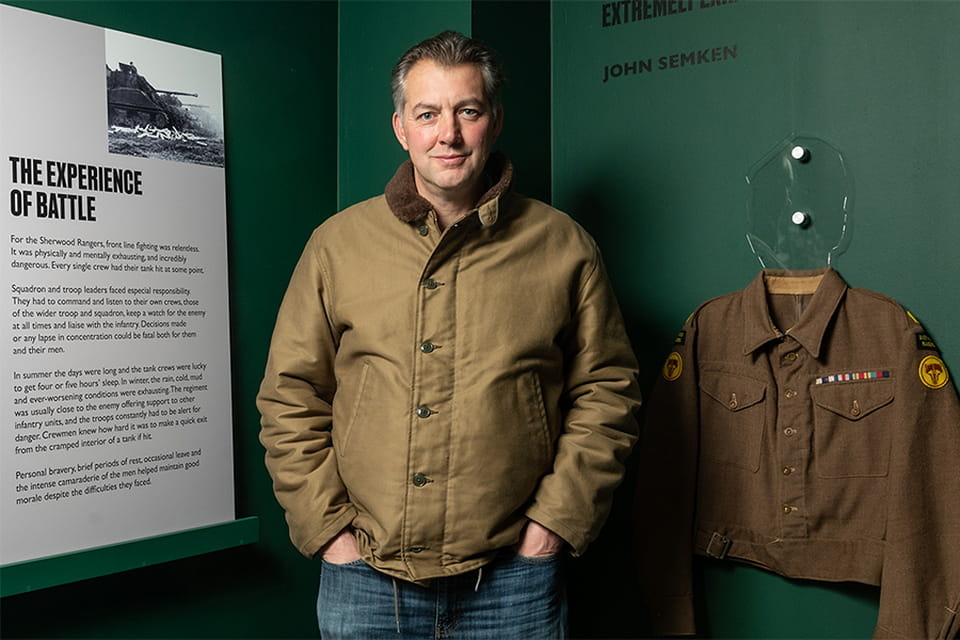
James Holland: The War in the West book review
James Holland spent twelve years on a book that was meant to be a trilogy, and then spent the next decade not finishing it. That is the first thing worth knowing about The War in the West, and it explains why you are probably here.
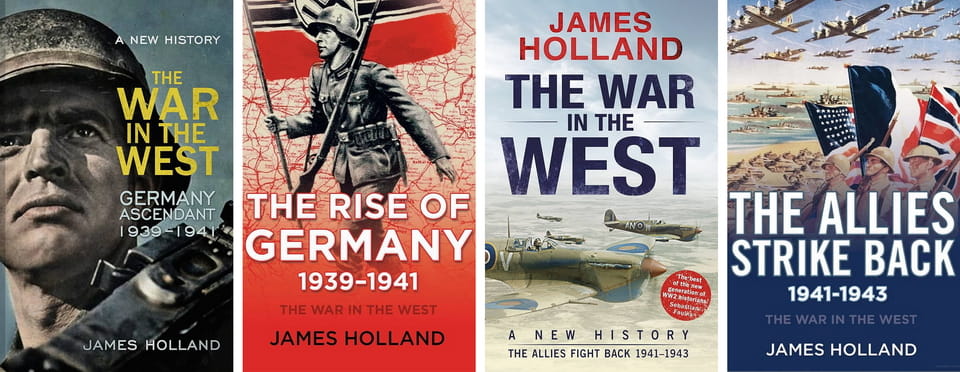
Volume one appeared in 2015 — in Britain as The War in the West: A New History. Volume 1: Germany Ascendant 1939-1941, in the United States as The Rise of Germany, 1939–1941. Same book, two titles, 692 pages. Volume two followed in 2017: The Allies Fight Back 1941-43 in Britain, The Allies Strike Back in America. Volume three has not appeared, and the question of where it is has become one of the most asked things about the series. There is an answer, and Holland has given it himself. It is at the end of this article.
What the first volume actually does is less obvious than its title suggests. It is not another narrative of 1939–41. Military history is usually written at two levels — strategic, the big picture of aims and decisions, and tactical, the battlefield. Holland works at a third: the operational level, the machinery that makes the other two possible. How many trucks. Of how many types. Repaired with what parts, by whom, brought how far. What proportion of the equipment in 1940 was left over from 1918? How a shell reaches the gun that fires it.
That sounds dry and is not, because Holland runs it through people: a U-boat officer, a German staff officer, an American war correspondent, Mussolini’s son-in-law. And it produces conclusions that overturn things most readers think they know — including the figure that British war production had already overtaken Germany’s by 1940.
WHICH BOOK IS THIS: THE WAR IN THE WEST AND THE RISE OF GERMANY
This is a source of genuine confusion, so it is worth settling first. The first two volumes of The War in the West were published under different titles in Britain and the United States.
| United Kingdom | United States | |
|---|---|---|
| Volume 1 | The War in the West: A New History. Volume 1: Germany Ascendant 1939-1941 Bantam Press, 10 September 2015, 692 pp |
The Rise of Germany, 1939–1941: The War in the West, Volume One Atlantic Monthly Press, October 2015, 656 pp |
| Volume 2 | The War in the West: A New History. Volume 2: The Allies Fight Back 1941-43 2017 |
The Allies Strike Back, 1941–1943 Atlantic Monthly Press, 2017, 752 pp |
| Volume 3 | End Game: The War in the West, 1944-1945 — announced, no date. See the section below | |
The American editions are not abridged or revised; they are the same text under a different jacket, and the page counts differ only because of typesetting. If you have read The Rise of Germany, you have read Germany Ascendant.
One further complication: the paperback editions in Britain sometimes drop «A New History» from the cover and appear simply as The War in the West, which is also the name of the series. So the same volume can turn up in a catalogue under three slightly different strings.
This review covers volume one — 1939 to mid-1941, ending on the eve of Operation Barbarossa.
THE SOURCES: TWELVE YEARS, THIRTEEN COUNTRIES AND THE ARCHIVES THAT OPENED
James Holland fully appreciates the last decades’ growing access to sources and interviews with still-alive veterans of the War. While writing his trilogy, the author has traveled actively to visit Germany, Austria, Norway, France, New Zealand, Italy, the United States, Australia, Canada, Egypt, Tunisia, Libya, and even India and South Africa. It’s a matter of fact that Holland obtained the majority of his studies back home in England. Whereas the after-WW2 world was poor in travel capabilities, with common diplomatic issues, a modern historian is free to travel all over the globe to have access to many countries, even on the periphery of the great battles.
The second cornerstone deals with the accessibility of the number of national and private archives, as some of them were restricted to the public during the decades of the Cold War. In the present day, James Holland can easily obtain full access to the contents of the captured archives, first-hand records of the diplomatic correspondence, and official orders. The modern process of globalization and international openness reveals the hidden secrets of World War Two, such as Stalin’s purges and the Bletchley Park operations (once left out of Churchill’s notorious memoirs).
James Holland pays tribute to the enormous number of books, written both first-hand by participants and victims and historians on the other hand, by historians, and published within the past 70 years. The modern evolution of digital media provides a modern historian with a means of access to thousands of memoirs and academic studies without leaving home. A significant proportion of the books initially written in German, Italian, French, Russian, etc. are now available in English editions. The Digital era grants us thousands of hours of documentary footage, and plenty of photos have been digitized and restored within the last two decades.
James Holland emphasizes the value of digital photos in working with sources. While half a century ago a historian had to use a pencil to take an extreme amount of notes with no ability to take documents out, his modern follower can take as many digital photos as he needs, copying the original. The calm academic atmosphere of the sanctum sanctorum workroom gives additional historical accuracy by getting deeper into every particular document.

PERSONAL ACCOUNTS: WHAT MEMORY ADDS AND WHAT IT CANNOT BE TRUSTED WITH
James Holland underlines the fact that still-living veterans and civilian witnesses of WWII were in their late 80s or 90s already during his work on the “The War in the West” trilogy. Modern military historiography has made a notable step forward within the last thirty years, shifting focus from the strategic reviews of the battles to the personal accounts and emotions of the soldiers, politicians, and civilians. The majority of this recollection has made its way over the decades through nightmares and the predominance of emotions over reality. “The War in the West 1939-1941. Germany ascendant” (The Rise of Germany, 1939–1941 in the United States) academically unites personal accounts with the actual documented facts to make them complement each other. James Holland admits personal drama was a driving force for him to travel the world, spend months within the archives and libraries, collect testimonials, and write books on the Second World War.
Live testimonials of the people, taken from the post-war memoirs or the interviews, give a different perspective on the cruelest and most destructive conflict in our history. Bare figures and graphics do not give us an understanding of what was happening in the minds of the soldiers and field commanders. James Holland, in this respect, uses his academic approach round-trip. The author fills the gap, as memory cannot be considered a truly authoritative source of factual evidence, varying from one narrator to another.
Emotional testimonials of the Allied veterans, who used to fight with the German Tiger tank, reveal an important account of how this massive weapon influenced the battlefield. Vice versa, the German tankmen give a speech full of nostalgia to describe the feeling of fighting for their motherland alongside their fellow soldiers within the Tiger moving fortress. Therewith, James Holland reveals the technical specifications of this machine expertly. The Tiger was a real mess in use and repair. Wehrmacht had to use the railway, changing tracks to perform logistical transportation of the tanks to the battlefields. It was greedy for fuel, which had become a great shortcoming after 1942. Tiger was almost useless to use within the cities.
THE PRINCIPAL CHARACTERS: WARLIMONT, TOPP, CIANO, SPEARS, PYLE
Paying significant academic attention to the archives, published and unpublished memoirs, and dozens of interviews, James Holland has his “favorites”. They are people, from soldiers to generals, Germans and British, French, and Italians, personal accounts of which are chosen to take on the job of the first-hand narrator. This approach is not something extraordinary in the military history of World War Two, as some prominent studies quote some characters more often than others. James Holland even puts these personalities at the very beginning of his “The War in the West” book, with the “LIST OF PRINCIPAL CHARACTERS FEATURED” title.
While examining the process of making strategic decisions within the Third Reich, the author frequently gets us acquainted with the thoughts of Walter Warlimont, taken from his “Inside Hitler’s Headquarters” after-war memoirs. Legendary memoirs of Winston Churchill are also a common source for the book. Erich Topp, a German submarine U-boat commander, first officer, and then a captain himself, dips us into the world of the ‘’Wolf packs’’. Henry Stimson, American Secretary of War, introduced backdoor processes before the United States joined the War in 1941. Major-General Sir Edward Spears, Member of Parliament and Churchill’s personal representative to the French government, and later to de Gaulle.

THE OPERATIONAL LEVEL: THE THIRD WAY OF WRITING MILITARY HISTORY
James Holland’s “The War in the West” book appears to be a unique historical study in many respects. The history of World War Two and the first two years of the War, in particular, is narrated without a sophisticated dive into strategic overviews. The book devotes its first pages to the maps and schemes of the campaigns and operations of the 1939-1941 period, maps that illustrate rather than instruct. Modern military historiography generally deals with three levels of understanding: strategic, tactical, and operational. James Holland’s trilogy works at the third of these levels, still rare and revolutionary even after 70 years and tens of thousands of books devoted to WWII.
The strategic level gives us the big picture of the War, emphasizing the key goals of the opposing sides. Military history employs the tactical layer to get closer to the battlefields and the front line, troop movement, wins and defeats, defense and attack, casualties and captured equipment. The operational level of understanding of military history explains how the previous two layers were possible. In other words, what actions and processes were necessary to perform combat between Troops A and Troops B in this particular place, considering the war economy, equipment, and arming logistics? In what way was one battle or another sustained for a desired period?

Former Waffen-SS soldiers praised the high level of equipment and ammunition, still without concern about what the price was and how other military units had been limited with the same “instruments of war”. What was the working day for foreign prisoners of war to supply one division to break through the enemy line in one particular episode of the war? American and British veterans recall a non-stop supply even within the most exhausting battles. Even if one day they had to say goodbye to the Sherman or the Hurricane, the day after, witnessing a supply of a new moving fortress without any concerns about how it was possible to deliver a machine weighing many tons to France or Germany.
While getting deeper into this complex layer of military history, we figure out not only the peculiarities of the railway logistics, but also detail the quality of ammunition and military equipment, progressive engineering, and the socio-cultural reality of the people who participated in WW2. James Holland takes his reader into the premises of the military warehouses to reveal the uniforms used to fight the war. What was the real percentage of the WWI equipment still in use in 1939-1940? The level of motorization of each army on the map of Europe and the correlation between the volume of civil and military machines. A variety of repair components to maintain more than 1000 types of trucks.

FOUR MYTHS HOLLAND TAKES APART
James Holland’s academic works are generally characterized as revisionist history, without the negative meaning commonly associated with Holocaust deniers and other falsifiers of history. In broader terms, historical revisionism implies a reconsideration of the long-standing myths and stereotypes, which generally are not supported by facts. Even 70 years after World War Two and thousands of studies on all aspects, modern historiography still preserves some concepts and does not hold up to criticism. The majority of these myths have not been revised since the 1940s and the first wave of research.

James Holland points out several basic historical myths and ways of thinking about WW2, which do not stand up to critical evaluation using solid facts. These concepts generally deal with the pre-war period and the 1939-1941 years of war.
- At the beginning of the Second World War, the German army was the most modern, equipped in the best way, and trained to have full supremacy.
- German Blitzkrieg in Poland, Norway, France, and the Balkans was a thoroughly planned and performed act of strategic and tactical supremacy over the opposing bloc of countries.
- After a painful defeat in France, a retreat from Dunkirk, and a loss of equipment and fighting spirit, the British army was surrounded by the enemy as a single stand against a new global order in Europe, waiting for the growing assistance of the USA and its participation in the War.
- An alliance between the German Reich and fascist Italy, tightened with the Berlin-Rome Steel Pact, was an example of ideological, military, and political cooperation. The main reason for its failure was the superior forces of the Allies.

James Holland does not constantly emphasize these conventional concepts in an attempt to disprove the myths. As a narrative alternative, he contrasts storytelling with an emphasis on factual information. For example, a significant part of the book is devoted to the abyss between a propaganda fantasy and reality, while delving into the Axis alliance between Germany and Italy. The author uses letters, memoirs, testimonies of common civilians, and facts on the arming infrastructure of Italy to reflect a detailed picture of life and war behind the closed doors of the Axis. Figures of British war manufacturing, which had surpassed the German ones already in 1940, and the actual correlation between the whole fleet and the number of vessels that sank. Lack of agreement within the Blitzkrieg, conflicts between the high officers, and tactical fortune of the talented warlords.
SOME PROFOUND IDEAS ON WWII
In 1919, Poland obtained its independence for the first time since the eighteenth century and its long-standing ‘division’ between Austria, Germany, and Russia. Millions of people of different nations and languages were now a part of Poland, a state agreed upon after the Great War.
Steel Pact between the German Reich and Italy, signed on May 22, 1939, meant more to the Germans as ideology than it did to Italians, for whom it promised little.
On the Threshold of the Second World War, Britain and France considered the communist Soviet Union even a more dangerous enemy than Germany. Totalitarian regime, mass executions, Stalin’s purges just two years before. British Empire, as a monarchy, could not stand the assassination of the Russian royal family. Vyacheslav Molotov, a Minister of Foreign Affairs appointed in May 1939, had been an active participant and a perpetrator of the crimes.
In 1939, 70% of German homes had a radio receiver, with radio repeaters in most public places such as streets, shops, theatres, barbershops, and public transport. A common German citizen was under constant ideological pressure with the propaganda details of the Poland campaign. The Germans considered the neighbor an aggressor who violated the rights of the German-speaking people and violated the border with acts of sabotage and violence.
Even though the fascist government had controlled Italy since 1922, the country was still a monarchy. Victor Emmanuel III and war leaders had enough power to shift the political rulers of the state. Nothing of the kind was conceivable in Germany.
Although only twenty years had passed since the end of the Great War (World War One), at the time of 1939 British expeditionary forces had a lack of real combat experience. The previous most difficult challenge was to deal with some rebellions on the periphery of the Empire.
While German propaganda did its bes to soften the fact of the German-Soviet Non-Aggression Treaty to their people, Italy was extremely confused. Germany had signed a treaty with the ideological enemy of both Steel Pact allies, a country that had been distributing communism across Europe.
The decision of Italy to enter the war in 1940 should be considered a combination of factors. A state had to preserve self-importance within the Axis at a time when Hitler had successfully invaded Western Europe. Another thing, Mussolini had a dream to expand a new version of the Roman Empire and rule northern Africa, employing British and French colonies.

HOW IT READS: NARRATIVE HISTORY THAT WORKS LIKE FICTION
James Holland emphasizes that his goal was wider than just writing another boring survey, looking over the figures on divisions in the West. The author sees the trilogy The War in the West as an accessible narration to reach a wide range of readers, who will enjoy the process and history. Each book, and “German Ascendant” in particular, is aimed at uniting the years of Holland’s studies and the up-to-date historical way of thinking. James Holland is a co-producer of television documentaries and an author of several historical monographs on WW2. He is also famous for his fictional books, using the greatest conflict in human history as a background. The author successfully manages to tell the story excitingly, intriguing us with the events. He constantly combines his principal characters and changes the focus of attention between the opposing sides, between ranks and regalia. Holland’s narration reminds me of fiction, especially when quoting memoirs and testimonies. At the same time, he can fill each chapter with the elements of the inserted stories, shifting focus and adding historical facts without interrupting the wholeness of the idea-driven narration.

WHERE IS VOLUME THREE? THE ANSWER, FROM HOLLAND HIMSELF
Volume two ended in May 1943. It appeared in 2017. Nothing has followed it, and the question comes up constantly — on Goodreads, in reviews, under every podcast episode. Amazon has no listing. Wikipedia says nothing. The publishers say nothing.
Holland has answered it in an interview, and the answer is more interesting than a date would have been. The third volume is coming. It will be called End Game: The War in the West, 1944-1945, and it will be a narrower book than the one originally planned — Northwest Europe and the air war, from Market Garden in September 1944 to the end. In Holland’s own words: «the third volume of The War in the West is happening, it’s just not happening as I originally conceived».
The plan in 2017 was one concluding volume covering mid-1943 to May 1945 at the same density as the first two — Sicily, Italy, Normandy, the bomber offensive, the last year in Germany. Then the eightieth anniversaries began arriving, and with them new material. Holland explains the first diversion directly: there were good reasons for postponing the trilogy to write a book on Normandy, because the anniversary was coming, it was a big moment, and he suddenly had a great deal of new material on it — and it seemed absurd to bury that inside a larger volume. That book was Normandy ’44 (2019), and it worked. Then there was a case for doing Sicily, so he did — Sicily ’43 (2020). Then the air war, which he had already been covering elsewhere: Big Week (2018) on the bomber offensive, after Battle of Britain and Dam Busters earlier. Then armour and the Normandy campaign from inside one regiment, in Brothers in Arms (2021). Then Italy, twice: The Savage Storm (2023) on the autumn of 1943, and Cassino ’44 (2024). Add it up and the missing volume has largely been published — just as six separate books rather than one. Holland’s own summary of the position: he has already done Sicily and Normandy, much of the air war, the last year in Italy, and Cassino. A lot of it, he says, has been covered. What is left is what nothing else has taken: the campaign in Northwest Europe after Normandy, and the air war over Germany, to the end. Hence End Game, and hence its narrower scope.
JAMES HOLLAND’S OTHER BOOKS: A READING ORDER
Holland has written more history since volume two than most historians write in a career, and much of it is the material that would have gone into volume three. Read in campaign order rather than publication order, it fills the gap almost completely.
The trilogy
— The War in the West, Volume 1: Germany Ascendant / The Rise of Germany (2015) — 1939 to mid-1941
— Volume 2: The Allies Fight Back / The Allies Strike Back (2017) — 1941 to May 1943
— End Game: The War in the West, 1944-1945 — announced, no date
The campaign books that fill the gap
— Sicily ’43 (2020) — the invasion of Sicily, July–August 1943. Picks up almost exactly where volume two ends
— The Savage Storm (2023) — the Italian campaign, autumn 1943
— Cassino ’44 (2024) — Monte Cassino and the road to Rome
— Normandy ’44 (2019) — D-Day and the seventy-seven-day battle for France
— Brothers in Arms (2021) — the Normandy campaign and beyond through one tank regiment, from D-Day to VE Day
The air war
— Battle of Britain — 1940
— Dam Busters (2012) — the Ruhr dams raid, May 1943
— Big Week (2018) — the American bomber offensive of February 1944
Elsewhere
— Burma ’44 — the Admin Box, February 1944
— Nine works of historical fiction, including the Sergeant Jack Tanner series, which begins with The Odin Mission
And beyond the books
Holland co-founded the Chalke Valley History Festival and the online Second World War resource WarGen.org, has written and presented documentaries for the BBC and Channel 4, including the BAFTA-shortlisted Battle of Britain and Dam Busters, and co-hosts the podcast We Have Ways of Making You Talk with the comedian Al Murray — which now reaches an audience in the millions and has done more to bring the operational level of military history to a general public than any of the books.
He was born in Salisbury, read history at Durham, and is a Fellow of the Royal Historical Society.
FREQUENTLY ASKED QUESTIONS
When is The War in the West volume 3 coming out? No date has been announced. Holland has confirmed that it is being written and that it will be called End Game: The War in the West, 1944-1945, covering Northwest Europe and the air war from Market Garden to the end — a narrower book than the one originally planned, because much of the intended material has appeared as separate volumes since 2017. In his words, the third volume is happening, just not as he originally conceived it.
Is The Rise of Germany the same book as Germany Ascendant? Yes. The Rise of Germany, 1939–1941 is the American title of the book published in Britain as The War in the West: A New History, Volume 1: Germany Ascendant 1939-1941. Same text, two jackets. Volume two has the same problem: The Allies Fight Back in Britain, The Allies Strike Back in America.
When was The War in the West published? Volume one in 2015 — Bantam Press in Britain on 10 September, Atlantic Monthly Press in the United States in October. Volume two in 2017.
How long is it? 692 pages in the British edition of volume one, 656 in the American; volume two runs to 752 pages. Holland spent over twelve years researching the series before the first volume appeared.
Do I need to read volume one before volume two? Strictly, no — each volume covers its own period and stands up alone. In practice, yes, because the argument is cumulative: volume one establishes the case about German unpreparedness and Allied production that volume two then carries forward.
What should I read to fill the gap after volume two? In campaign order: Sicily ’43, The Savage Storm, Cassino ’44, Normandy ’44, Brothers in Arms, and Big Week for the air war. Between them, they cover most of what volume three was originally meant to contain.
Is James Holland a revisionist historian? In the technical sense, yes — he reconsiders long-held conclusions using new evidence, which is what the word means in academic use and has nothing to do with the denialism the term is sometimes confused with. His main revisions concern the state of the German army in 1939–41, the nature of Blitzkrieg, British war production, and the reality of the Axis alliance with Italy.
What is the operational level of military history? The third of the three levels at which the subject is written. Strategy covers aims and grand decisions; tactics covers the battlefield. The operational level covers what makes both possible — production, supply, transport, maintenance, manpower — and it is the level at which Holland’s trilogy works. It is still comparatively rare, which is a large part of why the books matter.