

HITLER IN FLORENCE: MAY 1938
On 9 May 1938 Adolf Hitler spent ten hours in Florence. He arrived at two in the afternoon on platform sixteen of Santa Maria Novella and left just after midnight; in between, he was driven through a city that had been rebuilt for the occasion for 19 million lire, walked the Vasari Corridor above the Arno, stood on the balcony of the Palazzo Vecchio in front of a hundred thousand people, and watched fireworks spell out FÜHRER and DUCE over the Piazza Vittorio Veneto.
This article follows that day location by location, with the archive photographs and my own from October 2018 of the same angles. It also settles two things that are almost always got wrong. Almost everything on the route is still standing, and most of it is free to walk. The map below marks the whole cortege course; the sections follow it in order, from the platform to the last fireworks.
FROM BERLIN TO ROME, FROM ROME TO NAPLES, FROM ROME TO FLORENCE. HITLER IN ITALY 1938
My previous enthusiastically detailed material paid thorough attention to Adolf Hitler’s state visit to Italy back in May 1938, including his days in Rome. As a result of the most pompous diplomatic welcoming of all times (Mussolini’s visit to Germany in September 1937), Mussolini was impatient not only to demonstrate the mighty power of the Italian fascist regime (sixteen years after the ‘March on Rome’) but also to impress Hitler with the historical and cultural heritage of a current reincarnation of the Roman Empire. Each of the three Italian cities (which had been destined to play a part in scrupulously orchestrated ceremonies) was entitled to its unique role in a spectacle on a national scale. Rome was to be appreciated as a capital city of a newly crowded Empire (Impero Coloniale Italiano), a connecting link with the glorious past of the ancestors. The naval military maneuvers within the harbor of Naples were taken to symbolize Italian ambitions as a new sea ruler in the Mediterranean basin and to reinforce Hitler’s belief in the military power of his southern ally, far more theatricalized (with military parades in Rome and Naples) than the indeed. Florence, a pearl of the Tuscany region and the medieval center of European commerce and arts, was appreciated as a link between two cultures, the Italian one and the German, as well as an inseparable union between two regimes.


Mussolini and his political entourage had initially been playing on Hitler’s open passion for the arts, a theme taken to have a high profile on the joint visit of two dictators to Florence. Taking into account the fact that Victor Emmanuel III was de facto the host to Adolf Hitler in Rome and the Duce had to behave as no more than a second violin, the scheduled May 9 day in Florence was initially ‘rescued’ from the image of the nominal state ruler (The King). It should be mentioned that May 9 was to be appreciated not only as a day of a state visit of a German chancellor (Adolf Hitler) to Tuscany but also as Mussolini’s journey to the region. A diplomatic journey of the ruler of the state from Rome (a home for the fascist government and a location of Duce’s office) to Florence. In this respect, all while the citizens of Munich and Rome ‘were used’ to observe the paramount leader with their own eyes, Mussolini’s journey to Tuscany was no less than a double event.
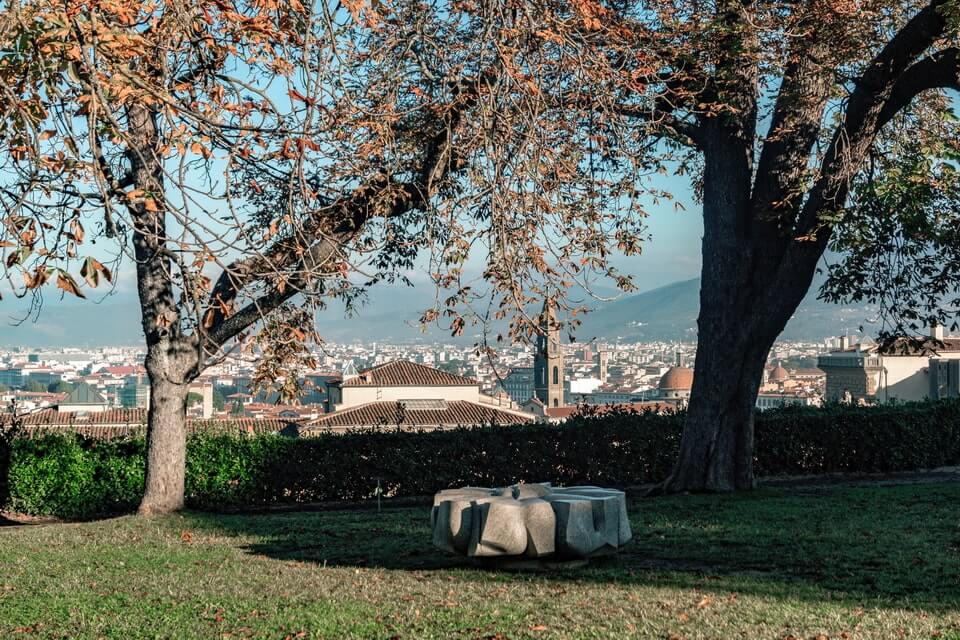

Nicolaus von Below, one of Hitler’s adjutants, would later recall that Hitler had always recollected a day in Florence with sincere enthusiasm, a chance for him to stand aside from the royal charade in Rome and to give himself over to the art of the city. Eugen Dollmann, Hitler’s interpreter, would later recollect the conventional historical argument that his boss had had his fill of the protocol imposed on him next to King Victor Emmanuel III, and the fuhrer was happy to ‘breathe freely’ on May 9, on his mutual journey with Mussolini. Taking Dollmann’s quotes for granted, the German dictator had been indeed fascinated with a city, with its architecture, streets, and museums, and with the enthusiasm of those thousands of people who crowded the motorcar route. Less than five years from that Mayday, as late as January 30, 1943, a devastating Hitler (with the doomed destiny of the 6th Army, besieged in Stalingrad) initiated a flaming discussion of Florence with the participants of the Italian delegation. Heinrich Hoffmann, his personal photographer, would elaborate in his post-war memoirs with a flashback that Hitler had particularly appreciated a painting known as ‘Plague in Rome’. This piece of art was no less than a gift from Mussolini and was to become the icing on the cake of a monumental art collection of works in the city of Linz, a place where Hitler dreamed of living his retirement years. Neither vision was ever fulfilled.


RESHAPING THE CITY FOR HITLER’S VISIT TO FLORENCE
Tailoring Florence as the cultural capital of a newly-formed Italian Empire and a connecting link between Italian and German cultures was reasonably beyond debate from the very beginning. Along with that ‘easy choice’, every element of the upcoming event (May 9 was even proclaimed a holiday in Tuscany) was to be carefully orchestrated to fit Hitler’s hyperbolized world-vision of arts and history. The image of Florence, a city scheduled to welcome two supreme rulers on May Day 1938, was now to demonstrate a highly stereotypical sense of the capital of Tuscany as no less than a ‘cradle of the Renaissance’. More than that, the image of the whole state visit would finally have much in common with the propaganda patterns from the ‘Triumph des Willens’ documentary by Leni Riefenstahl, a movie that had once depicted Nuremberg as the cultural medieval patrimony of Germany.

Through these new demands, the image of the beautiful Renaissance city and a former center of the arts was now to be updated with the symbolism of the two regimes. The special communique of ‘Comune di Firenze’, a local municipal bulletin, would later include the cross-national debates of the German and Italian art historians on means to deepen the cultural connection between the two allied nations. Along with the director of ‘Kunsthistorisches Institut in Florenz’, the guiding entourage was to include Ranuccio Bianchi Bandinelli, a fine art expert who had been previously put in place next to Mussolini and Hitler in Rome (a guide on the photos from the Colosseum).

The myriad of details, as with Rome, was not left to chance. As late as February 7, 1938, the local government initiated a new public body, ‘for the special artistic and technical organization’, an institution aimed at mobilizing human, technical, financial, and intellectual resources to reshape the image of Florence. This new federal agency was given a clear, unconcealed nomination: “Office for the celebrations on the occasion of the visit of the Führer”, made up of fine art experts, architects, sculptors, photographers, and engineers. As the events of the upcoming months would later show, the initial budget would be surpassed and peak at no less than 19 million lire. The historical irony is that while Hitler was amazed by the city of Florence and the ‘resolute might’ of the fascist regime, the expenses of his state visit would become a heavy burden for the regional budget of Tuscany.
Therefore, Florence was destined to transform, and the cradle of the Renaissance would become one giant construction site of a grand scale. The issued plan of reconstruction included restoration of the fronts of buildings (particularly along the cortege route), pavement, and bridges. Along with the obvious works, the city center witnessed a renovation of the outdoor street lighting system, and some merchants were granted a free-of-charge repair of their shop windows. Hundreds of fire hydrants were to be renovated, as well as fountains with drinking water, a traditional attribute of the Italian cities. Close to an endless myriad of efforts were delivered both to make an impression on Hitler and to impress their own people at home. Relatedly, the pompous decor on the buildings’ front sides and illumination covered in places the ‘insufficiencies’ in the same manner as the white coloration at Roma Ostiense were claimed to be seen as no less than marble on May 3, six days before Hitler arrived in Florence. The renovated historical heritage was now complemented with banners and pylons and the multi-thousand adoring crowds of people as the apogee of the whole surrounding had been beforehand orchestrated meticulously to welcome Hitler and Mussolini in the most festive way possible.

The route itself was appreciated as one of the most, not to say the most crucial, elements of the upcoming visit of two supreme leaders to Florence. The cortege directions were carefully modeled and brought to perfection for every single historical landmark to be clearly seen from the moving automobile. Along with the arranged emphasis on cultural aspects and, in general, in contrast to Rome, the urban design of Florence imposed its specifics, externalized in narrow streets and promenades. Eminently, two dictators would be in possession to drive along the narrow streets of the city center at arm’s length and within touching distance of the jubilant crowds. Ranuccio Bianchi Bandinelli (the guide appointed for the visit, indeed a globally renowned fine art expert) would later recall in his memoirs that two leaders (Mussolini and Hitler) were far from unreachable figures, yet in fact, they could touch people in the crowd. Early on, the members of the “Office for the celebrations on the occasion of the visit of the Führer” had considered several cortege routes, each including the key historical landmarks of the city center, before the final variant was adopted.
SANTA MARIA NOVELLA
The historical region of Tuscany has become one of the earliest beneficiaries of the railway age back in the XIX century, eminently next to the pioneers of the railway transportation service in Italy. As late as 1848, in a time when the maximum length of any particular line was beneath 40 kilometers, Florence witnessed the construction of two railway stations the same year. ‘Stazione Maria Antonia’, named after ‘The Grand Duchess of Tuscany ’, was to become one of these two transport hubs. Physical proximity to SANTA MARIA NOVELLA church once required the demolition of some buildings of the Christian holy place. Years later, with the 1860s to come (after the collapse of the Duchy-kind political pattern), the station would be retitled after the sanctuary nearby. Seventy years later, a new project of the station would win the personal appreciation of Benito Mussolini, with the grand opening that occurred in 1935 (three years before Hitler’s visit), sanctified by King Victor Emmanuel III personally. ‘Palazzina Reale di Santa Maria Novella ‘, a marble palace to host the royal family during their visits to Tuscany, was inaugurated the same year in proximity to the eastern wing of the station.


The special Rome-Florence train (which left Termini station at 9:33 a.m.) with Hitler and his numerous diplomatic entourage approached the 16th out of nineteen railway platforms of SANTA MARIA NOVELLA station around 2 p.m. on May 9, 1938. For this once, the German fuhrer had been pre-scheduled, disburdened from the necessity to be welcomed by the King, a man ‘of high rank, but a low stature, the way he had to experience in Rome six days earlier. Mussolini himself, accompanied by Count Galeazzo Ciano at his side, was now to welcome Hitler on a platform that had been previously decorated with banners bearing both swastika and fascist symbols, in the presence of hundreds of viewers, as well set on beforehand. In less than five years from that day, the same 16th railway platform would witness the departure of a train with 300 hunted Italian Jews, destined to perform their final doomed journey to the Auschwitz-Birkenau death camp, with only every twentieth of them returning home to Italy after the war. The majority of those 300 people were exposed to ‘Sonderbehandlung’ (‘special treatment’, the Nazi euphemism for mass killing) upon arrival at the camp facility.


The crowd of people who welcomed and cheered two dictators at Santa Maria Novella station was no more than an appetizer for 350 000 people, citizens of Florence and comers from almost every corner of Italy, who had gone to the streets to observe the automobile cortege with their own eyes. Hitler and Mussolini were to make their way in an open automobile, accompanied by another 19 cars passing from the square at the station along the carefully orchestrated route, with VIA PANZANI as the starting point. One of the preserved photos of the moment depicted the cortege as well as the eastern side of the station, with thousands of people lined up on both sides of the street in a military-like manner.


MUSSOLINI AND HITLER AT PIAZZA DEL DUOMO
Hitler had been reading about the Italian arts and history for decades before that May 1938 day, and the closely coordinated driving course was created to take the German supreme leader close enough to the key landmarks of Florence. While the preliminary alternatives of the route included variations, each of the iterations had initially included PIAZZA DEL DUOMO and the grandiose cathedral, generally attributed as the spiritual landmark of the city. The preserved Italian archive footage of May 1938, taken to give publicity to the visit for tens of millions of Italians and Germans, depicted the driving course of the automobile cortege, making its way from Santa Maria Novella, through the streets of the city to ‘La Cattedrale di Santa Maria del Fiore’, completed in general back in 1436. At least a few million lire (of the total 19 mln. expenses) had been previously spent on textile and carpet runners and banners with the symbolism of two regimes. The added attributes now covered the front sides of hundreds of buildings on the route to DUOMO. In disregard for the sacral meaning of the cathedral, the automobile column with Hitler and Mussolini made no stop at the site, moving at low speed next to the entrance, and thousands of people massed on the square on that warm day in May.

 SLIDE me
VISITING BASILICA DI SANTA CROCE
Benito Mussolini was indeed the final authority to approve the cortege course with some historical landmarks. Indeed, and not in name, one of the scheduled stops had been a source of a particular enthusiasm for Duce himself: a visit to the crypt of Basilica Di Santa Croce. After a ride along the Arno River promenade, the automobile procession with two allied dictators made a stopover within PIAZZA DI SANTA CROCE, a spacious open space, and one of the three largest squares in Florence. At that moment, dozens of thousands of people crowded the open site, ornamented with banners and flags. The police forces separated the crowd into two unequal parts, with one to experience the event just in front of the front side of Basilica Di Santa Croce. The cavalcade took a bend to a narrow street known as LARGO PIERO BARGELLINI to make the stopover next to the statue of Dante Alighieri, the famous Italian poet with immortal national repute. The monument to a grand visionary, depicted in his coat, was erected back in 1865 to honor the 600th anniversary of his birth, here in Florence.

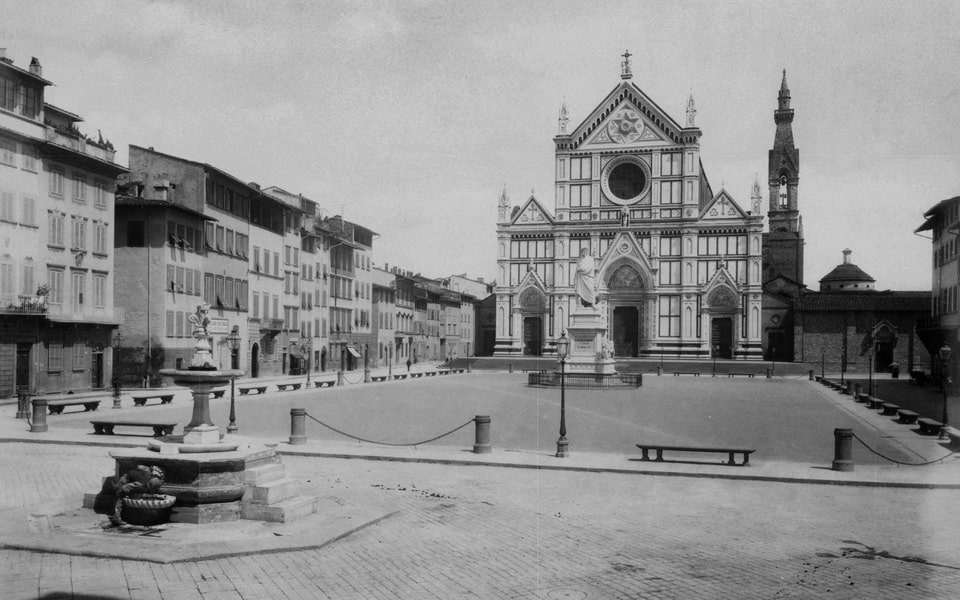


The statue of Dante Alighieri was once erected not only to beautify one of the main squares of Florence but also to emphasize the physical proximity to the crypt of the author, located within the undercroft of Di Santa Croce. The agreed plan of the visit prescribed that Hitler visit the “Sacrario di Martiri Fascisti” (Shrine of the Fascist Martyrs), of those who died “Caduti per l’idea fascista” (Fallen for the Fascist idea). This characterful new-made pantheon of the fascist regime was appended to the medieval basilica as late as 1934 to include the graves of both the Florentine citizens who once fell on the battlefields of the Great War (WW1) and the shrines of some of the representatives of the new regime. That very year, 1938, the crypt was ‘added’ with the gravestones of the Tuscan people, fallen “Per l’Impero e per la Spagna” (For Empire and Spain), meaning those who had lost their lives in support of the Franco fascist regime in Spain and Mussolini’s war in Abyssinia. For all that, the remains inside the crypt of Di Santa Croce were to be appreciated as another symbol of the unity of two regimes, born of sacrifice.

Mussolini, Hitler, and their retinue escort circumvented via Basilica, a cathedral that was inaugurated as ‘basilica’ only in 1933 at the time of the fascist government, and entered the crypt from the side. The 1934 Pantheon was in no way the invention of Mussolini’s regime, since the stone graveyard had been initially a part of the cathedral starting from 1294. At least 15,000 of the Tuscan citizens found their resting place here within the next seven centuries. The families of those dead had to file a special appeal addressed to the current Grand Duke, as well as a ‘generous donation’. This historical irony lies in the fact that one hundred years after the death of Saint Franciscus, the inspirer of the order of his name, the then Pope abolished the dogma of the Franciscus monks that Jesus was poor, and so the Christian people had to abandon themselves to wealth. In this respect, the Pope justified the fact that the ‘holy word’ could be interpreted to the benefit of those who have the power, an approach later upgraded by the totalitarian regime of Mussolini. The visit to the Di Santa Croce crypt was, in fact, the first occasion (since Hitler’s arrival at 2 p.m.) for two allies to speak face-to-face next to the graves of Dante Alighieri, Michelangelo Buonarroti, Niccolo Machiavelli, and Galileo Galilei. Dante Alighieri’s monument in Florence is empty because his actual remains are buried in Ravenna, Italy. Unable to ever retrieve the true bones, Florence built a grand honorary monument (cenotaph) for him inside the Basilica of Santa Croce in 1829.

HITLER AT PALAZZO PITTI AND BOBOLI GARDENS
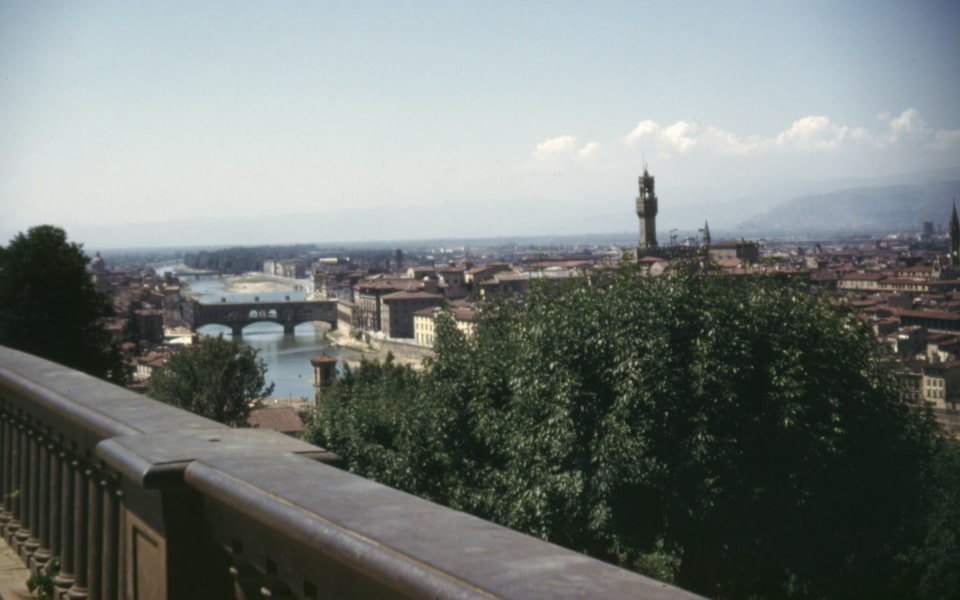
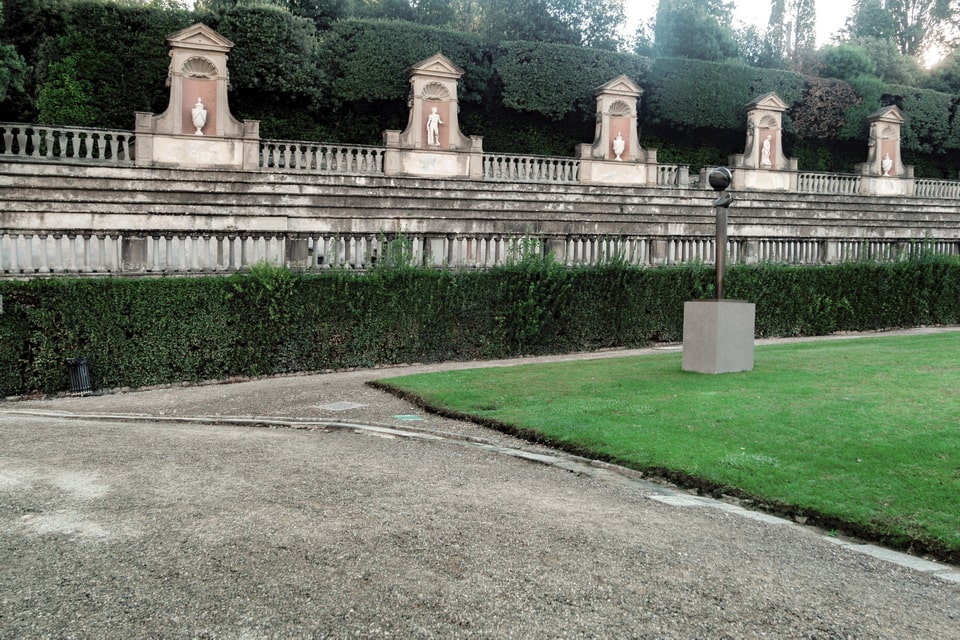
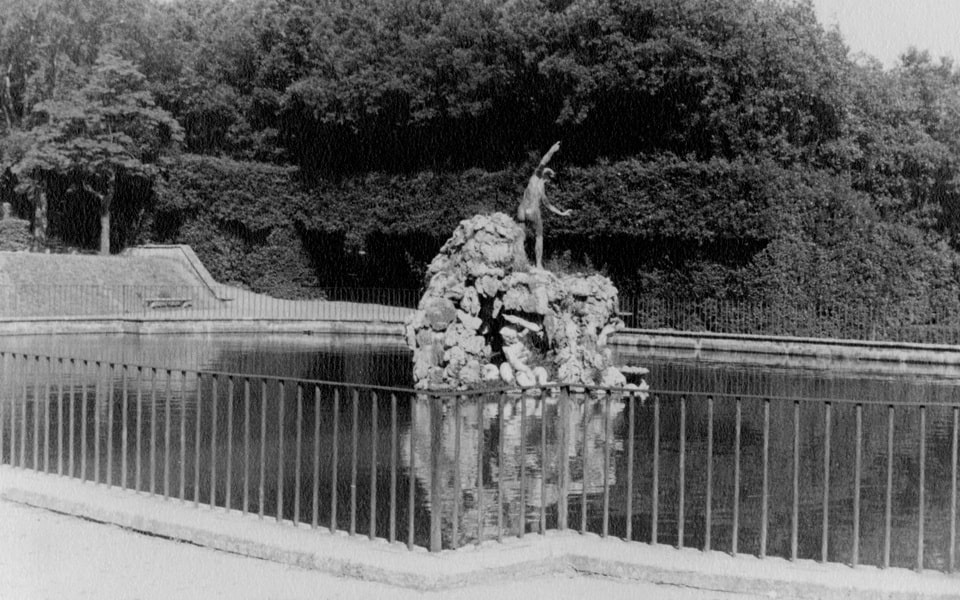
Quite apart from the fact that Hitler was initially ‘scheduled’ to spend less than one full day in Florence and leave for Germany on the same eve of May 9, luxurious apartments were arranged for him within Palazzo Pitti, the former historical residence of the almighty Medici dynasty. The motorcade of 20 cars coursed a picturesque route across Florence, visiting a viewing point at Piazzale Michelangelo and then moving towards Palazzo Pitti, through the PORTA ROMANA medieval city gate of the XIII century and the territory of the legendary BOBOLI GARDENS. Hitler and Mussolini were now to become viewers of the historical-kind games, in fact, a fancy-dress show with the participants from Florence, Pisa, and Arezzo. Once reaching the palace, the German fuhrer took a brief time to have a rest within the arranged apartments and was later taken on an excursion through the magnificent halls of Palazzo Pitti, full of pieces of art from Tuscany. Even though the final agreed route did not include several streets, VIA MAGGIO and PIAZZA SAN FELICE, to the northeast of the front side of the palace, they had been decorated with banners in a never-fulfilled wait for the cortege.




ADOLF HITLER AT PONTE VECCHIO AND UFFIZI GALLERY
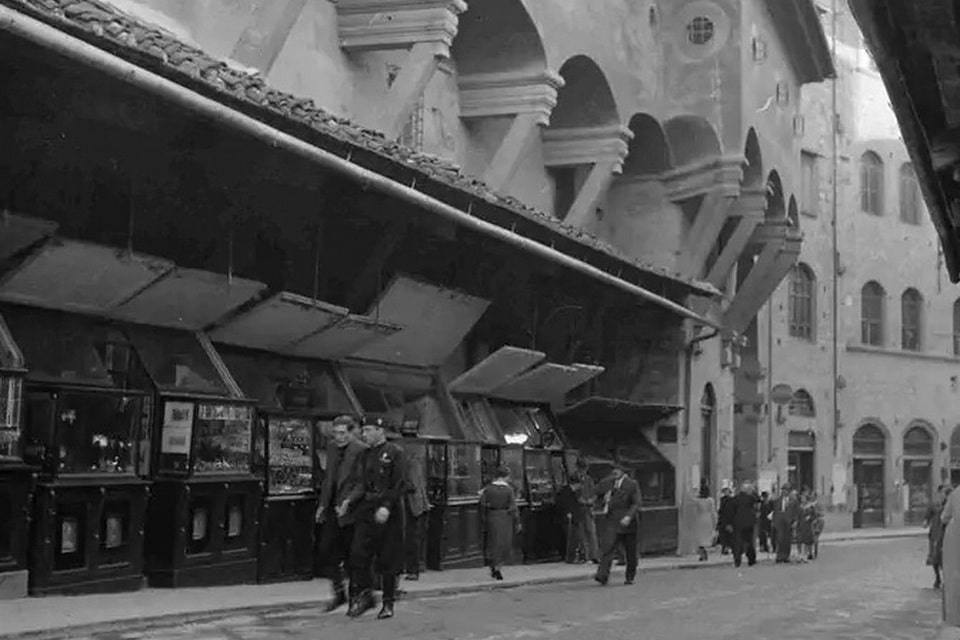
After a brief pause to see the marvelous art collection within the Pitti Palace, the VIP delegation followed the path of Hitler and Mussolini in their pursuit across the Florence landmarks. The preliminary masterminded route for two dictators included the famous VASARI CORRIDOR, a former privileged passage of the patriarchs of the Medici family, once used to cover an urban distance between the residence (Pitti Palace) and the ‘workplace’ (Palazzo Vecchio). The passage, almost one kilometer long, was built in only five months in 1565 to be later named after its creator, Giorgio Vasari. The Grand Duchy of Tuscany (the Medici family had ruled the region for almost a century in a row, except for a short period of ‘exile’) had historically experienced a strong desire to cover the city streets openly surrounded by a mob. The convenience of that route was constantly improving with every new ruler; to that degree, the dynasty-kind meat street shops within Ponte Vecchio were once swept to eliminate once and for all the ‘smell inconveniences’ for the Medici within the passage above, and made space for juvenile businesses. Four centuries forward the Medici times, Benito Mussolini and Adolf Hitler would reinvent the initial purpose of the ‘hidden pass’ into a means to remain in the public eye.

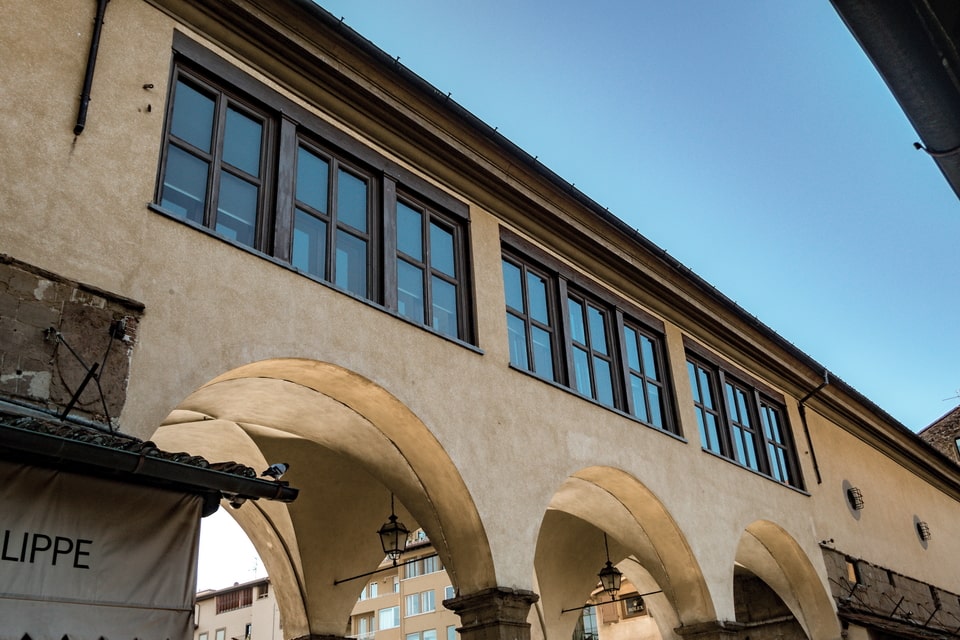
In contrast to the Medici family, who used to take advantage of the hidden nature of the Vasari Corridor across the Arno River and above the heads of the citizens of Florence, Hitler and Mussolini performed no less than a show of public awareness with their appearance in a window on Ponte Vecchio. The Duce himself approved, among other repair works in Florence, a small-scale renovation of the Ponte Vecchio. Three former small windows to the West (the Vasari Corridor was added to the bridge close to its eastern side) were transformed into one large one, in fact, a walking gallery with a panorama over the Arno River and ‘Ponte Santa Trinita’ (St. Trinity bridge). Both national leaders made an appearance and greeted the audience below, crowded on the bridge. Ponte Vecchio would famously become the only bridge over the Arno to survive the planned demolition, performed by the retreating German army on August 4, 1944. Regardless of the legend that Hitler’s 1938 walk here later resulted in his personal order to preserve the bridge, Ponte Vecchio indeed survived the war thanks to Gerhard Wolf, a German consul in Florence. His merits would be marked with a memorable plate at Ponte Vecchio sixty-three years later, in 2007.
Wolf was not a typical official of the regime. Born in Dresden, he studied philosophy, art history and literature and took a doctorate in philosophy before joining the foreign ministry in 1927. He was posted to Rome in 1933 and was invited to join the Nazi Party that year; he declined, and joined only on 1 March 1939, when it had become clear that a diplomatic career would otherwise be impossible. He arrived at the German consulate at Via dei Bardi 20 as consul on 7 November 1940 — a fortnight after Hitler’s second visit — and he had studied in the city before the war. During the ten months of German occupation, he used the office for things it was not intended for. He hid the Jewish-American art historian Bernard Berenson, who had been taken by the Germans. He intervened repeatedly for political prisoners and for Jews. On one occasion, receiving a complaint from a loyal party member that a German expatriate in Florence was insufficiently loyal to the party line, Wolf invited the woman to his house — and congratulated her on thinking for herself. He left Florence on 28 July 1944, days before the bridges went, having had a nervous breakdown after ten months of trying to save the city and its people. He was promoted, spent the rest of the war as Consul-General in Milan, and was interned by the Allies in May 1945.




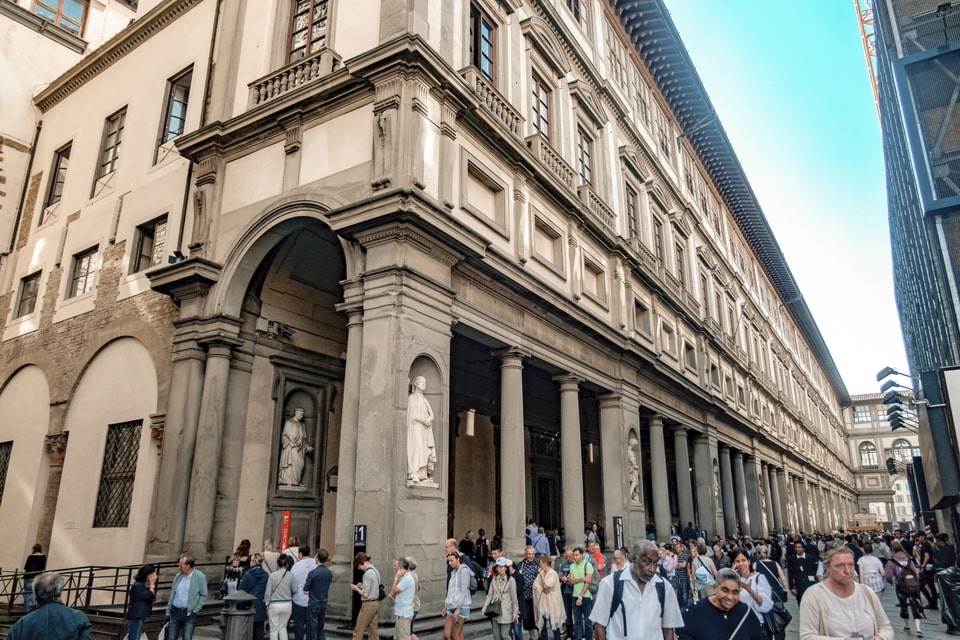
Regardless of the fact that Mussolini and Hitler were to cover the former Medici’s passage in the reversed direction (the ‘right’ direction is: Palazzo Vecchio – Vasari Corridor – Pitti Palace), they visited all key sections. UFFIZI GALLERY, the world-famous art collection across the Arno River, was initially masterminded as the next stopover within the dictators’ pedestrian route, spanned for a few hours, and was obviously beyond the schedule. Ranuccio Bianchi Bandinelli, the chosen guide (indeed a famous fine art expert), would later recall in his post-war memoirs that the abyss of behavior was more than obvious that day, speaking about Hitler and Duce. Paying attention to Bandinelli’s retrospective comments, Duce appeared to look uninterested and bored with the paintings, scratching his head and fondling his belly. Hitler, a well-known admirer of history and art, silently focused on every piece of the collection. The artists of Tuscany had collected a special exhibition of German art purely for Hitler. Eugen Dollmann would later make a quotation about his boss, who placed on record the fact that he was too poor at the time to have enough time to be enamored with paintings in Vienna and Munich (1906-1914), and now (in 1938), being a chancellor of Germany and a new master of Austria since the March Anschluss, Hitler has little time to devote himself to art. Mussolini’s displeasure with the timeout was only growing with Hitler, and Count Ciano took time at every piece of art within the UFFIZI GALLERY.

A MEETING AT PALAZZO VECCHIO
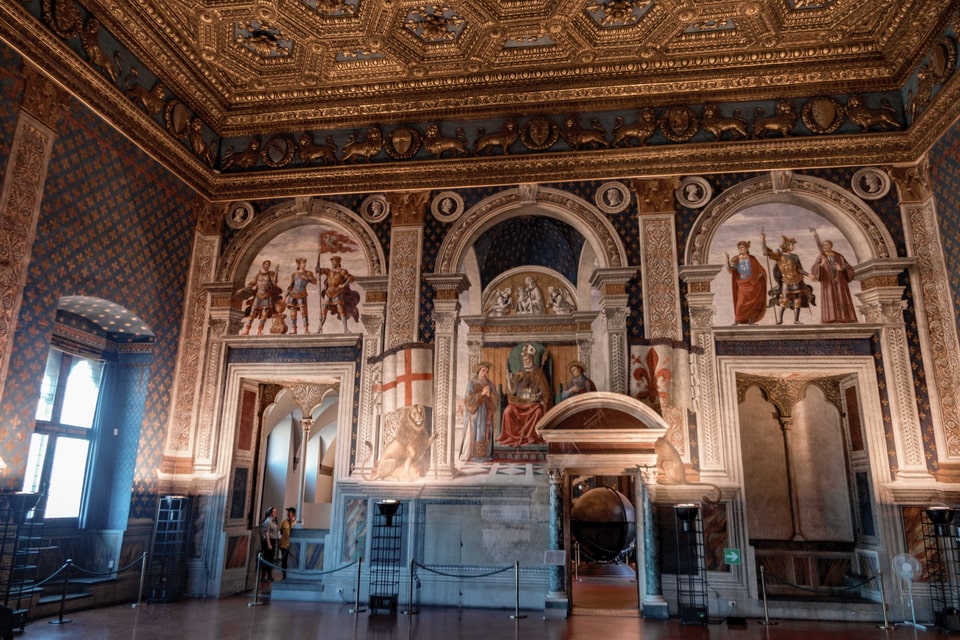
Throughout the major part of the time spent within the Uffizi Gallery, the cultural treasury of Italy, Mussolini did a little to hide his harried discontent with the delay, yet he made a polite reminder that the descendants of the noble families of Italy, as well as thousands of people at Piazza Della Signoria square (the shouting was already to be sensed outside), had already been tired of waiting for the guest. With the excursion coming to its end, the numerous retinue followed the two leaders towards the legendary PALAZZO VECCHIO, thus finalizing the passage of the Vasari corridor, almost 1 km long. The supreme council of the Florentine Republic had taken advantage of the luxurious palace since 1302, with patriarchs of the Medici Family taking it in the XVI century and later renaming it Palazzo Vecchio, soon after the completion of the Vasari Corridor.


 SLIDE me
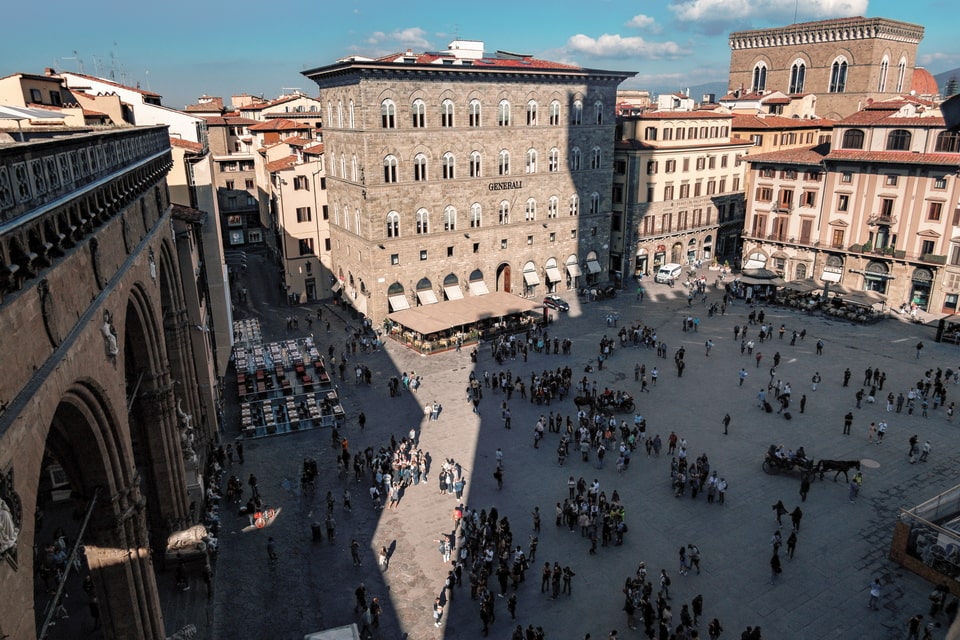
Hitler and Mussolini were taken to have a brief tour along the halls of the palace, including the iconic ‘Salone Dei Cinquecento’ (The Hall of the Five Hundred). They were now greeted and accompanied by the VIPs from modern Florentine privileged circles, including the mayor of Florence, the post generally attributed as ‘Podestà’ at the time of the fascist regime. According to different estimates, up to 100,000 people crowded the Piazza Della Signoria square in front of the Palazzo Vecchio by the time on sunset, when Adolf Hitler and Benito Mussolini finally made an appearance. The two leaders performed a theatrical kind of appearance on the balcony in a very similar way to the appearance they had previously made on the balcony of Palazzo Venezia in Rome, a few days earlier. The very balcony facing Piazza Della Signoria and the statue of David by Michelangelo had been pointedly ornamented to befit the pompous occasion. Hitler would once again visit Palazzo Vecchio in October 1940 as part of his second and less-known journey to Florence. Ranuccio Bianchi Bandinelli would later become a public celebrity in Italy despite the role of Hitler’s visit to Italy. On the other hand, we would later be greatly appreciated by the Germans, being invited to the Third Reich on multiple occasions.


PALAZZO MEDICI RICCARDI
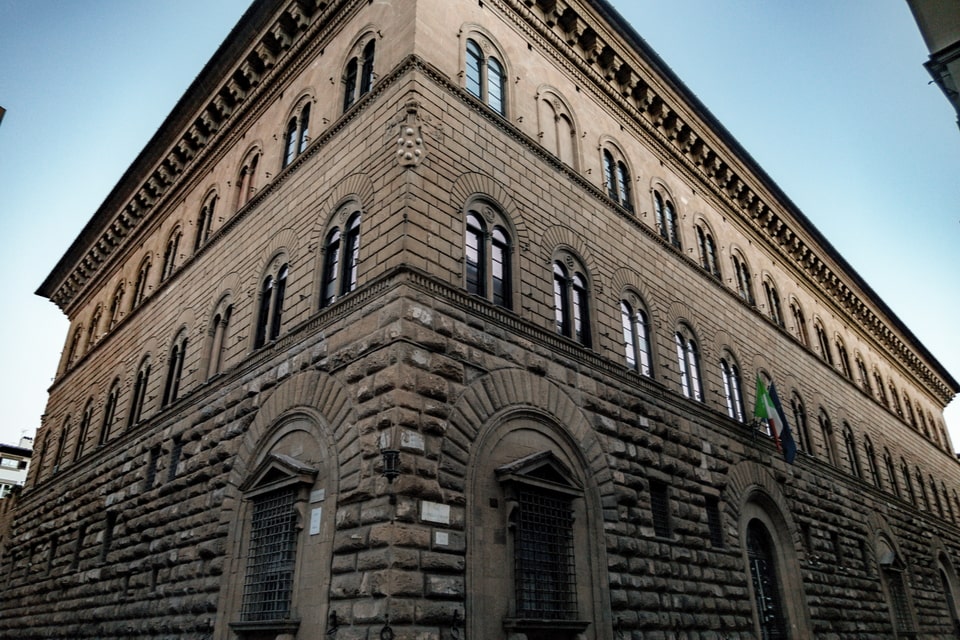
The encounter with the town mayor and the noble families of Tuscany within Palazzo Vecchio was not the only scene of Hitler socializing with the high society of Italy. After the appearance on the balcony facing 100,000 people, the automobile cavalcade took two allies and their entourage to PALAZZO MEDICI RICCARDI. The historical residence of the Medici family was built at the direction of Cosimo di Giovanni de’ Medici (1389–1464), and the Vasari Corridor above the heads of the citizens and the ruler was added in 1565. In the late hours (7:45 p.m.) of May 9, 1938, Hitler was a VIP guest at the diplomatic entertainment, organized within one of the halls of the long-standing home of the Medici, later renamed Riccardi after its new owners. A carefully set table for 126 privileged guests was served by 38 servants, and the calibrated menu, made mostly of vegetables and fruits, was to please the well-known vegetarian preferences of the German chancellor. Each guest was served a vegetable cream soup, strawberry and orange juice, a myriad of baked goods and ice cream, as well as beef medallions with beans, chicken breast with salad, and rare wine sorts of 1923 origin, a year after the fascists gained power in Italy. As much as anything else, Hitler was indeed captivated by the aristocratic women of Tuscany, who succeeded in being both beautiful and mothers of many children.
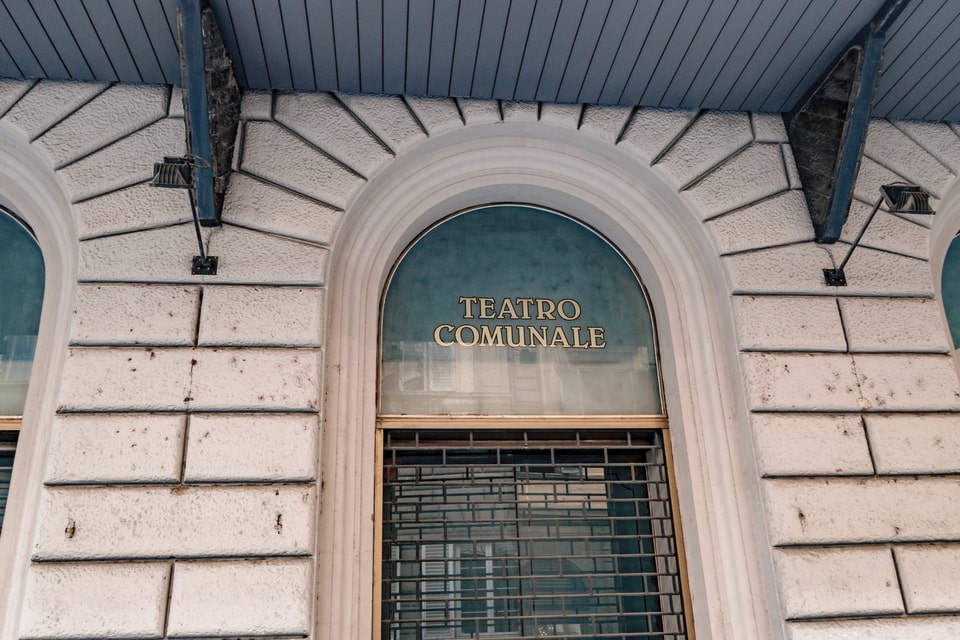
TEATRO COMUNALE
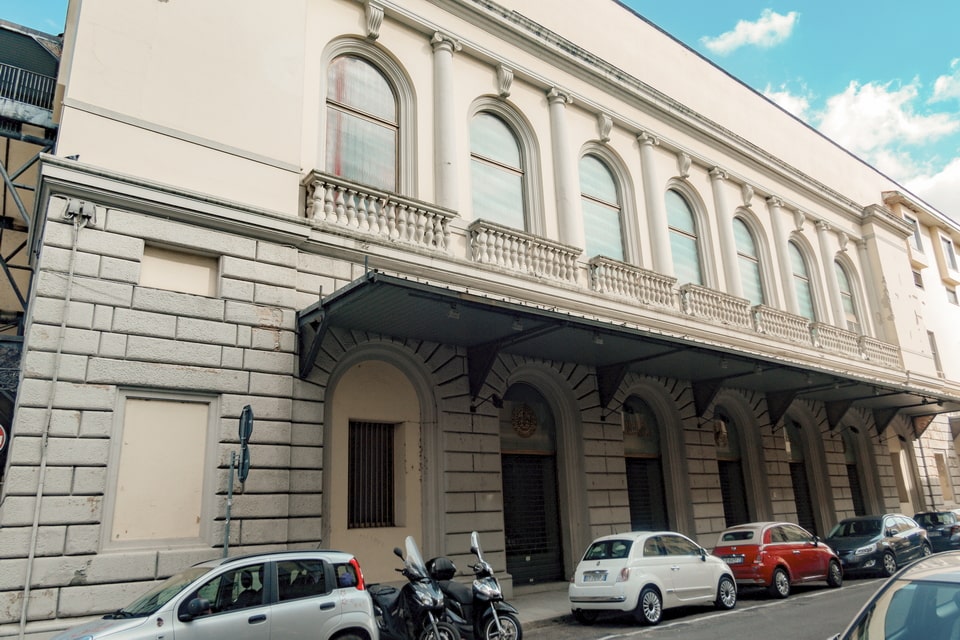
With the end of time-limited (in contrast to the ones in Rome) entertainment within the former residence of the Medici family, the mass diplomatic retinue followed Hitler and Mussolini to visit ‘Teatro Comunale Vittorio Emanuele II’, the well-known theater of Florence. By the time Duce and the German chancellor moved into their seats, the building had already been restructured and renamed several times, anyway, as an important part of the Florentine high society routine. The vast majority of 126 guests from Palazzo Riccardi were invited to visit Teatro Comunale that evening. Hitler and Mussolini were granted the VIP loge, generally reserved for the royal family. Hitler was accompanied by Heinrich Himmler, Rudolf Hess, Joseph Goebbels, Hans Frank, and Joachim von Ribbentrop. Mussolini was escorted by Count Ciano, Giuseppe Bottai (Minister of National Education), and Dino Alfieri (Ministry of Popular Culture). These three would later play their role in the overthrow of Duce in 1943. The other parts of the auditorium were granted to the privileged noble families as well as the members of the local fascist party. The following day, May 10, 1938, the Italian newspaper ‘La Nazione’ published the full list of the attendees of that concert. Orchestra Stabile Fiorentina (the resident Florentine orchestra) performed ‘Simon Boccanegra’, the opera in three parts, created by the iconic Giuseppe Verdi.

MUSSOLINI AND HITLER AT PIAZZA VITTORIO VENETO
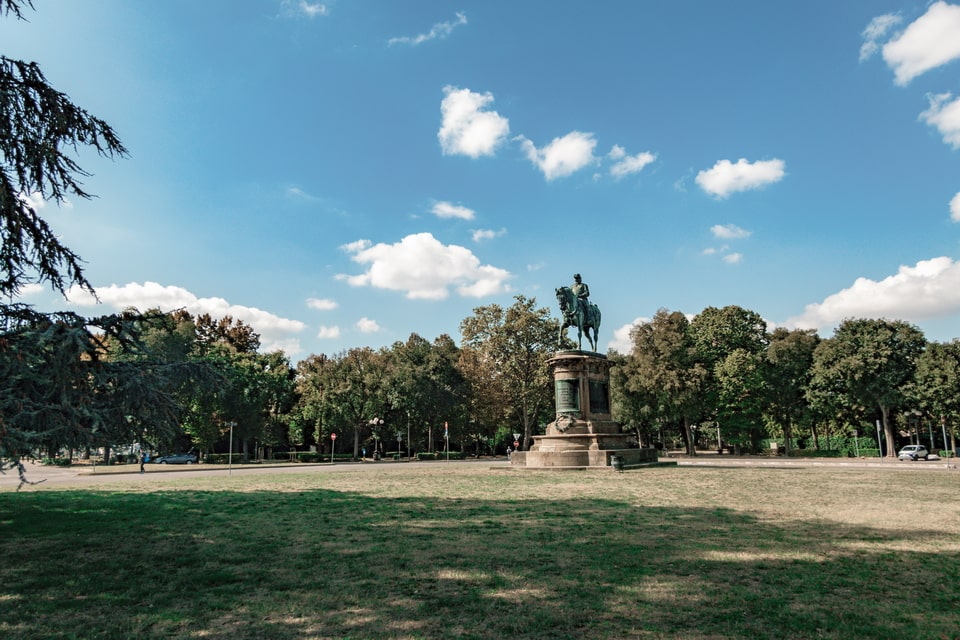
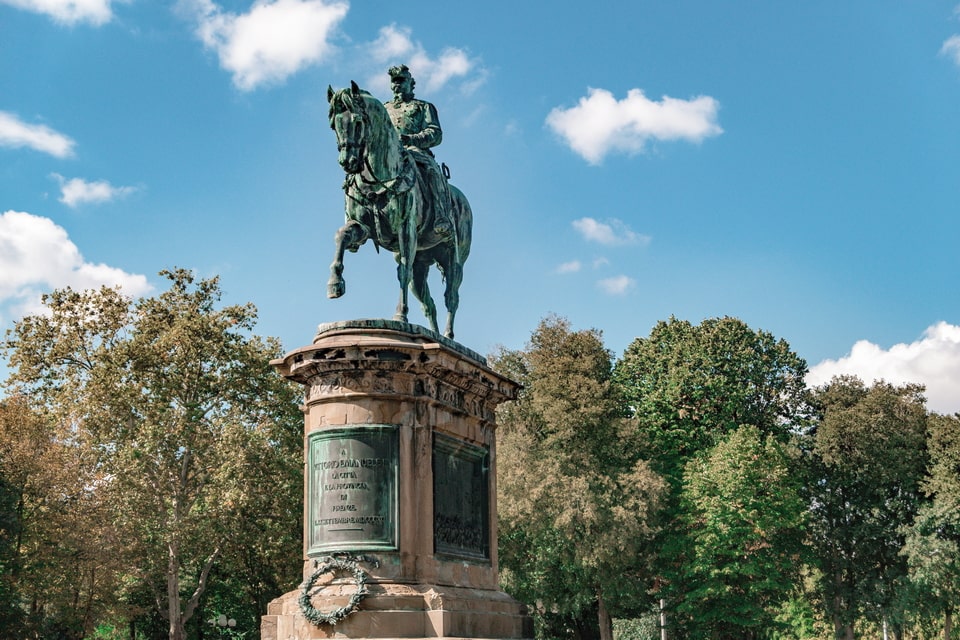
The final minutes of the third act of Verdi’s opera signified the ‘beginning of the end’ of Hitler’s state visit to Italy in 1938. Two dictators and their diplomatic entourage once again took the seats within a motorcade of 20 automobiles. Regarding the topographic logic and the shortest way from the theatre to Santa Maria Novella station to the North-East, the agenda included the last stopover within PIAZZA VITTORIO VENETO square, only 250 meters from Teatro Comunale to the West. The spacious open space was once put on the map of Florence to honor King Victor Emmanuel II, the grandfather of Victor Emmanuel III (a king at the time of Hitler’s visit). The square in front of CASCINE Park, the former hunting grounds of the Medici family, had been renamed Piazza Vittorio Veneto during the Great War (World War One) and later, in 1932, was renamed Piazza Vittorio Emanuele II. The cavalcade with Hitler and Mussolini made a stopover within the square to oversee the pyrotechnical show of a grandiose scale, the arranged apogee of the whole day. Carefully choreographed fireworks illuminated the Florentine sky over Piazza Vittorio Veneto with the fire inscription of ‘FUHRER’ and ‘DUCE’.
BACK TO SANTA MARIA NOVELLA
Only ten hours after he arrived in Florence, a motorcade was now scheduled to take Adolf Hitler back again to the SANTA MARIA NOVELLA train station. Soon after a brief stopover for the fireworks show, the cavalcade of cars proceeded to Viale Principe Umberto (modern Viale Fratelli Rosselli, renamed in 1947 to honor the Rosselli brothers (Carlo and Nello), two prominent anti-fascist intellectuals who were assassinated in 1937) and then turned to Piazza Santa Maria Novella (Piazza Stazione today). Even this last section of the route had been brainstormed beforehand: about 2000, candles were lit to illuminate the square and the carriage drive to the station. Arrayed in long coats, Hitler and Mussolini took some time to shake hands with each other on the railway platform. Count Ciano would later include a comment on the moment in his famous war diary. In his judgment, both leaders looked deeply moved by the day, with gleams of tears in Hitler’s eyes, now leaving Florence for the next two and a half years. The incredible contrast with the arrival in Italy a week before and the forced acquaintance with the King. Ciano would also quote the phrase, destined to become history thanks to him, when Mussolini told Hitler, ‘From this moment, no force in the world will divide us’.


It was a few minutes past midnight on May 10, when Hitler’s special train (with the ‘Potsdam’ inscription on the wagon) departed from the railway platform of Santa Maria Novella towards Berlin. The historical photos depicted the German chancellor, who waved his hand from the window of the carriage. Soon after the train had faded into the night, Mussolini took a seat in a car that would take him back to Rome the same night. Hitler’s transport was assigned to cover pretty much the same route he had made a week before from Germany, now in the opposite direction and with a section from Florence. The train was welcomed at the Brenner station on the Austrian-Italian border in the early hours of the same May 10 day. The still-moved German Chancellor sent a telegram to Duce, expressing his delight with the days spent together as well as his affirmation of the mutual alliance and personal friendship. His train would finally reach the Berlin Lehrte station at 10:45 p.m. on May 11. Hitler would return to Florence on October 28, 1940. He would attend a concert at Palazzo Pitti, arrange a meeting with Mussolini at Palazzo Vecchio, and will have dinner at Palazzo Riccardi. Along with that, he would always recall his very first journey in 1938.
28 OCTOBER 1940: HITLER RETURNS TO FLORENCE
Two and a half years after the pageantry of May 1938, Hitler came back to Santa Maria Novella. The second visit lasted a morning, involved no crowds and no fireworks, and mattered incomparably more. It had not been a good fortnight. On 23 October Hitler had spent nine hours at Hendaye on the Spanish border trying and failing to bring Franco into the war — afterwards he told Mussolini that rather than repeat the experience he would prefer to have three or four teeth pulled. The next day, at Montoire, he had met Marshal Philip Pétain. Now he was travelling south with a single purpose: to stop Mussolini invading Greece. The Italians had been told twice, explicitly, not to attempt it. Ribbentrop, travelling with him, put the German view plainly: the Italians would get nowhere against the Greeks in autumn rain and winter snow, and the Führer intended to halt the Duce’s mad scheme at all costs. He was too late. While the train was passing Bologna, word arrived that the invasion had already begun.
Hitler’s train Amerika pulled into Santa Maria Novella at ten in the morning on 28 October 1940. Mussolini was waiting on the platform — the same platform where he had greeted Hitler in 1938 — and greeted him with a sentence that has gone into every history of the war: «Führer, we are on the march! Victorious Italian troops crossed the Greco-Albanian frontier at dawn today!» Paul Schmidt, Hitler’s interpreter, recorded that his chief was beside himself. He concealed it. The two men shook hands and drove into the city. The date was Mussolini’s choice, and it was not accidental: 28 October was the anniversary of the March on Rome, eighteen years to the day since the Fascists had taken power. He had timed an invasion to fall on his own founding myth, and he had kept it from his ally precisely so that he would not be forbidden. Everything that followed vindicated Ribbentrop’s contempt. The Greek army held, then counter-attacked, and by December the Italians had been pushed back into Albania. Germany was obliged to intervene in the Balkans in the spring of 1941 to rescue an ally who had ignored instructions — a campaign that consumed divisions and weeks in the months before the invasion of the Soviet Union.
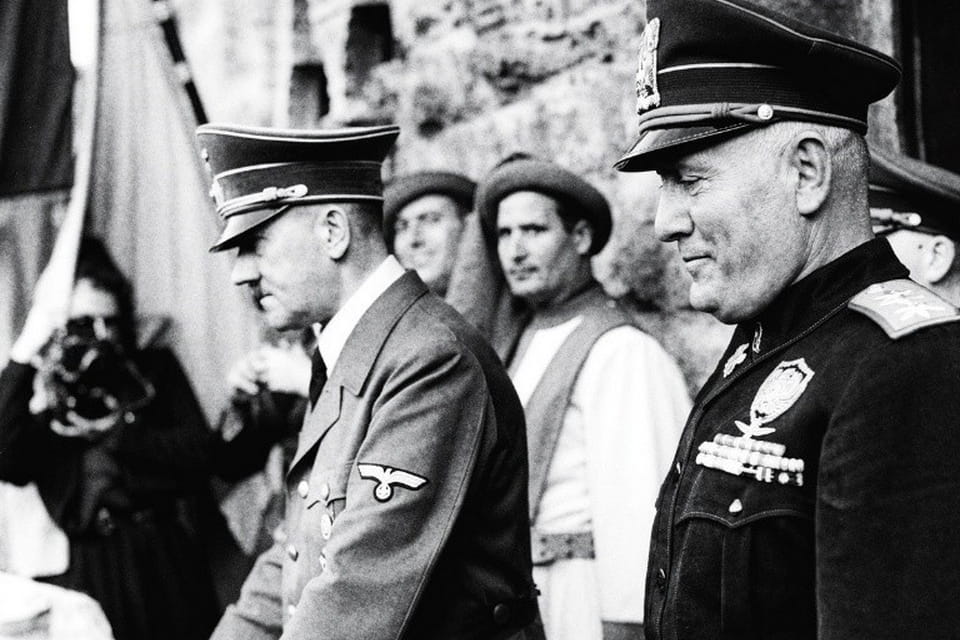
Historians have argued ever since about how much those weeks mattered on the road to moscow. What is not in dispute is that the relationship changed here. In May 1938 Mussolini had told Hitler on this platform that no force in the world would divide them. In October 1940, on the same platform, he presented him with a war Germany had expressly forbidden — and from that morning Italy was the junior partner in fact as well as in name. The two leaders met at the Palazzo Vecchio, the same building where they had appeared on the balcony in 1938. Ciano and Field Marshal Keitel were with them; the photograph in this article, with Hitler visibly grim, is from that day. There was no crowd of a hundred thousand, no cortege through decorated streets, no exhibition of German art at the Uffizi. The city had not been rebuilt for him. It was a working meeting between two men who no longer had the same war.
WHAT IS STILL THERE: THE FASCIST CITY UNDER YOUR FEET
The decorations came down within days. The banners, the pylons, the carpet runners and the nineteen million lire of temporary splendour were gone before the end of May 1938. But the regime left harder things behind, and most of them are still in place, unmarked, walked over daily by people who have no idea what they are looking at. The most numerous survivals are underfoot. Florence’s sewer and utility covers were largely replaced during the fascist period, and a great many of them still carry the marks of it — the fascio littorio, the bundle of rods and axe that was the emblem of the regime, cast into the iron alongside the municipal name and, on some, the year in the Fascist era calendar, counted from October 1922. They were never removed because removing them would have meant digging up the streets. Post-war Italy dealt with fascist monuments unevenly and with fascist infrastructure not at all, and the result is that the emblem of the regime is still lying in the pavement of one of the most photographed cities in the world. You will find them in the streets the cortege used — around the Duomo, along Via dei Calzaiuoli, on the approaches to Santa Croce. Once you have seen one, you will not stop seeing them.
— Santa Maria Novella station. Giovanni Michelucci’s building, opened in 1935 and one of the outstanding works of Italian rationalist architecture, is unchanged and still in use. Platform sixteen is where Hitler arrived in 1938 and again in 1940, and where three hundred Florentine Jews were loaded for Auschwitz in 1943.
— The Palazzina Reale beside it, built the same year to receive the royal family, survives as an exhibition space.
— The balcony of the Palazzo Vecchio, from which the two men faced a hundred thousand people, is part of the museum route. You can stand behind it.
— The window on the Ponte Vecchio. The three small openings on the western side were combined into a single large one specifically for this visit, and it is still there — the most conspicuous physical alteration the regime made to the medieval bridge, and the one nobody points out.
— The Sacrario dei Martiri Fascisti in the crypt of Santa Croce, where Hitler and Mussolini spoke alone for the first time that day, remains as it was.
None of it is signposted, and there is no reason it should be: Florence has rather more pressing things to show visitors than the route of a state visit in 1938. But the route is legible if you know it, and walking it takes about two hours from the station to the Piazza Vittorio Veneto — which is, give or take the stops, exactly what the motorcade did.
FREQUENTLY ASKED QUESTIONS
When was Hitler in Florence? Twice. On 9 May 1938, for ten hours, as the last stop of his state visit to Italy — the visit this article describes. And on 28 October 1940, for a morning, when Mussolini met him at the station to announce that Italy had invaded Greece.
Did Hitler save the Ponte Vecchio? No. He walked above it, through the Vasari Corridor, in May 1938, and the bridge was the only one over the Arno left standing when the Germans retreated in August 1944 — but there is no order from Hitler, and the decision is generally credited to Gerhard Wolf, the German consul in Florence, who has a plaque on the bridge. The section above sets out what actually happened.
What did Hitler see in Florence? Santa Maria Novella station, the Piazza del Duomo from a moving car, the crypt of Santa Croce, the Boboli Gardens and Palazzo Pitti, the Vasari Corridor and the Ponte Vecchio, the Uffizi, the Palazzo Vecchio and its balcony, the Palazzo Medici Riccardi, the Teatro Comunale, and a firework display at the Piazza Vittorio Veneto. The whole route is mapped above and can be walked in about two hours.
Where did Hitler and Mussolini meet? Many times, from Venice in June 1934 onwards. In Florence specifically, twice: on the platform of Santa Maria Novella on 9 May 1938, and on the same platform on 28 October 1940. The 1938 meeting ended with Mussolini’s line, recorded by Ciano: from that moment, no force in the world would divide them.
Did Hitler speak Italian? No. He was accompanied throughout by his interpreter Eugen Dollmann, whose memoirs are one of the main sources for what was said during the visit.
How much did the visit cost Florence? The initial budget was exceeded, and the final figure reached about 19 million lire — spent on restoring building fronts along the route, repaving, street lighting, fountains, fire hydrants, free repairs to shop windows, banners and illumination. A committee called the «Office for the celebrations on the occasion of the visit of the Führer» was created on 7 February 1938 to run it. The bill fell on the regional budget of Tuscany.
Is anything from the visit still visible? Yes, and more than you would expect — including the enlarged window on the Ponte Vecchio, which was cut specifically for this visit. The section «What is still there» goes through it.
Why did Hitler go to Florence at all? Because Mussolini wanted one day out of the reach of the King. In Rome, protocol made Victor Emmanuel III the host and the Duce a bystander at his own state occasion; Florence was staged as Mussolini’s day, and Hitler’s adjutant Nicolaus von Below and his interpreter both recorded that Hitler was visibly relieved by it.

I am very grateful to war archives, museums, libraries, private collections, and writers for the historical photos in this article. To the extent that some author or a copyright owner may not want some of the above black-and-white photos to be used for educational purposes here, please contact me for adding credits or deleting the pictures from the article.